In mid-September, Search Engine Roundtable's Barry Schwartz reported a Google test, first spotted by Sachin Patel, that shows where paid search is heading. Sponsored results in AI Mode appeared as plain text links inside the answer itself, with a single "Sponsored" label above the response, and his verdict was that they "look way too organic."
That test is one step in a longer move, and it matters for organic search as much as for paid. Google now places ads around and inside AI Overviews and is testing several ad formats inside AI Mode. It has also expanded AI Overviews onto more commercial queries. This guide covers where the ads appear today and what the click data means for B2B marketing teams. Sources were checked on September 26, 2026.
Where ads appear in AI Overviews today
Google's own help page for advertisers sets out the current rules, and they reach further than many SEOs assume. Ads can show above or below an AI Overview in all of the 200-plus markets where Overviews run. Inside the Overview itself, ads are live in English on mobile and desktop in 12 countries, among them the US, Canada, India and Australia.
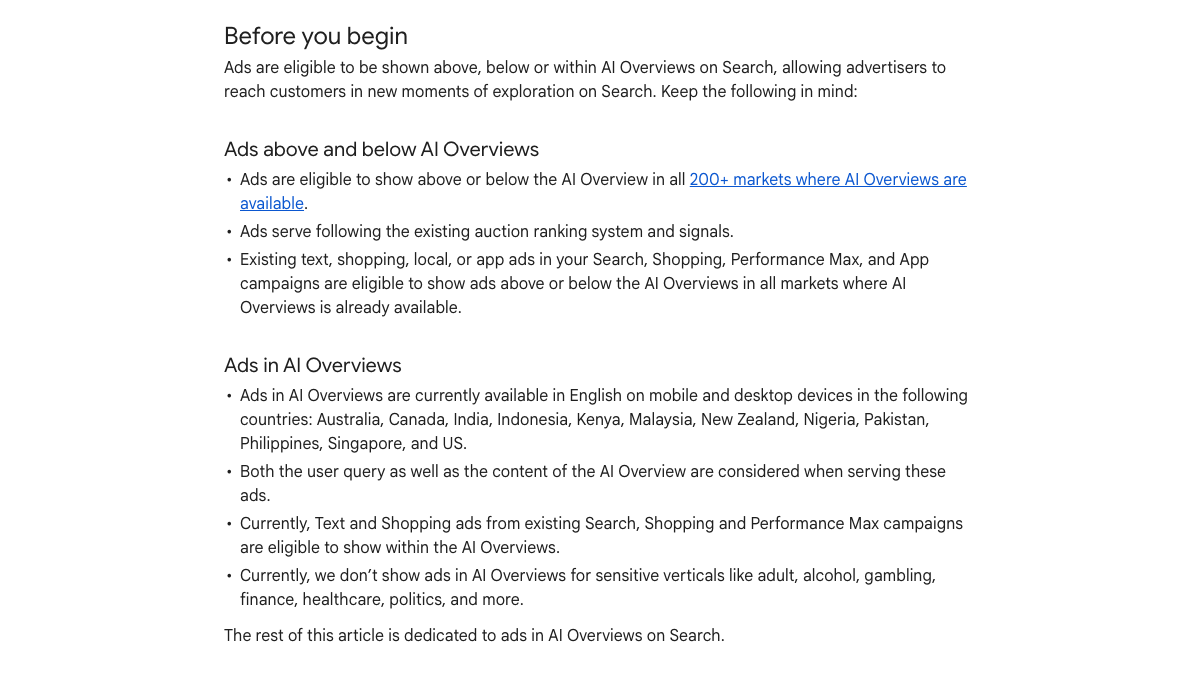
Only text and Shopping ads from existing Search, Shopping and Performance Max campaigns qualify for the slot inside the Overview, and Google skips sensitive categories such as finance and healthcare. Two details matter for anyone reading their own data. According to Google's help page, advertisers can't opt out of the placement, and Google Ads doesn't report AI Overview impressions separately.
So neither the SEO team nor the paid team can see exactly how often the brand sits next to an ad. A marketer running search ads for a chain of clinics made the same point in r/PPC this month: with no opt-out and no split in reporting, the placement "could already be happening to me and I'd have no idea."
How often does it happen? Semrush tracked more than 10 million keywords through 2025 and found that the share of AI Overview results pages carrying Google Ads rose from about 5% in March to 25.56% in October. Nearly all of those pages showed ads at the bottom of the results.
AI Mode goes further
AI Mode is where Google is experimenting hardest. At Google Marketing Live on May 20, it announced tests of two ad formats built with Gemini: Conversational Discovery ads, which answer a specific question with a tailored ad, and Highlighted Answers. The second matters most for organic search, because when AI Mode gives a list of recommendations, Google's announcement says "highly relevant, high-quality ads are eligible to appear on that list."
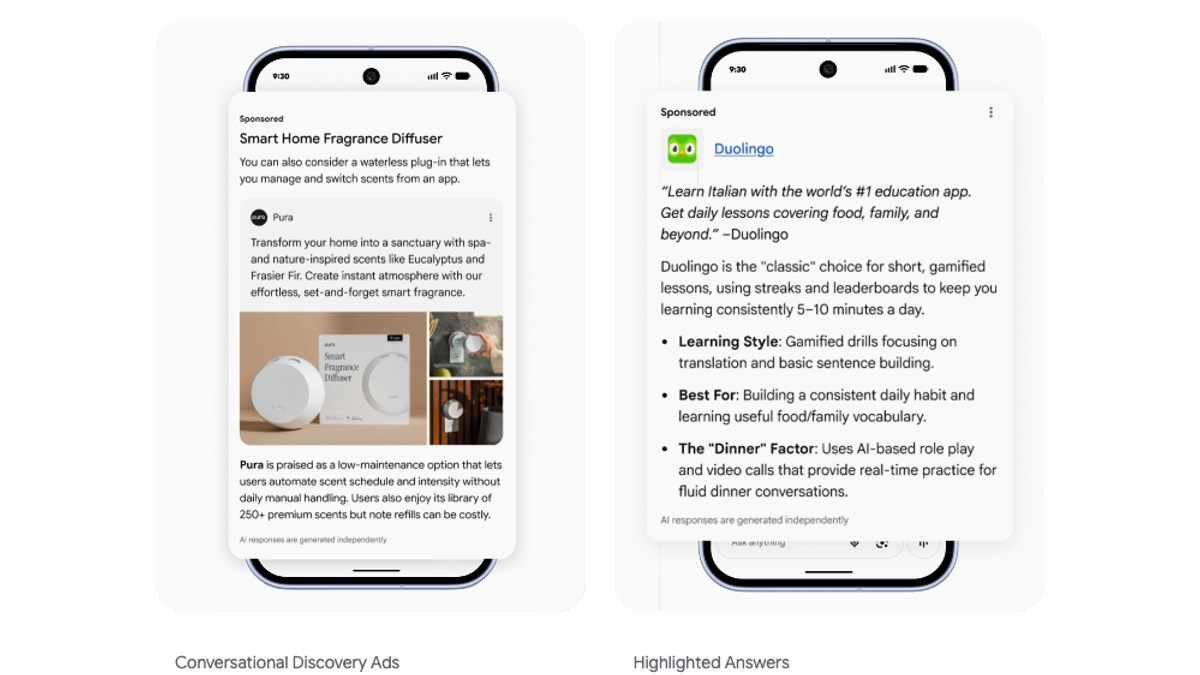
Both formats carry a Sponsored label and an "independent AI explainer" written by Google's model. We call the result the shared shelf: the list inside an AI answer where the brands AI Mode picked on its own and the brands that paid now sit side by side, told apart only by that label. On Alphabet's July 22 earnings call, chief business officer Philipp Schindler said that placing "clearly marked sponsored links inside list responses" was showing early user traction.
September brought two more changes. Google confirmed a "small experiment" that lets ordinary Search campaigns with exact and phrase match keywords serve text ads in AI Mode when the intent is explicit, a slot that until then needed AI Max or Performance Max. The text-link test Schwartz flagged then moved sponsored results into the running text of the answer.
Google is testing text anchor based links for sponsored results in Google AI Mode, which make them look more organic, but I guess get fewer clicks than other ad units in AI Mode https://t.co/IwJfx8S4UG via @SachuPatel53124 https://t.co/LGnaTagDQN
 Barry Schwartz@rustybrickSep 15, 2026

Direct Offers, a pilot Google introduced in January, adds one more kind of placement: discounts from a merchant's product feed, shown in AI Mode when Google judges a shopper is ready to buy. Schindler said in July that IHG Hotels & Resorts would soon use it during trip planning. Our roundup of August's search changes covers the AI Mode homepage tests that came alongside these formats.
26 content formats. Published on your domain. Matched to your brand.
Guides, comparisons, listicles, case studies, and more. RankControl generates content that gets cited by ChatGPT, Perplexity, Claude, Gemini, Grok, Google AI Mode, and Google AI Overviews.
What the click data says about organic search
The ads arrive on pages that already send fewer clicks out. In a Pew Research Center study of 900 US adults' browsing in March 2025, people who saw an AI summary clicked a traditional result on 8% of visits, against 15% when no summary appeared. They clicked a link inside the summary on just 1% of visits.
The picture has shifted since then, though not back to normal. An agency study of 53 brands and 5.47 million queries tracked organic click-through rate on AI Overview queries falling from 3.19% in January 2025 to 1.31% in December. It then recovered to 2.36% by February 2026, still well short of the 3.82% on queries without an Overview.
Over the same period, paid results kept a far bigger share of the clicks on those pages, with a click-through rate of about 16%, several times the organic rate.
For organic teams, the most useful number in the study is the gap between cited and uncited brands. Brands cited inside the Overview earned about 120% more organic clicks per impression than uncited brands on the same query, though they still trailed queries with no Overview by 38%.
PPC managers feel the pressure from the other side. One r/PPC poster said AI Overviews and AI Mode grew again in the second quarter of 2026, and described losing a client whose sales fell 20% in a month after a large AI Overview rollout.
AI Overviews increased again in Q2. How are you handling these conversations with clients & boss?
More reports coming out showing an increase in AI overviews and AI mode during Q2 2026. The last couple times we’ve seen a big increase in these results, there can be negative impacts to PPC. There’s always a decrease in ad performance or S...
Why AI Overviews now show up on buying searches
AI Overviews started as an answer box for informational questions. In Semrush's data, informational queries made up 91.3% of the keywords triggering an Overview in January 2025, and by October that share was down to about 57%, with commercial and transactional searches taking much of the rest.
Google confirmed the direction on its July earnings call, where Schindler said, "We've expanded AI Overviews to more commercial queries." He added that the company remains "encouraged with monetization performance on queries that show AI Overviews."
One analyst has a theory about how Google picks those queries. Mike Ryan of Smarter Ecommerce looked at 175 billion Shopping ad impressions from mid-2025 to mid-2026 and found median impressions falling while median click-through rate rose, from 1.20% to about 1.55%. His reading is that Google shows AI Overviews more often on queries where ads were less likely to be clicked anyway, which protects ad revenue. Google hasn't confirmed this, and it rests on one company's retail accounts, so treat it as a hypothesis that happens to fit the earnings-call language.
For a B2B software company, the practical meaning is that comparison and pricing searches are now much more likely to show an AI answer with an ad beside it than they were a year ago.
What changes for organic search
The biggest shift is that the citation now matters more than the rank. With organic click-through rate on Overview queries well below normal, being one of the cited sources is what still earns the click, and our guide to tracking AI Overviews separately from organic rankings shows how to split the two in your reports.
Recommendation lists also become contested ground. On the shared shelf, a Highlighted Answer can sit next to the brands AI Mode chose unprompted, so the third-party reviews and community threads that put you on the organic list carry more weight than before.
Bottom-of-funnel pages need to be quotable, too. A pricing or comparison page that states its price and its main difference from rivals in the opening lines gives the Overview something to cite on exactly the searches where ads now appear.
Paid and organic teams should plan together, since they're bidding and writing for the same buying queries. One r/PPC practitioner said leaning on branded search and defensive bidding kept their accounts stable through the second-quarter increase. It helps to know the alternative model as well: Perplexity stopped selling ads altogether, as our piece on Perplexity ads and B2B visibility explains.
Your competitors are getting cited by AI. You're not.
Every day without citation tracking is a day your competitors pull ahead in ChatGPT, Perplexity, and Claude.
How to measure the effect on your own site
Start with your buying questions. Check them on Google each week and log whether an AI Overview appears, where any ads sit, whether you're cited and which competitors are named.
Then compare click-through rates. Use a rank tracker that flags which of your keywords show an AI Overview, and compare those keywords against the rest in Search Console's Performance report. The generative AI report Google added to Search Console in June shows impressions in AI Overviews and AI Mode but no clicks, so it can't answer this on its own.
On the paid side, ask how much spend runs through AI Max and Performance Max, the campaign types that currently reach AI Mode most easily. Our AI Max checklist for B2B teams covers what to test before scaling it.
RankControl covers the citation side. Our AI visibility tracking checks your 50 questions every week on seven engines, Google AI Mode and Google AI Overviews included, alongside your Google and Bing rankings, and notifies you when a new citation lands.
The work behind staying cited
Staying on the shared shelf is mostly content work: pages that answer buying questions in their first lines and stay current, plus mentions on the sites Google already cites. Done by hand, publishing eight solid articles a month takes 16 to 24 hours, and checking 50 questions on seven engines takes about six hours a week. Those are rough estimates.
RankControl's content engine writes each article against the pages already ranking for its keyword and scores it for how easily AI engines can quote it. The content engine publishes every article on your own domain. Analytics shows AI-referred visits once you connect a traffic source, and the free AI visibility checker shows who ChatGPT cites for three questions from your market.
You can run all of this yourself with a spreadsheet and a weekly hour in Search Console. Or RankControl's agents can run it every week while your paid team decides how much of its budget belongs in AI Overviews.
200+ SaaS teams already track their AI citations.
They know exactly when ChatGPT mentions their brand, and when it stops. Do you?