
Search for "google sge" today and Google's own AI Overview will explain that SGE was an experiment from May 2023 that became AI Overviews in May 2024. Scroll down and something odd shows up. When we looked on October 19, 2026, nine of the ten organic results on page one still had "SGE" or "Search Generative Experience" in the title, more than two years after Google moved on.
We call this the name lag. The feature changed, its name changed and Google's answer changed. Most of the pages ranking for it didn't.
So this post does two things. It lays out what actually happened, from the 2023 experiment to AI Overviews to AI Mode, with Google's own dates and words. Then it covers what Google says it takes to get cited now, and what that means in practice.
The timeline, in Google's words
| Date | What happened | Who announced it |
|---|---|---|
| May 10, 2023 | SGE launches as an opt-in Search Labs experiment, US and English only | Elizabeth Reid, Google Search |
| May 14, 2024 | AI Overviews begin rolling out to everyone in the US | Elizabeth Reid, at Google I/O |
| March 5, 2025 | AI Mode launches in Labs for Google One AI Premium subscribers | Robby Stein, Google Search |
| May 20, 2025 | AI Mode opens to all US users, no sign-up needed | Elizabeth Reid |
| April 2026 | AI Overviews pass 2 billion monthly users in 200+ countries and 40 languages | Sundar Pichai, earnings call |
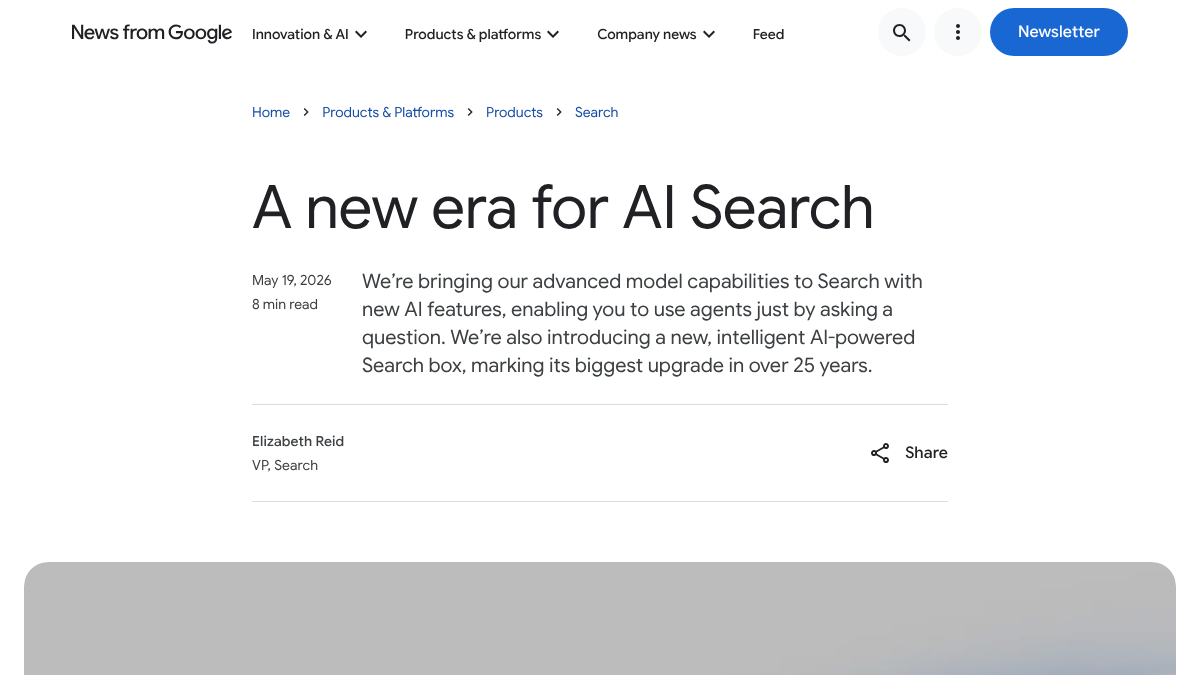
| May 19, 2026 | AI Mode passes one billion monthly users | Elizabeth Reid, at Google I/O |
SGE, May 2023. Reid's announcement was careful about what it was. "We're starting with an experiment in Search Labs, called SGE (Search Generative Experience)." You had to sign up for Labs to see it, on Chrome desktop or the Google app, in the US and in English.
AI Overviews, May 2024. A year later, at Google I/O, Reid announced the graduation: "AI Overviews will begin rolling out to everyone in the U.S., with more countries coming soon." The opt-in experiment became the default.
AI Mode, 2025. Google then added a second, separate product. Stein described AI Mode as something that "expands what AI Overviews can do with more advanced reasoning, thinking and multimodal capabilities," built for complex, multi-part questions. It opened to everyone in the US in May 2025, "no Labs sign-up required."
Scale, 2026. On the April 2026 earnings call, Pichai said AI Overviews had passed 2 billion monthly users across more than 200 countries and 40 languages. At I/O in May 2026, Reid wrote: "Just one year after its debut, AI Mode has surpassed one billion monthly users, with queries more than doubling every quarter since launch."
Your competitors are building backlinks while you read this.
Organic outreach, social mentions, and citations from Editorial Circle member sites, with managed backlinks available as an add-on. Grow your domain authority without running the campaign yourself.

What actually changed
SGE and AI Overviews look similar on the page. A summary sits at the top, with links to sources. But a lot changed underneath, and most of it matters to site owners.
| SGE (2023) | AI Overviews (2024 onward) | |
|---|---|---|
| Who saw it | People who opted in through Labs | Everyone, by default |
| Where | The US at launch | 200+ countries by 2026 |
| Languages | English at launch | 40 languages by 2026 |
| Status | An experiment | A core part of Search |
| Companion | None | AI Mode, a separate chat-style mode |
The biggest change was the default. An opt-in experiment reaches people who chose to try it. A default feature reaches everyone who searches. That's when AI answers started affecting traffic for ordinary sites.
How often AI Overviews appear now
Estimates vary by study, sample and month, but they all point the same way.
| Source | When | Share of searches with an AI Overview |
|---|---|---|
| Pew Research Center | March 2025 | 18% |
| BrightEdge | February 2026 | About 48% of tracked queries |
| Advanced Web Ranking | July 2026 | 43% of sampled US desktop results |
Pew's study, published July 22, 2025, tracked real browsing by 900 US adults across 68,879 Google searches. It found that "some 18% of all the Google searches in our study generated an AI summary." The later figures come from tracking tools with different samples, so they aren't directly comparable. But the jump from about one search in five to nearly half of tracked queries happened in less than a year.
The same Pew study measured clicks. "Users who encountered an AI summary clicked on a traditional search result link in 8% of all visits. Those who did not encounter an AI summary clicked on a search result nearly twice as often (15% of visits)." Clicks on the links inside the summary were rarer still, at about 1% of visits. Our analysis of CTR by position in 2026 covers the click data in more depth.
Google tells a different story about those links. When AI Overviews launched, it said "links included in AI Overviews get more clicks than if the page had appeared as a traditional web listing." Both claims can hold at once. Being linked in the summary can beat being a plain result, while total clicks to the open web still fall.
Not everyone trusts it
Publishers and users have pushed back. One former commercial litigator turned travel publisher called AI Overviews "theft" on X in February 2025, when Chegg sued Google over them, and shared notes on the complaint.
Google's AI Overviews = theft 🚨 And Google just got smacked with a lawsuit by Chegg -- and it's utterly fantastic ⚖️ I'm a former commercial litigator turned online travel publisher -- here are my notes from reading the complaint (link in next tweet) 👇 (warning, this summary
 Nate Hake@natejhakeFeb 25, 2025
Readers are split too. A post in r/ArtificialNtelligence asking whether people like Google's AI Overviews drew 158 upvotes. The original poster felt it got things wrong more often than other AI tools. Replies split between people who find it usually on point because it shows sources, and people who said they'd never seen it get a topic they knew well right.
Do you like Google AI overview?
I have experienced, that this one AI , hallucinates a lot more compared to others, even more than Gemini probably.
For the legal side of wrong answers, see our post on AI Overviews and liability for false answers.
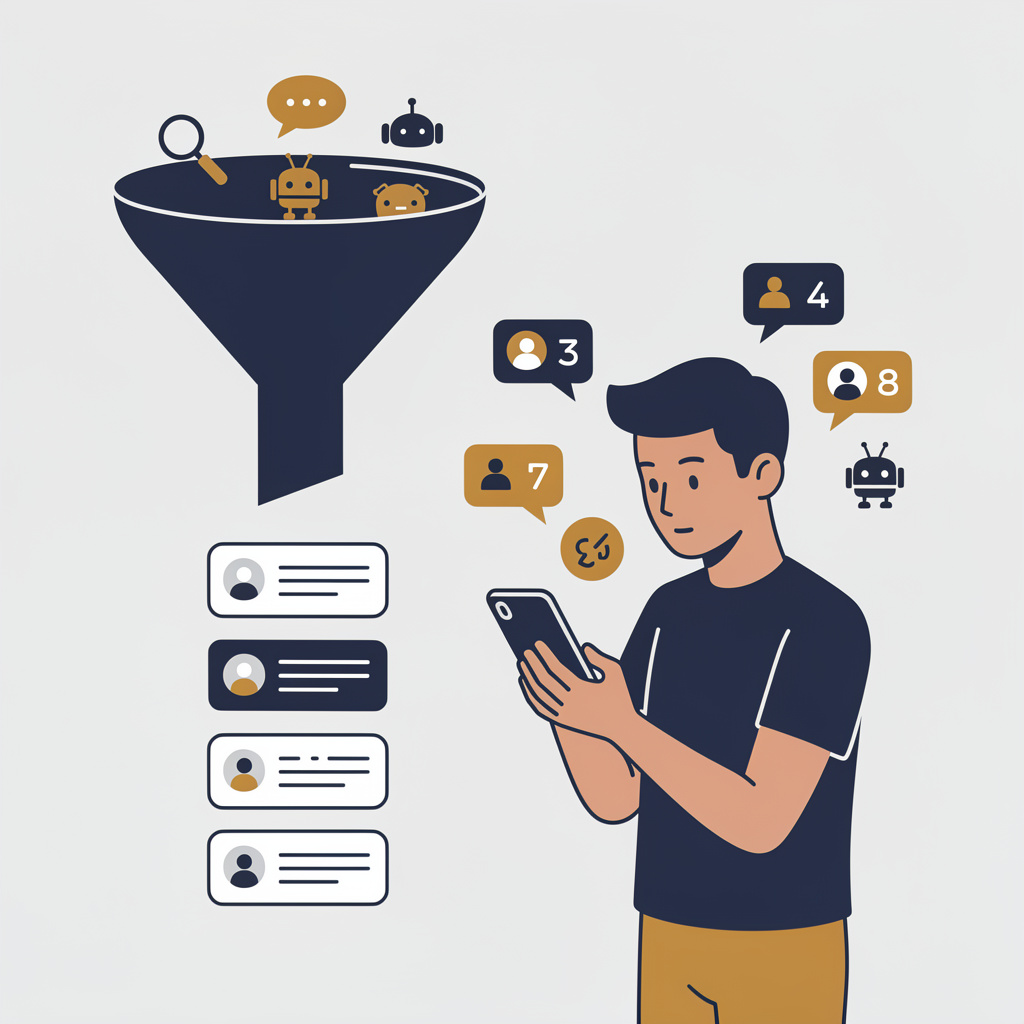
You're getting AI traffic. But do you know where it comes from?
RankControl credits every visit to the assistant that sent it: ChatGPT, Perplexity, Claude, Gemini, Copilot, or Grok. Full source attribution, next to your Google traffic.
What Google says it takes to get cited
Google's guidance is short. Its page on AI features and your website says: "There are no additional requirements to appear in AI Overviews or AI Mode, nor other special optimizations necessary."
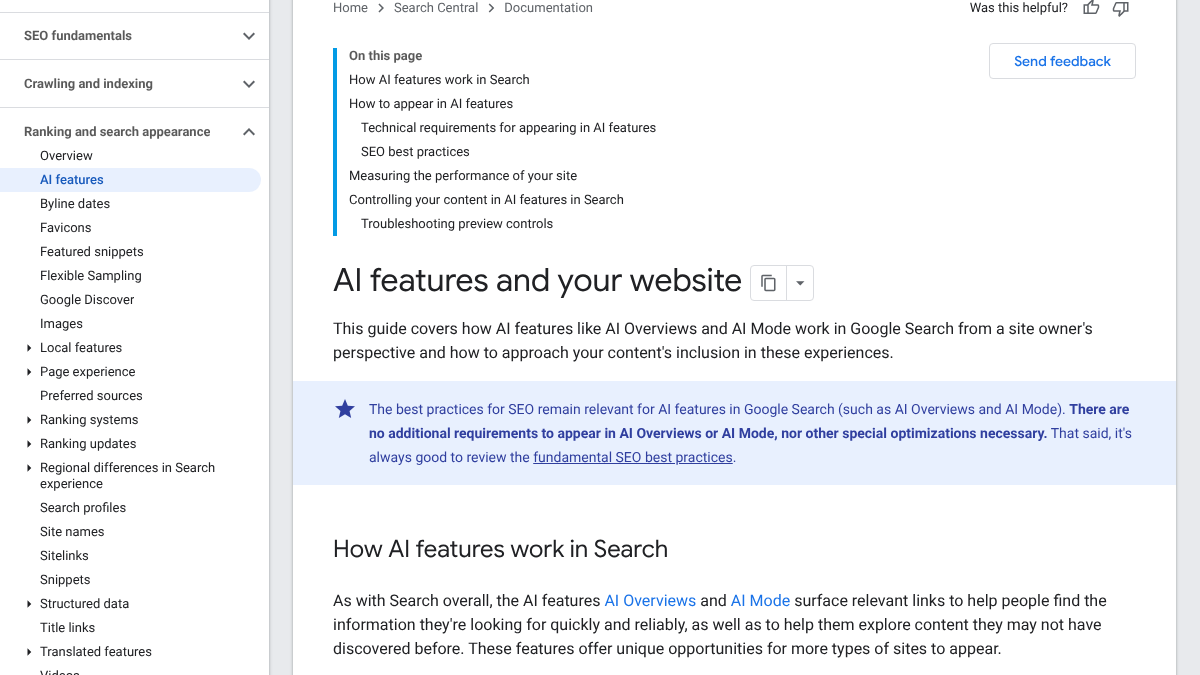
The one firm requirement is basic eligibility. A page "must be indexed and eligible to be shown in Google Search with a snippet." Google also says you don't need special files or markup: "You don't need to create new machine readable files, AI text files, or markup to appear in these features."
Beyond that, it points to ordinary SEO. Let Google crawl the page, link to it internally, give it a good page experience, put the important content in text and keep any structured data accurate.
What that means in practice
"No special optimization" doesn't mean nothing helps. It means the things that help are the same things that help a page rank.
- Rank well first. Studies of AI citations keep finding that pages higher in Google's results are more likely to be cited. Our guide to pages stuck on page two covers how to move up.
- Answer the question near the top. AI Overviews lift short passages. A clear answer right under the heading that asks the question is easy to quote. Our guide to featured snippets covers how to write those answers.
- Don't block snippets. The
nosnippetrule also stops a page being used as a direct input for AI Overviews and AI Mode. - Skip the markup myths. Schema doesn't unlock AI Overviews. Our analysis of schema and AI citations compares the studies.
- Earn mentions and links. Pages that other sites trust and reference are easier for Google to trust too.
For real examples of pages that get cited, see our breakdown of how to rank in AI Overviews, and our AI Overviews checklist for a page-by-page review.
If your content still says SGE
The name lag is an easy win. If your own posts still describe SGE as a coming experiment, they're out of date, and readers can tell. Update the facts, use the current names and dates, and say what AI Overviews and AI Mode do now. If the update is substantial, change the modified date too. For the wider set of AI search terms, our guide to LLM SEO, GEO, AEO and AIO explains which names are current.
Doing it yourself or handing it off
Getting cited in AI Overviews comes down to pages that rank, answer clearly and get referenced elsewhere. That's ongoing work, not a one-time fix.
You can do it yourself with the steps above. RankControl writes articles with the answer near the top, against the pages already ranking for each keyword, and publishes them to your site. Our AI visibility tracking checks up to 50 buyer questions every week across seven AI engines, including Google AI Mode and Google AI Overviews, plus your Google and Bing rankings. Expect traffic from Google first, with AI citations following more slowly as links and mentions build up.
We'll show you exactly where your brand stands in AI search.
No commitment. $0 due today, cancel anytime. See how ChatGPT, Perplexity, Claude, Gemini, Grok, Google AI Mode, and Google AI Overviews talk about your brand today.