
On September 14, a federal judge in Illinois let Jimmy Keene's defamation case against Google go forward. Google's AI Overviews had told people searching for him that he was serving life in prison for murdering three women. In fact, his 1997 drug conspiracy conviction had been expunged after he worked as an FBI informant against a suspected serial killer.
Google argued that its overviews carry a warning that AI responses may include mistakes. Judge Thomas Durkin wasn't persuaded. "An ordinary user searching 'Jimmy Keene net worth' on Google is seeking factual information, not AI work product," he wrote.
That ruling joins a run of 2026 decisions that make Google AI Overviews liability a real question for brands. This guide covers where the cases stand and what courts are weighing. Then it covers what a brand should do when an overview gets it wrong. It's a plain-language summary of public rulings, not legal advice. Sources were checked on September 27, 2026.
Where the AI Overview liability cases stand
Five cases shape the picture so far. Four involve Google, and one involves OpenAI:
| Case | What the AI answer said | Status in September 2026 |
|---|---|---|
| Wolf River Electric v. Google (Minnesota) | That the state attorney general had sued the solar installer | Sent back to state court in January after Google missed a filing deadline; no ruling on the merits |
| Starbuck v. Google (Delaware) | Google's AI tools, including Bard and Gemma, tied the activist to false sexual assault claims | Google's motion to dismiss denied in July; now in discovery |
| Keene v. Google (Illinois federal court) | That the author was serving life for three murders | Claims over three of four overviews survived dismissal on September 14 |
| Two publishers v. Google (Munich) | That two publishing companies ran scams and subscription traps | Injunction granted May 28; Google says it will appeal |
| Walters v. OpenAI (Georgia) | That a radio host had been accused of embezzlement | OpenAI won summary judgment in May 2025 |
None of these is a final judgment against Google. Walters is the only one that reached a final ruling in the trial court, and the AI company won it.
Still, the early rulings since then have gone the other way. The Keene and Starbuck decisions let the cases move past a motion to dismiss, the stage where suits against online platforms often end.
Wolf River shows what's at stake for a business. The company says none of the pages the overview cited actually contained the claim about an attorney general lawsuit. Its settlement letter put its 2024 damages at $24.7 million, and its later filings claimed $110 million to $210 million.
Why "it's just search" is getting harder to argue
A traditional search result points to someone else's page. That matters legally, because the law gives platforms broad protection for content created by others, through Section 230 in the US and host-provider rules in the EU.
An AI Overview is different. Google's system writes the paragraph. The Munich court leaned on exactly that point, finding that the overview rewrites and judges search results in Google's own words. It treated the text as Google's own content, and it noted that most of the harmful statements couldn't be traced to any source Google showed.
A German court has ruled that Google is directly liable for false claims in AI Overviews after AI summaries wrongly linked two publishers to scams. Judges rejected Google's argument that users should fact-check the results themselves https://t.co/5W7oAhFz0R
 Press Gazette@pressgazetteJun 10, 2026
The German judges also rejected Google's argument that users should check results themselves, since the overview is written to be understood on its own. Google told MediaPost it disagreed with the ruling and planned to appeal, saying the case focused on "specific and narrow errors."
Disclaimers are the other weak spot. Google's own help page is unusually direct about accuracy:
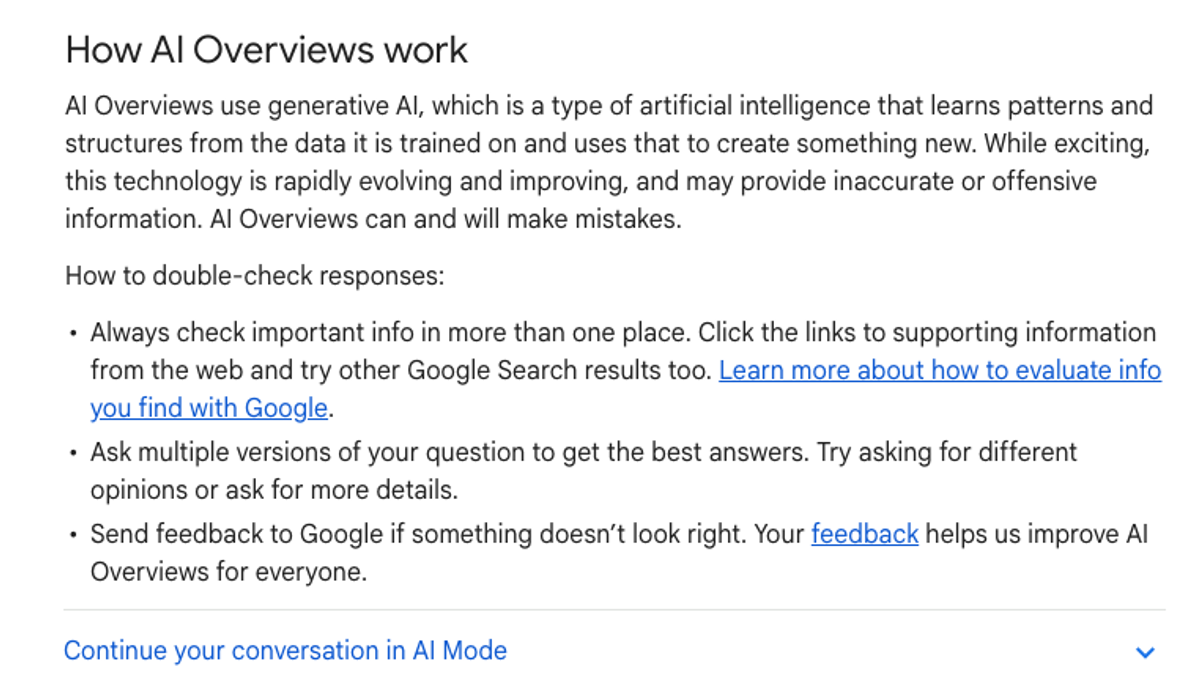
That warning lives on a help page most searchers never open. In Keene, the court found that an answer shown in response to a factual search can reasonably be read as fact, whatever the fine print says.
Walters came out differently for reasons that don't carry over well. The journalist in that case had used ChatGPT deliberately and had been warned it couldn't access the linked page. He also realized quickly that the answer was wrong. Walters also couldn't show any damages. A search answer shown to strangers looking up a business is a different situation.
Whether Section 230 covers text an AI system writes itself is still an open question in US courts.
200+ SaaS teams already track their AI citations.
They know exactly when ChatGPT mentions their brand, and when it stops. Do you?
What courts are weighing
Across these cases, the same four questions keep coming up. Each one points to something a brand can document now:
| Question | Why it matters | What happened in the cases |
|---|---|---|
| Does the answer read as fact? | Opinion and obvious error are harder to sue over | Keene: a search answer about a person reads as fact |
| Did the company know? | Public figures must show knowledge or reckless disregard | Keene: repeated notices supported that element |
| Can the claim be traced to a source? | An untraceable claim is harder to blame on someone else | Wolf River and Munich: cited pages didn't contain the claims |
| Is there measurable harm? | Without damages, a claim can fail | Walters lost partly because it showed none |
The second question is where brands have the most control. Keene's lawyers argued that he told Google repeatedly that the overviews were false and that similar statements kept appearing. The judge found that was enough to plead actual malice at this stage.
We call this the notice trail: the dated record of every time you told Google an answer was false, and of what the answer said after each report. Without it, a company can argue it never knew. With it, a repeat of the same false claim looks much worse for the publisher, whether that's Google or anyone else.
How exposed are brand searches?
The searches where false claims do the most damage are the ones buyers run before they sign. On September 27 we checked Google in the US for 30 reputation searches about 10 well-known software brands, such as "hubspot lawsuit" and "is quickbooks legit." An AI Overview appeared on 29 of them.
The sources behind those answers are worth a look. Nine of the 10 "lawsuit" overviews cited at least one law firm page or class-action site, and many of those pages exist to find plaintiffs. The monday.com overview was built largely from law firms' shareholder-alert press releases. For the complaint and "legit" searches, 14 of 19 overviews cited Trustpilot or the Better Business Bureau.
One answer showed how a mix-up can happen without a single false sentence. For "canva lawsuit," the overview described class actions over a May 2026 data breach at Instructure, which makes the Canvas learning platform. That's a different company with a one-letter-different product name. A reader skimming the answer could easily come away thinking Canva had been breached.
Smaller businesses are already feeling this. In February, a company running a nationwide service platform posted in r/GoogleMyBusiness about a drop in sales:
Google AI Overview Is Summarizing Only Negative Content About Our Business Looking for Advice
posting here because we’re trying to understand how to navigate something we’ve never dealt with before. We operate a nationwide service platform, and over the past few months we’ve seen a noticeable drop in sales. After digging into analyt...
The overview for its name summarized mostly Better Business Bureau complaints and one negative Reddit post. Prospects were quoting it back to the team, and some assumed it meant the company was under formal investigation. Reporting the overview hadn't changed anything.
How often does ChatGPT mention your brand?
Most founders have no idea. The answer might surprise you.

What to do when an AI Overview says something false
Most wrong answers are fixable without lawyers, but the steps you take early decide your options later. Work through them in order:
- Capture the answer. Screenshot it with the search terms and the date, and save the links it cites. Note where you searched from, and capture every version you see, since overviews change between searches.
- Sort the error. A wrong price, address or feature is a correction problem. An accusation of fraud, a crime or a lawsuit is also a potential legal problem.
- Trace the claim. Open each cited source and check whether it actually says what the overview says. If a page does, that page is the first fix, and our guide to correcting false information in AI Overviews covers how to get it changed. If none does, write that down.
- Report it twice. Use the thumbs-down feedback on the overview, and for defamatory claims, file Google's legal removal request as well. Keep every confirmation.
- Build the notice trail. Recheck the same searches on a schedule and log what the answer says each time, with screenshots.
- Record the harm. Log lost deals and prospects who mention the answer, with dates, and watch conversion rates over the same period.
- Talk to a lawyer before responding publicly if the answer accuses you of wrongdoing.
Step 2 is where many teams go wrong. In June, a relocated business owner posted in r/GoogleMyBusiness that their summary had shown an old service area for months. They asked whether there was a department at Google a lawyer could write to. That's a correction problem. Fixing the old listings and pages that still name the old area will usually do more than a letter.
Our explainer on why AI search engines cite the wrong sources covers where most of those stale facts come from.
The same rule applies to your own AI
Liability runs in both directions. In February 2024, a Canadian tribunal ruled against Air Canada after its website chatbot gave a customer wrong advice about bereavement fares. The airline argued the chatbot was responsible for its own actions.
The tribunal disagreed. "It should be obvious to Air Canada that it is responsible for all the information on its website," it wrote. It added that it makes no difference whether the information comes from a static page or a chatbot. The airline paid about C$812 in total.
If your company runs a support chatbot or publishes AI-written pages, the same logic applies to you. Before anything goes live, check its claims about pricing and competitors against a current source.
Why monitoring comes first
Every step above depends on knowing about the answer in the first place. Keene's case turned partly on what Google knew and when. For your own brand, the harder problem is knowing when an overview changes, since it can shift between one week's searches and the next. Our look at why AI Overviews are still unreliable found one regenerated within minutes with a different answer.
A workable routine is a fixed list of reputation searches, such as your brand name with "lawsuit," "complaints," "legit" or "pricing." Add your founders' names if they're public. Check them on a schedule, and save each answer so you have a history to compare against. Our guide to tracking brand mentions in AI search covers how to set that up.
Done by hand, checking 50 questions on seven engines takes about six hours a week, and publishing eight solid articles a month takes 16 to 24 hours more. Those are rough estimates.
RankControl's AI visibility tracking runs your 50 questions every week on seven engines, including Google's AI Mode and AI Overviews, marks each one as mentioned, cited or both, and records which competitors and sources each engine used. The content engine writes each article against the pages already ranking for its keyword and publishes it on your own domain. That puts the accurate version of your story where engines can find it.
You can keep this record yourself with a spreadsheet and a screenshot folder. Or RankControl's agents can run the weekly checks while your team handles the corrections and, if it comes to that, the lawyers.
15 hours a week manually. Or 15 minutes with RankControl.
Track citations, monitor competitors, and fix content gaps across every AI search engine. Automatically.