
The most useful AI search change of the third quarter wasn't a model launch. It was a report: on August 31, Google finished rolling out Search Console's generative AI performance report to every site, so anyone with a verified property can now see AI Overview and AI Mode impressions page by page.
That fits the quarter. From July to September 2026, AI search got a control panel, with dials for crawlers, reports for impressions and migration deadlines for anyone running tools against the engines. It also got stranger, with ChatGPT reshuffling its sources and Google's AI Overviews producing sentences that went viral for the wrong reasons. Here are the nine changes we'd rank highest for a B2B marketer, most important first, with what to do about each.
1. ChatGPT reshuffled its sources after GPT-5.6
GPT-5.6 became ChatGPT's default model on August 8, and within a week the sources it cited looked different. Tracking vendors reported Reddit's share of ChatGPT search citations falling by roughly three quarters or more, while help-center and documentation pages gained ground. Those numbers come from companies that sell citation tracking, so treat the exact percentages loosely, but the direction matched what many teams saw.
The searches behind the answers changed too. The same trackers saw ChatGPT run far more searches scoped to a single site, and the word "official" started showing up in its searches, which fits an engine that went looking for vendors' own pages instead of discussions about them.
We checked it ourselves on September 27, running three buyer questions through OpenAI's API with web search:
| Question | Domains cited | What got cited | |
|---|---|---|---|
| Best project management software for remote teams | 8 | 0 | All vendor sites, including Asana's investor relations site |
| Best CRM for a small business | 10 | 0 | Nine vendor sites and one tech publication |
| Best email marketing platform for a SaaS startup | 6 | 0 | Vendor sites, a vendor help center and one review site |
Asana's investor relations site is the odd one out. It was cited for a buyer question about project management tools, which says a lot about how widely the engine now reads a vendor's own domains once it trusts them.
What to do: stop treating Reddit threads as your main route into ChatGPT, and put the effort into pricing, docs and comparison pages on your own domain. Our post on what to do after the Reddit citation drop goes into detail.
2. Google ran two spam updates in five weeks
The August 2026 spam update started on August 18 and took two days and 16 hours. SE Ranking data shared with Search Engine Land found 16.71% of top-10 URLs fell beyond position 100 during that window, against 9.2% in a normal July week. Then, on September 24, Google started a second one. When we checked the Search Status Dashboard on September 27, the September update was still listed without a completion time.
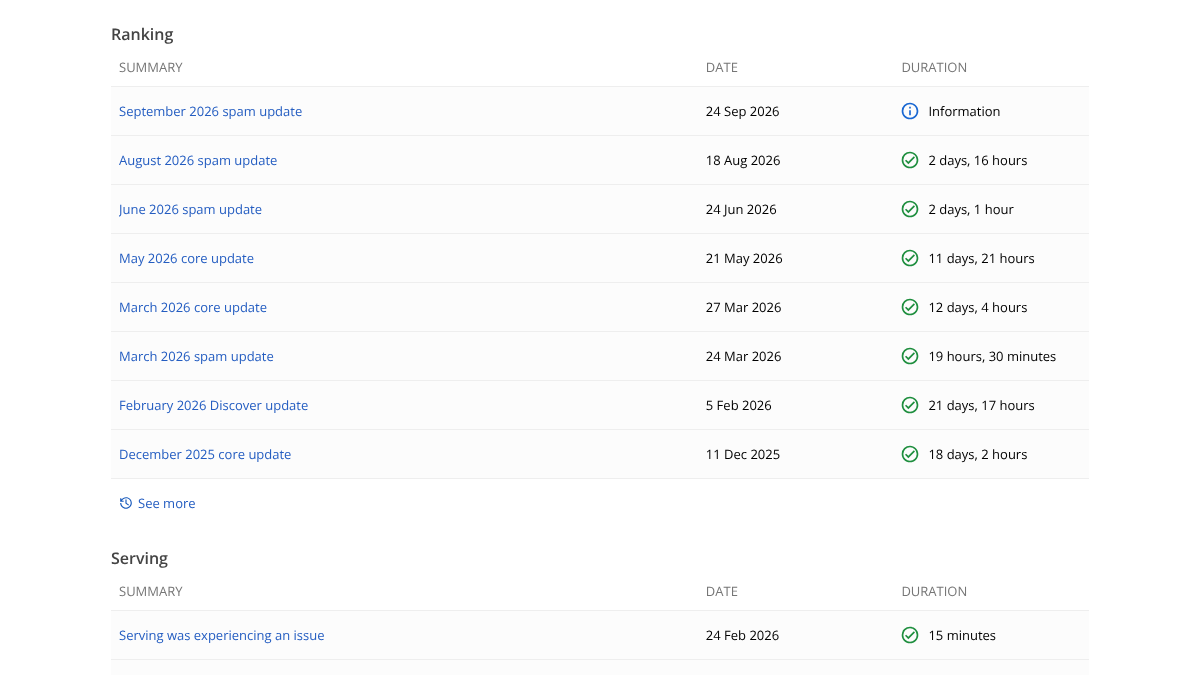
There was no core update in the quarter. The most recent one on the dashboard is still May 2026, and if you count the June 24 spam update just before the quarter began, Google ran three spam updates in about three months.
Today we released the September 2026 spam update. We'll update our ranking release history page when the rollout is complete: https://t.co/gaZTPxc9tA
 Google Search Central@googlesearchcSep 24, 2026
What to do: if organic traffic moved in late August or late September, check it against both date windows before blaming AI Overviews. Our guide to diagnosing the August spam update works for the September one too.
3. Search Console's AI report reached every site
Google announced the generative AI performance report in June with a limited rollout. Its help page now says, "As of August 31, 2026, we've rolled out this control to all websites worldwide." It shows impressions from AI Overviews and AI Mode, split by page, country, date and device.
It doesn't show queries or clicks. So you can see which pages appear in AI answers, but not which questions triggered them or whether anyone clicked.
What to do: set a baseline this month. Export the top pages by AI impressions and compare them against your pages by organic clicks, because the gap between the two lists is where AI answers are using your content without sending visits. Our Search Console AI report guide walks through it.
15 hours a week manually. Or 15 minutes with RankControl.
Track citations, monitor competitors, and fix content gaps across every AI search engine. Automatically.

4. Cloudflare turned AI crawler blocking into dials
Cloudflare made three moves in the quarter, and together they change what "block AI bots" means. On July 1, it split its AI crawler controls into Search, Agent and Training, and introduced a monetization gateway for charging AI systems that want your pages. On August 21, it added Bot Preference Sync, which "reflects what you've set in your AI bot configuration by updating corresponding preferences to your robots.txt," available from the free plan up.
Then, on September 15, its Block settings started applying to mixed-use crawlers such as Googlebot, Bingbot and Applebot. Cloudflare added a separate Disallow AI Training option for sites that want to stop training without losing search.
What to do: open your Cloudflare dashboard and read your current AI crawler settings, because a Training block set months ago can now reach Googlebot. Our Bot Fight Mode checklist covers what to check.
5. Perplexity retired Sonar
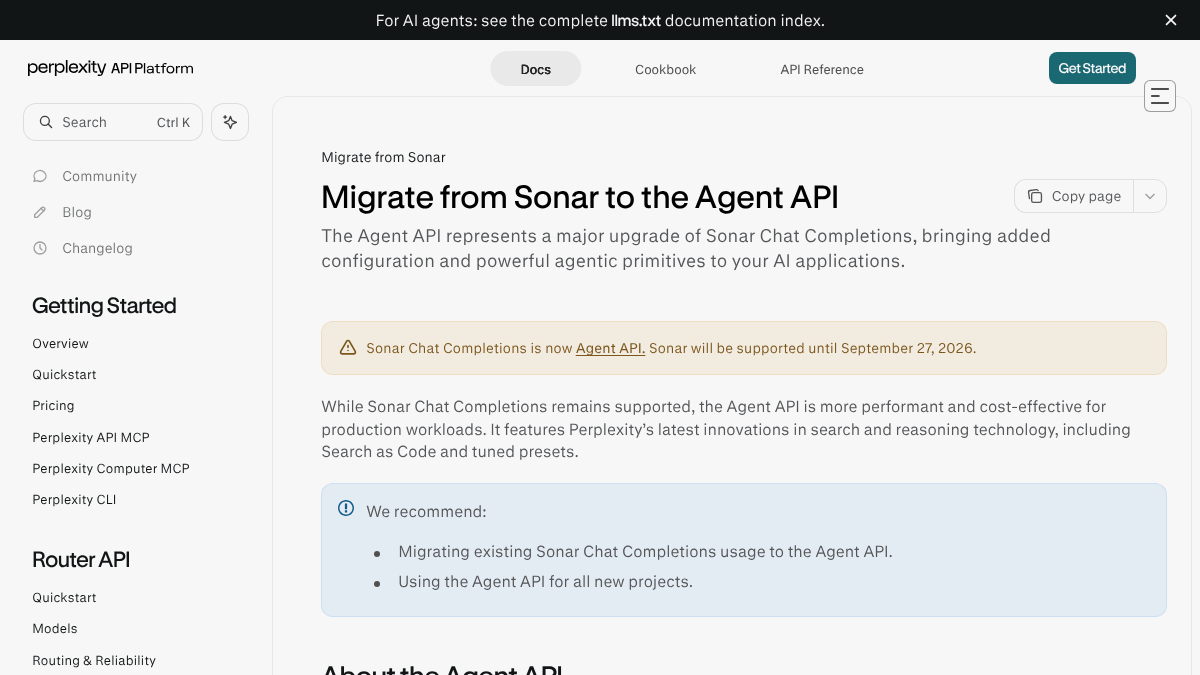
Perplexity's developer account announced in August that "Sonar is moving to the Agent API," and its migration docs set the end date: "Sonar will be supported until September 27, 2026." Perplexity pitched the replacement hard, saying that on two research benchmarks the Agent API "more than doubles the best Sonar score." Plenty of rank trackers, dashboards and in-house scripts called Sonar to check what Perplexity says about a brand, so the switch reached further than developers.
The change confused regular users too. A thread in r/perplexity_ai in September asked where "sonar 2" had gone, and the replies were not kind.
Where did sonar 2 go?
What to do: ask any vendor that reports Perplexity data how they call it now, and check your own scripts. Our Perplexity for developers post has the migration details.
6. Siri started answering from the web
Apple released Siri AI on September 14, as part of its 2027 software releases. Apple's announcement describes an assistant with "broad world knowledge" that can answer questions on virtually any topic, available on devices that run the new software.
That's a new place where a buyer gets an answer without a click, and almost nobody measures it yet. There's no Apple equivalent of the Search Console AI report.
What to do: nothing to buy. Make sure you aren't blocking Applebot, which powers Apple's search features, while you block training. Blocking Applebot-Extended only opts you out of training. Our post on whether to block AI crawlers explains the split.
7. Agents moved from demos into products
Several launches in the quarter pushed AI from answering into doing. Anthropic made Claude in Chrome generally available in late August, and OpenAI shipped an Agents API with hosted sandboxes in September. OpenAI also spent August encouraging developers to build agent-ready websites on the WebMCP standard, with a hackathon co-sponsored by Google Chrome, Cloudflare and Shopify. Google's AI Mode also gained agent features, and a post in r/GeminiAI noting that AI Mode can now set up agents drew about 150 upvotes.
What to do: make sure an agent can complete the key tasks on your site, like finding pricing, comparing plans and booking a demo, without logging in or waiting for heavy scripts. Our post on Google AI Mode for marketers covers the agent side of search.
AI search traffic grew 835% this year. Is your content ready?
RankControl generates 26 content formats optimized for ChatGPT, Claude, and Perplexity. Published on your domain, matched to your brand.

8. AI Overviews got bigger and stranger
Google made AI Overviews larger on some queries in late August, and in July it added image generation inside AI Overviews. The quality didn't always keep up. In September, a post in r/mildlyinfuriating collected AI Overview sentences like "The Sahara is the world's largest hot britannica," where source names had leaked into the text. It drew more than 4,000 upvotes.
Google’s AI Overview is just inserting random words into sentences now
What to do: search your brand and top product questions in Google and read the AI Overview itself, as well as checking whether you're linked. A garbled or outdated summary of your product is worth knowing about even when you're cited.
9. The click cost got a B2B number
In late August, the B2B marketing agency Kalungi published a report that pulled together two outside findings. Citing tracking from Overthink Group, it said more than 76% of searches comparing software solutions now return an AI answer. Separately, it cited research from the Indian School of Business and Carnegie Mellon finding that clicks to websites fall 39.8% when Google shows an AI answer.
Two cautions come with those numbers. Kalungi is an agency summarizing other people's data, and we couldn't review the underlying studies ourselves. Treat them as a sign of direction rather than a forecast for your own traffic.
What to do: measure your own version of the number. Filter Search Console to your comparison and "vs" queries, then compare this quarter's clicks and impressions with the same quarter last year. If impressions held while clicks fell, AI answers are likely taking part of those visits.
Smaller changes worth a note
A few more items from the quarter won't change your plan, but they're worth knowing:
- Anthropic released Claude Opus 5 on July 24, which is the model many buyers now hit when they ask Claude to research a vendor.
- ChatGPT started testing ads on August 11, so some answers now sit next to sponsored placements.
- Search Console added platform properties on August 28, letting you track Instagram, TikTok, X and YouTube posts across Search and Discover.
- Google's July update added image generation inside AI Overviews, which matters mostly for retail and design-heavy categories.
None of these needs action this month. The ads test is the one to watch, because paid placement inside AI answers would change how much organic citations are worth.
What didn't make the list
Some things that looked like Q3 news weren't. ChatGPT's shopping improvements and Instant Checkout for Shopify merchants circulated in September posts as new, but OpenAI's release notes date them to March 2026 and November 2025. We also couldn't confirm on any primary source a claimed Google payment program for publishers cited in AI answers, or a claimed change to how Similarweb classifies AI traffic, so both stay off the list.
If you want the day-by-day version of August and September, our AI search news timeline has it.
Your to-do list before the year ends
- Export Search Console's AI report and save a baseline.
- Compare traffic changes against both spam update windows.
- Read your Cloudflare AI crawler settings and switch Training blocks to Disallow AI Training if you want to keep search.
- Check that any tool reporting Perplexity data has moved off Sonar.
- Ask ChatGPT, Perplexity and Google your top ten buyer questions and note which sources each cites.
Budget about half a day for the first four items and two hours for the fifth, then repeat the fifth monthly.
Keeping up next quarter
You can track all of this by hand. Set a monthly reminder, rerun your buyer questions on each engine and keep a changelog of what moved.
Or RankControl can do the tracking. Our AI visibility tracking checks up to 50 buyer questions every week across seven AI engines and records which sources each answer cited, so a shift like ChatGPT's August reshuffle shows up in your own data. Our analytics count AI crawler visits and AI-referred visits, which helps when a Cloudflare setting changes who can reach your site.

Built by the team that got cited in 48 hours.
Content generation, backlink building, AI visibility tracking, and Google rankings. One platform, zero guesswork.