
We tested Perplexity on September 26 with eight developer questions where the right answer hinges on a version number, and compared every answer with the vendor's official documentation. None of the facts fell over.
Its rundown of Postgres 18's new features tracked the release notes nearly line for line. So did its account of where Python 3.14's free-threading stands, and its summary of how caching changed in Next.js 16.
The citations were a different matter. Take the Stripe question, where the source list put a GitHub issue from May 2017 in one undifferentiated pile with pages edited two days before our test, and gave you no way to tell them apart. For me that sums up Perplexity for developers. It's very good at surfacing current primary sources, and the dating is left entirely to you.
This guide covers Perplexity as a research tool first, then building on its API, which was reshaped at the end of September. The last part is about what changes when your own documentation is what gets cited.
How accurate Perplexity is on version-sensitive questions
To see where the answers came from, we ran each question through the two API models that mattered at the time, Sonar and Sonar Pro. Every source got tagged as official or not, where official meant the vendor's own docs, blog or GitHub organization.
| Question | Sources | Official share |
|---|---|---|
| Verify a Stripe webhook signature in Node | 16 | 50% |
| Caching changes in Next.js 16 | 26 | 54% |
| Row-level security in Supabase, multi-tenant | 15 | 47% |
| New features in Postgres 18 | 35 | 23% |
| OIDC in Keycloak 26 | 16 | 25% |
| Free-threading in Python 3.14 | 44 | 14% |
| Tailwind config migration to v4 | 17 | 18% |
| Bun vs Node.js performance in 2026 | 20 | 0% |
The results split cleanly by question type. For "how do I" questions about a single vendor, roughly half the sources were official. On wider ecosystem questions that fell to a quarter or below. The Bun vs Node question got zero official sources, which is fair enough, because neither project puts out a benchmark comparing the two.
When we spot-checked three of the answers against the vendor docs, we didn't find a single hard version error. The closest call came on Next.js. Both models claimed unstable_cache was "replaced" by use cache, yet the Next.js docs still carry a live page for unstable_cache. That's sloppy wording rather than a bug, and your build would survive it.
Mixed-vintage citations are the real risk
The real hazard, as I see it, is the one we've named mixed-vintage citations. In every answer the freshest sources were only a day or two old, so Perplexity is obviously re-reading these pages all the time. Yet the oldest source with a trustworthy date, that 2017 Stripe issue, sat among current documentation.
Perplexity's own date field was little help. For the Keycloak question, it gave Red Hat's release notes for Keycloak 26.2 a date of February 2016, years before that release existed.
Through the API you do get a last_updated date on each source, and it was populated much more often than the publish date. Nothing in the answer text uses it to flag an old source, though. So date-check any cited page before you copy code from it, just as you'd check which version a Stack Overflow answer was written against.
Something else caught us off guard. Across all eight questions, Sonar and Sonar Pro pulled almost the same sources, never more than a URL apart. The expensive model phrased things more carefully, but it was reading the identical pages. If you're choosing a tier for an internal tool, try the cheaper one on your real questions before you pay for depth you might not use.
Lock it to your docs with a domain filter
For an "answer from our docs" feature, this is where I'd begin. You can hand the Search API a search_domain_filter listing as many as 20 domains, used either as an allowlist or as a denylist such as -reddit.com, and path prefixes like nature.com/articles work too. The old Sonar endpoint accepted the same parameter, which let us rerun three of our questions restricted to each vendor's documentation domain.
Official sources across the board was the predictable part. The coverage wasn't. Restricted to nextjs.org, the Next.js question came back with 19 sources, including some the open run had never found.
Those were the posts for point releases 16.1 to 16.3. Left open, the search had been giving third-party blogs spots that the vendor's pages took over once they had the list to themselves.
Supabase got the same lift, growing from 15 sources to 19 with new pages on column-level security and RLS performance.

Your competitors are getting cited by AI. You're not.
Every day without citation tracking is a day your competitors pull ahead in ChatGPT, Perplexity, and Claude.
The API changed on September 27
Anyone who built on Sonar needs this part. The Sonar models now sit under a "Legacy API" heading in Perplexity's docs, and Perplexity picked September 27, 2026 as the last day of support for Sonar Chat Completions.
Developers are being pointed to its Agent API. You call it at POST https://api.perplexity.ai/v1/agent, and it will also take requests in OpenAI's Responses format.
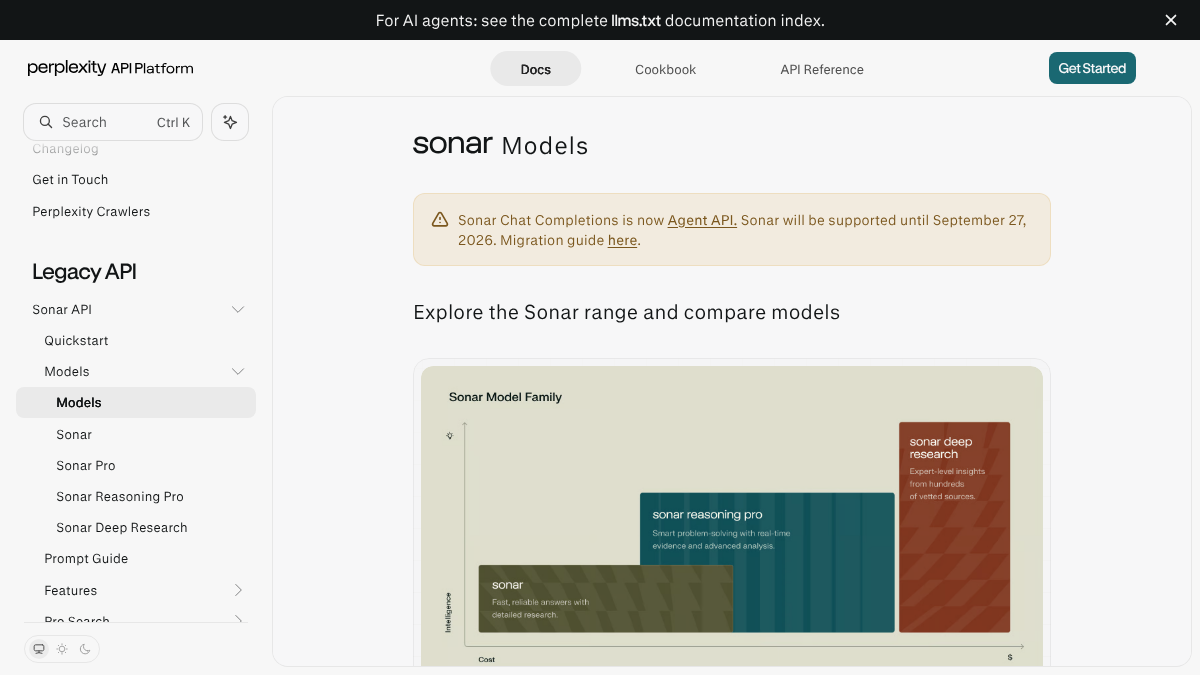
Every old model has a preset now. Plain Sonar turns into fast and Sonar Pro into low. Sonar Reasoning Pro maps to medium and Sonar Deep Research to high, and there's an xhigh preset beyond those. Perplexity claims the Agent API scores more than twice the best Sonar result on its toughest benchmarks. Since that's Perplexity grading its own work, I'd test with your own questions first.
Sonar is moving to the Agent API. The Perplexity Agent API keeps grounded web search, and adds multi-step research, code execution, built-in tools, and access to multiple models through one API. On BrowseComp and WideSearch, Agent API more than doubles the best Sonar score. https://t.co/0ET6MxYcbh
 Perplexity Developers@perplexitydevsAug 13, 2026

More has changed under the hood than the naming. The Agent API sends requests on to models from other companies, namely Anthropic, OpenAI and Google, and treats Perplexity's search as a tool it can call. When we tried the fast preset, the model that answered was openai/gpt-6-luna, and it came back with ten sources on the Stripe question.
The call cost $0.00194, and $0.001 of that went to a single web search. The total showed up in the response's usage block, which I appreciated, since it spares you matching each call against a billing dashboard.
The Search API, the CLI and three MCP servers
The Search API hands back ranked results with no language model attached, leaving the model choice to you. Pricing is $5 per thousand requests, and Perplexity announced a cheaper Fast Search on September 24.
Fast Search costs $1 per thousand. It allows 50 queries per second at every usage tier.
For terminals and coding agents, the pplx CLI wraps that same search. pplx search web "your question" returns JSON, and every result carries a trust rating. In the research run, Wikipedia was rated "trusted" and a personal engineering blog "credible." That rating is worth feeding into your agent if content-farm pages worry you.
Where teams really get lost is the MCP servers, because Perplexity runs three:
| Server | Address | What it does | Billing |
|---|---|---|---|
| API MCP | api.perplexity.ai/mcp | Search, ask, research and reason tools for your agent | API key or OAuth, per call |
| Docs MCP | docs.perplexity.ai/mcp | Read-only access to Perplexity's own docs | Free, no key |
| Computer MCP | perplexity.ai (OAuth) | Perplexity's general agent that browses and takes actions | Account credits |
Claude Code needs a single line for the API server: claude mcp add --transport http perplexity https://api.perplexity.ai/mcp. Go for the Computer server only when you want an agent doing things on your behalf, since its usage comes out of your Perplexity plan and not your API balance.
200+ SaaS teams already track their AI citations.
They know exactly when ChatGPT mentions their brand, and when it stops. Do you?

A sensible setup for a dev team
Setting this up for an engineering team, I'd start small. The API MCP server goes into Claude Code or Cursor first, which keeps research beside the code and out of a browser tab. Any feature that answers from your own docs should call the Search API with search_domain_filter pointed at your docs domain.
I'd also make dates part of code review, so a snippet lifted from a cited source has to arrive with the source's date and the version it was written for. For work tied to a fresh release, use either recency_filter, which offers windows from an hour up to a year (day, week and month sit in between), or a specific published_after_date. One request can't use both.
Most of the value is in those steps. Leave the Computer agent and the deep-research presets for later, when you know which questions your team asks most.
How developers use it
Most developers don't reach for Perplexity first. The 2025 Stack Overflow Developer Survey found that 16.2% of respondents had used it.
ChatGPT sat far ahead, at 81.7%. The people who do use Perplexity lean on it for search. One of the top replies in an r/perplexity_ai thread asking what it beats its rivals at described its internal model as "a pretty good search engine" and praised its Notion connection over MCP.
What is Perplexity better at than its competitors?
For a bit of context, I'm a power user of Claude Code and an occasional user of ChatGPT and Gemini. I got a free year of access to Perplexity Pro and am currently exploring best practices for using it and integrating into my workflow. Based...
If you go hunting in forums for API help, mind the naming. The consumer app's default chat model is also called "Sonar," so a thread griping about "Sonar 2" concerns the app and not the API models you'd build on.
If your docs are the thing being cited
Reverse the experiment and you get homework for any company that makes developer tools. On single-vendor how-to questions, official docs made up roughly half of Perplexity's sources, and on Bun vs Node they made up none. If buyers weigh you against a competitor and no one has published numbers, a third-party benchmark blog will fill that hole. My advice is to publish a plain, dated comparison of your own.
The whole docs-first process, with a weekly check you can script, is in our guide to building a developer AI search workflow. Your marketing colleagues will prefer the non-technical take in Perplexity for marketers.
A cron job and the API are enough to run those checks yourself. RankControl can also run them for you. Its AI visibility tracking puts up to 50 of your questions to seven engines every week, Perplexity and ChatGPT among them, and shows the sources each engine quoted. It connects to Claude Code through its own MCP server as well.
To get a quick baseline, try a free check of your brand in AI answers.
How often does ChatGPT mention your brand?
Most founders have no idea. The answer might surprise you.