
A marketer asked r/DigitalMarketing in September whether anyone had actually traced a real B2B deal back to an AI recommendation, or whether AI visibility is just a number teams report because it happens to be easy to measure. Nobody had a dashboard to point to. The best answer came from someone whose sales reps ask "where did you hear about us" on every qualifying call, and closed deals kept coming back with ChatGPT in the answer.
For B2B: has anyone traced a real deal back to an AI recommendation — or is AI visibility anumber we report because it is measurable rather than because it is connected to revenue?
Most AI-visibility reporting I see stops at the mention. Your brand appeared in 18% of answers for this prompt set, up from 11%. That is a real measurement and I am not dismissing it. What I cannot find is anyone carrying it forward to a si...
That's the actual job a B2B SaaS team is hiring a tool for. A buyer asks ChatGPT for a shortlist, then shows up on a demo call already leaning one way before anyone's said a word. This post compares two tools built for that job, Athena HQ and RankControl, from the point of view of a SaaS marketing team.
Everything about Athena HQ below comes from its plans page, its SaaS industry page and its credit calculator, checked on October 19, 2026. On that same day, we ran 24 B2B SaaS buyer questions through ChatGPT and Google AI Mode to see whose pages actually get cited. Our first RankControl vs Athena HQ comparison covers the general feature set; this one stays on SaaS specifically.
RankControl vs Athena HQ for SaaS teams, in short
For a seed to Series B SaaS team running a small marketing crew, RankControl is the better fit, because we write and publish the comparison, alternatives and how-to pages our test found AI engines actually citing, then track the answers weekly for one flat price.
For a SaaS team that wants Claude and Grok inside its weekly tracking, RankControl is also the simpler pick. Both come included in the 50 tracked questions at no extra charge, where Athena HQ bills five credits per answer for each one.
| RankControl | Athena HQ | |
|---|---|---|
| Price | $400/mo or $4,000/yr | Free Essential; Starter $295/mo, or $245/mo yearly |
| Billing unit | Flat plan | Credits, 3,600 a month on Starter |
| Engines | 7: ChatGPT, Perplexity, Claude, Gemini, Grok, AI Mode, AI Overviews | 11 on Starter; Essential has 5, without Claude |
| Claude and Grok | Included | 5 credits per answer each |
| Tracked questions | 50, checked weekly | Unlimited prompts, limited by credits |
| Content | Up to 100 articles a month, 26 formats | Content optimization agent; article count not listed |
| Publishing | 9 destinations, native posts | 8 CMS integrations |
| Outreach | Sent from your mailbox after approval | Drafted pitch; you send it from your mail app |
| Seats | 5 | Unlimited |
| Trial | 7 days, $0 today | Free plan with 300 credits |
What SaaS buyers ask AI, and where the answers come from
We wrote 24 questions a real SaaS buyer might ask, running from the first hint of a problem all the way to the setup guide after the purchase closes. They covered seven kinds of software SaaS companies actually buy, everything from CRMs and help desks to SOC 2 tools and call recorders. Each one went through ChatGPT's web app and Google AI Mode, via a data provider's live feed, and we sorted every cited page by who owns it.
ChatGPT searched the web for 23 of the 24 questions. The lone exception it answered from memory was "how do I know if my support team needs a help desk tool." That fits what we found about how often ChatGPT searches the web: questions touching products and prices almost always trigger a search.
| Buying stage | Example question | Cited pages | On SaaS company sites |
|---|---|---|---|
| Early research | What features should I look for in a product analytics tool? | 10 | 70% |
| Head-to-head | Zendesk vs Intercom vs Freshdesk for a SaaS startup | 29 | 83% |
| Best-of and alternatives | Best alternatives to Gong for small sales teams | 89 | 73% |
| Validation and pricing | Is Vanta worth it for a seed stage startup? | 30 | 53% |
| Setup, migration and integrations | Does Linear integrate with GitHub? | 37 | 95% |
| All questions | 24 questions, two engines | 195 | 75% |
Three in four cited pages sat on software companies' own websites. Independent review and comparison sites made up 17% of the rest, Reddit and YouTube 5%, and agencies the remainder. ChatGPT leaned even harder on company sites than Google AI Mode did, at 79% of its 149 cited pages, and it cited no Reddit threads at all across any of these questions.
The home-field share
Call that 75% figure the home-field share, the part of the answer a SaaS company can simply write on its own site. It's bigger than most teams assume, and it's built from entirely ordinary pages.
Pricing pages alone accounted for 38 of the 195 cited pages, roughly one in five. Help docs, developer docs and knowledge-base articles made up another 33. For "does Notion have an API for syncing data," all seven citations across both engines pointed straight to Notion's own help and developer docs.
The most useful finding for a marketing team, though, was who actually wrote the best-of lists. Ask ChatGPT for Gong alternatives and it shortlists Avoma, Fathom, Fireflies.ai and Claap. Among its sources sat Gong alternatives articles written by Claap, Sybill and FirstTouch, all companies that compete directly against Gong. Claap wrote one of those lists itself and still landed on the shortlist.
Intercom played the identical game from the other side. Its own "Intercom alternatives" page was one of just three sources ChatGPT cited in the opening lines of its answer to that exact question. Our guide to alternatives pages covers how to build one an engine can quote without it reading like an ad.
15 hours a week manually. Or 15 minutes with RankControl.
Track citations, monitor competitors, and fix content gaps across every AI search engine. Automatically.

What Athena HQ's SaaS page promises
Athena HQ runs a page built specifically for SaaS teams, headlined "Win the AI SaaS Evaluation." It lists four jobs. First is tracking how AI ranks your software for category, use case and head-to-head prompts. It also promises to check that AI is showing your current features and pricing, to show when and why AI picks a competitor instead, and to tie AI visibility back to demo requests and trial starts.
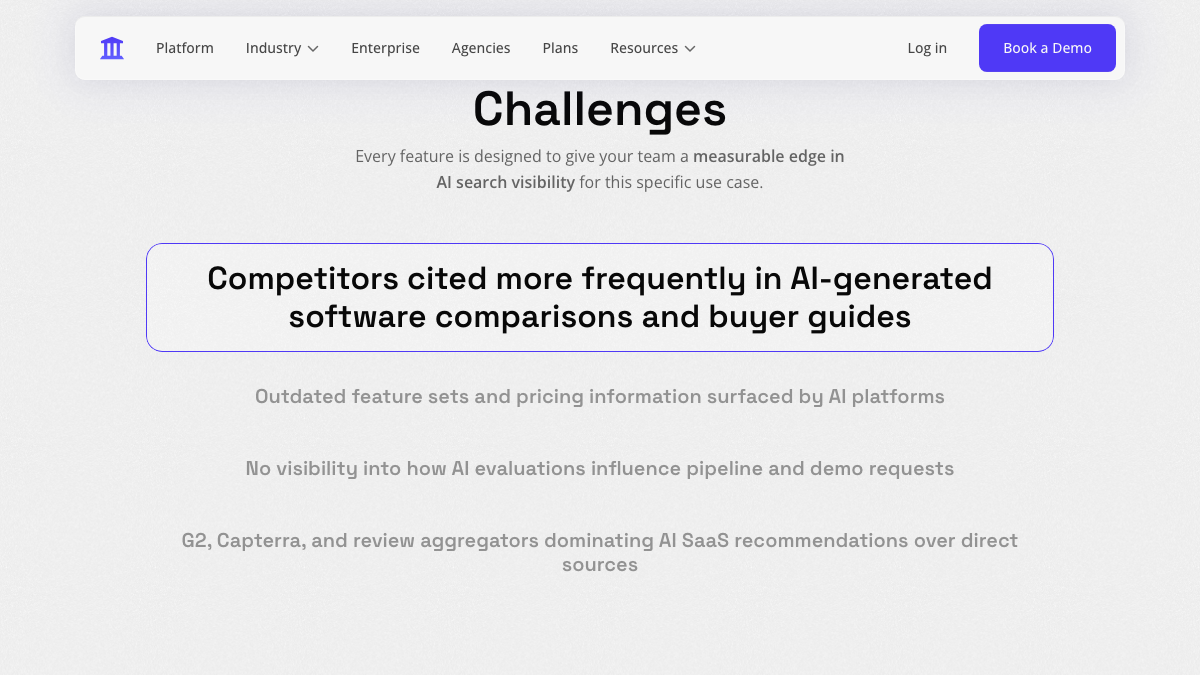
One challenge listed on that page is that G2, Capterra and review aggregators dominate AI SaaS recommendations ahead of direct sources. Its FAQ repeats the same point, and says Athena helps you get cited directly from your own site instead.
Our sample didn't back up that particular claim. Review sites made up only 9 of the 195 cited pages, and 8 of those 9 came from a single question, "what do customers say about Drata." For the best-of, head-to-head and setup questions, G2 and Capterra barely showed up at all. Athena's advice still holds together, since it pushes teams toward docs, comparison pages and use-case pages on their own sites either way. The review-site problem it describes just happened to show up in only 1 of our 24 questions.
Athena HQ follows its own advice on its own site, for what it's worth. The footer links out to five comparison pages of its own, including Athena vs Profound and Athena vs Semrush.
Tracking SaaS buyer questions: the credit math
Athena HQ bills its tracking in credits, where one credit buys one AI answer. Its credit calculator reveals something the plans page never mentions: five models, Claude and Grok among them, are marked as heavier, so each answer from one of those costs 5 credits instead of 1.
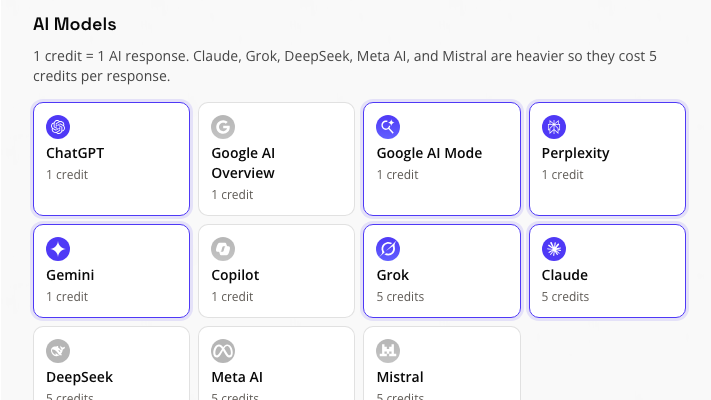
We set the calculator to match RankControl's own tracking exactly. Fifty prompts, the same six engines, run once a week from one location. That came to 3,031 credits a month, fitting comfortably inside Starter's 3,600.
Nudge one setting, though, and the picture moves fast. Running the same set twice a week jumps to 6,062 credits, pushing you into add-on credits priced on request. Turn on prompt expansion, which adds three rephrasings of every prompt, and a once-a-week schedule alone needs 12,124 credits a month, which the calculator routes straight to Enterprise. Athena's own default setup, 50 prompts on seven models three days a week, lands at 7,145.
Where Athena HQ genuinely pulls ahead is coverage. Starter tracks 11 models, Copilot included, and RankControl doesn't check Copilot at all, which matters plenty if your buyers sit inside Microsoft-heavy companies.
RankControl's AI visibility tracking checks 50 questions across seven engines every week, Claude and Grok included, and shows exactly which sources each answer cited. There's no credit meter sitting underneath our tracking, so adding Claude to the mix never once pushes the plan over its limit.
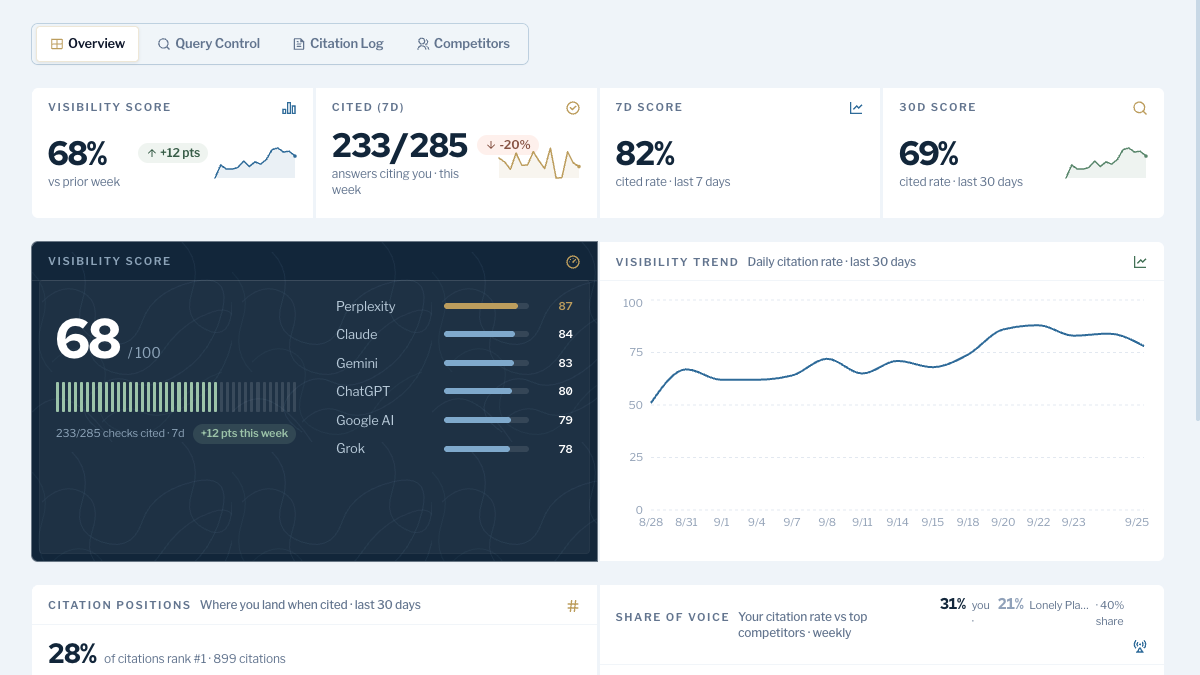
For a SaaS team, 50 questions goes further than it sounds once you split them by stage. Give ten to head-to-head matchups against your main rivals and another ten to alternatives questions. Spread the remaining thirty across best-of, pricing and setup questions, and you've covered every row of the table above.
Writing the pages that get cited
If three in four citations come straight from company sites, the real work here is writing pages, and both tools write, just in very different amounts.
Athena HQ's Starter plan includes a content optimization agent, on-page and off-page actions, and what it calls self-learning content improvement. Its SaaS page names the content types it believes move recommendations most, which are integration docs, use-case pages, category comparison guides and thought leadership. The plans page never actually says how many articles a month Starter writes.
RankControl's content engine writes up to 100 articles a month across 26 formats, including comparisons, alternatives pages, listicles and how-to guides. The content engine plans titles from the questions you're currently losing, writes each one against the pages already ranking, and publishes it as a native post on your site once you approve it. Auto-publish stays off until you decide to turn it on.
Your pricing page and API docs stay your job no matter which tool you pick, and in our test they made up nearly half the entire home-field share between them. Write your prices in plain text on the page itself; a price that lives only inside an image, or behind a monthly and yearly toggle, is simply harder for an engine to read.
AI search traffic grew 835% this year. Is your content ready?
RankControl generates 26 content formats optimized for ChatGPT, Claude, and Perplexity. Published on your domain, matched to your brand.

Getting onto other people's lists
The other 17% of citations came from independent sites, mostly software directories and comparison blogs. For the Gong question, ChatGPT also cited two sites that publish their own Gong alternatives lists. Getting your product onto pages like those is outreach work, plain and simple.
Athena HQ's Action Center lists the pages AI cites for your prompts, finds the authors behind them, and drafts a pitch, based on our September read of its docs. To actually send it, you open the draft in your own mail app and send each one yourself.
Link Control in RankControl finds prospects and contacts for every published article, and sends the pitch from your own mailbox once you approve it. Follow-ups go out on a schedule and stop the moment someone replies. Our guide to getting your SaaS onto AI product lists covers which directories and lists are worth chasing first.
From AI answer to demo request
The Reddit thread at the top of this post names the hard part for any SaaS team. A buyer reads an AI answer, doesn't click anything, and books a demo a week later from a branded search instead. No tool sees that whole path cleanly.
Athena HQ's SaaS page says it connects to your CRM and analytics stack to attribute demo requests and trial starts back to AI discovery. Its plans page lists GA4 and Search Console connections specifically. RankControl's analytics show visits arriving from each AI engine, AI crawler visits, and your Google and Bing positions sitting right next to your citations.
Whichever tool you end up using, add the one field those Reddit replies kept suggesting. A simple "how did you hear about us" question on your demo form, with ChatGPT and Perplexity listed as options, catches the buyers your analytics would otherwise file under direct.
Limits of our test
We ran 24 questions once each, from the US, on a single day. The questions were ours to pick, so a different set in another category could easily shift these shares. AI Mode cited far fewer pages than ChatGPT did, 46 against 149, which means the combined numbers lean toward ChatGPT's own habits more than Google's. We sorted sources by who owns the site, and a handful of company blogs read more like independent publishers than vendors.
What this takes by hand
Here's a rough monthly budget for a SaaS team doing this without any tool, by our own estimate.
| Task | Hours a month |
|---|---|
| Running 50 buyer questions on seven engines | 7 to 9 |
| Sorting cited sources by owner | 2 to 3 |
| Writing four comparison or alternatives pages | 12 to 16 |
| Keeping pricing and docs pages current | 2 to 4 |
| Pitching independent list owners | 4 to 6 |
| Total | 26 to 37 |
RankControl vs Athena HQ for B2B SaaS teams: which fits
For most B2B SaaS teams under a few dozen people, RankControl fits better. Our test found that company-owned pages win most citations, and RankControl writes and publishes those exact pages every month, sends the outreach for the rest, and tracks 50 questions across seven engines for a flat $400. If you're already on Athena HQ, our switch guide covers the export, and the three-way comparison with Otterly throws a cheaper tracker into the mix as well.
You can run the questions, write the pages and send the pitches entirely yourself. Or RankControl's agents can do it every month while you stay focused on the product, starting with a 7-day free trial.

Built by the team that got cited in 48 hours.
Content generation, backlink building, AI visibility tracking, and Google rankings. One platform, zero guesswork.