
Athena HQ is the closest thing to RankControl on the market, so RankControl vs Athena HQ comes down to how each one charges and how far each one goes. Both track AI answers, write content, publish to your CMS and work on the sites AI engines cite. Athena HQ bills in credits and covers 11 models from $295 a month. RankControl charges a flat $400 and sends the outreach itself.
Both want your brand named when buyers ask AI, and both do more than watch. The differences are in the details, and they add up.
Everything below about Athena HQ comes from its own plans page, platform and integrations pages, help docs and terms. I read them on September 27, 2026. If you're already leaving, our Athena HQ switch guide covers the export. If Otterly is also on your shortlist, our three-way comparison puts all three side by side. For a SaaS team, our B2B SaaS comparison adds a test of whose pages AI cites.
RankControl vs Athena HQ at a glance
| RankControl | Athena HQ | |
|---|---|---|
| Price | $400/mo or $4,000/yr | Free Essential; Starter $295/mo or $245/mo yearly |
| Billing unit | Flat plan | Credits, 1 per AI response |
| AI engines | 6: ChatGPT, Perplexity, Claude, Gemini, Grok, AI Mode | 11 on Starter, adding AI Overviews, Copilot, DeepSeek, Meta AI, Mistral |
| Cadence | Weekly | You choose the days; each check spends credits |
| Tracked questions | 50 | Limited by credits |
| Content | Up to 100 articles a month, written and published | Content agent; publishes to 8 CMSs |
| Outreach | Sent from your mailbox after approval; follow-ups stop on reply | AI drafts; you send from your mail app |
| Seats | 5 | Unlimited |
| MCP / API | 80+ MCP tools | MCP; API is a paid add-on on Starter |
What Athena HQ is in 2026
Athena HQ is run by NuvoTech, Inc., and its terms are governed by California law. Its platform page says it's trusted by more than 300 brands, and its quotes come from marketing leads at consumer and software companies. The pitch is enterprise-grade: governed workflows, ownership of each task, and measurement across teams.
The product has three parts. Monitoring tracks visibility, mentions, citations, sentiment and competitors. Analysis traces answers back to their sources, finds inaccurate claims and pages AI crawlers can't reach, and ranks opportunities. The Action Center turns those into content, citation outreach and commerce work. In August it added shopping page templates, ChatGPT ads reporting for its larger plans, and tracking across 185 markets down to city level.
The first week on each tool
Athena HQ's Essential plan is free, not a time-limited trial. It includes 300 credits and five engines: ChatGPT, Perplexity, AI Overviews, Gemini and Copilot. Setup walks you through your brand, competitors, prompts, region and Search Console. The last step sets which models to scan and on which days, with a cost summary of the credits it will spend. Claude, Grok and the other advanced models stay locked until you pay for Starter.
RankControl's trial runs 7 days, with the card up front and $0 charged today. Setup reads your site and drafts your brand profile, products, buyers and competitors for you to correct. You connect a CMS, add up to 50 questions and 10 competitors, and the first weekly check runs across six engines. Meanwhile the planner builds a calendar from the questions you're losing, and the first articles start drafting that week.

Your competitors are getting cited by AI. You're not.
Every day without citation tracking is a day your competitors pull ahead in ChatGPT, Perplexity, and Claude.
RankControl vs Athena HQ on AI visibility
On coverage, Athena HQ goes wider. Starter covers 11 models. Five of them are engines RankControl doesn't check: Google AI Overviews, Copilot, DeepSeek, Meta AI and Mistral. Enterprise adds multiple regions and languages, persona targeting and a knowledge base for correcting what AI says about you. For a brand selling in many markets, that breadth matters.
RankControl checks 50 questions on its six engines every week and shows which sources each answer quoted. That covers the engines most buyers use, at a fixed rate. It also checks every day whether AI crawlers can reach your site, which overlaps with Athena HQ's check for pages AI can't access.
Whichever tool you pick, the number will move on its own. In r/aeo this June, a new agency asked whether to choose Athena HQ or Peec AI. The most detailed reply said these tools all work the same way underneath. They send a prompt set to the models on a schedule and record whether you appear. The reply added that the score shifts with the prompts, the model version and plain chance.
AthenaHQ vs Peec AI for a beginner GEO/AI visibility agency — which would you choose?
For agencies just getting started with AI visibility / GEO, would you choose AthenaHQ or Peec AI? I'm evaluating both and would love feedback from people who have actually used them. From what I can tell: • Peec AI seems more focused on AI...
The cadence tax
I call it the cadence tax: the extra credits you spend each time you add a check day. Athena HQ's setup screen multiplies your prompts by your models by your days to estimate the monthly cost, and one credit buys one AI response.
On Starter's 3,600 credits, the numbers work out like this. Fifty prompts on six engines, checked once a week, use about 1,290 credits a month. Check them twice a week and it's about 2,580. A third day takes you to roughly 3,870, which is more than the plan includes. Checking daily on six engines fits about 20 prompts, and a weekly check on all 11 models fits about 75.
None of that is a problem if you plan for it, and Athena HQ shows the cost before you save. But every choice about cadence and coverage is also a budget decision. RankControl's 50 weekly questions on six engines are included in the $400, and there's nothing to ration.
Weekly is enough for most teams, since single answers change from run to run anyway. The tax bites when you want daily checks on a big prompt set, or every model at once. If that's your plan, price the extra credits before you commit, because Starter lists them as an add-on with pricing on request.
Content and publishing
Both tools write and publish, which is rare in this category. Athena HQ's Starter plan includes a content optimization agent, on-page and off-page actions, and what it calls self-learning content improvement. Its integrations publish to eight content systems, with drafts or live posts depending on the platform. On Wix it creates blog drafts to publish when you're ready, and on Contentful it can send entries as drafts or published. On Shopify it can also update product titles, descriptions and FAQs.
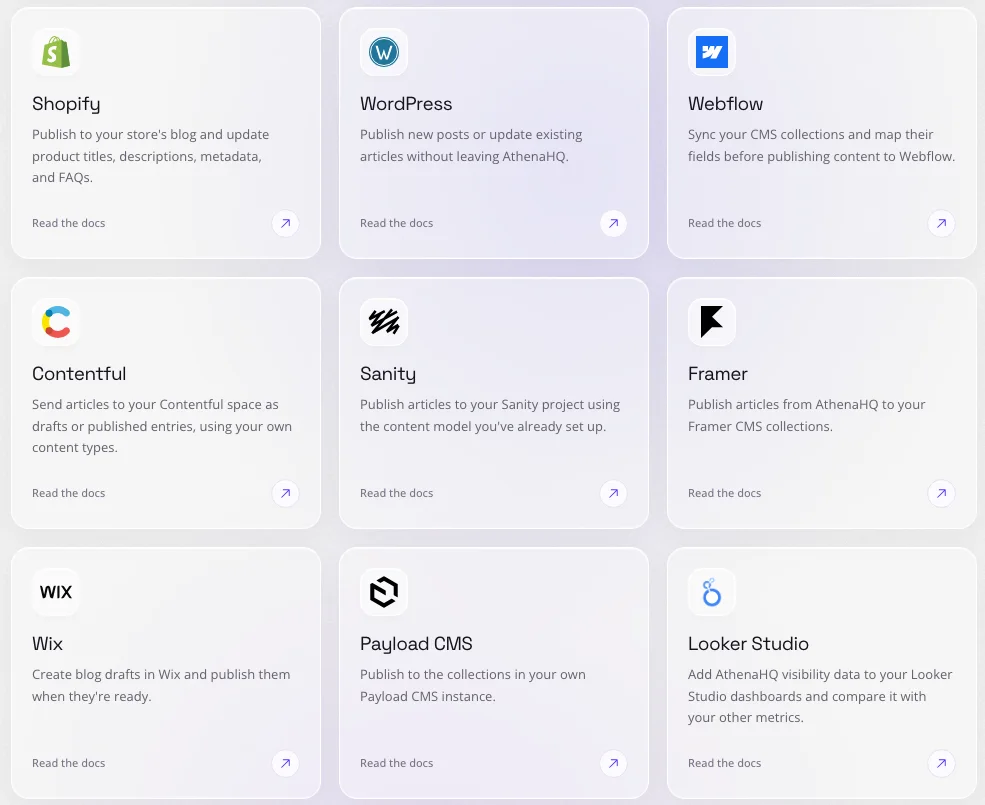
The plans page doesn't say how many articles a month Starter produces. RankControl's content engine does: up to 100 a month across 26 content types. It plans titles from the questions you're losing, researches the pages already ranking and writes each article with images and internal links. It publishes native posts through one of nine destinations, and auto-publish stays off until you turn it on.
The destination lists overlap on WordPress, Shopify, Webflow, Framer and Wix. Athena HQ adds Contentful, Sanity and Payload for headless sites. RankControl adds Ghost, Notion, webhooks and a content API for Next.js and other headless builds.
200+ SaaS teams already track their AI citations.
They know exactly when ChatGPT mentions their brand, and when it stops. Do you?

Links and outreach
This is where the two tools differ most. Athena HQ's outreach page lists the pages AI cites for your prompts, with each page's citation rate and estimated impressions. It also shows whether your brand or your competitors appear there. It can find each page's author with AI, draft a pitch you can customize, and track every target on a board from New to Done. You can filter the list by prompt tag or model, run author searches and drafts in bulk, and export the list as CSV.
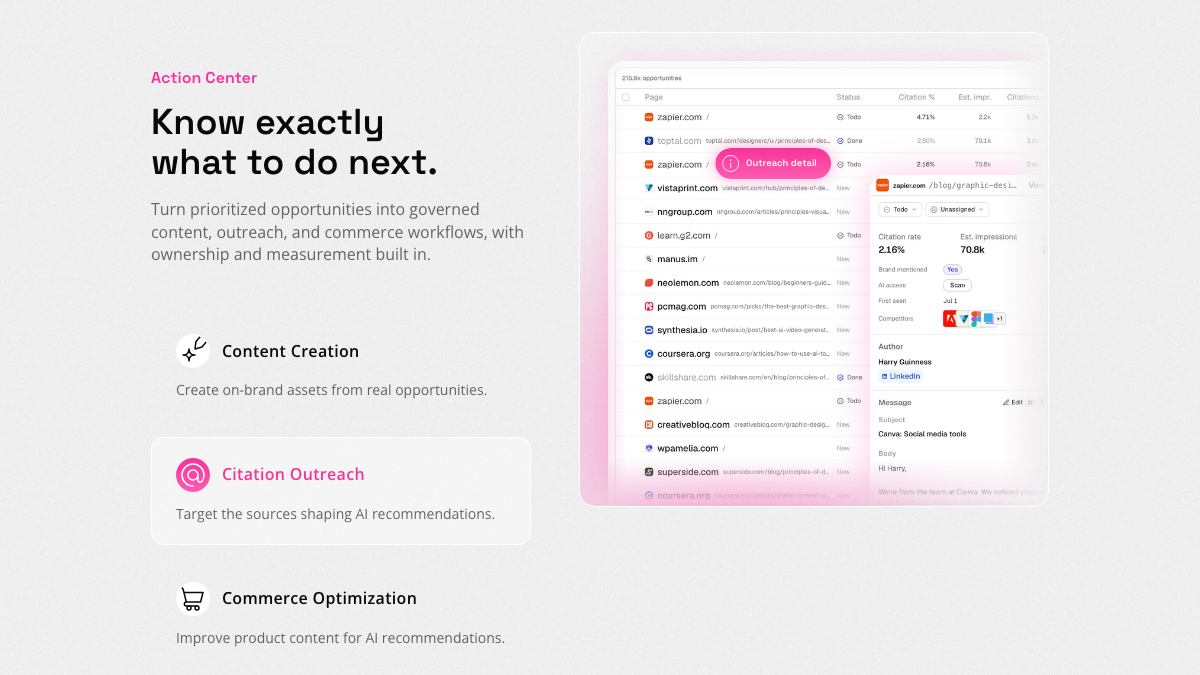
To send, you click Open in mail client, which opens your computer's email app with the address, subject and body filled in. You send each one yourself, and the docs don't describe follow-ups.
Link Control in RankControl finds prospects and contacts for each published article and sends the pitch from your own mailbox once you approve it. Follow-ups go out on a schedule and stop when someone replies. Managed Backlinks adds five links a month from DR 25+ sites for $350.
Shopping, ads and enterprise features
Athena HQ covers ground RankControl doesn't. Commerce optimization improves product content for AI shopping answers, and Shopify syncs product titles, descriptions and FAQs. Shopping page templates came in August. ChatGPT ads reporting covers its enterprise and agency plans. Enterprise also adds SSO, audit logs, a claims knowledge base and dashboards for Tableau, Power BI and Looker.
For a large ecommerce brand or a team with procurement rules, those features matter, and RankControl doesn't offer them.
Reporting and teams
Athena HQ gives every plan unlimited members, which suits a company where SEO, content, PR and commerce all want to look. It sends weekly reports to Slack and feeds Looker Studio, and Enterprise adds executive dashboards in Tableau, Power BI and Looker. You can connect Search Console during setup.
RankControl includes five seats. Its analytics show AI crawler visits, a daily Search Console sync and Google and Bing positions next to your citations. Each Monday a weekly brief sums up what changed and what the agents did. It's built for a small team that wants one summary, not for a reporting department.
Price
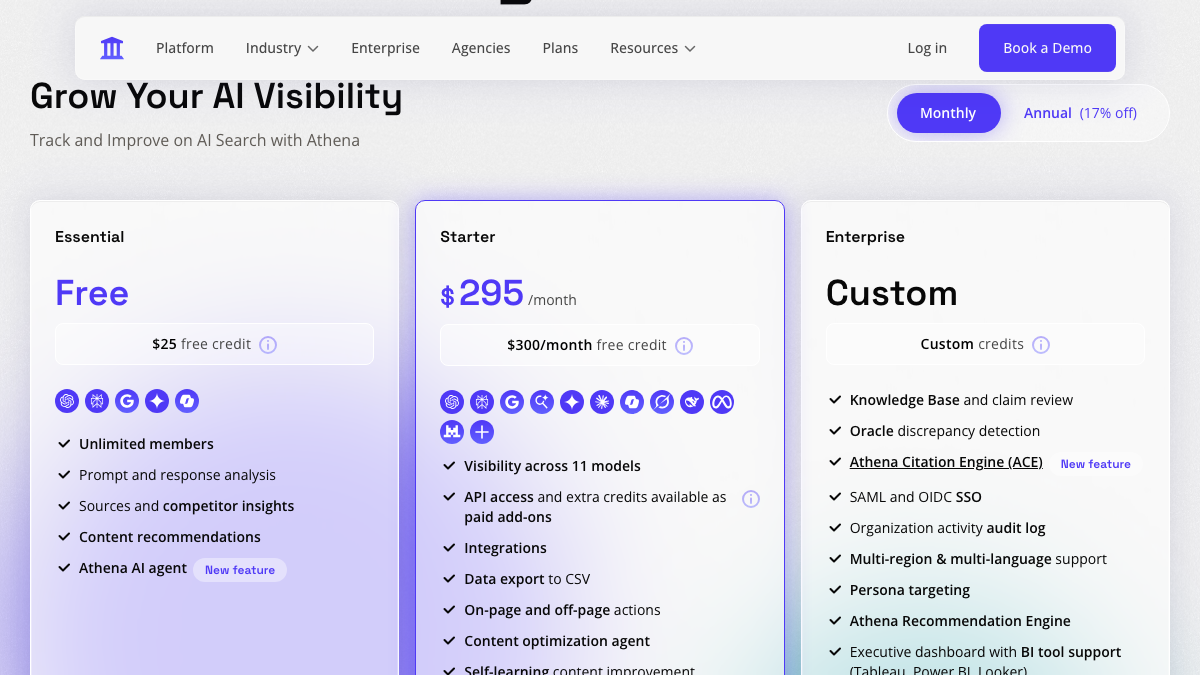
Athena HQ's Essential plan is free with 300 credits. Starter costs $295 a month, or $245 a month billed yearly, with 3,600 credits and 11 models. Extra credits and API access are add-ons priced on request. Enterprise is custom, with credits negotiated in the contract.
RankControl costs $400 a month or $4,000 a year, with tracking, up to 100 published articles, outreach and five seats in one plan. Athena HQ is cheaper to start and has unlimited members. RankControl's price doesn't change with cadence or volume.
Working from Claude
Athena HQ connects to ChatGPT and Claude over MCP, so you can review visibility data, research citations and draft content from a chat. Its REST API is an add-on on Starter. RankControl's MCP server has 80+ tools covering tracking, planning, writing and publishing, and publishing through it stays a dry run until you confirm.
Contracts and cancelling
Athena HQ's subscriptions renew automatically. You cancel in account settings, and cancelling takes effect at the end of the paid billing period, so you keep access until then. Payments aren't refundable unless the law, an order form or Athena HQ itself says otherwise. Data retrieval and deletion follow the product's own export tools and its privacy policy. Disputes go to arbitration, with California law.
RankControl's trial runs 7 days with nothing charged today. Cancelling takes effect at the end of the billing period, with no pro-rated refunds, and your articles stay in your CMS.
RankControl vs Athena HQ: which wins AI search visibility?
For most small and mid-sized teams, RankControl wins because the work is included and nothing is metered. Up to 100 articles a month publish on your own site, outreach goes out from your mailbox with follow-ups, and six engines are checked every week for one price.
Athena HQ is the stronger pick for enterprises and larger ecommerce brands. It covers 11 models and 185 markets and adds shopping, ads and governance features, with a free plan to start. A tester who tried more than 20 tools in r/seogrowth this February found it analytics heavy. That fits a team with analysts to read the data.
You can call me a professional AI visibility checker tool tester. I tested over 20 AI visibility tools so you wouldn't have to
I made a list of tools that I want to share my opinion on and make a discussion out of this post, maybe you have something to add or to share your experience as well. This is not an ad, I paid for all of these tools myself out of pure curio...
You can run that loop by hand, or RankControl's agents can run it for you, starting with a 7-day free trial. Before you decide, the free AI visibility check shows who ChatGPT cites for three questions from your market today.
How often does ChatGPT mention your brand?
Most founders have no idea. The answer might surprise you.