
Someone asked r/AISEOforBeginners whether Jasper was still worth paying for to write SEO content. They'd used it since 2022, when it felt like a premium tool, and now had ChatGPT, Gemini and Perplexity too. One reply stood out. Their team had built a stripped-down Jasper of their own, and they said that getting the words out of an AI is the easy part, and most of the work is in everything around it.
Is Jasper still a thing to write for SEO?
I just noticed a credit card charge from Jasper. I've been using them since 2022 but now I realized I have subscriptions to ChatGPT and Gemini plus free 1 year Perplexity. Curious if anyone here still uses Jasper and if there's any sense to...
That's the right lens for this comparison. Our earlier RankControl vs Jasper comparison looked at AI search visibility. This one stays on a narrower job, getting SEO blog posts that can rank onto your site. It compares two products, Jasper and RankControl. Jasper details were checked on October 19, 2026 against its pricing page, its SEO and AEO agent library and its integrations page. We never used Jasper ourselves.
To make the comparison concrete, we first checked what blog posts that rank actually contain.
What page-one blog posts look like in 2026
On October 19, we searched 15 keywords a business blog might target, like "how to reduce customer churn," "employee onboarding checklist" and "how to write a cold email." We took Google's top five results for each, set aside Reddit, YouTube and similar sites, and read the 56 pages we could load in full.
| What we measured | Result across 56 page-one posts |
|---|---|
| Median length | About 2,200 words |
| Middle half of lengths | 1,445 to 3,019 words |
| Under 1,500 words | 29% |
| Median subheadings (H2) | 7 |
| Links to outside sources, median | 3 |
| Article schema in the page code | 68% |
| FAQ schema | 12% |
| At least one table | 16% |
| Updated in 2026 | 36% |
Three things stood out. First, these were mostly business sites. Of the 75 top-five results, 55 came from companies like Salesforce, Stripe, Close and Wrike. Forums and video took 13, government and university pages 4, and media sites only 3. A company blog can rank.
Second, length didn't decide the order. Posts in the top three had a median of about 2,000 words, a bit fewer than posts lower down. Third, ranking posts get updated. Of the posts first published before 2024, half showed an update date in 2025 or 2026.
What separated the top three
We also compared posts in positions one to three with posts lower on page one. The sample is small, 27 posts against 29, so read it as a pattern, not proof.
| Positions 1 to 3 | Positions 4 and lower | |
|---|---|---|
| Article schema | 78% | 59% |
| Updated since January 2025 | 63% | 45% |
| Median outside links | 3 | 3 |
| Median subheadings | 7 | 7 |
Structure and sources looked the same. The differences were in the page code and freshness. Google's Article structured data guide says the markup helps it understand the page and show better title, image and date information.
The updated posts were often old ones kept alive. SuperOffice's churn guide was first published in 2019 and updated in May 2026. DashThis's social media strategy post dates from 2019 and was updated in July 2026. Wrike's "what is a CRM" page went from 2022 to an August 2026 update.
So a ranking blog post in 2026 is usually a well-structured article of 1,500 to 3,000 words. It cites a few sources, carries page code that tells Google what it is, and gets updated. Now, which tool covers which part?
Know exactly what AI says about your competitors.
RankControl's Recon Agent monitors competitor citations across ChatGPT, Perplexity, Claude, Gemini, Grok, Google AI Mode, and Google AI Overviews. See where they show up and you don't.

RankControl vs Jasper, in short
For a small team that needs posts researched, written and published without a separate editor and web person, the better fit is RankControl, because it covers every step from topic to live post for one flat price.
For a team that wants to know whether those posts show up in AI answers as well as Google, the better fit is RankControl, because weekly tracking on seven AI engines is included, while Jasper's AI search tracking sits on its custom-priced Business plan.
| RankControl | Jasper | |
|---|---|---|
| Price | $400/mo or $4,000/yr | Pro $69/mo, or $59/mo yearly, per seat; Business custom |
| Seats | 5 included | 1 on Pro |
| Topic research | Finds the questions your buyers ask and plans a calendar | Query Planner and Gap Finder agents; Semrush integration |
| Drafting | Writes against the pages already ranking, 26 formats | Pillar Article agent and Canvas editor |
| Sources and links | Links to sources and your related articles | Citable Claims and Fact Density agents; Entity Mapper suggests link targets |
| Schema | Generated for every article; reaches the page on WordPress and headless sites | Schema Markup agent you paste into your page |
| Publishing | Native posts to 9 destinations, after approval | Webflow app; exports to Google Drive, SharePoint, Box; Zapier and Make |
| Ranking and AI tracking | Google rankings plus 50 questions weekly on 7 AI engines | GEO Hub on Business, credits per report |
| Trial | 7 days, $0 today | 7 days on Pro |
What Jasper does for a blog post
Jasper has grown well past the "AI copywriter" it started as. Its SEO and AEO page lists 14 agents grouped into three jobs it calls outrank, optimize and originate.
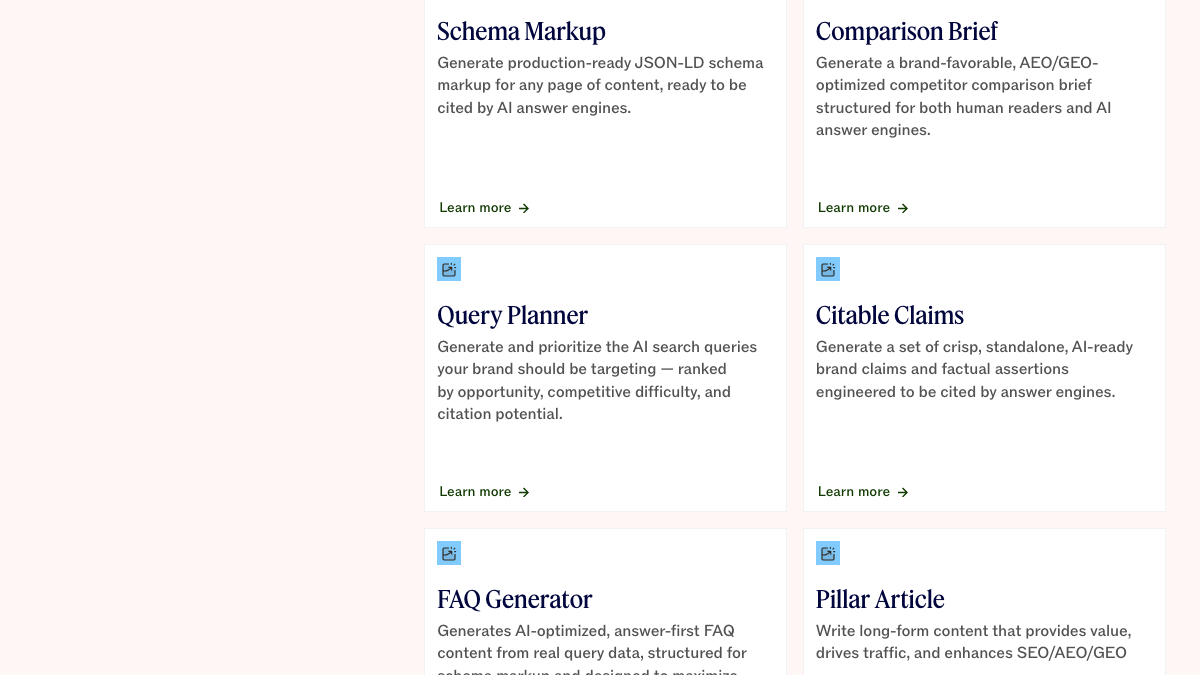
For a blog post, the relevant ones are Query Planner for picking topics, Pillar Article for long-form drafts, Citable Claims and Fact Density Audit for tightening the facts, Entity Mapper for spotting missing topics and suggesting internal link targets, and Schema Markup and FAQ Generator for the page code. Jasper's integrations page says its Semrush connection feeds richer search data into its optimization agent.
Jasper's pricing page puts the GEO agents, deep research, the no-code agent builder and the Grid for content at scale on the Business plan. Pro, at $69 a month or $59 billed yearly, includes one seat, the Canvas editor, agents for core marketing workflows and two brand voices.
Here's where Jasper is stronger. If you write for many channels and brands, its brand controls go deeper, with multiple brand voices, a style guide applied in the editor and visual guidelines, and a blog post is only one of the things it's built to produce.
Where Jasper's blog workflow stops
The gap shows up after the draft. Jasper's integrations page lists exports to Google Drive, SharePoint and Box, a Word add-in, project tools like Asana and Monday.com, and a Webflow app for writing inside Webflow. It doesn't list a WordPress, Shopify or Ghost integration, so for most blogs a person still copies the post into the CMS. They also add the schema, upload images and hit publish. Zapier and Make can automate part of that, if someone builds the workflow.
That matters given what ranking posts look like. Two in three page-one posts in our check had Article schema in their code. With Jasper, the Schema Markup agent writes the JSON-LD, and someone has to put it on the page.
What RankControl does for a blog post
RankControl starts earlier and ends later. It finds the questions your buyers ask, plans titles onto a calendar, and writes each article against the pages already ranking for it, so the length and structure match what Google is rewarding for that query. It scores each article for how easily AI engines can quote it, with a fix list.
Each article links out to sources and to your related articles, and it publishes as a native post on WordPress, Webflow, Shopify, Ghost, Notion, Wix, Framer, a webhook or a headless site. Schema is generated for every article and reaches the live page on WordPress and headless sites. Auto-publish is off by default, so you approve each post before it goes live.
After publishing, it tracks Google rankings and checks 50 of your buyer questions every week on ChatGPT, Perplexity, Claude, Gemini, Grok, Google AI Mode and Google AI Overviews. Our content engine page shows the workflow.
26 content formats. Published on your domain. Matched to your brand.
Guides, comparisons, listicles, case studies, and more. RankControl generates content that gets cited by ChatGPT, Perplexity, Claude, Gemini, Grok, Google AI Mode, and Google AI Overviews.

What a month of blog posts costs
Here's a rough comparison for a team publishing eight posts a month, by our estimate of the hours involved.
| Jasper Pro | RankControl | |
|---|---|---|
| Software | $69 a month for one seat | $400 a month, five seats |
| Topic research per month | 2 to 4 hours, or a Semrush plan | Included |
| Editing and fact-checking per post | 1 to 2 hours | 30 to 60 minutes reviewing before approval |
| Moving each post into the CMS with images and schema | 30 to 60 minutes | Included |
| Hours per month for eight posts | 14 to 28 | 4 to 8 |
Jasper's software is cheaper, and the hours are where the gap comes from. If your team already has an editor and a web person, those hours may already be paid for. If it's one marketer doing everything, they're the whole cost. Our guide to SEO content writing services vs software adds up those hours in more detail.
How to check a draft against page one
Whichever tool writes the draft, a quick check against the pages already ranking catches most gaps. It takes about 20 minutes per post.
- Search your keyword and open the top five results that aren't forums or videos.
- Note their length range and how many subheadings they use. Aim to cover the same questions, not to match the word count.
- Count the outside sources each one cites, and make sure yours cites real ones too.
- Paste your live URL into Google's Rich Results Test to confirm the Article schema is there.
- Check the update dates. If the top posts were refreshed this year, plan your own update for a few months out.
What ranking posts need that neither tool does for you
Some of what we saw on page one comes from people, not tools. The top posts often had first-hand detail, like a company's own data or examples from its product, and a few had original tables. Neither an agent nor a pipeline can invent your experience. Google's guide to its AI features warns against commodity content that only restates what's already out there.
So whichever tool you use, add what only you know. A short example from a customer, a number from your own data or a screenshot of your product makes a post harder to replace. Our post on why AI SEO content gets no traffic covers what's usually missing.
Limits of our check
We read Jasper's public pages and didn't use the product, so features inside the app may work differently from how they're described. Our page-one check covered 15 keywords, the top five results each, on one day from a US feed. Some pages blocked our requests or loaded their text with scripts, so we measured the 56 we could read in full.
RankControl vs Jasper for SEO blog content: which fits
Jasper is a capable drafting platform with a growing set of SEO agents, and it fits teams that already have the people and process around the draft. For a small team that needs blog posts researched, written, linked and published, with rankings and AI answers tracked afterward, RankControl fits better, because it takes the post all the way to your site for $400 a month.
You can do all of this by hand with a writing tool and a lot of copy and paste. Or RankControl's agents can do it every month while you focus on your product. For more on Jasper, see our list of Jasper alternatives and our guide to switching from Jasper.

Your competitors are getting cited by AI. You're not.
Every day without citation tracking is a day your competitors pull ahead in ChatGPT, Perplexity, and Claude.