
Daydream is an SEO agency that runs on AI agents, so RankControl vs Daydream comes down to hiring a team or running software. Daydream assigns you a Growth Lead who directs its agents, sets a quarterly plan and ships editorial and programmatic pages on your site. RankControl's agents plan, write, publish and pitch on one $400 plan that you run yourself.
Both aim at the same outcome, showing up in Google and AI answers. They differ on price, scale, and who makes the decisions each week.
Everything below about Daydream comes from its site, case studies and the terms for its sunbeam product, which I read on September 26, 2026. If you're already leaving, our Daydream switch guide covers what to request before your last month.
RankControl vs Daydream at a glance
| RankControl | Daydream | |
|---|---|---|
| Model | Software with agents; you run it | Agency: a Growth Lead directs AI agents |
| Price | $400/mo or $4,000/yr | Not published; intake brackets from under $10K to $20K+ a month |
| Try it | 7-day trial, card up front, $0 today | Strategy audit before you commit; waitlist |
| AI tracking | 6 engines, weekly, 50 questions | Client dashboard; engines and cadence not published |
| Content | Up to 100 pages a month | Editorial plus programmatic pages, often thousands |
| Publishing | Native posts on 9 destinations | Your own CMS, through Daydream's tooling |
| Links | Outreach from your mailbox after approval | Authority building through "vetted partners" |
| MCP / API | 80+ MCP tools | None documented |
| Terms | Cancel at period end, no pro-rated refunds | Agency contract not public |
What Daydream is in 2026
Daydream is run by daydream Labs in San Francisco and started in 2023 as software that automated programmatic SEO. In May 2025 it moved to full service.
It now describes itself as an AI-native agency: AI agents modeled on the top 1% of practitioners, paired with experts who stay with you from day one. In April 2026 it raised a $15 million Series A, bringing its total to $21 million, and said the money would pay for more Growth Leads. Those are the people who guide its agents. Along the way it picked up an SEO software company, Positional, and a Shorty Award for its OpenArt program.
Its client list leans toward venture-backed tech. The case studies include OpenArt, Piktochart, Lighthouse and Twingate, and the site says it has worked with 12% of the Forbes AI 50. Its CEO, Thenuka Karunaratne, has said removing every "GEO" acronym from the website was a deliberate choice.
Who does the work
At Daydream, your Growth Lead owns execution. Its method page says that person coordinates with your engineering and content teams and balances speed against strategy, with a quarter-by-quarter plan and clear goals behind it. The agents do the research, drafting and audits, and the humans decide what ships.
That model has a real advantage when your site needs engineering work, custom data pipelines or a lot of stakeholder wrangling. It also means the pace is set by a shared calendar of weekly cycles and monthly reviews, and your own team spends time in those meetings.
In RankControl, the agents do the execution and you make the calls. You approve titles and articles, or switch auto-publish on once you trust the output, and you can check the dashboard or ask Claude at any time rather than waiting for a review. If you'd rather have a person set the plan, the Dedicated Strategist add-on covers that.
The first week on each tool
Daydream doesn't offer a trial. Its pricing link opens a form that says it onboards a limited number of new partners each month, and asks about your SEO spend, funding round and total raise. If you're a fit, it runs a full strategy audit and shows you what it would do before you commit.
RankControl's trial runs 7 days with the card up front and $0 charged today. Setup reads your site and drafts your brand profile, products, buyers and competitors for you to correct. You connect a CMS, add up to 50 questions and 10 competitors, and the first weekly check runs across six engines while the planner builds a calendar from the questions you're losing.
AI search traffic grew 835% this year. Is your content ready?
RankControl generates 26 content formats optimized for ChatGPT, Claude, and Perplexity. Published on your domain, matched to your brand.

The retainer floor
Daydream doesn't publish prices. Its intake form asks what you spend on SEO each month, with answers from "Under $10K" through "$10K–$20K" to "$20K+", plus "Nothing yet, but exploring." Behind the form sit separate endings for qualified, disqualified, agency and waitlist answers. Its careers page lists its Growth Lead role at $140,000 to $155,000 a year, which gives a sense of the human time inside a retainer.
I call the lowest budget an agency model can serve the retainer floor. Below it, the hours a strategist needs to understand your business don't fit the fee. Daydream's form suggests its conversations start well into five figures a year, and the audit happens before any number is agreed.
RankControl's floor is $400 a month, or $4,000 a year. It includes up to 100 pages a month, 50 tracked questions on six engines, link outreach and five seats. If you want a person in the loop, the Dedicated Strategist add-on is $1,500 a month.
A thread in r/SEO this August showed how that math looks from inside a company. An in-house SEO wrote that their employer pays an agency five figures a month for work they could largely handle themselves. The top reply suggested doing it in-house with the help of AI tools.
Over $10,000 a Month for SEO??
My company is paying an SEO agency five figures a month. For that we get: - 80 keywords a month and auditing interlinking — the only two things they seem to be doing properly - Like 5 Reddit comments - "Auditing and monitoring content" whic...
RankControl vs Daydream on AI visibility
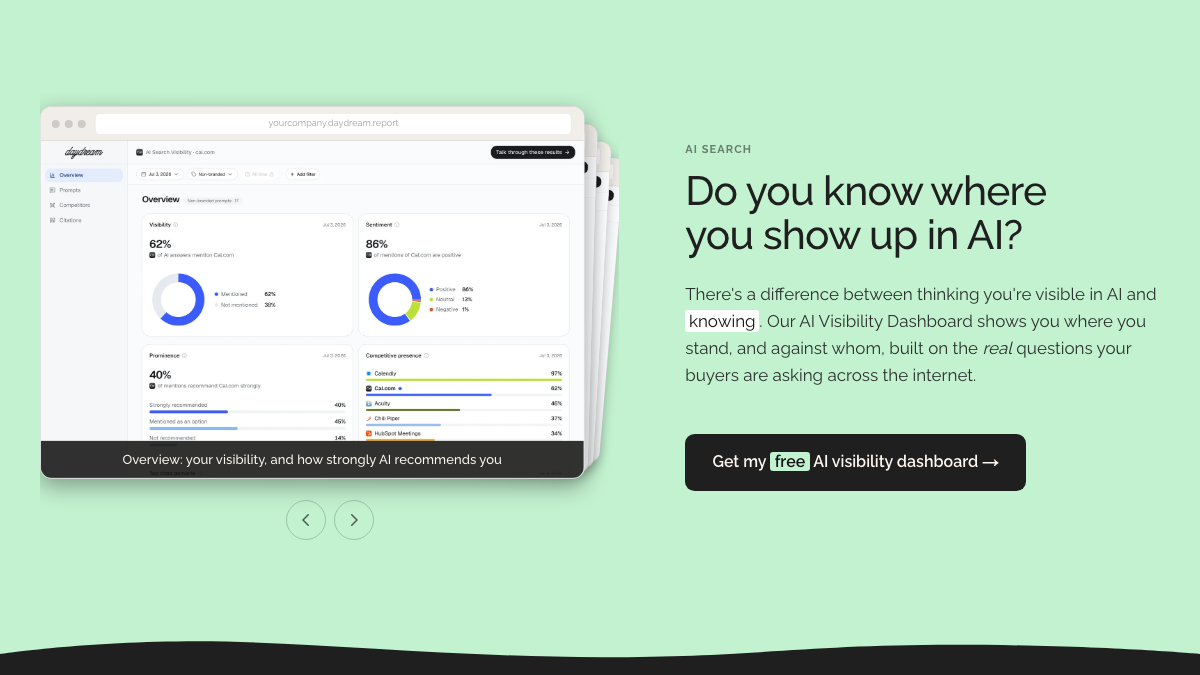
Daydream clients get reporting on a per-company daydream.report address, with tabs for an overview, prompts, competitors and citations. The overview tracks visibility, sentiment, prominence and competitive presence. Daydream doesn't say which AI engines client tracking covers, how many prompts you get or how often they're checked. Its free dashboard for prospects runs buyer prompts through a single assistant, whichever one your audience uses most.
Its public AI Visibility Leaderboard gives a hint. Each edition runs 12 questions per category through five engines, including Claude and Google AI Overviews. Each one is a single dated run rather than a rolling average.
RankControl checks your questions every week on six engines, including Grok and Google AI Mode. Each check shows which competitors got named instead of you and which sources the answer quoted. You get a notification when a new citation appears, and the weekly brief lists what you gained.
Content and scale
Daydream's method runs weekly production cycles, monthly performance reviews and quarterly strategy check-ins across seven areas, from keyword strategy and technical fixes to programmatic pages and authority building. The pages go into each client's own CMS, and Daydream builds the templates and data behind the programmatic ones.
Daydream goes further than we do on scale and custom engineering. Its case studies describe programs of thousands of pages: about 12,000 programmatic pages across 12 languages for OpenArt, more than 2,200 for Piktochart, and 200 a week at one point for Prospect. If your growth plan is a database turned into pages, with a dedicated team to run it, that's the work Daydream is built for.
The content engine in RankControl plans titles from the questions you're losing and writes each article against the pages already ranking for its keyword, across 26 content types. It publishes up to 100 pages a month as native posts through one of nine destinations, with auto-publish off until you turn it on.
Links and authority
Daydream's method lists authority building as ongoing work through "vetted partners," and doesn't describe the process further on its public pages. Its sister product's sub-processor list and terms don't cover the agency's link work either.
Link Control in RankControl finds prospects and contacts for each published article and sends the pitch from your own mailbox once you approve it, with follow-ups that stop when someone replies. Managed Backlinks adds five links a month from DR 25+ sites for $350.

Built by the team that got cited in 48 hours.
Content generation, backlink building, AI visibility tracking, and Google rankings. One platform, zero guesswork.
Sunbeam, the software side
Daydream's company also builds sunbeam, an autonomous SEO agent that launched around May 2026. It spends several hours researching your product and competitors, picks the strategy, and can open pull requests for technical fixes. Its terms also describe "auto-outputs" that execute AI-generated work without manual review, with the customer responsible for the results. For now it's in private beta by demo, works with Webflow only, and has no public pricing.
Sunbeam's terms are public, unlike the agency's. They say fees are non-refundable and that you must cancel at least 24 hours before renewal. The company may also delete your content on termination, so you should keep your own copies. RankControl is self-serve today, publishes to nine destinations, and keeps every article in your CMS.
Reporting and proof
Daydream reports through its dashboard, which has a button on each view to talk the results through with your team. It also reports through the monthly and quarterly reviews in its method. Its case studies lean on Google data. Lighthouse published 92 pages in four months: 48 editorial articles and 44 programmatic pages. The results are shown as search traffic and rankings. The Final Round AI study mentions AI visibility tracking for May 2025, but it doesn't name the engines.
RankControl doesn't wait for a review meeting. The dashboard shows citations, share of voice and each article's progress. A weekly email sums up new citations, ranking moves and visits from AI answers. Its analytics log AI crawler visits on your own domain and sync Search Console daily. Google and Bing positions are tracked for each published page, so you can see a new article move before any AI engine quotes it.
Working from Claude
Daydream doesn't document an API or MCP server for clients, and its reporting lives in the daydream.report dashboard. RankControl's MCP server has 80+ tools covering tracking, planning, writing and publishing, and publishing through it stays a dry run until you confirm. You can ask Claude which questions you lost this week and have it plan the articles.
Contracts and cancelling
Daydream doesn't publish the terms of its agency contract, so the term, notice period and refund policy are whatever you sign.
Its method page makes the case for staying: "The longer we work together, the better results we get because authority compounds." That's true of most SEO work, and it's also why the exit terms deserve a close read before you sign. Its privacy policy covers website visitors rather than client work. Because the pages live in your CMS, they stay when you leave, but ask in writing for the templates, data and prompt history behind them before your last month.
RankControl has no contract beyond the monthly or yearly cycle you pick. Cancelling takes effect at the end of the billing period, with no pro-rated refunds, and your articles stay in your CMS.
RankControl vs Daydream: which wins AI search visibility?
For AI search visibility, RankControl wins for most teams because it puts the whole loop within reach. It publishes up to 100 pages a month on your own site and pitches the sites AI engines already cite from your mailbox. Every week it shows which answers named you across six engines, all for $400 a month.
Daydream's retainer buys a team and custom programmatic work at a scale few companies need. But the page count, the outreach and the weekly readout are what move AI answers, and they don't have to cost five figures a month.
You can run that loop by hand, or RankControl's agents can run it for you, starting with a 7-day free trial. Before you decide, the free AI visibility check shows who ChatGPT cites for three questions from your market today.
See your first AI citation report in under 5 minutes.
No setup calls. No onboarding meetings. Connect your domain and see where AI mentions your brand right now.