
Daydream is an SEO agency, so a switch from Daydream works differently from leaving a software tool. The pages it published already sit on your own site. What you need to protect is everything that lives on Daydream's side: the strategy, the keyword data, the templates behind any programmatic pages, and the history of your AI visibility.
Daydream is run by daydream Labs in San Francisco. Each client gets a human Growth Lead who directs AI agents doing the keyword work, writing and technical fixes. It raised a $15 million Series A in April 2026 and lists clients such as OpenArt, Piktochart and Twingate on its case study pages.
This guide covers what stays, what to ask for before your last month, how to read your contract, and where the work lands in RankControl. I read Daydream's site, its privacy policy and the terms for its sunbeam product on September 26, 2026.
Why teams look past Daydream
Price is the first reason, and Daydream doesn't publish one. Its pricing link opens a "Get started" form, and the form asks what you spend on SEO each month, with brackets from under $10,000 up to $20,000 and above. It also asks about your latest funding round, which tells you who the service is built for.
The second reason is pace. Daydream's method page describes weekly production cycles, monthly performance reviews and quarterly strategy check-ins, all run through your Growth Lead. That suits a team that wants to hand SEO off completely. It frustrates a team that wants to ship pages when a question comes up. Our RankControl vs Daydream comparison sets the two models side by side.
The third is proof. A marketer in r/AskMarketing wrote in September that they'd paid an agency promising AI search visibility for six months, still didn't show up in ChatGPT or Perplexity, and felt the work was ordinary blog posts relabelled for AI. That wasn't a Daydream client, but it's the question every AI search agency gets asked eventually.
Anyone found a good GEO agency after a bad experience?
Hired an agency last year that promised LLM visibility alongside traditional SEO. Six months in, our content wasn't showing up in ChatGPT or Perplexity at all, and organic traffic barely moved. Felt like they were just doing basic blog post...
200+ SaaS teams already track their AI citations.
They know exactly when ChatGPT mentions their brand, and when it stops. Do you?
What stays on your site when you switch from Daydream
Every Daydream case study shows the work living on the client's own domain. Lighthouse's immigration lawyer pages sit under its own URL paths, Piktochart's colour pages live in its own tips section, and OpenArt's programmatic pages sit in its own theme library. The pages went into each client's own site, and none of the case studies mention Daydream hosting anything.
So cancelling doesn't take pages down. Unless someone removes them, every article and landing page stays live, keeps its rankings and keeps whatever links it has earned. That's the good news, and it's why this switch is mostly about the material that never reached your CMS.
The orphan set
Programmatic pages need more care than articles. Daydream builds them from templates, prompts and datasets, and some pull live data by API. Prospect's case study describes automatic API calls that kept company data current on each page. When the agency leaves, that machinery leaves too.
I call what's left the orphan set: pages that are still live and indexed, with nobody feeding them. A page listing which streaming service carries a show, or a company's current details, goes stale quietly. Before your last month, sort your programmatic pages into three piles. Keep and maintain the ones that earn traffic, freeze the evergreen ones, and plan to merge or retire the thin ones.
How to export your data from Daydream
Daydream has no help center, API or published export feature, and no page on its site describes one. So a Daydream export is a written request to your Growth Lead, sent while the relationship is still friendly.
| What | Where it lives | How to get it |
|---|---|---|
| Published pages | Your CMS | Already yours |
| Keyword strategy and roadmap | Daydream's strategy documents | Ask for the latest version |
| Keyword research data | Daydream's strategy audits | Ask for the spreadsheets |
| Programmatic templates and data | Daydream's generator | Ask for templates, prompts and source datasets |
| AI visibility prompts and results | Your company's daydream.report dashboard | Ask for the prompt list and monthly results |
| Monthly performance reports | Shared docs or Slack | Save copies |
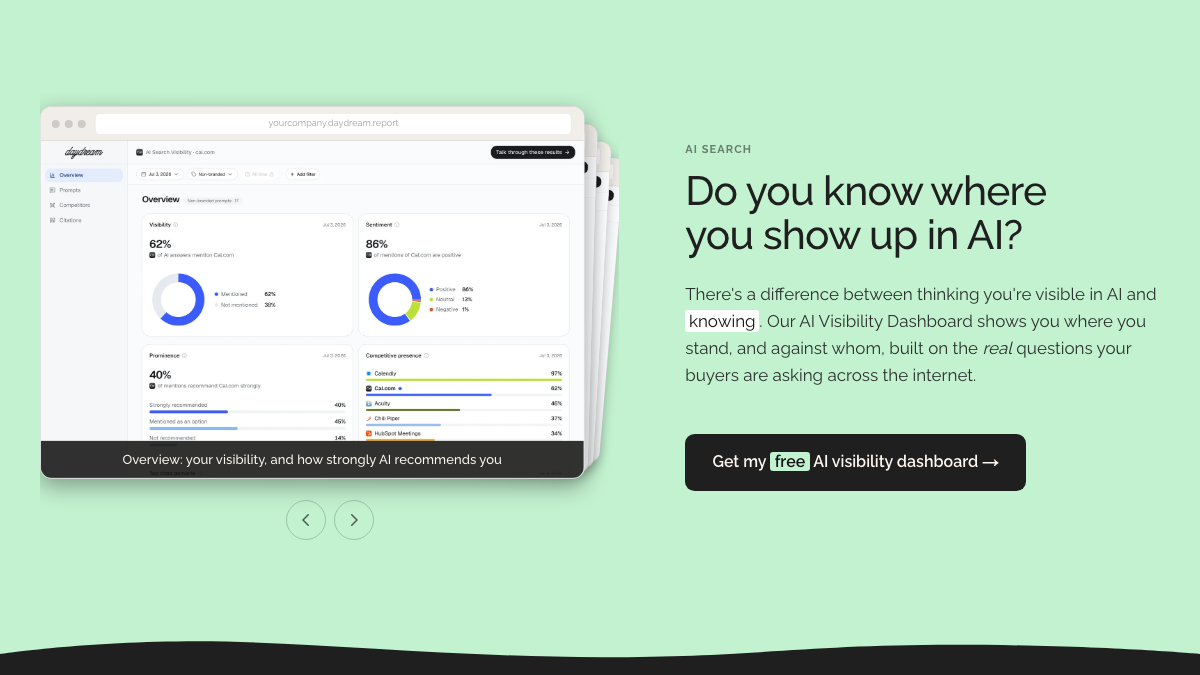
The dashboard deserves the most attention. Client reports live on a per-company daydream.report address with tabs for prompts, competitors and citations. Screenshot each tab, and ask which AI assistants your prompts were checked on and how often. Daydream's public leaderboard checks five engines, including ChatGPT, Perplexity and Google AI Overviews, but the site doesn't say what client tracking covers.
Ask one more question in writing: who owns the templates and prompts that generated your pages. Daydream's case studies say it provided the technical platform behind OpenArt's programmatic program, so the answer sits in your agreement rather than on its website.
Contract, notice and refunds
Daydream doesn't publish terms, a master services agreement or a refund policy for its agency work. Its only public legal page is a privacy policy, and that covers website visitors rather than client data. Your signed agreement is the reference for the term, the notice period and what happens to work in progress.
If your team uses sunbeam, the autonomous SEO agent Daydream launched in May 2026, public terms do apply. They say fees are non-refundable except as required by law, and that you must cancel at least 24 hours before renewal. Section 9 says the company may delete any content tied to your account on termination.
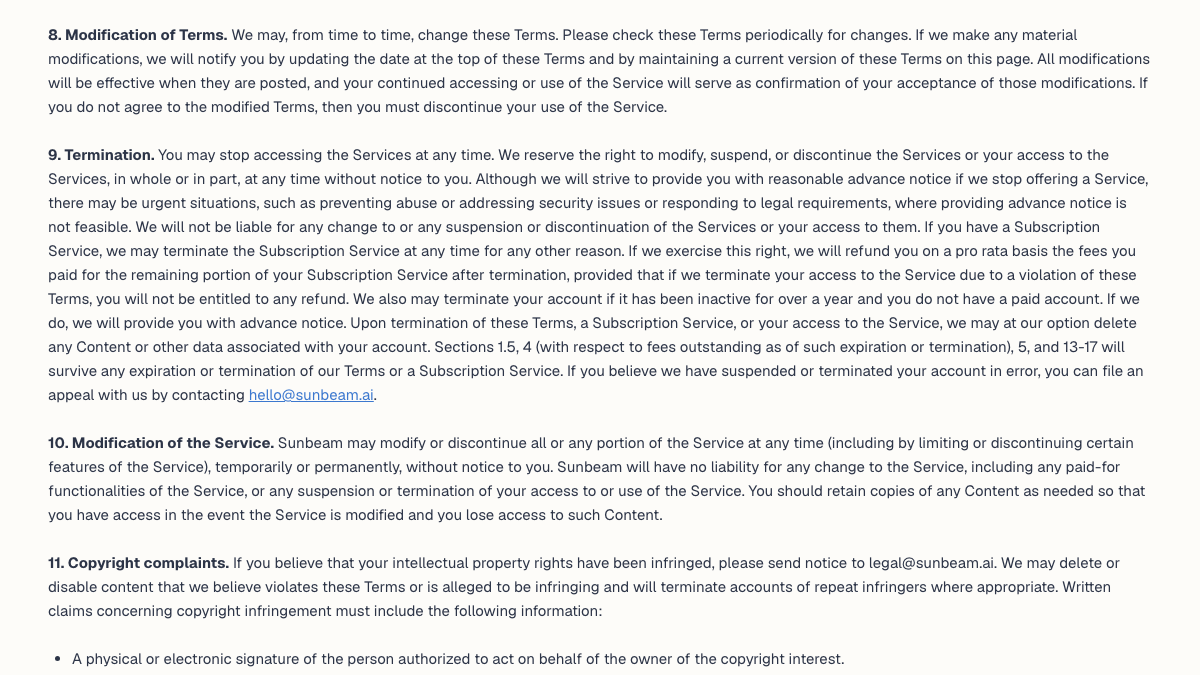
Section 10 is blunter: "You should retain copies of any Content as needed so that you have access in the event the Service is modified and you lose access to such Content." It's good advice for the agency relationship too.
Take back access
An agency ends up with keys to a lot of your stack. In your CMS, revoke any app connection Daydream set up and delete the API tokens you created for it. Remove Daydream's users from Search Console and Google Analytics, and delete any verification file, meta tag or DNS record it added to prove ownership.
If you used sunbeam, uninstall its GitHub app, since it opens pull requests for technical fixes. Close any Slack Connect channel and remove shared Notion pages. The r/SEO crowd gives the same order for any vendor exit. Change shared passwords and remove the vendor from your analytics accounts first, then announce the change.
Keep your AI visibility baseline
Carry your prompts over word for word, not the scores. Different tools ask the engines in different ways, so a visibility percentage from one won't match another's. Run the same prompts on the new tool for four weekly checks before you publish anything new.
One reply in that r/AskMarketing thread put it well: ask for a logged-out, fresh-session citation check before and after, because anything else isn't measuring what's being sold. RankControl checks each tracked question weekly on six engines, including Google AI Mode, and records which sources each answer quoted.
Where things land in RankControl
Some teams leaving an agency skip the next agency entirely. Claudio Fuentes, a co-founder of Comp AI, posted in July that the company fired its SEO agency and its ads agency on the same day to test whether AI could run both jobs better.
We fired our SEO agency and our ads agency on the same day. Conventional wisdom says outsource everything thats not your core (the Bezos "does it make your beer taste better" thing). The model already has basically all of humankind's knowledge compressed into it. Wouldnt it https://t.co/e1aq2lz5fw
 Claudio Fuentes@claud_fuenJul 9, 2026

RankControl has no import tool, so your Daydream material becomes the starting point while your pages stay put.
| From Daydream | Into RankControl |
|---|---|
| Published articles and pages | Stay in your CMS as internal link targets |
| Keyword strategy | Reference while the planner builds your calendar |
| Tracked AI prompts | Up to 50 tracked questions, checked weekly on six engines |
| Competitors | Up to 10 in your share of voice |
| Growth Lead | Your team, or RankControl's Dedicated Strategist add-on |
The content engine plans titles from the questions you're losing, writes each article against the pages already ranking for it and publishes native posts through one of nine destinations, including Webflow and Framer, with auto-publish off by default. AI visibility tracking shows who got cited instead of you, and Link Control sends outreach from your own mailbox after you approve it.
If you want a person in the loop, the Dedicated Strategist add-on is $1,500 a month on top of the $400 plan. Managed Backlinks adds five links a month from DR 25+ sites for $350.
How often does ChatGPT mention your brand?
Most founders have no idea. The answer might surprise you.

The switch from Daydream, step by step
- Find the notice period in your signed agreement and put the date in your calendar.
- Send your Growth Lead a written request for strategy, keyword data, templates and prompt history.
- Screenshot every tab of your daydream.report dashboard.
- Sort your programmatic pages into keep, freeze and retire.
- Start the RankControl trial, connect your CMS and add up to 50 tracked questions.
- Revoke CMS, Google, GitHub and Slack access once the handover is done.
Getting the documents out is the quick part. The slower work is publishing pages that answer your buyers' questions and getting other sites to mention them. You can run that yourself after the switch, or RankControl's agents can run it every month for $400, with a 7-day free trial. Before you start, the free AI visibility check shows who ChatGPT cites for three questions from your market.
15 hours a week manually. Or 15 minutes with RankControl.
Track citations, monitor competitors, and fix content gaps across every AI search engine. Automatically.