
In September, someone at a B2B software services company asked r/SEO whether anyone had traced a real lead back to ChatGPT or Perplexity. Not a mention count or a visibility score, but a person who got in touch and said an AI answer sent them. Their own attribution was too messy to tell.
Has anyone traced a real B2B lead back to ChatGPT or Perplexity recommending them?
There are a lot of tools now that promise to track how often AI assistants mention your brand. I work at a B2B software services company and we’ve been trying to understand whether visibility in AI search actually turns into leads. Our attr...
Several people said yes, through analytics tags and by asking leads directly. One reply added the detail that matters most here. Most people who get a name from an AI answer never click it. They search for the brand a day later, so the evidence turns up in Google.
That's the core problem with comparing ChatGPT search and Google search. They don't just differ in size. They leave different trails. This guide covers what each one lets you measure and why the numbers look so different. It then covers the signal that falls between them and a monthly scorecard for both. Sources were checked on September 27, 2026.
What you can measure on each
Google gives you a first-party report. ChatGPT mostly doesn't, so you build the view yourself:
| What you want to know | Google Search | ChatGPT search |
|---|---|---|
| Where you appear | Search Console queries, impressions and average position | No official report, so you run a fixed list of questions yourself |
| AI answers | Search Console's Generative AI report shows impressions in AI Overviews and AI Mode by page | Whether each tracked answer mentions or cites you |
| Clicks | Search Console clicks by query and page | Visits tagged utm_source=chatgpt.com in analytics |
| Crawling | Googlebot activity in logs and crawl stats | OAI-SearchBot and ChatGPT-User visits in server logs |
| Conversions | Organic search as a source in analytics | chatgpt.com as a source, plus what leads tell you |
The ChatGPT column rests on one detail OpenAI documents in its publisher FAQ:
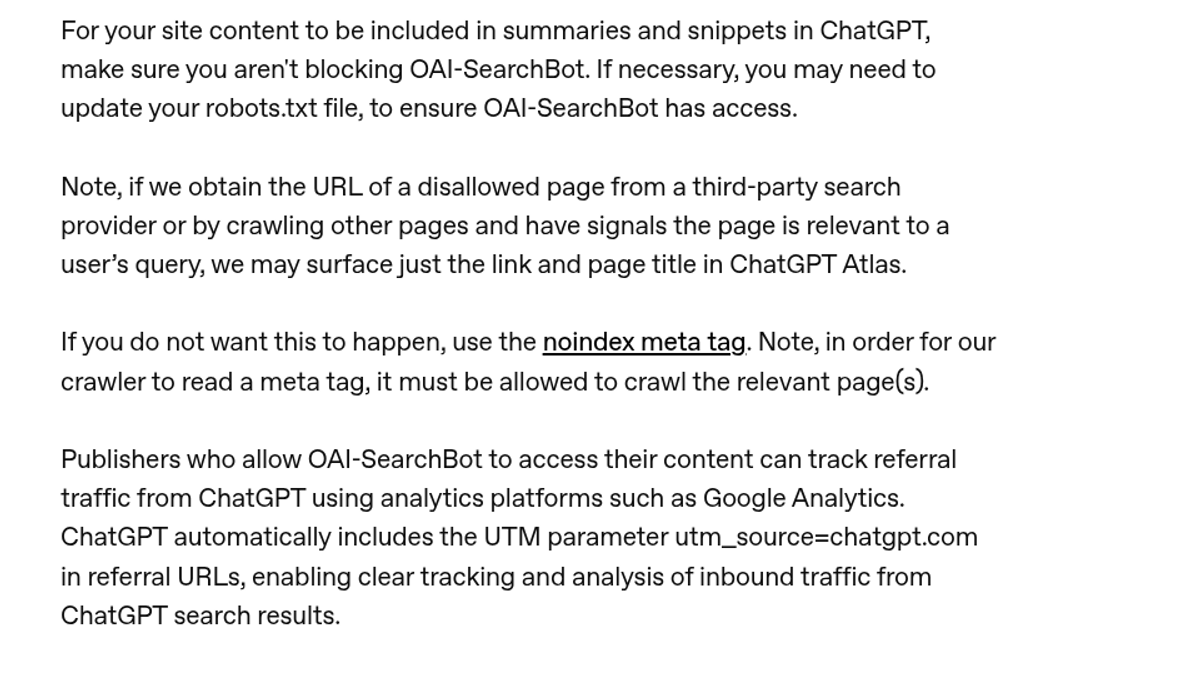
The tag makes ChatGPT clicks easy to find. It doesn't catch everything. In a September r/SaaS thread about tracking ChatGPT visits through to signups, commenters reported that mobile apps can open links in ways that drop the tag. Those visits land in direct traffic. Treat the tagged count as a floor.
You're getting AI traffic. But do you know where it comes from?
RankControl credits every visit to the assistant that sent it: ChatGPT, Perplexity, Claude, Gemini, Copilot, or Grok. Full source attribution, next to your Google traffic.
Why the numbers look so different
Start with scale. Google said in early 2025 that it handles more than 5 trillion searches a year, around 13.7 billion a day. OpenAI's latest public figure is 2.5 billion ChatGPT messages a day, from July 2025, and only about a quarter of messages seek information. Our AI search adoption statistics put those figures side by side.
Referral traffic follows the same pattern. Demandbase data released in August showed ChatGPT sending about 2.6 million visits a month to B2B websites in its network in June 2026. That was up from roughly 645,000 a year earlier, across more than 11 billion visits it analyzed. Referrals from Perplexity fell over the same period, while Gemini and Claude stayed flat.
So ChatGPT traffic is growing fast from a small base. That makes raw traffic a poor way to compare the two. By that measure Google wins every time, and ChatGPT's influence on B2B shortlists goes uncounted.
The two also disagree about which pages matter. When we checked 76 pages cited in answers to buying questions from OpenAI's API with web search in September, only 13 ranked in Google's US top 20 for a keyword version of the same question. Our look at whether ChatGPT search uses Bing explains why the sources differ. A strong Google report tells you little about ChatGPT, and the reverse.
What to measure on Google
Keep the core Search Console metrics: impressions, clicks and average position for the queries that matter to pipeline. Then add two newer views.
The Generative AI performance report, available to all sites since August 31, shows how often your pages appear in AI Overviews and AI Mode. It counts impressions only, with no queries or clicks.
The branded queries filter splits your performance data into branded and non-branded searches. Google introduced it in November 2025 and extended it to all eligible sites on March 11, 2026. Sites with low impressions may not see it yet. That filter matters more for ChatGPT than it looks, for reasons covered below.
What to measure on ChatGPT
With no official report, you measure ChatGPT from four angles.
- Answers. Track a fixed list of buyer questions and record whether each answer mentions your brand, cites your pages or both, and which competitors it names. Our guide to AI citation tracking covers building the list and reading changes.
- Referral visits and conversions. Set up a channel in analytics for utm_source=chatgpt.com and chatgpt.com referrals, and follow those visits through to signups and demo requests. Our GA4 guide to tracking AI referrals walks through the setup.
- Crawler access. Check server logs for OAI-SearchBot and ChatGPT-User. If OAI-SearchBot never shows up, your pages may not be in ChatGPT's search results at all.
- Self-reported attribution. Ask how people found you, in a free-text field. A dropdown without a ChatGPT option hides every one of these answers.
Run the answer checks the same way every time. Use the same questions and the same account settings, and run each question more than once, since answers vary between runs. When OpenAI changes its default model, note the date. A shift in your mention rate that week may come from the model, not your content.
We'll show you exactly where your brand stands in AI search.
No commitment. $0 due today, cancel anytime. See how ChatGPT, Perplexity, Claude, Gemini, Grok, Google AI Mode, and Google AI Overviews talk about your brand today.
The silent referral
The reply in that r/SEO thread described something most dashboards miss. A buyer asks ChatGPT for options and sees your name. They don't click. Days later they search your brand on Google and arrive as branded organic traffic.
We call this the silent referral: a visit that an AI answer caused but analytics credits to Google. It's why ChatGPT's impact often shows up in Google's numbers.
You can't see individual silent referrals, but you can see the pattern:
- Watch branded impressions and clicks in Search Console with the branded queries filter, month by month.
- Mark the months when your brand started appearing in more tracked ChatGPT answers.
- Check the free-text answers on your forms for ChatGPT, AI or "asked an assistant."
If branded searches rise after your mention rate rises, and leads start naming ChatGPT, that's evidence even without a single tagged click. It isn't proof on its own. Launches, press and campaigns also lift branded search, so note those in the same timeline. Our comparison of ChatGPT citations and AI referral traffic looks at how few mentions come with a clickable link.
A monthly scorecard for both
One page, reviewed monthly, keeps the two channels in proportion:
| Metric | Source | What it tells you |
|---|---|---|
| Non-branded impressions and clicks | Search Console | Whether Google still finds you for category searches |
| Branded impressions and clicks | Search Console, branded filter | Demand for your name, including silent referrals |
| AI Overview and AI Mode impressions by page | Search Console, Generative AI report | Which pages Google's AI features show |
| Mention rate and citation rate on tracked questions | Your question tracking | Whether ChatGPT puts you on the shortlist |
| Competitors named in ChatGPT answers | Your question tracking | Who you're being compared with |
| Tagged ChatGPT visits and conversions | Analytics | The minimum traffic and pipeline ChatGPT sends |
| Leads that mention ChatGPT or AI | Form answers and sales notes | Influence that never produced a click |
Read the rows together. A rising mention rate with flat referral visits is normal. A rising mention rate followed by rising branded search is the pattern to look for.
Give each row an owner. Search Console rows usually sit with SEO, while form answers and sales notes sit with marketing operations or sales. The scorecard only works if every row is pulled on the same day each month, including the ones that are awkward to collect.
Mistakes to avoid
A few habits make the comparison misleading. Judging ChatGPT only by tagged visits undercounts it. Using Google rankings as a stand-in for ChatGPT visibility misses most of what ChatGPT cites. And a jump in ChatGPT visits from a tiny base can look like a trend when it's one busy week, so compare months, not days.
Done by hand, checking 50 questions on seven engines takes about six hours a week, and publishing eight solid articles a month takes 16 to 24 hours more. Those are rough estimates.
RankControl's AI visibility tracking runs your 50 questions every week on seven engines, marks each one as mentioned, cited or both, and records which competitors and sources each engine used. We track your Google and Bing rankings too, so both columns of the scorecard sit in one place. The content engine writes each article against the pages already ranking for its keyword and publishes it on your own domain.
You can build this scorecard yourself from Search Console, your analytics and a question list. Or RankControl's agents can run the weekly checks while your team reads the scorecard and decides what to publish next.
Know exactly what AI says about your competitors.
RankControl's Recon Agent monitors competitor citations across ChatGPT, Perplexity, Claude, Gemini, Grok, Google AI Mode, and Google AI Overviews. See where they show up and you don't.