On September 26 we asked OpenAI's API and Perplexity's API six questions a SaaS buyer might ask, such as the best CRM for a 10-person B2B sales team and the best tool for subscription billing. The answers named at least 78 software vendors between them. Only 19 of those vendors had their own website linked in the answer.
OpenAI's API was the starker case. It named 43 vendors across its six answers and linked to three of their sites. Every other mention happened with no click to record, so the vendors it recommended would see nothing in their analytics.
That's the measurement problem of zero click search in one number. This guide lists what B2B SaaS marketers should track instead, where each number comes from and how often to check it. Sources were checked on September 26, 2026.
Traffic now misses most of your visibility
The share of Google searches that end without a click has climbed fast. In June, SparkToro analyzed Similarweb's clickstream panel and found that 68.01% of US Google searches ended without a click in the first four months of 2026, up from 60.45% in 2024.
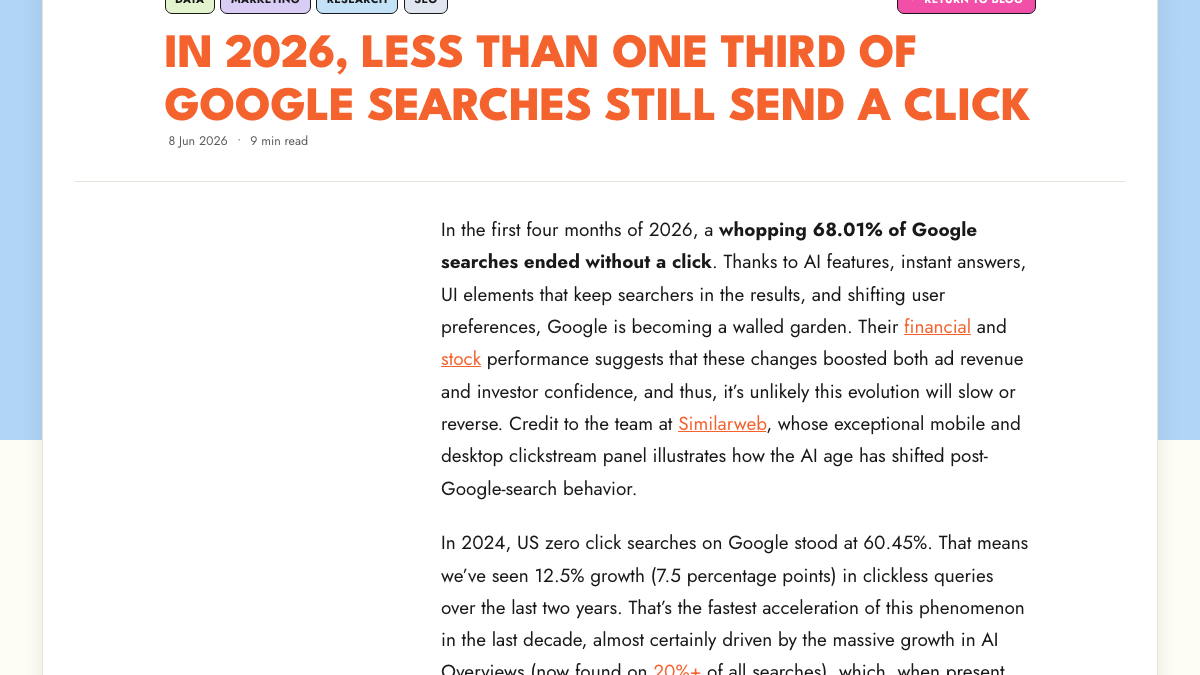
Rand Fishkin called it the fastest rise in the zero-click trend in a decade.
NEW Research: https://t.co/wIrac9r0a3 From Jan-April of this year, 68.01% of Google searches in @Similarweb's mobile+desktop panel ended without a click. That's 12.5% growth from two years ago; the fastest we've seen the zero-click search trend rise in the last decade. https://t.co/hXV6dtG8hl
 Rand Fishkin@randfishJun 9, 2026

AI answers push the same way. In a 2025 Pew Research Center study, people clicked a traditional result on 8% of visits to a Google results page with an AI summary, against 15% without one. And as our test showed, an AI assistant can recommend your product by name without linking to you at all.
So organic sessions still matter, but they now measure a shrinking slice of the moments when buyers meet your brand. Reporting on traffic alone makes a stable brand look like it's losing, and it can hide a real problem just as easily.
The proof chain
We think of zero-click visibility as what we call the proof chain: four layers that run from being seen to being bought, each with its own data source. A drop in one layer means something different from a drop in another, which is why they belong in separate rows:
| Layer | What to track | Where the data comes from | How often |
|---|---|---|---|
| Presence in AI answers | Mentions, citations, share of voice, how you're described | Your own question set on each engine, plus Bing's and Google's webmaster reports | Weekly |
| Search presence | Rankings for commercial and comparison queries, branded impressions | Search Console, rank tracking | Weekly to monthly |
| Visits | AI referrals, branded and direct visits to pricing and demo pages | Google Analytics 4 | Monthly |
| Pipeline | What buyers say about how they found you | Signup and demo forms, sales call notes | Monthly |
The top layer is the one most teams skip, because it isn't in any default dashboard. The bottom layer is the one leadership cares about, and it's the only place you'll hear about a ChatGPT recommendation that never produced a click.
You're getting AI traffic. But do you know where it comes from?
RankControl credits every visit to the assistant that sent it: ChatGPT, Perplexity, Claude, Gemini, Copilot, or Grok. Full source attribution, next to your Google traffic.
Layer one: presence in AI answers
Start with a fixed set of 20 to 50 questions your buyers ask, weighted toward the ones closest to a purchase. Run them on each engine on a regular schedule and record four things for each answer: whether your brand is named, whether one of your pages is cited, which competitors appear and whether the description of your product is accurate.
Keep mentions and citations in separate columns. Our comparison of mention tracking and citation tracking explains why they move independently, and a share of voice figure against named competitors makes the result easier to read, as our piece on share of voice in AI search covers.
Two platforms now give you some first-party data. Bing Webmaster Tools reports which of your pages Copilot and Bing's AI summaries cite, and since June it shows a citation share for each grounding query. Google added generative AI performance reports to Search Console in June 2026, with impressions from AI Overviews and AI Mode by page.
Treat single answers as samples. SparkToro found in January that ChatGPT and Google's AI gave the same list of brands in fewer than 1 in 100 repeated runs, so a week-to-week swing on one question tells you little. The trend across the whole question set is the number worth reporting.
Layer two: search presence
AI answers draw heavily on search results, so the rankings layer still feeds the one above it. Google's own guide to AI features says they're rooted in its core ranking and quality systems.
Track rankings for the commercial and comparison queries that matter to your pipeline, and track branded search impressions in Search Console separately. Branded impressions are one of the few places zero-click visibility shows up later. Research by Similarweb with Rand Fishkin found that most visits following a ChatGPT recommendation came through search rather than a click in the answer, so rising branded impressions can reflect AI mentions you never saw.
If organic clicks fall while positions hold, that's usually answers on the results page taking clicks rather than a ranking loss. Our guide to separating SEO loss from AI search shifts covers that diagnosis.
Layer three: visits you can still count
Some visits do come through, and they're worth counting properly. ChatGPT tags the links it shows with utm_source=chatgpt.com, and visits from Perplexity and other assistants arrive with recognizable referrers, so you can group them into an AI referral channel in Google Analytics 4. Our GA4 guide to AI referral tracking has the setup.
Keep that channel in proportion. One team shared a study of 95 sites on r/SEO_LLM in September, finding that organic search sent 39 times more traffic than AI assistants and that AI referrals converted slightly better, at 7.18% against 6.08%. The top reply made the point that matters for zero click: most AI mentions can't be clicked, so referral traffic undercounts the influence.
A 5% improvement in organic search performance delivers more conversions than doubling AI referral traffic
We ran a study across 95 sites over 1 year and looked at organic traffic and AI referral traffic. A mix of B2B/B2C sites, all businesses. Organic search delivered 39 times more traffic than AI assistants. For every 100 conversions organic s...
Look at where those visits land, too. AI referrals that arrive on pricing, comparison or integration pages usually come from buyers who are further along than the average blog reader, which makes them worth a separate line in the report.
Also remember what's missing. Clicks from AI Overviews and AI Mode land in Google organic, with no separate label, so that channel can't tell you how much Google's AI features send.
Layer four: ask buyers directly
The cheapest fix for zero-click attribution is a question. Add a free-text "How did you hear about us?" field to your demo and signup forms, and ask the same thing on first sales calls. Tag answers that name an AI assistant or mention "AI search."
If your team records sales calls, search the transcripts once a month for the names of AI assistants. Buyers often mention in passing that they asked ChatGPT for a shortlist, and that line rarely makes it into the CRM on its own.
Free text matters. A dropdown with "Search engine" as an option will swallow the buyer who asked ChatGPT for a shortlist and then searched your name, which is exactly the path the zero-click web creates.
This layer is also the easiest one to explain to leadership. When a poster in r/marketing asked how to explain zero-click search to non-marketing stakeholders without sounding defensive, one of the most upvoted replies suggested showing them: open a browser and a chatbot, ask a buyer's question and let them see where the brand appears.
How would you explain Zero-Click searches to a non-marketing stakeholder without sounding defensive?
2026 is all about search answers without visits. Traffic is down, visibility is fragmented, and yet influence still exists in ways dashboards don’t clearly show. Curious how others are explaining this shift to stakeholders who still expect...
We'll show you exactly where your brand stands in AI search.
No commitment. $0 due today, cancel anytime. See how ChatGPT, Perplexity, Claude, Gemini, Grok, Google AI Mode, and Google AI Overviews talk about your brand today.
What to stop reporting
A few numbers do more harm than good now. Organic sessions as the headline KPI will trend down for most B2B sites no matter how well the team performs. An "AI rank" for a single prompt, or a screenshot of one good answer, mostly measures noise, given how much answers vary between runs.
Replace them with a one-page monthly report that covers the four layers:
- Mention and citation rates across your question set, with the change from last month and the competitors ahead of you.
- Rankings and branded impressions for your priority queries.
- AI referral visits and conversions, next to organic.
- The count and wording of self-reported AI mentions from forms and calls.
Our piece on how B2B SaaS can adapt to zero click AI search covers the content side of the same shift.
Keeping it running
Done by hand, checking 50 questions on six engines takes about five hours a week, and publishing eight solid articles a month takes 16 to 24 hours more. Those are rough estimates.
RankControl covers the top two layers. AI visibility tracking runs your 50 questions every week on six engines, marks each one as mentioned, cited or both, and records which competitors and sources each engine used, alongside your Google and Bing rankings. For a quick first read, the free AI visibility checker shows who ChatGPT cites for three questions from your market.
You can build the proof chain yourself with a spreadsheet and a form field. Or RankControl's agents can run the top half every week while your team adds the buyer answers only it can collect.
Know exactly what AI says about your competitors.
RankControl's Recon Agent monitors competitor citations across ChatGPT, Perplexity, Claude, Gemini, Grok, Google AI Mode, and Google AI Overviews. See where they show up and you don't.