
Google is moving Search campaigns into AI Max whether advertisers opt in or not. Campaigns using automatically created assets or the campaign-level broad match setting are being upgraded from September 2026, and Dynamic Search Ads campaigns are scheduled to follow from February 2027.
For B2B teams, that raises an uncomfortable question. In July, a PPC manager posted in r/PPC that they had yet to see AI Max work for B2B software. The Google reps pushing it, they added, had shown no B2B evidence at all.
Anyone ACTUALLY have an any use cases or success stories in using AI Max for B2B SaaS campaigns?
I have yet to see AI Max work well or even be viable to use in for B2B SaaS campaigns. But also, I’m a forward thinker and I know that just running exact match only Search campaigns isn’t very sustainable, and trying to get creative in the...
The replies were mixed. One advertiser in home services reported 30% more leads. Another agency switched AI Max off after a month or two of irrelevant queries. The pattern in between is useful: AI Max works when it learns from the right conversions, and B2B accounts rarely give it those by default.
This checklist covers what to test first, in order, and what to measure. Sources were checked on September 27, 2026.
What AI Max changes
AI Max is a setting on an existing Search campaign, not a new campaign type. Google's help page lists what it adds:
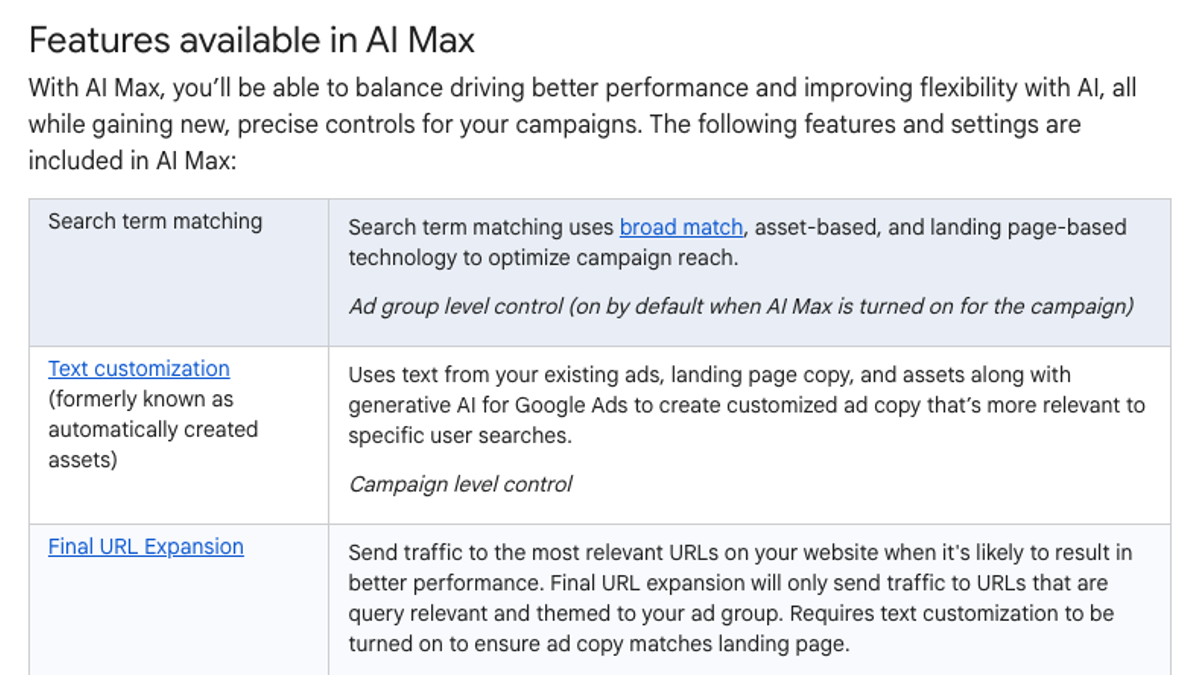
Search term matching expands beyond your keyword list, including queries with no matching keyword at all. Text customization writes ad copy from your existing ads and landing pages. Final URL expansion sends each click to whichever page on your site Google predicts will perform best, and it requires text customization to be on.
New controls came with it. Brand and URL settings work as inclusion and exclusion lists, and locations of interest can be set for each ad group. Google's own figure for the full feature set is 7% more conversions or conversion value at a similar cost per action, compared with search term matching alone. Google announced the move out of beta in April:
AI Max for Search is moving out of beta, and we’re officially announcing the timeline for Dynamic Search Ads (DSA) to transition to AI Max. The transition roadmap: - 𝗦𝘁𝗮𝗿𝘁𝗶𝗻𝗴 𝘁𝗼𝗱𝗮𝘆, we’re rolling out new tools to help you transfer settings and data into new
 AdsLiaison@adsliaisonApr 15, 2026
The Dynamic Search Ads part of that timeline has since moved. In a June update, Google pushed the DSA sunset and auto-upgrade to February 2027. The September date still applies to automatically created assets and campaign-level broad match.
26 content formats. Published on your domain. Matched to your brand.
Guides, comparisons, listicles, case studies, and more. RankControl generates content that gets cited by ChatGPT, Perplexity, Claude, Gemini, Grok, Google AI Mode, and Google AI Overviews.

Why this matters more in the age of AI Overviews
On September 27 we checked Google results in the US for 20 B2B software searches. They ranged from "crm software" to "which help desk software is easiest to set up for a startup," and all 20 showed an AI Overview.
That matters for ads because Google's help page on ads in AI Overviews recommends broad match or AI Max's keywordless matching for that placement. Ads shown inside an AI Overview are reported as top ads, with no separate breakdown, and advertisers can't opt out of or target the placement directly. For B2B buyers who now start many searches with a question, AI Max is the route into that space. It's also why a bad setup gets expensive quickly.
Check 1: Fix the conversion signal first
This is the step that decides everything else. AI Max learns from the conversions you give it. If the campaign optimizes for form fills, it will find more people who fill in forms, and in B2B many of those aren't buyers.
Commenters in the r/PPC thread said the same thing in different ways. One said AI Max only expands responsibly when it's fed deep-funnel conversions imported from the CRM. Another said that without that feedback it optimizes for spammy leads, because those conversions are easier to get.
We call this the lead-quality gate: don't turn AI Max on for a campaign until it bids on qualified leads. In practice that means importing offline conversions from your CRM, such as qualified leads or opportunities. Assign values that reflect how likely each stage is to close, and make the qualified stage the primary conversion.
If your CRM can't send those stages back yet, fix that before testing AI Max. It's the difference between a test that measures pipeline and one that measures form spam.
Check 2: Set the controls before you switch it on
Set brand controls first. If you run a separate brand campaign, decide whether your non-brand campaigns should exclude your own brand name, so AI Max doesn't take credit for searches you'd win anyway. Consider excluding competitor brands if you don't want to bid on them.
Then set URL exclusions. Final URL expansion can send clicks to any page on your domain that it considers relevant. Exclude pages that shouldn't receive paid traffic, such as careers and legal pages, plus old product pages you no longer sell.
Use locations of interest if you sell into specific regions, since keywordless matching can otherwise reach searches you never planned for. Your negative keyword lists still apply, so bring them up to date before the test starts.
Check 3: Test one feature at a time
Google recommends turning on every AI Max feature and testing with its one-click experiments. For B2B, a slower sequence tells you more:
| Test | What to switch on | What to watch |
|---|---|---|
| First | Search term matching only | New search terms, and cost per qualified lead |
| Second | Text customization | Which generated headlines appear, and their conversion rate |
| Third | Final URL expansion | Which landing pages get selected, and lead quality from each |
Run each as an experiment against the current campaign, and keep it running until both arms have enough qualified conversions to compare. At typical B2B volumes, that often takes longer than a few weeks.
One commenter suggested a 14-to-21-day test, but only with offline conversion tracking in place. Another advertiser with a mature consumer software account said AI Max added about 2% more volume, and that most of it probably wasn't incremental because broad match was already running. Measure incrementality against the control, and don't count total conversions alone.

Your competitors are getting cited by AI. You're not.
Every day without citation tracking is a day your competitors pull ahead in ChatGPT, Perplexity, and Claude.
Check 4: Audit the pages AI Max will read
Text customization writes ads from your landing pages, and final URL expansion chooses among them. Your website copy becomes ad copy.
Read your key pages the way the system will. Old pricing or retired features can turn up in generated headlines. When we asked a model with no web access to write posts about help desk software, every draft carried outdated prices. Generated ad text is only as current as the pages it draws from.
Pick the pages you want paid traffic to land on and make sure each one states clearly who it's for and what it costs. The same pages feed AI Overviews and assistants too, so the work pays off twice.
Check 5: Read the new reports every week
AI Max adds reporting that makes the checks above possible. The search terms report shows "AI Max" as a match type, with a source column saying whether a term came from broad match expansion or keywordless matching. A combined view shows each search term with the headline and URL used.
The landing pages report has a "Selected by" column showing which pages AI Max chose. The asset report shows how generated assets perform on spend and conversions.
Each week, add negatives for irrelevant terms and remove generated headlines you wouldn't have written. Add URL exclusions for any landing page that attracts the wrong leads.
What to measure
Here's a simple scorecard for the test:
| Metric | Where it comes from | Why it matters |
|---|---|---|
| Cost per qualified lead or opportunity | CRM, imported into Google Ads | The only number that reflects pipeline |
| Share of AI Max search terms you'd have chosen | Search terms report | Shows whether expansion is relevant |
| Leads by landing page selected | Landing pages report and CRM | Catches pages that attract the wrong buyers |
| Incremental conversions against the control | Experiment results | Separates new demand from reshuffled demand |
If qualified cost rises and relevance falls after a fair test, switch search term matching off at the ad group level and keep the rest under review.
The organic side of the same results page
Every one of the 20 B2B searches we checked showed an AI Overview. Ads can buy a place around those answers. The sources the answer cites are earned, and they come from pages that answer buyers' questions directly. Our comparison of ChatGPT citations and AI referral traffic covers how that visibility turns into visits, and our look at ads inside AI Overviews covers the paid side.
Done by hand, publishing eight solid articles a month takes 16 to 24 hours, and checking 50 questions on seven engines takes about six hours a week. Those are rough estimates.
RankControl's content engine writes each article against the pages already ranking for its keyword and publishes it on your own domain. AI visibility tracking runs your 50 questions every week on seven engines, including Google's AI Mode, and marks each one as mentioned, cited or both.
You can run the organic side with a spreadsheet and your own writers. Or RankControl's agents can keep it running while your team tests AI Max.
200+ SaaS teams already track their AI citations.
They know exactly when ChatGPT mentions their brand, and when it stops. Do you?