
If you've wondered whether "LLM SEO" is its own discipline or ordinary SEO under a new name, plenty of people share the doubt. Google Ads data puts US searches for "llm seo" at about 720 a month, and the Reddit threads on the topic keep circling that same question.
Google says it's SEO. Our own test mostly agrees, but it also turned up two differences you should understand before you pay anyone for either one.
On September 27 we put five questions a B2B software buyer might ask to OpenAI's API, running each twice with web search on and twice with it off. In four of the five, the product named first was the same either way. The search answers, though, named products the model never brought up by itself, and most of those were smaller or newer.
That split is the practical answer to whether LLM SEO is a thing. We'll start with Google's position and our test, then get to what you should do about each part. Every source was checked on September 27, 2026.
What people mean by LLM SEO
Most people use LLM SEO to mean getting your brand named and cited when large language models answer, whether that's ChatGPT, Claude or Perplexity, or Google's AI Overviews and AI Mode. You'll also hear the same work called GEO, AEO or LLMO. The naming differences are mostly cosmetic, and our guide to what these terms mean sorts them out.
What you really want to know is simpler. Does getting into AI answers take different work from ranking in Google?
Google says it's SEO
Google hasn't been shy about its position. In June, Google's Brendon Kraham published a piece arguing that good SEO is good GEO, and Glenn Gabe pulled out its main points.
New from Google's Brendon Kraham -> Good SEO is good GEO "Our new generative AI features are rooted in the same core ranking and quality systems as traditional Search. And, because these AI experiences retrieve up-to-date content from the existing search index, the best formula https://t.co/zyFirDzsEX
 Glenn Gabe@glenngabeJun 22, 2026

Google's May 2026 guide to optimizing for its generative AI features goes a step further, with a whole section on things you don't need to do.
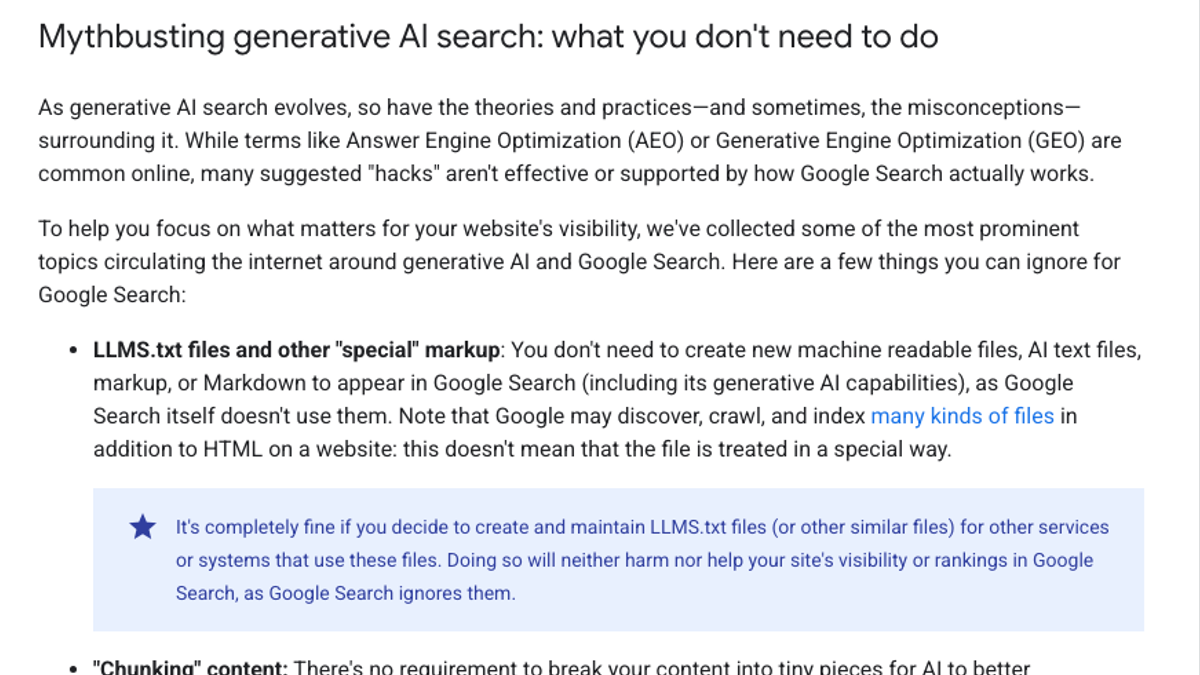
The full list also tells you there's no need to rewrite content just for AI or to chase inauthentic mentions. For Google's own AI features, that ends the debate. They pull pages from Google's index with its core ranking systems, so the work you do there is SEO.
We'll show you exactly where your brand stands in AI search.
No commitment. $0 due today, cancel anytime. See how ChatGPT, Perplexity, Claude, Gemini, Grok, Google AI Mode, and Google AI Overviews talk about your brand today.
Where the other engines differ
Once you leave Google, the picture changes, because ChatGPT, Claude and Perplexity aren't Google. Two things set them apart, and our test caught both.
The first is memory. A model can answer a buying question from what it absorbed in training without running a search at all, and you can see that in how the answers compared.
| Question | Named first, search on | Named first, search off | Named only when searching |
|---|---|---|---|
| Best CRM for a 10-person B2B sales team | Pipedrive | HubSpot | Salesflare, Nutshell |
| Best tools for SaaS subscription billing | Stripe | Stripe | Orb, Lago, Metronome and two others |
| Product analytics tool for a B2B SaaS company | Amplitude | Amplitude | Userpilot, Glassbox |
| Best email marketing software for B2B | HubSpot | HubSpot | Brevo, MailerLite, Klaviyo and four others |
| Best project management tool for a remote software team | Linear | Linear | Asana, Wrike, monday.com and five others |
Our name for what the model says before it searches is the memory layer, and in our test it decided the top of the list. Across the five questions, 33 of the 51 products named without search showed up again with search on, and the leader matched in four questions out of five.
Search mostly made the list longer. The products that only appeared with search tended to be newer or smaller, like the usage-based billing tools Orb, Lago and Metronome. If your company isn't the category leader, retrieval is most likely your way into the answer.
You can watch that happen in the CRM question. Both answers with search cited a comparison of Salesforce, Zoho, HubSpot and Pipedrive that Salesflare published on its own blog, and both named Salesflare, which never came up without search. Third-party pages counted as well, and a G2 page was cited for four of the five questions.
The second difference is which pages get pulled in. In a separate study, we compared AI citations with Google rankings for 12 B2B questions. Of the pages Google's AI Overviews cited, 40% ranked in Google's top 10. OpenAI's API cited 23 pages, and not one of them ranked in Google's top 20. A strong Google ranking gets you into Google's AI features, but it's no promise that ChatGPT will use the same pages.
What doesn't change
Most of your day-to-day work will look familiar. Any engine that searches needs pages that answer the question directly, and it can only use pages that are crawlable and indexed.
So write pages for the questions your buyers actually ask, including the comparison and pricing questions that come up close to a purchase. Then check that AI crawlers can get to them. OpenAI's search crawler, OAI-SearchBot, needs access, as does Perplexity's PerplexityBot, and a firewall or CDN setting can block either one without anyone noticing. Keep your facts current too, because engines searching the live web go for pages with up-to-date prices and plan details.
None of this calls for a new discipline. If your SEO team already works this way, the only change is a longer list of questions to cover.
What is different
SEO can't reach the memory layer directly. What a model knows about your category reflects what was widely written about it before training, and that builds up over time from mentions on sites your buyers read, from review profiles and comparisons, and from community discussions. You can't change it quickly, and Google warns that inauthentic mentions don't help. Our comparison of brand mentions and backlinks explains how a mention differs from a link.
Retrieval outside Google is the second difference. ChatGPT and Perplexity run their own searches and often land on different pages, so Bing matters more for you than it does in Google-only SEO. Submit your sitemap in Bing Webmaster Tools and look at its AI performance report.
The third difference is measurement. AI answers change from run to run, and no engine publishes query volumes, so track how often you're named and cited across a fixed set of questions instead of reading much into any single answer. Our piece on whether AI visibility is worth tracking covers which numbers hold still.
Know exactly what AI says about your competitors.
RankControl's Recon Agent monitors competitor citations across ChatGPT, Perplexity, Claude, Gemini, Grok, Google AI Mode, and Google AI Overviews. See where they show up and you don't.

A practical plan for B2B SaaS teams
Begin by checking both layers in your category. Take five to ten buyer questions and ask them in an AI assistant with web search off, then ask again with it on, noting whether you're named each time.
Not every assistant lets you turn search off, and some decide for themselves when to search. The cleanest view of the memory layer comes from an API call with search disabled, and asking each question twice shows you how much of the answer stays put.
If you're missing from both, start with retrieval. Publish pages that answer those questions, get them indexed in Google and Bing, and earn a spot on the comparison and review pages the engines cite.
Showing up only when the model searches is a good sign, so keep at it. Your pages are working, and the memory layer tends to catch up as more sites write about you.
Being named in both means you have a position to protect. Keep your pricing and comparison pages current, and keep an eye out for competitors turning up in the answers.
Whatever you find, skip the hacks. Google's list above already covers the common ones, from llms.txt files to chunking.
Do you need an LLM SEO specialist?
Agencies haven't agreed on how to sell this. Back in January, someone on r/SEO asked whether other agencies package AI visibility as part of SEO or offer it as a separate service.
Do you treat LLM ranking as part of SEO, or as its own service?
With AI Overviews, ChatGPT, and similar LLM's becoming more visible, I’m curious how others are packaging this. Are you including AI ranking / AI visibility inside your regular SEO packages, or offering it as a completely separate service f...
The top reply said you can't pull the two apart while AI answers depend on search engines. Another commenter kept it inside the SEO package but ran it as its own workstream, because AI visibility leans harder on signals from outside your site, such as mentions, reviews and consistent brand information.
Our test backs that second view. If you're hiring, ask what the specialist would do that your SEO team wouldn't. Earning mentions and improving buyer pages are useful work, and so is tracking across engines. A pitch built on llms.txt files and special schema, on the other hand, is selling you things Google has said you don't need. We go deeper in our look at whether GEO agencies are worth it.
By hand, publishing eight solid articles a month takes 16 to 24 hours. Checking 50 questions on seven engines adds about six hours a week, and both figures are rough estimates.
RankControl covers the tracking and the pages. Each week, AI visibility tracking runs your 50 questions on seven engines and marks each one as mentioned, cited or both. Our tracking also records which competitors and sources each engine used. The content engine writes each article against the pages already ranking for its keyword, then publishes it on your own domain.
You can run the two-layer check yourself with an AI assistant and a spreadsheet. Or RankControl's agents can run the tracking every week while your team puts its time into the pages and mentions that move the numbers.
26 content formats. Published on your domain. Matched to your brand.
Guides, comparisons, listicles, case studies, and more. RankControl generates content that gets cited by ChatGPT, Perplexity, Claude, Gemini, Grok, Google AI Mode, and Google AI Overviews.