
Yes, good SEO helps with answer engine optimization. How much it helps depends on which AI engine you're talking about, and on which search engine your SEO is aimed at.
On September 26 we checked that directly. We took 12 B2B software questions, collected the pages cited by Google's AI Overviews and by the APIs behind Perplexity and ChatGPT, and checked how many of those pages ranked in Google's top 10 for the same question. For AI Overviews it was 40%, and for Perplexity 20%. None of the 23 pages OpenAI's API cited ranked in Google's top 20.
So good SEO is the entry ticket for Google's AI features and a partial help on Perplexity. For ChatGPT, Google rankings barely register. This guide explains why, and what to add on top. Sources were checked on September 26, 2026.
What Google says
Google's answer is an unambiguous yes. In June, Google's Brendon Kraham published a piece titled "Good SEO is good GEO," saying its AI features are rooted in the same core ranking and quality systems as traditional search and retrieve content from the existing search index.
New from Google's Brendon Kraham -> Good SEO is good GEO "Our new generative AI features are rooted in the same core ranking and quality systems as traditional Search. And, because these AI experiences retrieve up-to-date content from the existing search index, the best formula https://t.co/zyFirDzsEX
 Glenn Gabe@glenngabeJun 22, 2026

Google's own guide to AI features, published in May, makes the same point from the other direction. It names AEO and GEO, then says that from Google's perspective optimizing for AI search is still SEO, and it lists "hacks" like chunking content into tiny pieces as unnecessary.
Kraham's piece also warned that chasing inauthentic mentions isn't as helpful as it might seem, which rules out the shortcut of seeding your brand name across forums and directories.
That's true for Google's surfaces. It's only part of the answer for engines that don't search Google's index.
What our ranking check found
Here's the full result from the September 26 check. We used 12 questions about SOC 2 compliance and common B2B software categories, and compared each engine's cited pages with Google's top 10 and top 20 organic results for the same question:
| Engine | Pages cited | In Google's top 10 | In Google's top 20 |
|---|---|---|---|
| Google AI Overviews (7 questions that showed one) | 50 | 40% | 52% |
| Perplexity's API (12 questions) | 111 | 20% | 23% |
| OpenAI's API with web search (12 questions) | 23 | 0% | 0% |
The overviews also leaned on community threads. Reddit appeared in five of the seven, and the overview for SaaS billing tools cited three Reddit threads and a Hacker News discussion alongside three vendor pages. Those threads sit outside anything a vendor's own SEO controls.
It's a small sample, but the AI Overview figure lines up closely with the largest study on this. In March, Ahrefs analyzed 863,000 keyword results and 4 million AI Overview citations and found that 37.9% of cited URLs ranked in the top 10 for the same query.
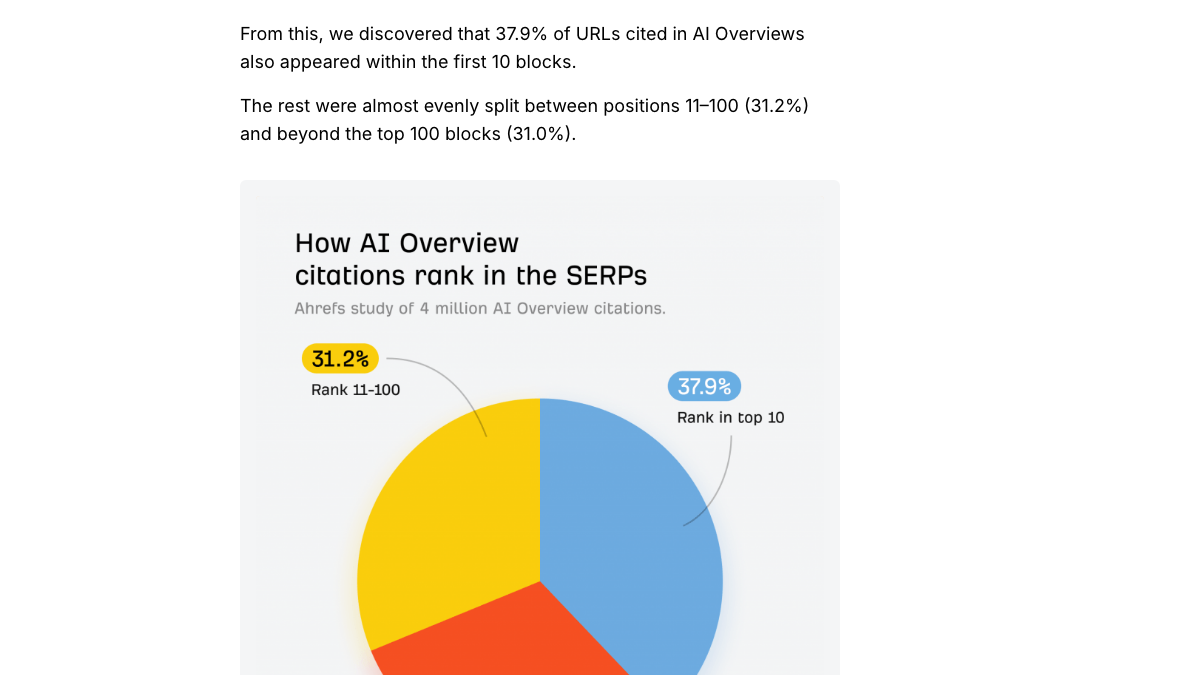
A year earlier the same kind of study found 76%. Ahrefs noted that Gemini 3 took over AI Overviews in January 2026 to better answer long-tail questions, which fits a wider pool of cited pages. So even on Google, ranking in the top 10 now accounts for well under half of the citations.
For the other engines, an earlier Ahrefs study of 15,000 prompts found that only 12% of links cited by ChatGPT, Gemini and Copilot appeared in Google's top 10. Our OpenAI result sits at the low end of that range.
26 content formats. Published on your domain. Matched to your brand.
Guides, comparisons, listicles, case studies, and more. RankControl generates content that gets cited by ChatGPT, Perplexity, Claude, Gemini, Grok, Google AI Mode, and Google AI Overviews.

The index map
The reason the numbers differ is simple once you see it. Each AI engine searches a particular index, and "good SEO" only helps directly where your pages rank in that index. We call this the index map:
| Engine | Where it searches | How closely citations track that index |
|---|---|---|
| Google's AI Overviews and AI Mode | Google's index | Moderately: 38% of AI Overview citations rank in the top 10 |
| ChatGPT | OpenAI's own index, alongside Bing | Loosely: none of its cited pages ranked in Google's top 20 in our check |
| Claude | Brave Search | Tightly: about 79% of cited URLs sit in Brave's top 10 in two 2026 studies |
| Perplexity | Its own index | Partly: 20% of cited pages ranked in Google's top 10 in our check |
ChatGPT's link to Bing used to be much tighter. An agency analysis from January 2025 found 87% of ChatGPT search citations matched Bing's top organic results, and that coupling has loosened as OpenAI built out an index of its own.
The practical upshot is that "good SEO" for AI search covers more than Google. Check whether your key pages are indexed and ranking in Bing, which Microsoft's Copilot uses and ChatGPT has leaned on, and in Brave, which feeds Claude. Few teams look at either, and both have free webmaster tools or simple site searches you can run in an afternoon.
What good SEO already gives you
A lot of the AEO checklist is SEO work you may already be doing. Cyrus Shepard made the case in August that a set of tweaked SEO strategies drives most AI visibility, and that the useful question is where the two overlap.
New: These SEO Strategies Drive 90% of Your AI Visibility Asking if GEO/SEO are the same isn't the right question, it's seeing where they overlap. If you tweak traditional SEO, you can use the same strategies+tactics for • AI Inclusion • AI Citations • AI Recommendations 1/2 https://t.co/pek8LJKJ5A
 Cyrus SEO@CyrusShepardAug 4, 2026
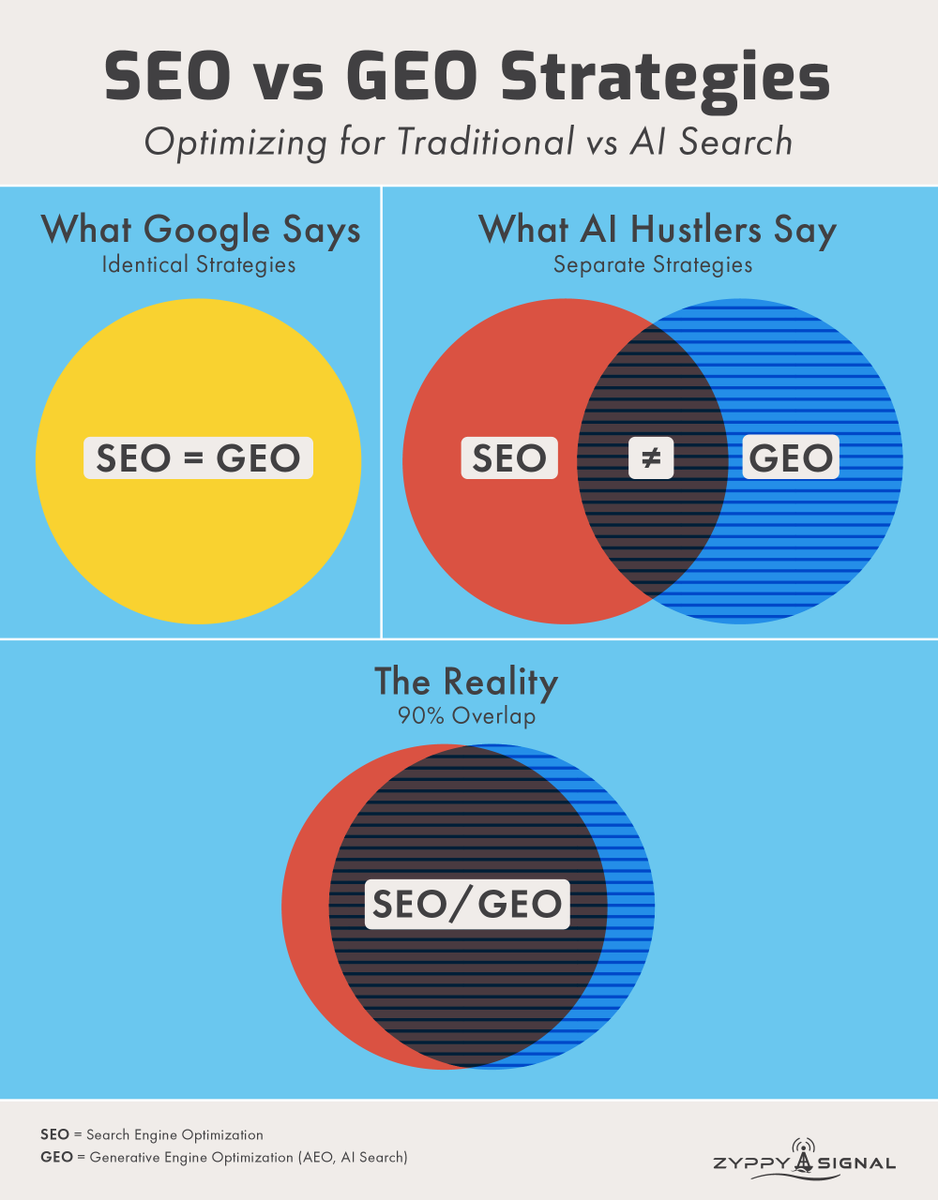
The overlap is large. Pages AI engines can crawl and index, fast and well-structured templates, helpful content with a clear point of view and a reputation built from other sites mentioning you all come from SEO work. Make sure your robots.txt allows the AI search crawlers, such as OAI-SearchBot and PerplexityBot, since blocking them removes you from those engines no matter how well you rank. It's also worth confirming that your main content doesn't depend on JavaScript to appear, because the crawlers behind ChatGPT and Claude don't render it the way Googlebot does.
Where SEO stops
Ranking well still leaves gaps, and a September thread on r/SEO_LLM captured the most common one. The poster had pages ranking in Google's top three to five that barely appeared in AI answers, while lower-ranking pages got cited again and again.
Why does a page rank well on Google but still never get cited by ChatGPT or Perplexity?
I’ve seen pages rank in the top 3–5 on Google but barely appear in AI-generated answers, while lower-ranking pages get cited repeatedly. Do LLMs care more about things like: Direct answer quality Passage-level relevance Original data Third-...
Four gaps explain most of those cases:
- Sub-question coverage. AI engines split a question into several searches, and a page that ranks for the head term may not answer the sub-questions. Our guide to topical authority for AI search covers how to fill them.
- Answers near the top. Some engines read only a short snippet from the top of a page. A July 2026 study of 1,249 ChatGPT answers found the free tier often worked from about 200 characters, so an answer buried under a long introduction may never be seen.
- Mentions on other sites. AI engines lean on what others say about you, and branded web mentions track AI visibility more closely than backlinks do, as our comparison of brand mentions and backlinks explains.
- The other indexes. A page that ranks first on Google but isn't indexed in Bing or Brave is missing from several engines' candidate pools.
There's also an encouraging detail for smaller sites. In the Princeton research that coined GEO, adding citations to a page raised its visibility by about 115% when it ranked fifth, while the top-ranked page's visibility fell. Answer-engine formatting helps challengers most, which is useful if you're not yet the site in first place.

Your competitors are getting cited by AI. You're not.
Every day without citation tracking is a day your competitors pull ahead in ChatGPT, Perplexity, and Claude.
What to do with this
Keep doing SEO, then add the work that turns rankings into citations across more engines:
- Cover the sub-questions around each topic you want to own, with one clear page per distinct question.
- Put a direct answer in the first few lines of each page.
- Check your rankings in Bing and Brave for your most important questions, and fix indexing gaps.
- Measure citations per engine, since a gain on Google tells you little about ChatGPT.
If you only have time for one of these this month, make it the third. Checking Bing and Brave takes an afternoon, and an indexing gap there can hide good pages from several engines at once.
Our explainer on what an AI citation engine is covers how each engine goes from search results to cited sources.
Done by hand, checking 50 questions on six engines takes about five hours a week, and publishing eight solid articles a month takes 16 to 24 hours more. Those are rough estimates.
RankControl is built on the SEO foundation. The content engine writes each article against the pages already ranking for its keyword and publishes it on your own domain. AI visibility tracking then runs your 50 questions every week on six engines and marks each one as mentioned, cited or both, alongside your Google and Bing rankings, so you can see where rankings turn into citations and where they don't.
You can run the ranking check yourself with a spreadsheet and a few searches. Or RankControl's agents can run it every week while your team works on the pages that close the gaps.
200+ SaaS teams already track their AI citations.
They know exactly when ChatGPT mentions their brand, and when it stops. Do you?