
In December 2025, a chart claiming Google's search market share had fallen to 70% made the rounds online. It was shared in r/fivethirtyeight, where one of the top replies pointed out the problem. The chart came from a survey of where people say they look for things, not from counting actual searches.
Google's search engine market share falls to 70% in 2025, its lowest level in more than a decade, as competition from ChatGPT strengthens. Ironically, this drop in market share derailed a recent antitrust case against Google, in which the courts ruled that Google would not divest its search engine.
Source: "The court rejected the most severe structural remedies including forcing Google to divest [...] The ruling preserved Google’s integrated ecosystem and maintained its distribution payment arrangements with partners like Apple. Indus...
Measured by real searches and clicks, Google is still near 90%. But that headline number hides a lot. Bing is far stronger on desktop than most people think. Google isn't the leader in China or Russia, and it only just leads in South Korea. And the AI engines everyone talks about send a tiny share of the traffic Google does.
This roundup of search engine market share in 2026 uses Statcounter data we exported on October 19, plus a published analysis of Cloudflare Radar data. Every figure has a source and a month.
Search engine market share at a glance
| Statistic | Figure | Source |
|---|---|---|
| Google, worldwide | 89.94% | Statcounter, September 2026 |
| Bing, worldwide | 5.29% | Statcounter, September 2026 |
| Google, US | 85.19% | Statcounter, September 2026 |
| Bing, US | 9.91% | Statcounter, September 2026 |
| Google, worldwide desktop | 78.09% | Statcounter, September 2026 |
| Google, worldwide mobile | 95.68% | Statcounter, September 2026 |
| Google's share of search referrals | 89.04% | Cloudflare Radar, Q3 2026, via Technology Checker |
| ChatGPT vs Google, share of referrals | 0.39% | Statcounter, September 2026 |
| Bing monthly active users | 1 billion | Microsoft, April 2026 |
Worldwide search engine share
Here's how the main engines have moved worldwide over three years, from Statcounter's monthly data.
| Engine | September 2023 | September 2025 | September 2026 |
|---|---|---|---|
| 91.58% | 90.38% | 89.94% | |
| Bing | 3.01% | 4.10% | 5.29% |
| Yahoo | 1.24% | 1.46% | 1.36% |
| Yandex | 1.81% | 1.65% | 1.31% |
| DuckDuckGo | 0.58% | 0.87% | 0.74% |
| Baidu | 1.00% | 0.76% | 0.44% |
Google slipped by about a point and a half in three years. Bing gained most of what Google lost. Everything else stayed small.
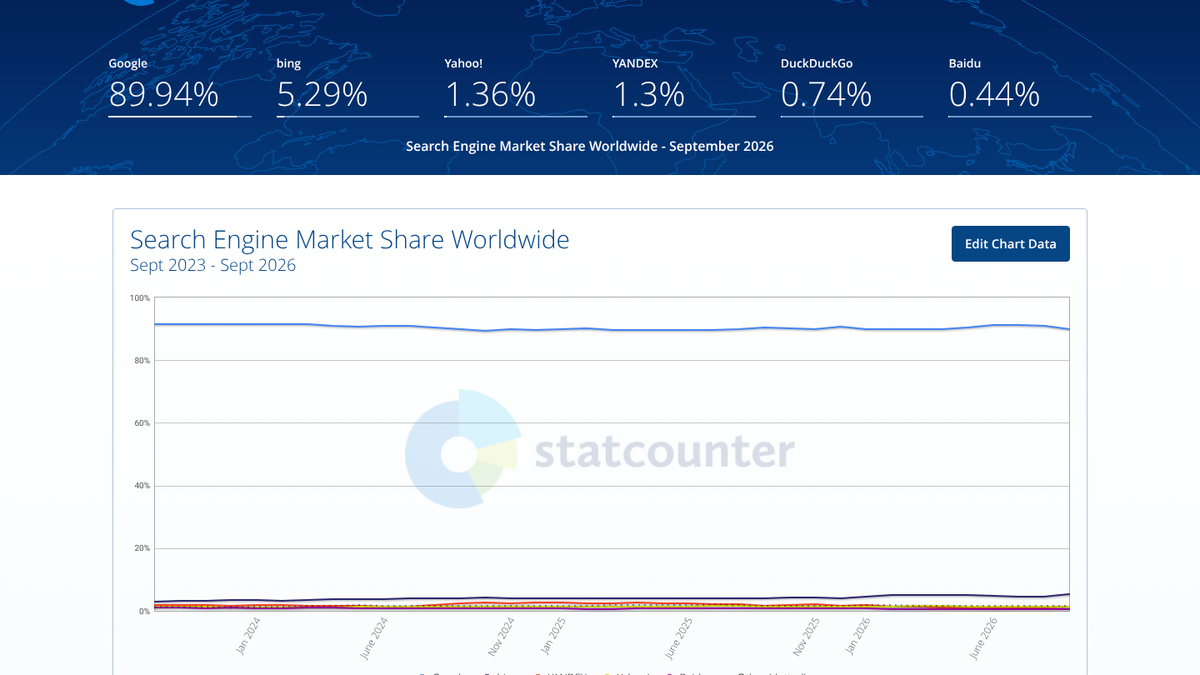
Statcounter counts page views on the sites that use its tracking code and records which search engine sent each visitor. It's the most widely quoted source for this, but it's one network, so treat the second decimal place loosely.
For how many searches that share represents, see our Google search statistics for 2026.
Your competitors are building backlinks while you read this.
Organic outreach, social mentions, and citations from Editorial Circle member sites, with managed backlinks available as an add-on. Grow your domain authority without running the campaign yourself.

The US over two years
The US is where most of our readers' buyers are, and its trend differs from the worldwide one.
| Engine | September 2024 | September 2025 | September 2026 |
|---|---|---|---|
| 87.99% | 85.02% | 85.19% | |
| Bing | 7.03% | 8.50% | 9.91% |
Google lost almost three points in the US over two years, more than it did worldwide, and Bing picked up most of them. Bing's US share peaked at 10.48% in February 2026, its highest in Statcounter's data for this period, before settling back below 10%.
Desktop and mobile tell different stories
The worldwide figure blends two very different markets.
| Engine | Desktop, worldwide | Mobile, worldwide |
|---|---|---|
| 78.09% | 95.68% | |
| Bing | 14.65% | 0.69% |
| Yahoo | 3.35% | 0.45% |
| Yandex | 1.51% | 1.22% |
On phones, Google is close to a monopoly. The second engine on mobile worldwide is Yandex, at 1.22%, ahead of Bing's 0.69%. On desktop, Bing has almost one in seven searches, thanks to Windows, Edge and the Bing box built into the Start menu. In the US the gap is even wider. Bing had 18.83% of desktop searches in September 2026 and 2.15% on mobile, as we covered in our Microsoft Copilot statistics.
That matters if your buyers work at desks. A B2B site may get a much bigger share of its search visits from Bing than a consumer site does.
Search engine market share by country
Google leads almost everywhere, but not by the same margin. Here's Statcounter's September 2026 data for 12 big markets.
| Country | #1 engine | #2 engine | Bing |
|---|---|---|---|
| United States | Google 85.19% | Bing 9.91% | 9.91% |
| Canada | Google 85.28% | Bing 10.08% | 10.08% |
| United Kingdom | Google 91.35% | Bing 6.12% | 6.12% |
| Germany | Google 87.84% | Bing 6.50% | 6.50% |
| France | Google 88.14% | Bing 5.49% | 5.49% |
| Australia | Google 87.87% | Bing 9.19% | 9.19% |
| Brazil | Google 88.42% | Bing 9.63% | 9.63% |
| India | Google 96.69% | Bing 1.89% | 1.89% |
| Japan | Google 59.08% | Bing 31.63% | 31.63% |
| South Korea | Google 47.97% | Naver 43.05% | 4.84% |
| China | Baidu 46.85% | Bing 21.61% | 21.61% |
| Russia | Yandex 70.35% | Google 28.10% | 0.75% |
Three markets stand out. In Japan, Bing has almost a third of searches, by far its strongest big country. In South Korea, Naver runs Google close. And in China and Russia, local engines lead, with Google blocked in China and a distant second in Russia.
If you sell in those countries, a Google-only SEO plan misses a big part of the market. Naver, Yandex and Baidu each have their own webmaster tools and ranking quirks.
The smaller engines
Outside Google and Bing, no engine has more than a few percent anywhere big. But a few are worth knowing.
| Engine | US | UK | Germany | France |
|---|---|---|---|---|
| Yahoo | 2.63% | 1.32% | 1.70% | 2.75% |
| DuckDuckGo | 1.75% | 0.66% | 1.07% | 0.84% |
| Ecosia | 0.12% | 0.30% | 1.03% | 1.34% |
| Qwant | Under 0.1% | Under 0.1% | Under 0.2% | 0.86% |
DuckDuckGo is strongest in the US, where it has almost one search in 50. Ecosia, which plants trees with its ad revenue, does best in Germany and France. Qwant is a French engine and barely registers outside France.
Interest in DuckDuckGo is growing, slowly. US Google searches for "duckduckgo" rose from about 6.1 million a month in September 2025 to 7.5 million in September 2026, per Google search volume estimates. Searches for "yahoo" fell from 30.4 million to 24.9 million over the same year.
Most of these engines use Bing's index for at least part of their results. So for a site owner, being findable in Bing covers several of them at once.
A second measure: Cloudflare Radar
Statcounter isn't the only way to count. Cloudflare sees a large share of the web's traffic, and its Radar service reports which search engines refer visitors to sites on its network. Technology Checker pulled that data on October 1, 2026, and published the results.
| Referrer | Q3 2025 | Q3 2026 |
|---|---|---|
| 81.10% | 89.04% | |
| Bing | 2.61% | 3.22% |
| TikTok | 10.89% | 2.17% |
| Yandex | 1.59% | 1.62% |
| DuckDuckGo | 1.09% | 1.44% |
| ChatGPT | 0.21% | 0.64% |
Two things stand out. Google's share rose, mostly because TikTok's fell, and Technology Checker found that drop was concentrated in shopping sites. And Bing looks smaller here than in Statcounter's data, at 3.22% against 5.29%. The two networks see different slices of the web, so neither is "the" number.
Technology Checker also split the Cloudflare data by the type of site receiving the visits. TikTok's fall was mostly a shopping story. Its share of referrals to shopping sites dropped from 23.49% in the first quarter of 2026 to 5.64% in the third. And in one category, computers and electronics, claude.ai sent 3.67% of referrals in the third quarter, more than DuckDuckGo or TikTok sent there. So AI referrals are small overall, but not small everywhere.
AI crawlers take far more than they send back
Cloudflare's data also shows how many pages each company's crawlers fetch for every visit they send back. Technology Checker reported these ratios for the third quarter of 2026.
| Company | Pages crawled per visit referred |
|---|---|
| 4.9 | |
| Microsoft | 37 |
| OpenAI | 309 |
| Anthropic | 988 |
| Perplexity | 1,083 |
Google sends back roughly one visit for every five pages it crawls. The AI companies crawl hundreds of pages per visit. That gap is why many publishers block AI crawlers, and why being named in an AI answer doesn't translate into traffic the way a Google ranking does.
How AI engines compare with Google
This is the question most people actually want answered. Are AI engines taking search from Google? Our analysis of whether Google search is shrinking looks at search volume and clicks alongside share.
Statcounter tracks Google and ChatGPT head to head, as a share of the visits the two send to websites. In September 2026, ChatGPT had 0.39% worldwide and 0.19% in the US. That share has barely moved since April 2025, when it was 0.22% worldwide. Cloudflare's data points the same way, with ChatGPT at 0.64% of search referrals in the third quarter.
Within AI engines, Statcounter's September 2026 data had ChatGPT sending 80.47% of AI chatbot referrals, Gemini 10.94%, Perplexity 5.84%, Microsoft Copilot 1.78% and Claude 0.95%. Our AI chatbot market share analysis covers those in detail.
There's an irony in the data too. People still use Google to get to the AI engines. US Google searches for "chatgpt" ran at about 124 million a month in September 2026, per Google search volume estimates. Searches for "gemini" rose from 16.6 million to 30.4 million over the past year, and "claude" from 1 million to 9.14 million. Google is still the front door to its own rivals.
So why does it feel like AI is replacing search? Because people do use it heavily. OpenAI says ChatGPT has more than a billion weekly users. But most of what they ask gets answered in the chat, without a click to any website. Usage and referral traffic are different things. Our ChatGPT statistics cover both sides.
Google also absorbed some of the change itself. Its AI Overviews and AI Mode answer many questions on the results page, so a search can stay on Google without sending a click anywhere. That doesn't show up as lost market share, but it does show up as fewer clicks for some sites. Search Console's generative AI report, available to all sites since August 31, 2026, shows how often your pages appear in AI Overviews and AI Mode, which is the easiest way to see how much of your Google visibility now happens inside AI answers.
You're getting AI traffic. But do you know where it comes from?
RankControl credits every visit to the assistant that sent it: ChatGPT, Perplexity, Claude, Gemini, Copilot, or Grok. Full source attribution, next to your Google traffic.
Bing's billion users, and the doubts
In April 2026, Microsoft said Bing had reached 1 billion monthly active users for the first time. That's a big number for an engine with about 5% of searches, and not everyone believed it.
Bing Confirms 1 Billion Monthly Users Are Human, Not Agents
In r/SEO, the top reply joked that they'd only ever used Bing by accident. Another suggested Windows itself drives much of it, since typing into the Start menu can return Bing results. Both are fair points. A monthly user count includes anyone who touched Bing once, while market share measures how much each engine is actually used.
Bing's reach also extends beyond bing.com. DuckDuckGo, Yahoo and Ecosia all use Bing's results in some form, and Microsoft's Copilot uses Bing to find web pages. So being findable in Bing matters more than its 5% suggests.
What this means for your website
For most sites, three practical points follow from the data.
- Google is still most of your search traffic. Nothing in 2026 changes that for English-language sites.
- Bing is worth an hour of setup. Submit your sitemap through Bing Webmaster Tools, especially if your buyers use work computers. Our guide to submitting a sitemap to Google and Bing covers it.
- AI engines are a small but growing source of visits. They matter more for being named in answers than for clicks today, so track both.
- Local engines matter in a few big markets. If you sell in Japan, plan for Bing. In South Korea, plan for Naver. In China and Russia, Baidu and Yandex lead, and each has its own webmaster tools, ranking signals and rules on what it will index.
Check your own analytics before trusting any market share figure. Your audience may look nothing like the worldwide average.
Why the monthly numbers jump around
Market share data is noisy month to month, and that's worth knowing before you react to a headline.
Statcounter's figures depend on which sites use its tracker and how much traffic each gets that month. A single large site joining or leaving can move a country's numbers. In April 2024, Statcounter's worldwide data showed Google dropping to 86.99%, and Search Engine Land asked whether Google had really lost share to Bing. When we exported that month again in October 2026, Statcounter showed 90.91%. Even past months can be revised.
The same happened in our US data. Bing's share of US desktop searches fell from 16.66% in February 2026 to 11.65% in June, then jumped to 18.83% in September. Cloudflare noted that it reclassified some human and bot traffic in September, so its own September figures were marked provisional too.
So look at three-month or yearly trends, not single months. A one-month swing of a point or two is usually noise.
How to read search market share figures
- Check what was counted. Page views, referrals, survey answers and user counts give different results.
- Check desktop and mobile separately. A blended figure hides Bing's desktop strength.
- Check the country. Worldwide figures say little about Japan, Korea, China or Russia.
- Be wary of surveys. They measure what people say, not what they do, and they tend to make new tools look bigger.
- Check for revisions. Statcounter updates past months, so a figure quoted a year ago may not match its data today. Note the date you pulled any number.
How much this takes to track by hand
Watching search share for your markets takes about an hour a month. Export Statcounter's data for each country you sell in, split by desktop and mobile, and compare it with your own analytics. Add another hour a quarter to check Bing Webmaster Tools and your AI referrals.
That tells you which engines your buyers use. It doesn't tell you whether AI engines name you when buyers ask about your category. Checking that by hand takes two to four hours a month for 20 questions.
You can do all of this by hand. Or RankControl can do much of it for you, checking ChatGPT, Perplexity, Claude, Gemini, Grok and Google AI Mode every week for your buyers' questions, tracking your Google and Bing rankings and writing the pages that answer them, while you focus on your product.
We'll show you exactly where your brand stands in AI search.
No commitment. $0 due today, cancel anytime. See how ChatGPT, Perplexity, Claude, Gemini, Grok, and Google AI Mode talk about your brand today.