
In the same September that OpenAI told advertisers ChatGPT had more than 1 billion weekly users, Statcounter's data put its share of website referrals against Google at 0.39%. One number says ChatGPT is one of the biggest products on earth. The other says it barely shows up in the traffic reports of the sites it reads.
Both are true, and most ChatGPT statistics pages pick one and skip the other. This roundup collects the 2026 figures that hold up, with the date and source for each. It also covers why the user count, the market share and the search share tell such different stories, which matters most if you run a website.
ChatGPT statistics at a glance
Here are the figures worth quoting, with the newest first in each row.
| Statistic | Figure | Source and date |
|---|---|---|
| Weekly users | More than 1.2 billion | OpenAI at DevDay, late September 2026 |
| Weekly users | More than 1 billion | OpenAI, August 2026 |
| Monthly app users | 1.1 billion | Sensor Tower, June 2026 |
| Consumer subscribers | More than 50 million | OpenAI, February 2026 |
| Paying business users | More than 9 million | OpenAI, February 2026 |
| US adults who have used ChatGPT | 44% | Pew Research Center, February 2026 survey |
| Messages asking for information or advice | 49% | OpenAI and NBER study, 2025 |
| Share of AI chatbot referrals to websites | 80.48% | Statcounter, September 2026 |
| Share of AI assistant app users | 46.4% | Sensor Tower, May 2026 |
| Share of referrals against Google | 0.39% worldwide, 0.19% in the US | Statcounter, September 2026 |
| OpenAI annualized revenue | About $50 billion | Financial Times, end of September 2026 |
| ChatGPT Ads annualized revenue | $1 billion | OpenAI, September 2026 |
If you only need one number, use the weekly user count with its date. Everything else in this post explains what that number does and doesn't tell you.
How many people use ChatGPT
OpenAI counts weekly active users, and it has published a new milestone every few months. The study OpenAI ran with Harvard economist David Deming used 700 million weekly users as its base in mid-2025. In February 2026, OpenAI's funding announcement gave more than 900 million.
The billion arrived later than planned. The Information reported in July that ChatGPT was nearing 1 billion weekly users, seven months after OpenAI's own target. OpenAI announced the milestone in early August, and its ads update on September 18 repeated it, saying the free tier keeps ChatGPT available to "more than 1 billion weekly active users".
Less than two weeks later the figure moved again. At DevDay, OpenAI shared more than 1.2 billion weekly users, according to The Decoder, and Tibo, who works on Codex and ChatGPT at OpenAI, repeated it when announcing apps inside ChatGPT.
We are opening up our platform and you can now build full native apps with plugin extensions, and ship them right in ChatGPT. We have over 1.2B weekly users and will surface relevant plugins right in the conversations.
 Tibo@thsottiauxSep 29, 2026
That's roughly 500 million new weekly users in about 15 months, or more than 30 million a month on average.
Weekly, monthly and app users aren't the same count
Sensor Tower measures something different. It estimates monthly users of the ChatGPT app, and by its count ChatGPT reached 1 billion monthly app users in May 2026. That made it the fastest app ever to get there, beating Google Maps by about a year and a half, as CNBC reported.
So you'll see "1 billion" quoted for both weekly and monthly users, from two different sources. They aren't the same claim. OpenAI's weekly figure covers every surface, including the website. Sensor Tower's monthly figure is an outside estimate for the mobile app only. When a stats page puts them side by side without saying which is which, treat the page with some care.
See your first AI citation report in under 5 minutes.
No setup calls. No onboarding meetings. Connect your domain and see where AI mentions your brand right now.

Who uses ChatGPT
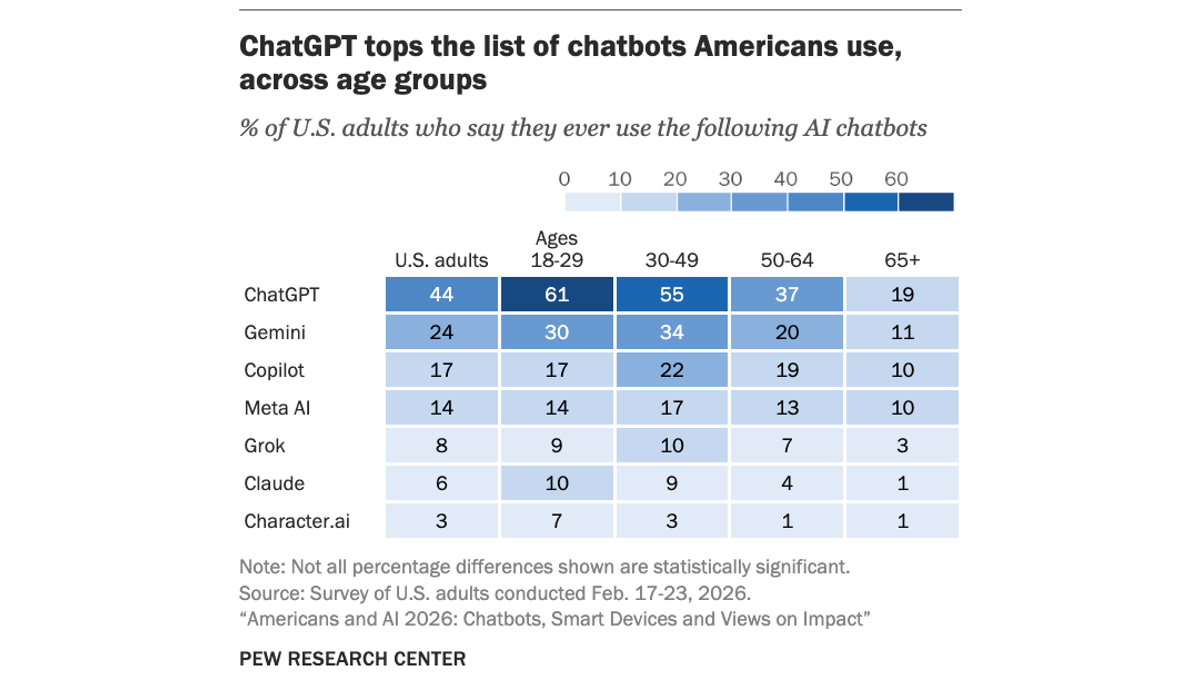
The best survey data is American. In Pew Research Center's February 2026 survey, 44% of US adults said they had used ChatGPT. That's far ahead of Gemini at 24%, Copilot at 17% and Claude at 6%.
Age is the biggest divide. ChatGPT use ranges from 61% of adults aged 18 to 29 down to 19% of those 65 and older, with 30 to 49 year olds at 55%. Pew also found 51% of US adults don't use any AI chatbot, while 24% use one every day.
OpenAI's own study adds two shifts. In January 2024, 37% of users whose names could be classed as typically masculine or feminine had feminine names. By July 2025 that share was 52%, close to the general adult population. And by May 2025, adoption was growing more than four times faster in the lowest-income countries than in the richest ones.
If you want the wider picture across every AI tool, our AI search adoption statistics cover Gemini, Claude, Perplexity and Grok as well.
What people use ChatGPT for
The largest public study of real use is the NBER working paper by OpenAI's economic research team and David Deming. It looked at 1.5 million consumer conversations, and OpenAI's summary sorts them three ways.
- Asking, at 49% of messages, means questions and advice, where ChatGPT acts like an advisor.
- Doing, at 40%, covers tasks like drafting text, planning and coding.
- Expressing, at 11%, is personal reflection, exploring ideas and play.
About 30% of consumer use was for work and 70% wasn't, with both growing. Three quarters of conversations fell into practical guidance, looking up information and writing. Writing was the most common work task, while coding stayed a niche use.
The "Asking" share is the one that matters for search. Close to half of what people send ChatGPT is a question they might once have typed into Google. That's where brands get named, recommended or skipped.
Reddit shows the same mix from the user side. A recent r/randomquestions thread asking how many people use ChatGPT every day drew more than 500 comments. People listed PowerShell scripts, meal plans, budgeting and interview prep, and some said they'd never used it at all.
Paying users, revenue and ads
OpenAI's February post gave two paid figures, more than 50 million consumer subscribers and more than 9 million paying business users. At DevDay it added 2.5 million businesses on OpenAI products and 35 million weekly users of ChatGPT Work and Codex.
Revenue numbers need care, because two versions are in circulation. Axios first reported that OpenAI was nearing a $70 billion annualized revenue rate. The Financial Times later put the rate at about $50 billion at the end of September, and the gap comes from how partner sales are booked. Bloomberg reported that OpenAI expects to reach at least $70 billion by the end of 2026.
Ads are the newest line. OpenAI says ChatGPT Ads reached a $1 billion annualized run rate in under 200 days, with tens of thousands of advertisers and availability in more than 40 countries. Sensor Tower estimated that by May, 17% of daily users were seeing ads. We covered what this means for paid budgets in our post on ChatGPT ads for marketers.
Your competitors are building backlinks while you read this.
Organic outreach, social mentions, and citations from Editorial Circle member sites, with managed backlinks available as an add-on. Grow your domain authority without running the campaign yourself.

ChatGPT market share depends on what you count
This is where ChatGPT stats get confusing. Three well-known sources report ChatGPT's share of the AI market, and they land between 46% and 80%.
| Source | What it counts | ChatGPT share | Next biggest | Date |
|---|---|---|---|---|
| Statcounter | Referrals from AI chatbots to websites using its tracker | 80.48% | Gemini 10.91% | September 2026 |
| Similarweb, via PPC Land | Visits to AI chatbot websites | 52.7% | Gemini 27.3% | May 2026 |
| Sensor Tower, via TechCrunch | Monthly users of AI assistant apps | 46.4% | Gemini 27.7% | May 2026 |
None of them is wrong. They just measure different things, and our AI chatbot market share analysis compares all five measures side by side.
Sensor Tower counts people using apps, and Gemini comes built into Android phones. Its figures put Gemini at 662 million monthly users and Claude at 245 million, against ChatGPT's 1.1 billion, as TechCrunch reported. Year on year, Sensor Tower had monthly use of Claude up 640% and Meta AI up 973%, against 62% for ChatGPT.
Similarweb counts website visits. Its data, reported by PPC Land, had ChatGPT falling from 76.4% to 52.7% of AI chatbot visits in a year, while Claude went from 1.6% to 8.9%.
Statcounter counts the clicks those tools send to other websites. On that measure, ChatGPT still has 80.48%, and the rest is small. Gemini has 10.91%, Perplexity 5.85%, Copilot 1.79% and Claude 0.95%.
Statcounter's monthly data also shows how steady that lead has been. We pulled the 12 months from September 2025 to September 2026.
| Month | ChatGPT | Gemini | Perplexity | Copilot | Claude |
|---|---|---|---|---|---|
| September 2025 | 81.12% | 2.82% | 10.85% | 4.04% | 0.99% |
| January 2026 | 80.51% | 7.20% | 7.87% | 3.50% | 0.92% |
| April 2026 | 76.85% | 9.00% | 7.73% | 3.76% | 2.66% |
| September 2026 | 80.47% | 10.94% | 5.84% | 1.78% | 0.95% |
ChatGPT dipped to 76.85% in April and came back. The real change was underneath it. Gemini nearly quadrupled its share of referrals, and Perplexity's fell by almost half, so Gemini is now the second-biggest source of AI clicks. Our Perplexity statistics roundup covers that decline by country and device.
If you run a website, the Statcounter number is the one that touches your traffic report. ChatGPT may be losing share of attention, but it still sends about four in five of the AI clicks that reach websites. Our breakdown of AI referral traffic by engine compares Statcounter with other panels country by country.
The r/charts thread on the Sensor Tower figure drew hundreds of upvotes and a lot of comments predicting OpenAI's decline. One of the more useful replies argued the data seems to leave out much of the Chinese market, including ByteDance's assistant, so even the 46.4% depends on where you draw the borders.
ChatGPT drops below 50% market share of AI Assistants as Gemini grows
Source: https://techcrunch.com/2026/06/16/chatgpts-market-share-slips-below-50-for-first-time/
ChatGPT's share of search traffic
Here's the number most ChatGPT statistics pages leave out. Statcounter also tracks Google and ChatGPT head to head, as a share of the visits the two send to websites. We pulled its monthly data from April 2025 to September 2026.
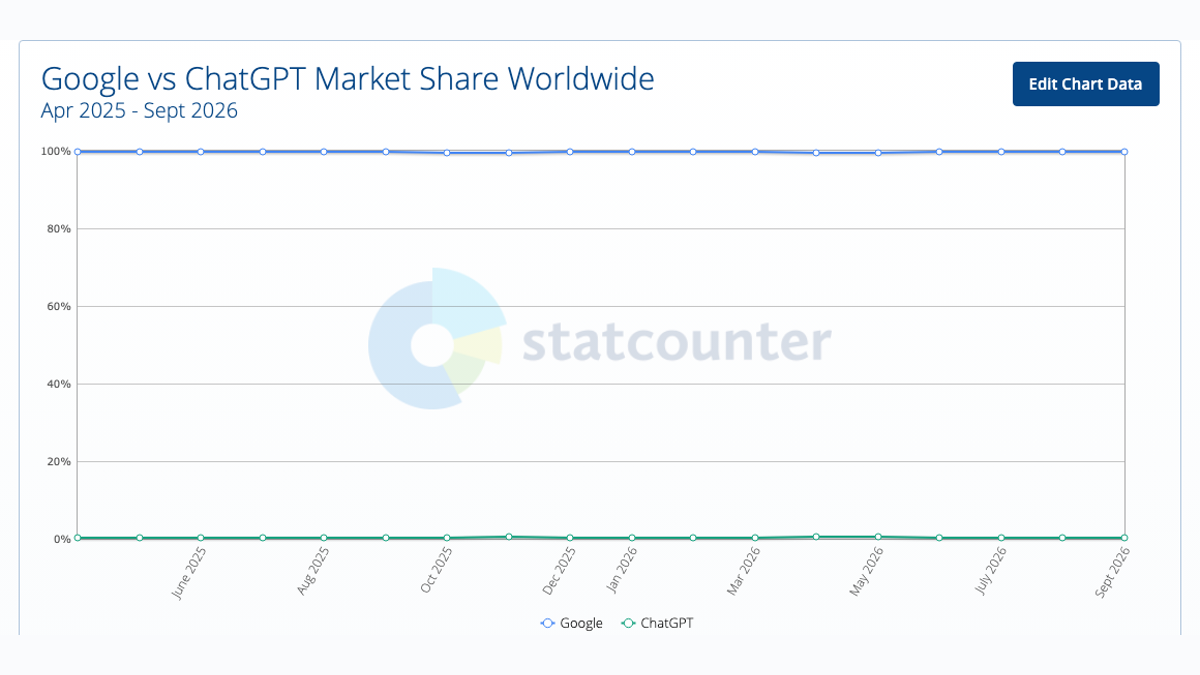
Worldwide, ChatGPT's share never left a range of 0.22% to 0.41% in those 18 months. It was 0.33% in September 2025 and 0.39% in September 2026. In the United States it went the other way, from 0.22% to 0.19%.
| Month | ChatGPT share, worldwide | ChatGPT share, US |
|---|---|---|
| September 2025 | 0.33% | 0.22% |
| December 2025 | 0.31% | 0.20% |
| March 2026 | 0.37% | 0.20% |
| June 2026 | 0.29% | 0.11% |
| September 2026 | 0.39% | 0.19% |
Over roughly the same stretch, OpenAI's weekly users went from about 700 million to more than 1.2 billion. The user count kept climbing and the click share barely moved.
One country breaks the pattern
The worldwide figure hides a lot of variety. In September 2026, ChatGPT's share against Google was 0.09% in the UK, 0.15% in Germany, 0.24% in Brazil and 0.45% in Japan. Indonesia is the outlier, at 7.94%.
Indonesia's share has also moved more than anywhere else we checked. It was 4.42% in September 2025, peaked at 8.35% in April 2026 and ended September at 7.95%. It likely helps explain why the worldwide average sits above the US and UK numbers.
We don't know from Statcounter's data why Indonesia is so different, and I wouldn't guess. The practical point is simpler. If you sell into a market like Indonesia, ChatGPT may already be a real traffic source for you, and the global average will understate it.
Why more users don't mean more clicks
The usage study explains a lot of it. Most of what people do in ChatGPT never needed a website, from drafting an email to planning a week of meals. Even the "Asking" half usually ends with an answer in the chat, not a link.
Our own testing shows the same pattern from inside a single answer. When we ran 10 everyday buyer questions through ChatGPT search in October, it read 304 pages and cited 20 of them. A page can be read, used and quoted without anyone clicking through to it.
Site owners see this in their own numbers. In an r/GEO_optimization thread about falling ChatGPT referrals, the most useful reply said much of it comes from ChatGPT's side. OpenAI keeps changing how often answers fetch live sources and how links are shown, so a drop isn't always about your site.
Has anyone seen ChatGPT referral traffic drop recently?
I’ve been reviewing referral traffic from ChatGPT and noticed that it has declined over the last couple of months, despite no major website or content changes. I’m curious whether others have seen a similar pattern or whether this is more l...
So I'd read the 0.39% as a measure of clicks, not influence. With 1.2 billion weekly users and close to half of messages being questions, a lot of buying decisions now start with an answer that names some brands and not others. The click is the small, visible part of that.
What these numbers mean if you run a website
Three things follow from the figures above, and I'd act on all three.
First, don't judge ChatGPT by referral traffic alone. A visit share under half a percent makes it easy to dismiss, but the visits that do arrive often come from people who already read a recommendation. We looked at that in our post on AI traffic that converts.
Second, track whether ChatGPT names you as well as whether it sends visits. That means checking a fixed set of buyer questions on a schedule and logging who gets cited each time. Our guide to how ChatGPT decides which websites to recommend covers what drives the answer.
Third, don't ignore the other engines. Gemini gained the most share of app users and site visits this year, and Claude's share of site visits grew more than fivefold. A brand that only checks ChatGPT will miss where the growth is.
RankControl's AI visibility tracking checks 50 buyer questions every week across ChatGPT, Perplexity, Claude, Gemini, Grok and Google AI Mode. Its analytics separates AI-referred visits by engine, so you can see the citations and the clicks side by side.
You're getting AI traffic. But do you know where it comes from?
RankControl credits every visit to the assistant that sent it: ChatGPT, Perplexity, Claude, Gemini, Copilot, or Grok. Full source attribution, next to your Google traffic.
How to read ChatGPT statistics without getting fooled
Most bad ChatGPT stats aren't made up. They're real numbers quoted without the context that makes them mean something. Four checks catch nearly all of it.
- Check whether the count is weekly or monthly. OpenAI reports weekly users, while app trackers report monthly ones.
- Check who measured it. OpenAI's numbers are its own, while Sensor Tower, Similarweb and Statcounter are outside estimates with their own panels.
- Check what surface it covers. App-only figures leave out the website, and website figures leave out the apps.
- Check what the share is a share of. Users, visits and referrals produce three different market shares for the same product in the same month.
The date matters most of all. ChatGPT added about 300 million weekly users between February and September 2026, so a year-old figure on a stats page is now well out of date. Our AI statistics roundup lists the most common stale numbers and what to quote instead.
How much this takes to track by hand
Pulling these numbers together took a few hours of reading company posts, surveys and panel data. Keeping them current for your own brand is a different job. You'd need to run your key buyer questions through each AI engine every week, log who gets named, and match that against AI-referred visits in your analytics.
For 20 questions across six engines, that's 120 checks a week, or a few hours of copying answers into a spreadsheet. You can do it by hand, and our free AI visibility check is a good place to start with three questions. Or RankControl can run the checks, write and publish the pages that answer those questions, and report back every week while you focus on your product.
We'll show you exactly where your brand stands in AI search.
No commitment. $0 due today, cancel anytime. See how ChatGPT, Perplexity, Claude, Gemini, Grok, and Google AI Mode talk about your brand today.