A marketer asked r/MarketingandAI in August whether anyone had actually seen AI search traffic turn into leads. The replies were warm, maybe warmer than the data. Several said yes, with higher conversion rates than regular organic. One consultant said ChatGPT had sent two clients worth $10,000 and $45,000. The most careful reply said it in two parts. The volume is small, and the quality is noticeably better.
has anyone actually seen traffic from AI search convert into leads?
I keep seeing discussions about visibility in AI, but I’m more interested in what happens after the click..
You've probably seen the bigger claims too. AI visitors convert 4x better, 11x better, 23x better. So we lined up eight studies that measured it, checked each one at the source on October 19, 2026, and looked at what each actually counted. The answer is yes, AI traffic mostly converts better. But the honest multiple for most businesses is closer to 1.3x than 23x, and as recently as early 2025 several big studies found it converting worse.
The eight studies at a glance
Here's every study, with what it measured and what it found.
| Study | Published | Sample | Conversion counted | Compared with | Result for AI traffic |
|---|---|---|---|---|---|
| Ahrefs | June 2025 | 1 site (ahrefs.com) | Free signups | Organic search | 23x better |
| Seer Interactive | June 2025 | 1 client, Oct 2024 to Apr 2025 | Site conversions | Google organic | 15.9% vs 1.76%, about 9x |
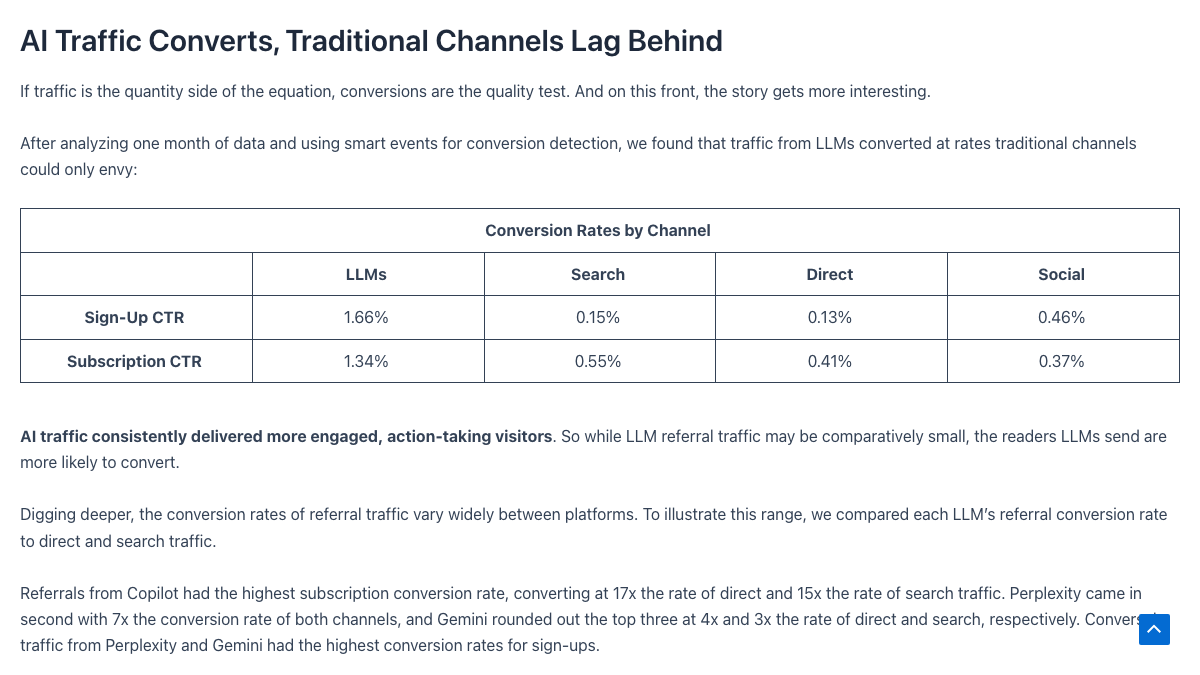
| Microsoft Clarity | Nov 2025 | 1,200+ publisher and news sites | Sign-ups, subscriptions | Search | Sign-ups 11x, subscriptions 2.4x |
| Similarweb | Sep 2025 | Ecommerce sites in its panel | Purchases | Organic search | 11.4% vs 5.3%, about 2.2x |
| Kaiser and Schulze | Oct 2025, in Marketing Science July 2026 | 973 ecommerce sites, 12 months | Purchases | Organic search and others | About 13% worse than organic |
| Visibility Labs | 2025 data | 94 ecommerce stores | Purchases | Non-branded organic | 1.81% vs 1.39%, 31% better |
| Adobe | Apr and Jun 2026 | US retail sites, 1 trillion+ visits | Purchases | All non-AI traffic | 42% better (Mar 2026), 40% better (Prime Day) |
| Shero Commerce | Sep 2026 | 73 stores, 96 million sessions | Purchases | Google organic | Median store 25% better |
That's a range from 13% worse to 23 times better. Both ends are real numbers from real data. They just aren't measuring the same thing.

Built by the team that got cited in 48 hours.
Content generation, backlink building, AI visibility tracking, and Google rankings. One platform, zero guesswork.
Pattern 1: the smaller the sample, the bigger the number
Sort the studies by size and a pattern jumps out. The two single-site studies report the biggest multiples, 23x for Ahrefs and about 9x for Seer's client. The studies covering dozens or hundreds of stores land between 13% worse and 31% better. Adobe, with the biggest dataset of all, reported 40% to 42% better in 2026.
That's not a knock on Ahrefs or Seer. Ahrefs said plainly that it was sharing its own numbers while it worked on a larger study. But a single site's result depends on that site's product, audience and how it tracks conversions. A company whose name ChatGPT already recommends for its category will see AI visitors who arrive half-sold.
The big multiples spread anyway, because "23x" is a number people remember. If you've seen it in a pitch deck, it came from one SEO software company's free signups in mid-2025.
Pattern 2: signups convert differently than purchases
The second split is what counted as a conversion. Ahrefs, Seer and Clarity counted signups, subscriptions or site conversions. The ecommerce studies counted purchases.
Clarity's study shows the gap inside one dataset. In its November 2025 analysis of more than 1,200 publisher and news sites, AI visitors signed up at 1.66% against 0.15% from search, about 11 times better. For subscriptions, which ask more of the visitor, the gap shrank to 1.34% against 0.55%, about 2.4 times.
A free signup or newsletter is a small step for someone who just asked an AI for a recommendation. A purchase asks for more, and shoppers often check other sites before they buy. That's the explanation the 973-store paper's authors gave for their result.
Pattern 3: who AI traffic is compared with
The third split is the baseline. "Better than organic" means different things in different studies.
Visibility Labs compared ChatGPT with non-branded organic search only. It excluded homepage traffic, which is mostly people searching for the brand by name, and blog traffic, which is mostly informational. That's the fairest test of the eight, because branded searches convert very well and would make organic look stronger.
Adobe compared AI traffic with all non-AI traffic, including paid search, email and social. Similarweb and Kaiser and Schulze compared it with organic search as a whole. So a 42% gap at Adobe and a 31% gap at Visibility Labs aren't the same kind of number, even though both say AI wins.
Pattern 4: it changed between 2025 and 2026
The most useful finding isn't any single multiple. It's that the answer flipped in about a year.
Adobe's own numbers show it clearly. In its April 2026 report, it said that in March 2025, AI-referred traffic to US retail sites converted 38% worse than non-AI traffic. In March 2026, it converted 42% better, a record. On Prime Day 2025, AI traffic converted 23% worse, and on Prime Day 2026 it converted 40% better.
The Kaiser and Schulze paper, from the University of Hamburg and the Frankfurt School of Finance and Management, fits the same timeline. It came out as a working paper in October 2025 and was published in Marketing Science in July 2026. Its 12 months of data, from ChatGPT search's first year, found ChatGPT converting above paid social but below every other channel. Digiday's report on the working paper put organic search about 13% ahead and affiliate links 86% ahead. But it also found ChatGPT's conversion rate rising over the period, and stronger results in complex product categories.
Shero Commerce's September 2026 benchmark shows where that trend went. Across 73 stores, AI assistants sent about the same number of visits a day in September 2026 as a year earlier, 917 against 896. Orders from those visits went from 5.9 a day to 16.1. On 41 of the 61 stores with at least 200 AI visits, AI visitors converted better than Google organic visitors.
So when someone quotes a 2025 ecommerce study saying AI traffic doesn't convert, they may be right about 2025. The 2026 data mostly says otherwise.
See your first AI citation report in under 5 minutes.
No setup calls. No onboarding meetings. Connect your domain and see where AI mentions your brand right now.
Why AI visitors might convert better
The usual explanation is that AI does the research before the click. Someone who asks ChatGPT to compare three products, reads the answer and then clicks through is further along than someone typing a broad keyword into Google. Visibility Labs called this intent compression.
Shero's data supports it in a concrete way. Half of all AI visits in its benchmark started on a product page. Stores where at least half of AI visits started on a product page converted that traffic at 1.62%, against 1.06% for the rest.
There's a catch in the order size, though. Visibility Labs found ChatGPT orders were 14.3% smaller, at $204 against $238. Shero's median store saw orders 15% smaller. Higher conversion with smaller baskets still came out ahead on revenue per visit in both studies, by about 10% at Visibility Labs and 23% at Shero, but by a smaller margin than the conversion rate alone suggests.
Which AI engine converts best
The per-engine numbers are the shakiest in this whole area, because each engine's share is so small. Still, three studies broke it out.
Seer's single client saw ChatGPT visitors convert at 15.9%, Perplexity at 10.5%, Claude at 5% and Gemini at 3%, against 1.76% for Google organic. ChatGPT sent 61% of that client's AI visits. Clarity found Copilot had the highest subscription conversion rate across its publishers, 15 times the rate of search, with Perplexity at 7 times and Gemini at 3 times.
Shero's stores show the trend by engine over a year. ChatGPT's conversion rate went from 0.69% in September 2025 to 1.77% in September 2026. The other assistants combined went from 0.34% to 1.38%. ChatGPT sent 88% of the AI visits, so for most stores, "AI traffic" still mostly means ChatGPT.
What it means by type of business
The studies split fairly cleanly by business model, which is more useful than any single average.
| Business type | What the studies show | Best evidence |
|---|---|---|
| Online stores | Purchases 25% to 60% better in 2026, with smaller orders | Adobe, Shero, Visibility Labs |
| SaaS and lead generation | Large multiples on signups, from single sites | Ahrefs, Seer |
| Publishers | Sign-ups about 11x better, subscriptions about 2.4x | Microsoft Clarity |
For stores, the 2026 evidence is the strongest, because it covers the most sites and the most purchases. For SaaS and services, the evidence is mostly single-company data and practitioner reports like the Reddit thread above, so treat any multiple as a hint until you've measured your own.
A worked example
Here's what the Visibility Labs ratios would mean for a store with 100,000 non-branded organic visits a month. These are rough numbers from that study's averages, not a forecast for any real store.
| Non-branded organic | ChatGPT | |
|---|---|---|
| Visits a month | 100,000 | about 1,430 (70 times smaller) |
| Conversion rate | 1.39% | 1.81% |
| Orders | about 1,390 | about 26 |
| Revenue per visit | $3.30 | $3.65 |
| Revenue a month | about $330,000 | about $5,200 |
At the fourth-quarter ratio of 47 to 1, ChatGPT's share rises to about 2,130 visits and $7,800 a month. Either way, the AI visitor is worth a bit more and there are far fewer of them. That's why the growth rate matters more than the conversion multiple. Visibility Labs saw ChatGPT sessions grow more than tenfold across 2025.
The counterweights
Better conversion doesn't mean AI traffic matters much yet. Three things keep it in proportion.
The volume is tiny. In Visibility Labs' data, non-branded organic search sent 70 times more traffic than ChatGPT across 2025, narrowing to 47 times by the fourth quarter. ChatGPT drove $474,000 in revenue against $32.1 million from non-branded organic. The 973-store paper found ChatGPT traffic roughly 200 times smaller than Google organic, under 0.2% of all traffic. Clarity put AI referrals under 1% of traffic.
Behavior is mixed. Ahrefs' study of about 82,000 websites in mid-2025 found AI visitors 4.1% more likely to bounce than search visitors, and viewing fewer pages per unit of time. Higher conversion and higher bounce can both be true when visitors arrive knowing exactly what they want.
And the counts are incomplete. A Shopify store owner posted in September that a customer said they'd found the product through ChatGPT, but Shopify recorded the order as direct traffic.
Customer said they found us through ChatGPT but Shopify shows direct traffic
Had an order recently where the customer mentioned they first came across the product through ChatGPT. Shopify had the order showing as direct traffic. I checked the conversion details because I thought I was missing something, but it looks...
A thread in r/SEO_for_AI this month made the same point from the analytics side, with clients' Direct and Unassigned channels growing alongside ChatGPT use. Search Engine Land reported on October 15 that ChatGPT appeared to have dropped its UTM tracking, which would make AI visits even harder to label. Every study above counts only the AI visits it could identify, so they all undercount AI's real reach in some way.
The traffic none of these studies count
All eight studies measure visits from AI assistants that send their own referrer, mostly ChatGPT. None of them can separate clicks from Google's AI Overviews or AI Mode. Those clicks come from google.com, so analytics files them under organic search, and they sit inside the organic numbers the studies compare against.
Google's own guide to its AI features points site owners to a generative AI performance report in Search Console for that side. So when a study says AI traffic converts better than organic, the organic side already includes some AI-assisted clicks.
What we'd tell a client
If you need one sentence, here it is. In 2026 data, AI-referred visitors to commercial pages convert somewhere around 25% to 60% better than other traffic for purchases, with bigger gaps for free signups, on volume that's still a small fraction of Google's.
That's good news for anyone deciding whether AI search is worth the work. It's not a reason to expect AI to replace search traffic, and it's not a reason to quote 23x in a budget meeting. Our earlier roundup of AI referral traffic conversion statistics covers the volume side in more detail, and our look at which AI engine sends the most visits breaks the traffic down by engine.
How to measure your own
The only number that matters for your budget is yours. Here's how to get it.
- Create an AI referral channel in Google Analytics 4, so visits from ChatGPT, Perplexity, Gemini, Claude and Copilot don't sit in Referral or Direct. Our GA4 guide for AI referral tracking walks through the setup.
- Compare AI visitors with non-branded organic visitors to the same kinds of pages, like product or pricing pages. Leave out your homepage and blog for this comparison, as Visibility Labs did.
- Look at revenue per visit as well as conversion rate, since AI orders may be smaller.
- Add a "how did you hear about us" question at checkout or signup. It's the only way to catch AI-influenced visits that arrive as direct traffic.
- Track it monthly. The 2025 to 2026 flip shows these numbers can move a lot in a year.
Limits of this roundup
We didn't collect new conversion data. Everything here comes from the eight studies, each checked at the source on October 19, 2026, except Visibility Labs, which we read on its own site. The studies differ in method, period and what they count, so the numbers can't be averaged into one figure. Several were published by companies that sell SEO or analytics tools.
What this takes by hand
Here's a rough budget for measuring AI traffic conversion properly, by our estimate.
| Task | Hours |
|---|---|
| Setting up an AI channel and conversion events in GA4 | 2 to 4, once |
| Building a non-branded comparison segment | 2 to 3, once |
| Adding and reading a "how did you hear about us" field | 1 to 2, once |
| Monthly review of AI conversion and revenue per visit | 1 to 2 a month |
Doing it by hand or with help
You can set this up yourself in an afternoon or two. Or RankControl can handle the steady part every month while you focus on your product. Its analytics show AI-referred visits next to the rest of your traffic, Copilot included, and its AI visibility tracking checks 50 of your buyer questions every week on ChatGPT, Perplexity, Claude, Gemini, Grok, Google AI Mode and Google AI Overviews, so you can see whether the visits are growing where the answers name you.
Your competitors are building backlinks while you read this.
Organic outreach, social mentions, and citations from Editorial Circle member sites, with managed backlinks available as an add-on. Grow your domain authority without running the campaign yourself.