
Most AI visibility audits hand you a scorecard to grade yourself with. We've published a few of those. This time we ran the audit on a real company's site and wrote down what we found.
The site is Teamwork.com, a project management platform for client-services agencies. It's a good test case because it's clearly put work into this, and on September 26, 2026 it passed almost every check. It still had a problem you'd only find by looking in the right place, and a gap in AI answers that no technical fix would close.
Here's the audit, layer by layer, and then how to run the same one on your site.
Layer 1: can AI crawlers get in?
Start with robots.txt, since a single line there can take you out of an engine's answers entirely. Teamwork.com's file names nine AI crawlers one by one, including GPTBot, OAI-SearchBot, PerplexityBot, ClaudeBot and Google-Extended. It gives each the same rule: everything is open except /launchpad/, the logged-in app. That's about as clean as it gets.
To check yours, fetch the live file from outside your own network (curl https://yoursite.com/robots.txt) and read what comes back, not what's in your code repo. The two can differ. One developer in r/SEO found their Next.js robots.txt allowed every AI crawler, while the live file started with a block they "definitely didn't write": a Cloudflare-managed section disallowing GPTBot.
Cloudflare has been quietly blocking GPTBot and PerplexityBot on my site for months. Here's how to check yours.
Spent the morning debugging why my site wasn’t showing up in any AI search tools like ChatGPT, Perplexity, or AI Overviews. Everything looked fine on my end. My robots.txt in Next.js explicitly allowed every AI crawler. Then I ran a curl on...
Cloudflare's defaults changed again this September. New domains that monetize with ads are now offered a preset that disallows AI training, while search crawlers stay open. That's a sensible default, but it's exactly the kind of setting that changes under you, so check the live file every quarter. If you use a firewall or bot-protection service, check its rules as well, since a blocked request never reaches robots.txt at all. Our AI crawler checklist covers what each bot does.
Layer 2: can they read the page without JavaScript?
Many AI crawlers don't run scripts, so the text that matters has to be in the raw HTML. We fetched Teamwork.com's home page, pricing page and a blog post from the day before with plain curl, no browser. All three came back with their full text. The plan names and prices were right there in the HTML, and the blog post's byline and date were readable without a script.
Your check is the same. Fetch the page, search the raw HTML for a sentence from your first paragraph and for your prices, and if either is missing, it's being loaded by a script and some crawlers will never see it.
Your competitors are getting cited by AI. You're not.
Every day without citation tracking is a day your competitors pull ahead in ChatGPT, Perplexity, and Claude.
Layer 3: do the machine-readable facts match the page?
This is where the audit found its bug. Teamwork.com has more structured data than most sites we see: organization and product markup, FAQ blocks, article markup with named authors. It also has an llms.txt file with a section of instructions for AI assistants, and a plain-text pricing.md copy of its pricing page, written for machines to read.
The visible pricing page and pricing.md agree. The plans are Free, Basics at $9.99, Accelerate at $24.99, then Optimize and Enterprise on request.
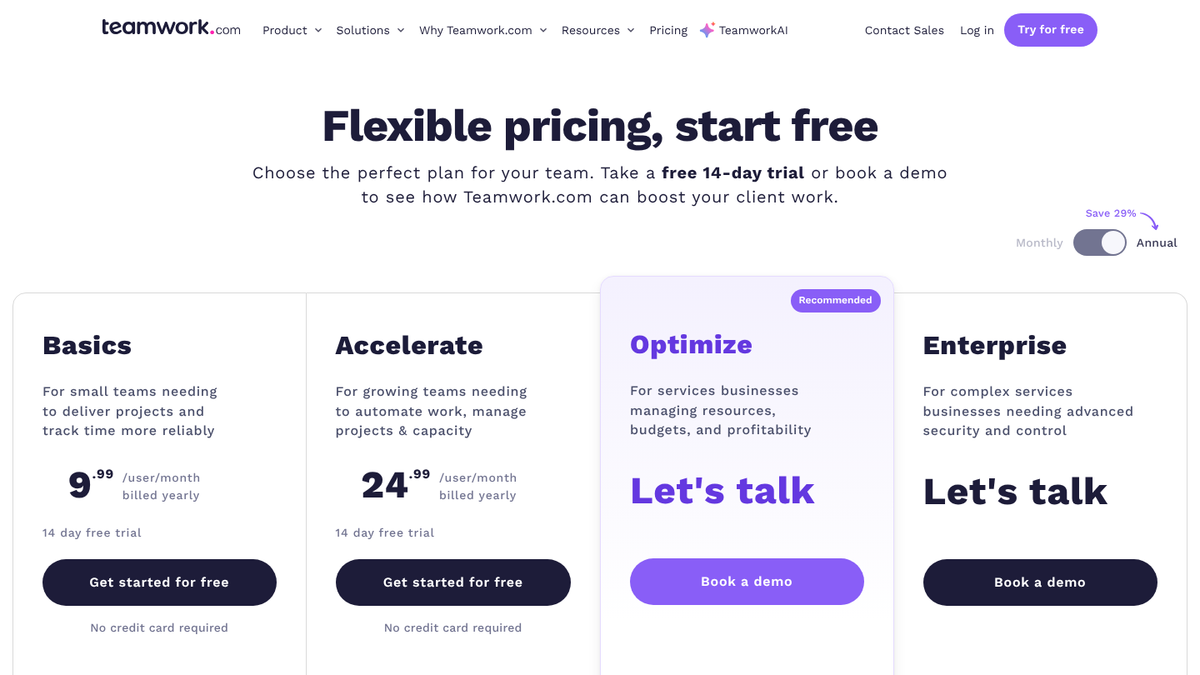
The same page's product schema says something else. It lists plans called Deliver at $13.99 monthly and $10.99 annually, Grow at $25.99 and $19.99, and Scale with no price. None of those plan names appear on the visible page, and Basics and Accelerate don't appear in the schema. It looks like markup left over from an older pricing model that nobody updated when the plans changed.
We call this fact drift: one fact saying different things in the different places machines read it. Here it was the schema against the page. On other sites it's the page against a review site, or the llms.txt against the docs. The fix here is simple, and it applies anywhere: generate the schema from the same source as the pricing page, and add "update the schema" to the checklist for every pricing change.
The same drift shows up off your site too. If your G2 or Capterra profile still lists last year's plans, AI engines that cite those sites can repeat the old numbers, and a comparison page on a rival's blog may be quoting them already.
Layer 4: do the engines get the brand right?
Next, ask the engines about the brand itself and compare their answers with the facts. We asked the APIs behind ChatGPT and Perplexity, with web search on, what Teamwork.com costs and who founded it.
Both engines gave the current prices, Basics at $9.99 and Accelerate at $24.99, and cited the pricing page and pricing.md. Neither picked up the stale schema numbers. Both also said the company was founded in 2007 by Peter Coppinger and Daniel Mackey, which matches the company's own llms.txt and AI information page.
So the drift hadn't reached an AI answer yet. That's good luck, not a reason to leave it. Every tool that reads schema directly, from comparison sites to shopping feeds, is a chance for the old numbers to spread.
Layer 5: which questions name you, and which don't?
The last layer is visibility itself. We asked six buyer questions across both engines.
| Question | What the engines did |
|---|---|
| Best project management tools for client services agencies | Both named Teamwork.com first; Perplexity cited six Teamwork.com pages |
| Teamwork.com vs Asana for agencies | Both favored Teamwork.com; Perplexity's first source was Teamwork's own comparison page |
| What is Teamwork.com's pricing? | Both gave current prices, citing the pricing page |
| Is Teamwork.com good for a creative agency? | Both said yes, with accurate feature detail |
| Who founded Teamwork.com, and when? | Both correct, citing Teamwork's own pages |
| Top alternatives to Teamwork.com | Almost entirely other people's pages |
The last row is the gap. For "top alternatives to Teamwork.com," Perplexity cited 19 sources. Most were review sites like G2 and Capterra, and five were "Teamwork alternatives" posts from competitors: monday.com, Toggl, Scoro, Rocketlane and ProofHub. The only Teamwork.com page on the list was its own "Jira alternatives" post. ChatGPT's API cited competitors' feature pages.
That pattern shows up at most companies. A brand wins the questions where it's the subject, and loses the one question buyers ask right before they leave. Whether to contest it, with a straightforward "alternatives to us" page or a comparison page for each rival, is a business call. The audit's job is to show you it's happening.
200+ SaaS teams already track their AI citations.
They know exactly when ChatGPT mentions their brand, and when it stops. Do you?
The whole audit on one page
| Check | Result | Fix |
|---|---|---|
| AI crawlers allowed in robots.txt | Pass | None |
| Text and prices in raw HTML | Pass | None |
| Structured data coverage | Pass | None |
| Schema matches the visible page | Fail: old plan names and prices in the schema | Generate schema from the pricing source |
| llms.txt and machine-readable pricing | Pass | None |
| Brand facts in AI answers | Pass | Keep checking monthly |
| Category, comparison and use-case questions | Pass | None |
| "Alternatives to us" question | Gap: rivals and review sites own it | Decide whether to contest it |
How to run this on your own site
Set aside about two to three hours for the first pass. Spend 20 minutes on robots.txt and raw HTML for five important pages: home, pricing, one product page, one comparison page and your best blog post. Then spend an hour on facts. List your prices, plan names, founding details and core claims. Then check each one in your page text and your schema, in your llms.txt if you have one, and on your two biggest review-site profiles.
If you only have one afternoon, our timed AI visibility audit shows which checks found problems most often across 49 small business sites.
Then spend an hour or more on answers. Ask 20 to 30 buyer questions in ChatGPT, Perplexity, Gemini and Google's AI Mode, signed out, and log who gets named and which pages get cited. One marketer in r/MarketingandAI described almost exactly this routine, with 30 to 50 real customer questions asked once a month and tracked over time, and put the cost at "2-3 hours a month."
How do you Audit your AI visibility right now? Do you have a set process? Because I am not trusting the tools to do it.
Like mentioned in the title do you guys have a set process or structure you use to understand what your brand is for AI? What it knows what it doesn't and what are positives and negatives so you could work towards better perception from AI...
Be wary of paying for an audit that skips the last two layers. One working SEO on X described receiving a $25,000 "AI visibility audit" from a large communications firm that turned out to be an export of an SEO tool's suggestions. Crawler and schema checks are the easy part. The facts and the answers are where the findings are.
hot take but a lot of new people selling ai search do the “aeo” / “geo” version of this. Then say some stupid toxic shit like we’re all figuring this out together to justify their clown dumbass tactics like: - llms.txt file - auto blog scaling (you lot know the tools I’m
 Harpreet@harpreetchatha_Sep 25, 2026
For the other ways to run this, see our 30-minute AEO audit playbook, the AI search readiness checklist, and our guide to auditing AI crawlers in your server logs.
You can repeat the answer checks by hand every month. Or RankControl can run them: AI visibility tracking asks up to 50 buyer questions every week on seven engines, including ChatGPT, Perplexity and Google AI Mode. Our tracking shows which competitors got named instead of you and which sources each engine quoted.
For a quick first look, run a free check of your brand in AI answers.
How often does ChatGPT mention your brand?
Most founders have no idea. The answer might surprise you.