
You update a client's address on four directories, wait a few weeks, and the Maps ranking doesn't move the way it would have ten years ago. That's not a mistake on your end. Citations have quietly dropped to the bottom of the list of things that move a local pack result.
What's odd is that the same listings just picked up a second job. AI answers started leaning on them to describe local businesses to buyers, often the exact directories SEOs stopped bothering with. This guide walks through what a citation is, how little it now does for Maps, where the underlying data lives, and why it matters again somewhere else entirely.
What a local citation is
Any online mention of your business's name, address and phone number counts as a citation. SEOs shorten that to NAP. Most of them are listings: a Yelp profile, Bing Places, Apple Maps, Yellow Pages, Facebook, or whatever directory covers your industry. A write-up in a local newspaper or a chamber of commerce page counts too, even without a structured listing behind it.
| Type | What it looks like | Example |
|---|---|---|
| Structured | A business listing with fields for name, address, phone, hours | A Yelp or Bing Places profile |
| Unstructured | A mention inside an article or post | A local news story naming your shop |
People sometimes lump citations in with backlinks, and that's a mismatch worth clearing up. Plenty of listings don't link to your site at all, and the ones that do often tag the link nofollow. What a citation actually does is confirm, in a place search engines and AI tools both check, that your business exists, where it sits and how to reach it. The link side of the picture is covered in our guide to types of backlinks.
How much citations still matter for Google Maps
Whitespark's 2026 Local Search Ranking Factors report put a number on the decline. Published November 6, 2025, it surveyed 47 local search experts across 187 ranking factors and grouped their answers by signal type.
| Signal group | Share of local pack and Maps ranking |
|---|---|
| Google Business Profile | about 23% |
| Reviews | about 21% |
| Behavioral signals | about 16% |
| Links | about 14% |
| On-page | about 13% |
| Citations | about 7% |
| Personalization | about 4% |
| Social | about 2% |
Citations landed near the bottom, well under reviews, links and the website itself. It's worth noting Whitespark makes its living selling citation tools, so a result this unflattering to its own category probably isn't inflated in the other direction.
One electrical contractor put a similar split on their own books. They told their followers on X that they spend about 20% of their local SEO budget on citations and authority links, and the other half on review volume and response speed, adding that their agency can only move half of what actually grows the business.
@theseoguy_ Local biz SEO playbook: 10% on-page SEO 10% supporting content, service pages, etc 10% GBP address/service area, NAP consistency 20% local citations and authority links 50% google review volume & velocity My SEO agency is great, but they can only affect 50% of my growth
 Fred McGill@freddymcgillAug 31, 2026
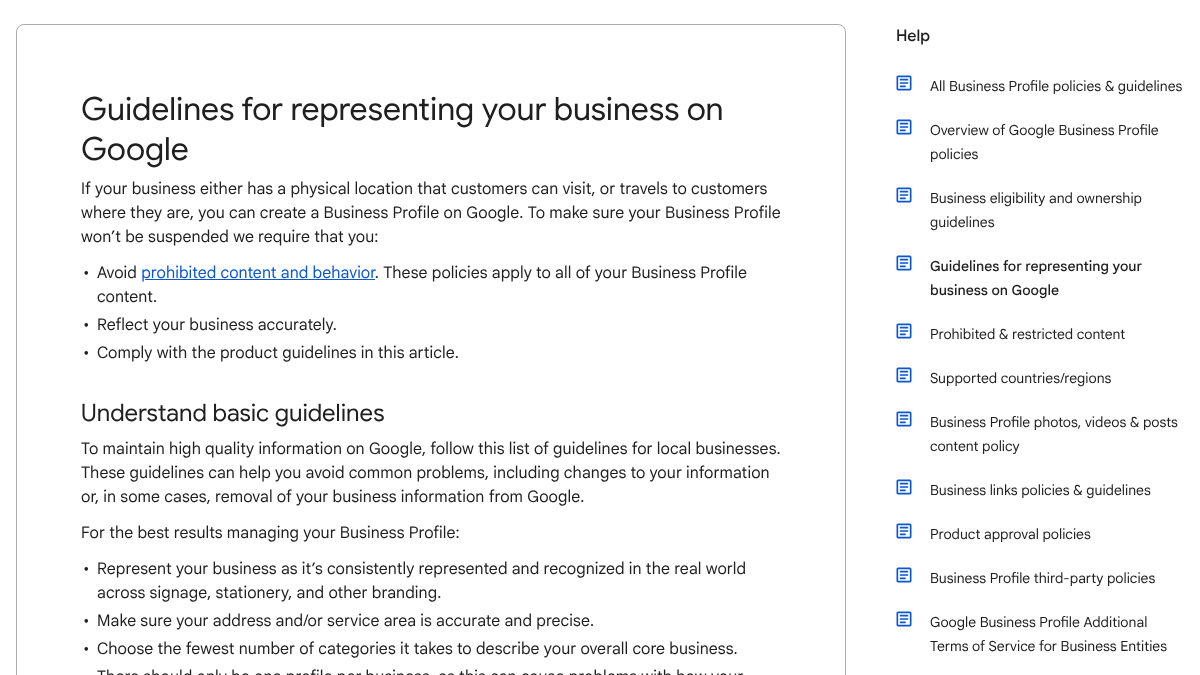
So citations haven't disappeared as a factor, they've just stopped being a lever worth pulling hard on their own. Where they earn their keep now is accuracy. Google's own guidelines for representing your business ask owners to represent their business "as it's consistently represented and recognized in the real world across signage, stationery, and other branding."
A wrong set of hours on Yelp isn't going to tank your rankings. It will send someone to a locked door on a Tuesday afternoon.
See your first AI citation report in under 5 minutes.
No setup calls. No onboarding meetings. Connect your domain and see where AI mentions your brand right now.
The second job: AI answers
Whitespark's 2026 survey asked something new this time: which factors shape how a business shows up in AI answers. Its own summary line is blunt. "In AI SEO, mentions (citations) are the new link."
The numbers back that up. A study from Foundation Marketing and AirOps, reported by PPC Land in May 2026, counted how often AI engines cited local directories across the last quarter of 2025. Yelp alone picked up 512,680 citations in that window, "outpacing BBB by 3.4x." BBB came in second at 149,710, and Angi third at 145,633. Roughly two thirds of Yelp's citations traced back to Google AI Mode specifically.
Local Falcon, which sells its own local rank tracking, went looking for where ChatGPT pulls its local business details and landed on a similar answer. It found that "one of the biggest data sources for ChatGPT's local recommendations is Bing Places for Business," alongside Yelp, Tripadvisor, BBB, MapQuest and Yellow Pages.
There's a name worth giving this: the directory echo. The same profiles that barely nudge a Maps ranking anymore now get read back word for word when a buyer asks an AI engine about you, mistakes included.
Directories aren't the whole picture, though. A Reddit user in r/GoogleMyBusiness ran their own breakdown of 14,472 AI citations for local business queries and found business websites still carried about 60% of them, ahead of directories, forums and review sites put together. The same user noticed something else worth sitting with: asking an engine the identical prompt twice turned up the same sources only about 40% of the time.
We analyzed 14,472 AI citations to see what Gemini and ChatGPT actually use when recommending local businesses
A few of the findings surprised me: Business websites still dominate. 60% of citations went to the businesses' own websites — more than directories, forums and review platforms combined. AI didn't create a new quality bar. AI-recommended bu...
Your own site is still doing most of the work. Citations are the supporting cast, there to keep your details looking the same no matter where an engine checks. Our post on where AI engines pull citations from goes deeper into the website half of that split.
The vendors have noticed
On October 19, 2026, we went through the main product pages of four citation and listings vendors to see how they're pitching themselves these days. Three of them, BrightLocal, Yext and Synup, now lead with AI visibility rather than citation building. Only Whitespark's Local Citation Finder page still frames itself purely around finding citation opportunities.
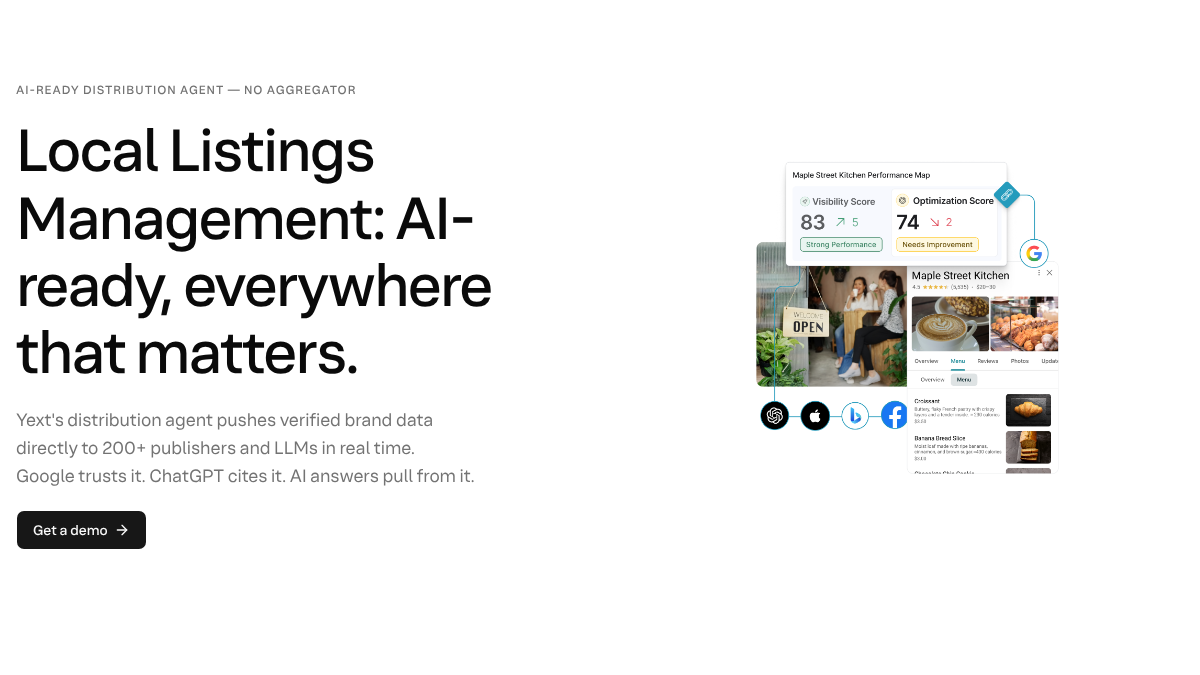
Yext goes the furthest of the four. It now calls its listings product an "AI-Ready Distribution Agent" with "No Aggregator," claiming it pushes business data "directly to 200+ publishers and LLMs in real time." Take that as marketing copy, because it is. It's also a decent signal of where this corner of the industry thinks the value has shifted.
Where the data comes from
Most directories don't gather business details on their own. They buy that data from a handful of aggregators, who then feed it to maps, apps, navigation systems and search engines downstream. Fix a wrong number at the source and the correction travels. Leave it wrong, and so does the mistake.
| Aggregator | What it claims to cover |
|---|---|
| Data Axle (formerly Infogroup) | "Verified profiles on 90+ million businesses," distributed to search engines, directories, navigation apps "and AI-driven search" |
| TransUnion Digital Business Profile (formerly Neustar Localeze) | "Partnerships with over 80 search platforms, directories, navigation systems, mobile applications, and more," including Bing and Apple Maps |
| Foursquare | Places data covering "100M+ points of interest across 200+ countries" |
Outside the US, you're usually looking at a local Yellow Pages equivalent plus the same handful of global players. Check which ones actually rank for businesses like yours in your own city before you assume the US list applies.
Your competitors are building backlinks while you read this.
Organic outreach, social mentions, and citations from Editorial Circle member sites, with managed backlinks available as an add-on. Grow your domain authority without running the campaign yourself.
Which citations to get right first
Skip the directory list with two hundred entries on it. Start with the small set that buyers, Maps and AI engines actually read.
- Google Business Profile. Your master record.
- Bing Places for Business. Feeds Bing, Copilot and, per Local Falcon, ChatGPT.
- Apple Business (formerly Apple Business Connect). Feeds Apple Maps and Siri.
- Yelp. The most cited directory in the AI study above.
- Facebook. Still the second website for a lot of small businesses.
- BBB and Angi, if you run a home or local service business.
- The top two or three directories for your industry, Tripadvisor for restaurants, Avvo for lawyers.
- The data aggregators, so the long tail of smaller listings updates without you touching each one.
Use one exact format everywhere for your name, address and phone number. "Suite 200" in one place and "#200" in another looks trivial, but it's exactly the kind of mismatch that leaves a system unsure whether two listings describe the same business. Our guide to NAP naming for multi-location brands covers the trickier cases, multiple locations included.
How to audit your citations in an afternoon
- Write down your official NAP, hours, website and categories in one document.
- Search Google for your business name plus your current phone number, then again with your old address if you've moved.
- Open each of the top listings above and check them against that document.
- Fix what's wrong, starting with whatever already ranks for your name.
- Ask an AI engine something like "What are the hours and phone number for [your business] in [your city]?" and note which details it repeats back.
That last step didn't exist a couple of years ago. If ChatGPT or Perplexity hands someone a wrong phone number, track down the listing it pulled that from and fix it there first.
Doing it yourself or handing it off
Cleaning up your citations is mostly a one-time job, followed by a check every few months. You can run it yourself in an afternoon, or lean on a listings tool once you're managing more than a couple of locations.
RankControl doesn't touch directory listings. It works on the half of this that carries more of the weight anyway, your own site. It writes and publishes articles that answer what local buyers are actually searching, and its AI visibility tracking checks up to 50 buyer questions every week across seven AI engines, things like "best plumber in Austin." You get a notification the moment an answer starts citing your site. Expect Google traffic to show up first, with AI mentions following more slowly as other sites link to you and talk about you. For more on where AI search and local SEO overlap, see our guide to local SEO for AI search.
You're getting AI traffic. But do you know where it comes from?
RankControl credits every visit to the assistant that sent it: ChatGPT, Perplexity, Claude, Gemini, Copilot, or Grok. Full source attribution, next to your Google traffic.