
You open your rank tracker on Monday and half your keywords have fallen off a cliff. Search Console says your average position hasn't moved. Plenty of SEOs saw that split in October 2026. In an r/SEO thread about third-party rank tracking breaking, one of the top replies said they'd rather just use Search Console data.
The tracker's SERP data was bad. SERP data is the record of what Google showed for a query at one moment. It covers which pages ranked where and which features showed up. More and more, it also covers what the AI Overview said and which pages it cited.
This post covers what's in that record, what it now shows about AI Overviews and why Google made it harder to collect. I checked every source on October 19, 2026.
What SERP data is, and what it isn't
SERP data is the raw material. Reading it before you write is a separate job, covered in our guide to SERP analysis. Each part of the page also has its own rules, which our guide to SERP features covers. This post sits one layer under both.
Every check of a results page produces roughly these fields:
| Field | What it records | What you read from it |
|---|---|---|
| Organic results | Position, URL, title and snippet for each link | Who ranks and which format wins |
| Ads | Paid results above and below the links | How commercial the query is |
| AI Overview | Whether one shows, its text and the pages it cites | Whether Google answers it and who gets quoted |
| People Also Ask | The questions listed and the pages that answer them | Follow-up questions your page should cover |
| Local, shopping and video blocks | Which ones show and where | Whether a blog post can compete at all |
| Related searches | Queries suggested at the bottom | Nearby topics |
| Check details | Date, location, device and language | Whether two checks can be compared |
The last row is the one people skip, and it's the one that bites. A result pulled from a phone in Ohio last Tuesday and one pulled from a desktop in London today aren't the same data.
Reading intent, difficulty and click potential from SERP data
Three questions come out of almost every SERP data pull. What does the searcher want, who would you have to beat, and will anyone click if you win?
Intent shows up in the result types, as on this results page for "best running shoes for flat feet":
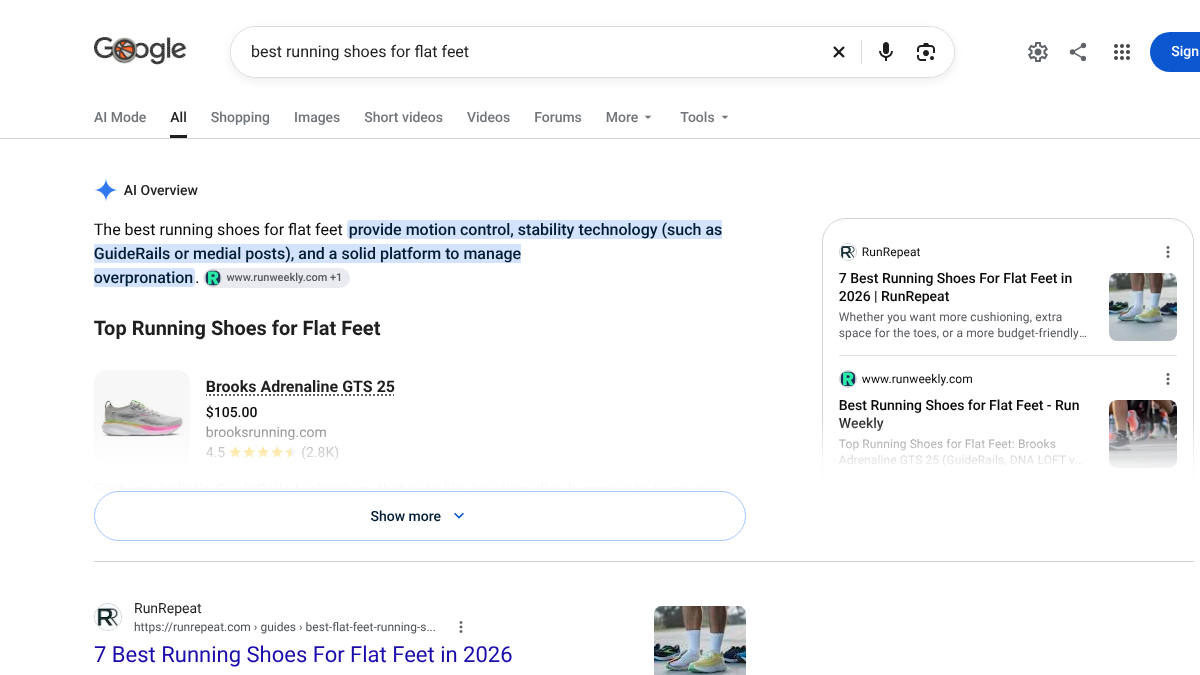
The AI Overview answers first, a product block with prices sits under it, and the first organic result is a ranked list from RunRepeat. That page tells you the searcher is comparing products before buying, so a how-to on foot types would miss.
Difficulty comes from who ranks. If the top ten are big brands with years-old guides, you'll need links and a better page. If forums and thin pages hold a few spots, the door's open.
Click potential is the part most people guess at. Count what sits above the first organic link, since every block up there takes clicks first. Our roundup of CTR by position shows how steep that drop has become.
People Also Ask blocks work both ways:
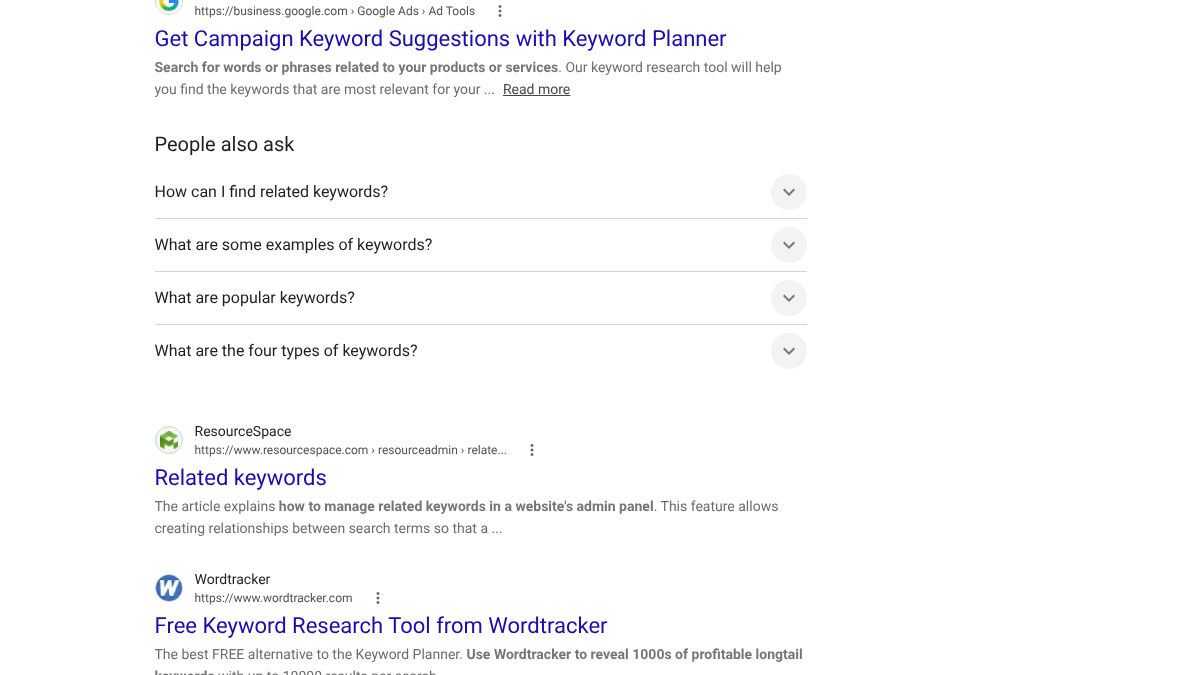
Each question is a spot where Google can show a page, and each one pushes the next link further down. I'd treat a PAA box as a list of sections to write.
We'll show you exactly where your brand stands in AI search.
No commitment. $0 due today, cancel anytime. See how ChatGPT, Perplexity, Claude, Gemini, Grok, Google AI Mode, and Google AI Overviews talk about your brand today.
What SERP data says about AI Overviews
The big studies on AI Overviews are all SERP data at scale, and they don't agree on how often the boxes show. Ahrefs looked at 55.8 million AI Overviews across 590 million keywords in May 2025. It found them on about 16% of US desktop keywords, and on 12.8% of all searches in its data by volume. Ahrefs said even that was too low, since it skips low-volume queries and checks logged out.
Semrush tracked more than 10 million keywords through 2025 and saw a rise and fall. AI Overviews showed for 6.49% of its keywords in January, peaked near 25% in July and slid to 15.69% by November. In January, 91.3% of the queries that triggered one were informational, and by October that share was down to 57.1%, while commercial queries grew from 8.15% to 18.57%.
So the boxes now show up on buying searches, like the running shoes page above. Both companies sell SEO tools and counted their own keyword sets, so use the numbers for direction, not for a precise share.
The overlap drop: from 76% to about 37%
The most useful finding in SERP data right now is about which pages AI Overviews cite. In July 2025, Ahrefs studied 1.9 million citations from 1 million AI Overviews. It found that 76.1% of the cited pages ranked in Google's top 10 for the same query, and only about 14% ranked below position 100.
Then Ahrefs ran it again.
| July 2025 study | March 2026 update | |
|---|---|---|
| Sample | 1.9M citations from 1M AI Overviews | 4M cited URLs across 863K keyword results pages |
| What was counted | The top 3 citations in each overview | All cited URLs |
| Cited pages in the top 10 | 76.1% | 37.1% (37.9% counting all SERP features) |
| Cited pages outside the top 100 | About 14% | 36.7% (organic only) |
The March 2, 2026 update roughly halved the overlap in about seven months. Ahrefs gave three reasons. Google splits a query into many related searches before it answers, called query fan-out, and AI Overviews moved to Gemini 3 in January 2026, which may fan out wider. Ahrefs also got better at reading citations.
The headline skips a caveat. The first study counted the top three citations per overview and the second counted every cited URL, so some of the drop is method. Ahrefs also sells Brand Radar, the tool behind the second study. Still, more than a third of cited pages ranking outside the top 100 is hard to blame on method alone.
I call this the fan-out gap. A growing share of citations comes from searches you never typed, so the SERP data for your keyword can't tell you who gets cited. You have to record the cited pages as a field of their own. Our guide to tracking AI Overviews separately from rankings covers how.
Know exactly what AI says about your competitors.
RankControl's Recon Agent monitors competitor citations across ChatGPT, Perplexity, Claude, Gemini, Grok, Google AI Mode, and Google AI Overviews. See where they show up and you don't.

Why SERP data got harder to collect
While AI Overviews changed what the data shows, Google was changing who gets to see it.
January 2025, JavaScript required
Google started requiring JavaScript to use Search in January 2025, as Techzine reported on January 20. Google said the goal was to "better protect Google Search from malicious activity like bots and spam and to improve the overall search experience for users." It also said fewer than 0.1% of searches came from people with JavaScript turned off.
Google's later lawsuit names the system. Per Search Engine Journal's report on the complaint, SearchGuard went live that month and sends a JavaScript challenge to requests it doesn't recognize. A plain script no longer worked, so collecting results took a full browser.
September 2025, the end of num=100
For years, adding num=100 to a Google search URL loaded 100 results on one page, and rank trackers relied on it. Search Engine Roundtable reported on September 12, 2025 that Google was testing dropping it, with AccuRanker seeing the setting honored only about half the time. It then "fully stopped working" and "broke most Google trackers." Google didn't comment.
Without it, pulling the top 100 for one keyword takes ten page loads. Trackers haven't been calm since. In an October 2026 r/localseo thread, one SEO said searches came back with 17 or 18 results instead of 100, sometimes with another country's results mixed in. In the r/SEO thread from the opening, another user said they check every tracker drop against Search Console before telling a client.
December 2025, Google sues SerpApi
On December 19, 2025, Google's General Counsel Halimah DeLaine Prado published why Google was suing SerpApi, a company that sells Google results through an API. It accuses SerpApi of "bombarding websites with massive networks of bots and giving their crawlers fake and constantly changing names." The complaint, filed in federal court in Northern California, claims SerpApi sent hundreds of millions of fake searches a day, as Search Engine Journal reported. Those are Google's claims, not findings, and SerpApi said it would "vigorously defend" itself.
The case hasn't ended. I read the court docket on October 19, 2026. On July 20, 2026, Judge Yvonne Gonzalez Rogers granted SerpApi's motion to dismiss and gave Google until August 10 to amend. Google filed an amended complaint on that day, and SerpApi moved to dismiss again on August 24. On October 5, the court cancelled the October 13 hearing, and no ruling on the second motion was on the docket as of October 19.
Aleyda Solís called the July ruling an important win for SERP data access, while noting the lawsuit was far from over:
⚡️ The Latest News & Updated in SEO & AI Search [From today's #SEOFOMO - July 26, 2026] 👇 * Google loses key DMCA claims against SerpApi in scraping lawsuit - SERP data access gets an important win, but the lawsuit is far from over * Exclusive: Yelp partners with ChatGPT to https://t.co/0qXjpJZ7LQ
 Aleyda Solis 🕊️@aleydaJul 26, 2026

Google's own rules are the other half of this. Its Terms of Service, in the version effective July 30, 2026, tell users not to be "using automated means to access content from any of our services in violation of the machine-readable instructions on our web pages (for example, robots.txt files that disallow crawling, training, or other activities)." They also say Google may suspend or end access if conduct causes harm, for example "scraping content that doesn't belong to you."
How to use SERP data without getting fooled
You don't need perfect data. You need to know how it was collected and where it breaks:
- Write down the date, location, device and language of every check. Compare checks only when those match.
- Check any sudden tracker drop against your average position in Search Console before you change a page or tell a client.
- Record AI Overview citations as their own field. A top 10 ranking now says little about who gets quoted.
- Read every study by its sample and method, and ask what the publisher sells.
- Repeat checks, since features and citations move week to week.
None of this is fast. By my rough estimate, checking 50 keywords by hand and noting the features and cited pages takes about two minutes each, close to two hours a week. Our roundup of zero-click search statistics compares the studies on how many Google searches end with no click at all.
Doing it yourself or handing it off
You can collect and read SERP data yourself with a private window, Search Console and a spreadsheet. Or you can let software run the checks every week while you work on the pages.
RankControl tracks your Google and Bing rankings and runs weekly checks on seven AI engines to see whether each one names or cites you for the questions you track. We offer one flat plan at $400/mo with a 7-day free trial.
26 content formats. Published on your domain. Matched to your brand.
Guides, comparisons, listicles, case studies, and more. RankControl generates content that gets cited by ChatGPT, Perplexity, Claude, Gemini, Grok, Google AI Mode, and Google AI Overviews.