
You open Search Console to look at the FAQ report, and it's gone. The Rich Results Test won't check FAQ markup anymore either. Meanwhile a plugin on your site is still printing FAQPage schema on every product page, and someone on the team wants to know if it should stay.
Google dropped FAQ rich results for every site on May 7, 2026. My answer to the schema question is simple. Keep the FAQ markup you already have if it matches what's on the page, stop adding new markup to win a rich result that no longer exists, and spend that time on the answers people can see. This post gives the dated timeline, what Google says about schema and its AI features, and a keep-or-remove table for each case. Sources were checked on October 19, 2026.
The FAQ rich results timeline, with dates
Most of the confusion comes from two changes almost three years apart. The first one cut FAQ rich results down to a few sites. The second one ended them.
| Date | What Google changed |
|---|---|
| August 8, 2023 | FAQ rich results limited to "well-known, authoritative government and health websites", and HowTo rich results ended outright |
| September 14, 2023 | FAQ docs updated to match, logged in the Search Central changelog |
| May 7, 2026 | FAQ rich results stop showing in Google Search for all sites, government and health included |
| June 2026 | FAQ search appearance filter, FAQ rich result report and Rich Results Test support removed |
| August 2026 | FAQ rich result support removed from the Search Console API |
| By October 2026 | The FAQPage docs page itself is gone |
Google logged the May change in its Search Central changelog on May 8, with a notice on the FAQ docs page. There was no blog post this time, which Search Engine Journal pointed out in its write-up. The notice, still readable in a Wayback Machine copy from May 11, set out the June and August steps in advance.
The last step is the one most write-ups miss. I checked the old FAQPage docs URL on October 19, and it now sends a 301 redirect to the changelog. Google's reason, given in the entry itself, is that the feature "is no longer shown in Google Search results."
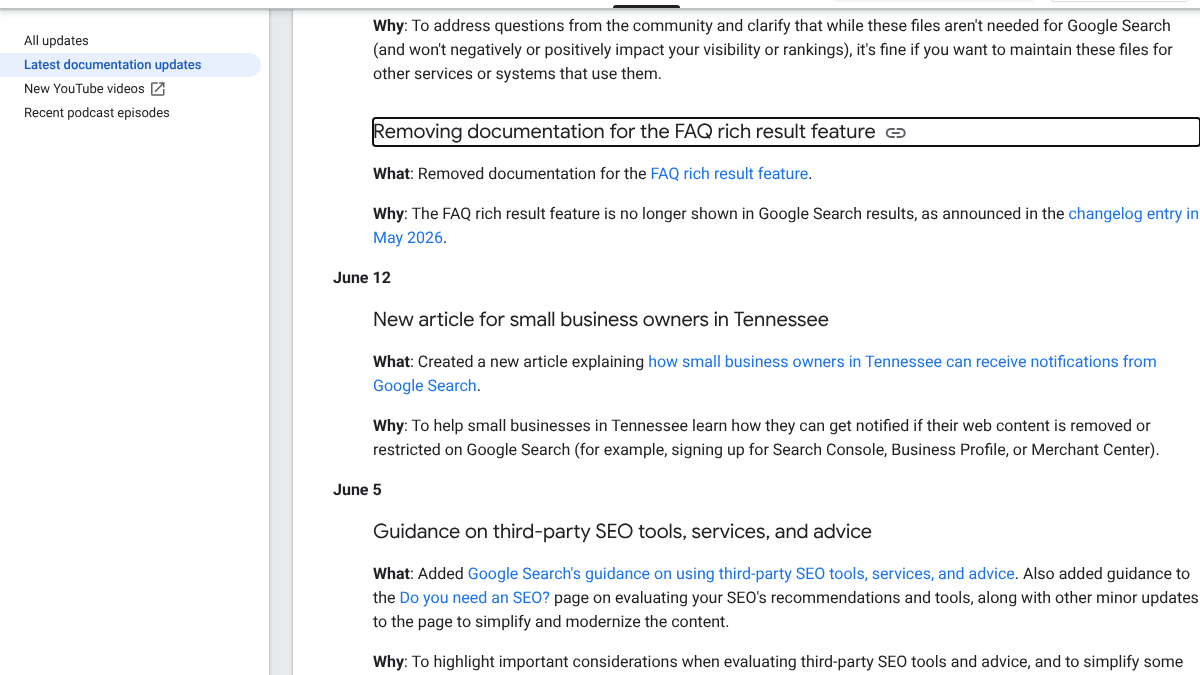
When someone tells you FAQ rich results died in 2023, they're mixing up two changes. The 2023 change was a limit, and HowTo was the one Google killed outright that year. FAQ rich results ended in May 2026, almost three years later.
What Google says about schema and AI features
If FAQ markup no longer earns a rich result, the next guess is that it helps with AI Overviews instead. Google's guide to AI features says otherwise, in plain words.
"There are no additional requirements to appear in AI Overviews or AI Mode, nor other special optimizations necessary," the guide says. A little further down, it adds that there's "no special schema.org structured data that you need to add."
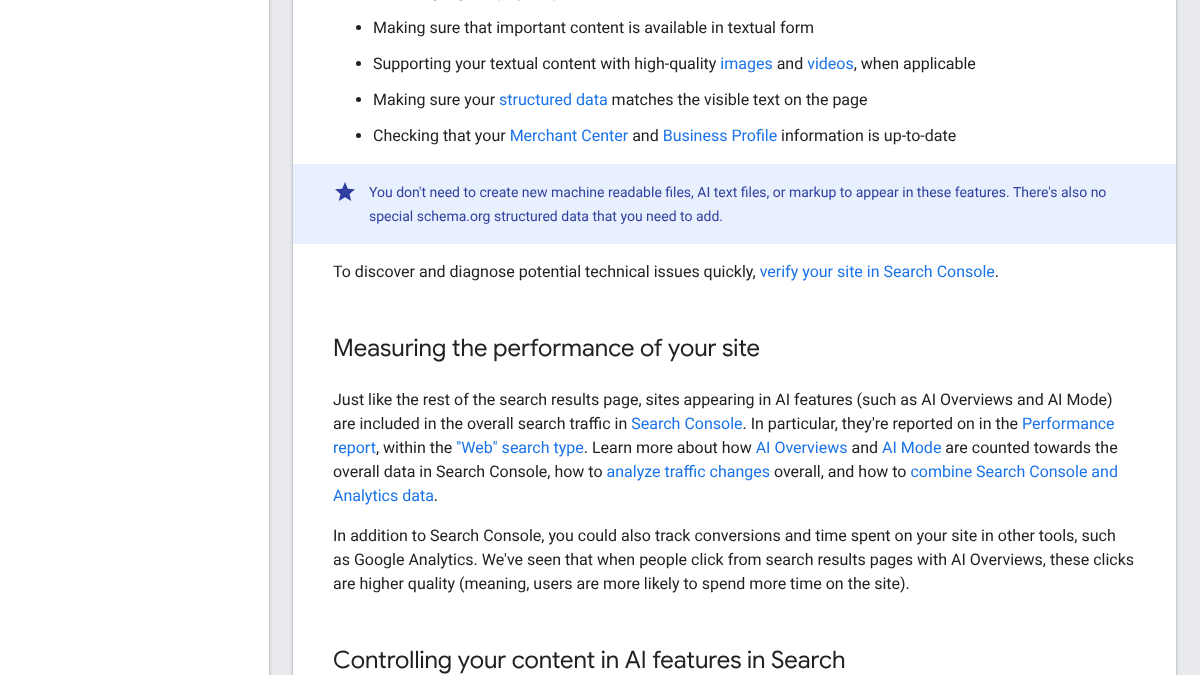
The same page asks one thing of the structured data you already have. It should match the visible text on the page. That's plain SEO hygiene, but it matters for the verdict below, because a lot of FAQ markup out there describes questions no visitor can see.
The guide says it was last updated on December 10, 2025, so it came before the May removal. Nothing in the 2026 changelog walks it back. One thing Google hasn't said either way is whether it still reads FAQPage markup to understand a page. Some roundups claim Google confirmed it does, but I couldn't find that line on any Google page, so I wouldn't count on it.
26 content formats. Published on your domain. Matched to your brand.
Guides, comparisons, listicles, case studies, and more. RankControl generates content that gets cited by ChatGPT, Perplexity, Claude, Gemini, Grok, Google AI Mode, and Google AI Overviews.

Does FAQ schema still help with AI citations?
It probably doesn't help much, and the newest data points the same way as the older studies. Ahrefs ran a controlled test on pages that added schema and found no real lift in AI citations. Our post on schema markup and AI citations lays that test next to every other study, so I'll skip the numbers here.
The freshest data point is a preprint posted to arXiv on September 28, 2026. Its two authors looked at about 2 million citations from ChatGPT, Claude, Google AI and Gemini over six months, joined to 10,000 pages from 19 B2B SaaS workspaces. In the pooled data, FAQ blocks and structured data looked helpful. Once pages were compared within the same domain, those effects reversed or fell to zero.
Statistics has a name for that, Simpson's paradox. Strong sites tend to have FAQ blocks, so the blocks look like the cause when the site is the cause. The paper's top predictor was how closely a page's words matched the questions people asked. Domain-level authority mattered about six times more than the next strongest page feature.
There are two caveats before you quote it. It's a preprint, so nobody has peer-reviewed it yet. And it was written by a vendor that sells AEO benchmarking, which has a stake in what the AEO checklist is worth. The sample is narrow too, since every page came from a B2B SaaS site.
Practitioners land in the same place for simpler reasons. In the r/SEO thread that shared Google's notice, the top reply said they'd leave the markup as it is, since Bing and AI crawlers may still find it useful. The thread drew 216 upvotes and 131 comments.
Google: FAQ rich results are no longer appearing in Google Search Result Appearances [Official]
From u/lilray on X (via GlennGabe) - thanks for sharing As of May 7, 2026, FAQ rich results are no longer appearing in Google Search. We will be dropping the FAQ search appearance, rich result report, and support in the Rich results test in...
The skeptics in those threads go further. Several argued that language models read a page as text and don't parse schema at all, which would put all the weight on the visible answer.
Keep, remove or add FAQ schema: the verdict by case
I call markup whose only Google display is gone orphan markup. It still sits in your HTML, it still checks out against schema.org's FAQPage type, and nothing in Google shows it to anyone. Whether to keep it depends on what's around it.
| Your situation | Verdict | Why |
|---|---|---|
| FAQPage markup matches a visible FAQ on the page | Keep it | Free to leave, still valid schema.org, and other engines may read it |
| A plugin adds FAQ markup to pages with no visible questions | Remove it | Google asks that structured data match the visible text |
| Two FAQPage blocks on one page, plugin plus hand-coded | Remove one | Two copies of the same answers can drift apart |
| You planned new FAQ markup to win rich results | Skip it | The rich result is gone for every site |
| You're adding a real FAQ section for buyers | Add the content | Markup is optional, and the visible answers do the work |
| A government or health site that kept the 2023 exception | Keep it, expect nothing | The exception ended on May 7, 2026 |
| Reports or scripts that read the FAQ filter or API | Update them | The filter went in June, API support in August |
For most sites, the first row is the answer. Taking working markup out costs developer time and gains nothing. Search Engine Journal's coverage of the May change reached the same view, that sites can leave the markup in place without consequence.
The rows people skip are the second and third. Plenty of sites have FAQ markup on pages where the questions sit in a hidden widget, or nowhere at all. That's the case worth fixing, because it breaks the one rule Google still states about structured data.

Your competitors are getting cited by AI. You're not.
Every day without citation tracking is a day your competitors pull ahead in ChatGPT, Perplexity, and Claude.
Why the FAQ schema advice is still mixed up
Search demand shows how much of the old habit is left. In US Google keyword data, "faq schema" gets about 720 searches a month, while "faq rich results" gets about 70. People still look up how to add the markup, years after the display began to shrink.
When we pulled Google's results for "faq rich results" in October, an AI Overview sat at the top. Google now answers questions about its removed feature with the AI feature it says needs no special schema.
Part of the mix-up is the two dates. In the same r/SEO thread, a reply with 17 upvotes called it old news and said FAQ rich results were deprecated back in 2023. They were limited in 2023 and ended in 2026. Treat them as one event and the May change looks like nothing happened.
Barry Schwartz of Search Engine Roundtable flagged the change on X on May 11, the same week as Google's changelog entry, which pins the date down from outside Google.
ICYMI: Google Search drops support for FAQ rich results https://t.co/sGnWZaumsS https://t.co/oUmxoQXYa4
 Barry Schwartz@rustybrickMay 11, 2026

The other part is advice that never got updated. One r/bigseo poster said their SEO person had put FAQ blocks on every category page of their store, and the team went along because he said it mattered. Another reader in the r/SEO thread had just started updating their FAQs and asked whether to stop. Both get the same answer. Keep writing FAQs that real buyers ask, and stop writing them for the rich result.
Where the FAQ effort should go now
The work that still pays is the visible part. Write the questions buyers really ask, and answer each one near the top of the page in their own words. That lines up with the preprint's strongest finding, the match between a page's words and the questions people put to AI engines.
Our guide to FAQ pages for AEO covers the structure, answer length and placement in detail, so I won't repeat it here. If you're checking every type of structured data on your site, the structured data blueprint goes type by type.
If you want markup that still says something useful, Organization schema is a better use of an afternoon. It carries facts about your business, like your name, logo and social profiles, that an engine might repeat. FAQ markup restates text that's already on the page, so it gives an engine no new facts.
For a wider view of which tactics have aged badly, our list of AEO best practices for 2026 puts FAQ schema next to the rest.
How to check your own FAQ markup
The audit is a small job. Crawl your site for FAQPage markup and check each page for visible questions that match. Remove the orphans that have nothing on the page behind them, then fix any dashboard that read the old FAQ report. For a site with a few hundred templated pages, I'd guess four to six hours, most of it spent on the crawl review.
The harder part is knowing whether your answers show up in AI search at all, since Search Console won't tell you that for ChatGPT or Perplexity. RankControl's AI visibility tracking checks up to 50 buyer questions every week across seven AI engines and marks which ones mention or cite you. Our content engine writes articles that answer those questions and publishes them on your own domain, where they can earn traffic from Google and AI search.
You can run the markup audit and the weekly question checks yourself, with a crawler and a spreadsheet. Or RankControl can run the weekly checks and the publishing while you fix the pages that matter.
200+ SaaS teams already track their AI citations.
They know exactly when ChatGPT mentions their brand, and when it stops. Do you?