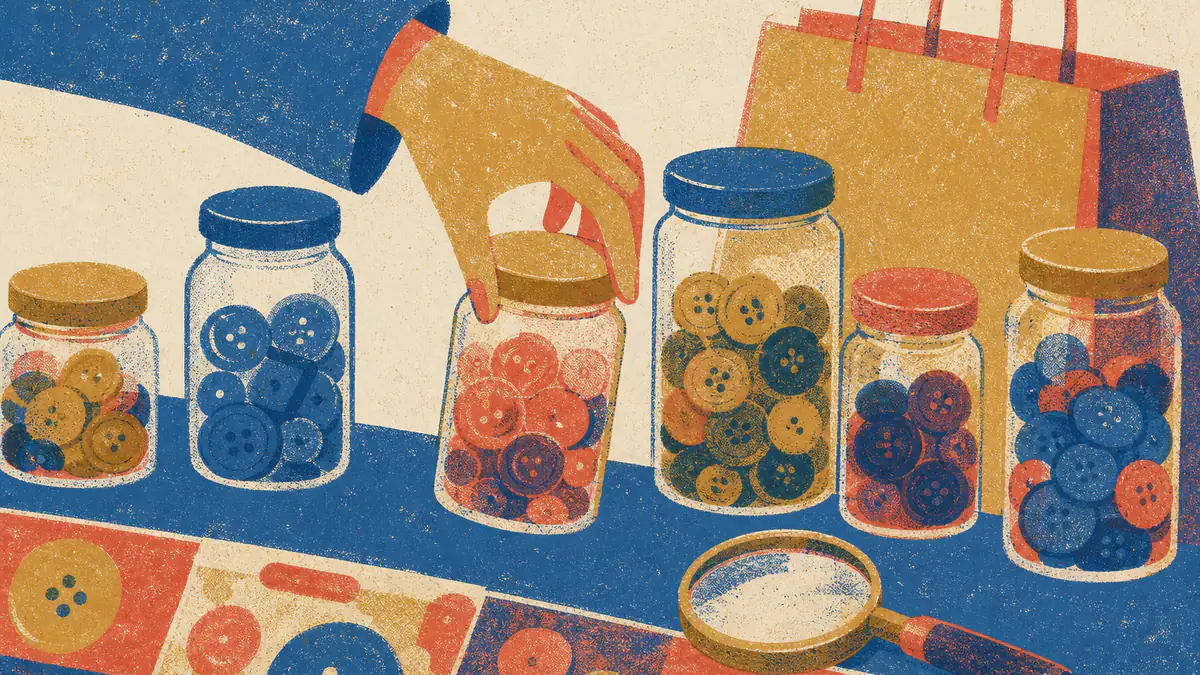
Nearly every online store already has product pages, and most have a blog too, usually a handful of posts about company news or some loosely related lifestyle topic. What's actually missing is the layer in between: the pages that help a shopper decide which product to buy in the first place.
That middle layer carries more weight now than it used to. Google's shopping results and AI shopping answers both lean on detailed product information, comparisons and reviews to make their picks. OpenAI says ChatGPT considers "structured metadata from first-party and third-party providers (e.g., price, product description) and other third-party content" when it decides which products to show someone.
So here's what an online store should publish beyond the product page itself, type by type, and why each one earns its place on Google and in AI answers.
The content types at a glance
| Type | The shopper's question | Where it lives |
|---|---|---|
| Buying guide | "What should I look for?" | Guide hub, linked from categories |
| Comparison | "Which of these two?" | Guide hub, linked from both products |
| How-to and care guide | "How do I use or look after it?" | Guide hub, linked from product pages |
| Category page copy | "Which in this range suits me?" | Top or bottom of the category page |
| Size and fit guide | "Will it fit?" | Linked from every relevant product page |
| Gift guide | "What should I buy for them?" | Seasonal pages |
| Reviews | "Is it any good?" | Product pages, plus written reviews |
I think of this as the aisle test. A good shop assistant would answer the question standing right there in the aisle, which means it's worth a page. If they'd only bring it up at the company party, it probably isn't.
What big stores already do
We checked the content hubs of six large online retailers on October 19, 2026. Four blocked our requests, so we can't say what they run, but two let us in.
Wayfair runs its Ideas & Advice hub 123 pages deep, filed under sections like Guides, Rooms, Styles, DIY and Organization, with titles ranging from a kitchen organization guide to a kitchen lighting plan. Chewy organizes Chewy Education by pet type instead, with breed guides, health questions and how-tos covering things like whether guinea pigs can eat oranges.
Neither hub reads as a list of products. Both answer the questions people actually have before, during and after they buy.
We'll show you exactly where your brand stands in AI search.
No commitment. $0 due today, cancel anytime. See how ChatGPT, Perplexity, Claude, Gemini, Grok, Google AI Mode, and Google AI Overviews talk about your brand today.
Buying guides
A buying guide answers "what should I look for?" for one whole category, which makes it the page a shopper often reads before they even know which product they want.
Put the handful of things that matter most when choosing in order of importance, say plainly what each option is good and bad at, name who each type suits, and link to the matching products and category pages as you go. Google's guidance on writing reviews applies just as well here. It asks writers to "explain what sets something apart from its competitors" and to "cover comparable things to consider, or explain which might be best for certain uses or circumstances."
Comparisons
Comparisons answer the exact moment a shopper has narrowed things down to two or three products. "Model A vs Model B" is about as decision-ready as a search gets.
A side-by-side table of the specs that actually matter does most of the work, followed by who should pick which in plain terms and what you'd choose for a common use case and why. Google's guidance asks that when you call something the best, you "include why you consider it the best, with first-hand supporting evidence." You sell these products, so that evidence is probably already sitting in your return rates, your support inbox and what customers tell you.
How-to and care guides
These answer what happens after the sale: how to set something up, use it, clean it or store it properly. They bring in searches from people who already own the product, or are close enough to buying it that the question has started to matter.
They also cut returns and support tickets, which pays for the work before a single search visitor shows up. Link each guide from the product pages it relates to.
Category page copy
Category pages often rank for the broad searches, things like "women's running shoes," and a short block of genuinely useful text helps both shoppers and search engines understand the range they're looking at.
Keep it to what the range covers in a sentence or two, how the main options differ from each other, and a link to the buying guide and size guide. Keep it short, full stop. A wall of text sitting above the products just gets in the way. Our ecommerce SEO guide covers how category and product pages rank differently on Google and on ChatGPT.
Know exactly what AI says about your competitors.
RankControl's Recon Agent monitors competitor citations across ChatGPT, Perplexity, Claude, Gemini, Grok, Google AI Mode, and Google AI Overviews. See where they show up and you don't.

Size and fit guides
For clothing, shoes and furniture, "will it fit?" is often the one question standing between a shopper and the checkout button. A real size guide answers it with actual measurements. "S, M, L" on its own answers nothing.
Give the measurements for each size, in both units you sell in, explain how someone measures themselves or their space, and say plainly whether the product runs large or small against a standard size. Google's guidance asks reviewers to "share quantitative measurements about how something measures up," and a size guide is where a store has the most precise numbers it owns.
Gift guides
Gift guides answer a completely different question: "what should I buy for someone else?" They peak hard around the holidays, so publish them weeks ahead of that and update the same page each year rather than writing a fresh one every time.
Group by who the gift is for, or by budget, never by your own product categories. The shopper is thinking about a person, not about how you organize your catalog.
Reviews, and reviews you write
Reviews pull double duty. Customer reviews sitting on product pages help shoppers directly, and they give AI answers raw material to summarize. OpenAI says ChatGPT "may also display product review summaries," built "on reviews from public websites."
You can write reviews yourself too. Google's ecommerce documentation, last updated December 10, 2025, names "an expert staff member or a merchant who guides people between competing products" as one legitimate kind of reviewer.
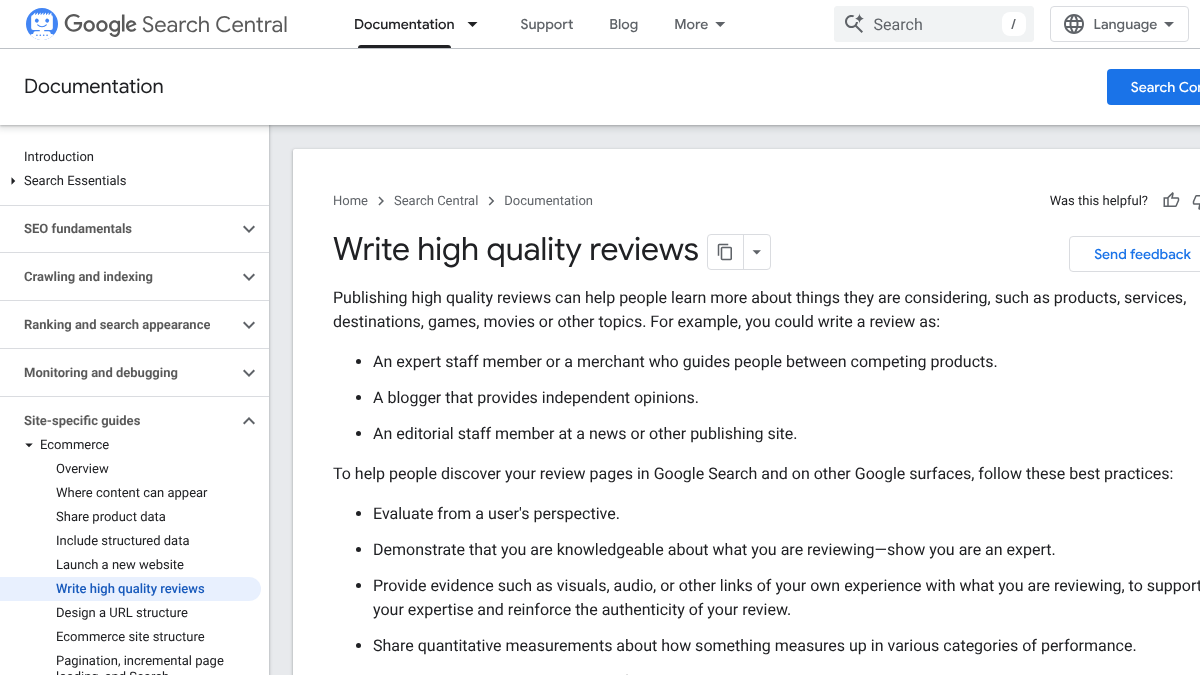
Google's reviews system "aims to better reward high quality reviews, which is content that provides insightful analysis and original research," and it's built against "thin content that simply summarizes a bunch of products." A staff review worth publishing shows the product in use, with your own photos and specific findings.
For the AI side of reviews, see our guide to how DTC brands get recommended by AI.
How AI shopping answers use this content
AI shopping answers pull from the same kind of information these pages already contain. OpenAI's help page on shopping in ChatGPT search says merchants "are ranked based on factors like availability, price, quality, and whether they are the maker or primary seller of that item."
Google's layer works much the same way. Its Universal Cart, launched October 15, 2026, draws on "60+ billion continually refreshed product listings in Google's Shopping Graph" to track prices and stock across retailers in something close to real time.
So structured product data does most of the work for which products even appear. The content around it, the guides, comparisons and reviews, is what helps a shopper, and an AI answer, understand why your product fits. Our test of which store pages ChatGPT cites shows what that looks like.
Is a blog worth it?
Someone asked exactly this on r/bigseo. One reply pointed to JetPens, the pen and stationery store, as a store that gets it right, since its guides surface on related category and product pages as well as on the blog itself. Another reply put it more bluntly. A store blog only earns its keep when it answers questions customers are already typing into Google.
Is a blog on your ecommerce site actually worth it, or a waste of time?
Hi everyone, I have a question: does anyone here run an online shop with a blog attached to it? Is it actually worth having a blog for an online shop? Has anyone made real sales through their shop that came from blog posts? I'm asking becau...
That's really the whole rule. A post about company news or some loosely related lifestyle topic rarely helps anyone choose anything. A guide to choosing between two of your own products almost always does.
Where to start
Starting from nothing, this order tends to pay off the fastest.
- A size or fit guide, if you sell anything that has to fit a body or a room. It removes the single biggest blocker to checkout.
- Buying guides for your two or three biggest categories.
- Comparisons between whichever products get the most views.
- Short copy on your top category pages, linking back to those guides.
- How-to and care guides for whatever generates the most support questions.
- Gift guides, built six to eight weeks ahead of your biggest season.
Our guide to ecommerce keyword research covers finding the exact searches each one of these should target.
Mistakes to avoid
The most common one is writing about the company when the shopper actually has a product question. Close behind it is burying good guides in a blog nothing else links to, when every guide should link back from the product and category pages it relates to.
Thin roundups of products you already sell are another trap, and Google's reviews system targets exactly that. So is category copy that pushes products off the screen, and writing a brand new gift guide every year instead of updating the one page that already has the links.
Doing it yourself or handing it off
You already know your products, your returns data and the questions your customers keep asking. That's the raw material behind every page above. Turning it into a steady stream of guides and comparisons is the part that eats hours.
RankControl does that part. We find the questions your shoppers search, write each guide or comparison against the pages already ranking for it, and publish it to your store as a native post, including on Shopify, Wix and WordPress. Our AI visibility tracking checks up to 50 buyer questions every week across seven AI engines. Expect Google traffic to move first, with AI citations following more slowly as links and mentions build up.
26 content formats. Published on your domain. Matched to your brand.
Guides, comparisons, listicles, case studies, and more. RankControl generates content that gets cited by ChatGPT, Perplexity, Claude, Gemini, Grok, Google AI Mode, and Google AI Overviews.