
Google's guide to AI search optimization explains query fan-out with an ordinary question: how to fix a lawn that's full of weeds. Before answering, the model runs related searches like "best herbicides for lawns," "remove weeds without chemicals" and "how to prevent weeds in lawn." One question from the person turns into at least three intents for the machine.
That example says more about AEO than most checklists do. Answer engine optimization is often sold as query optimization: find the prompts people type, match their wording and track them. Conversational AI changes search intent in ways that make the exact wording matter less and the situation behind it matter more. This guide covers how intent changes in a conversation, what stays the same and what to focus on instead.
What changed about the question
The biggest change is length. In May, Google published data from AI Mode's first year in the US:
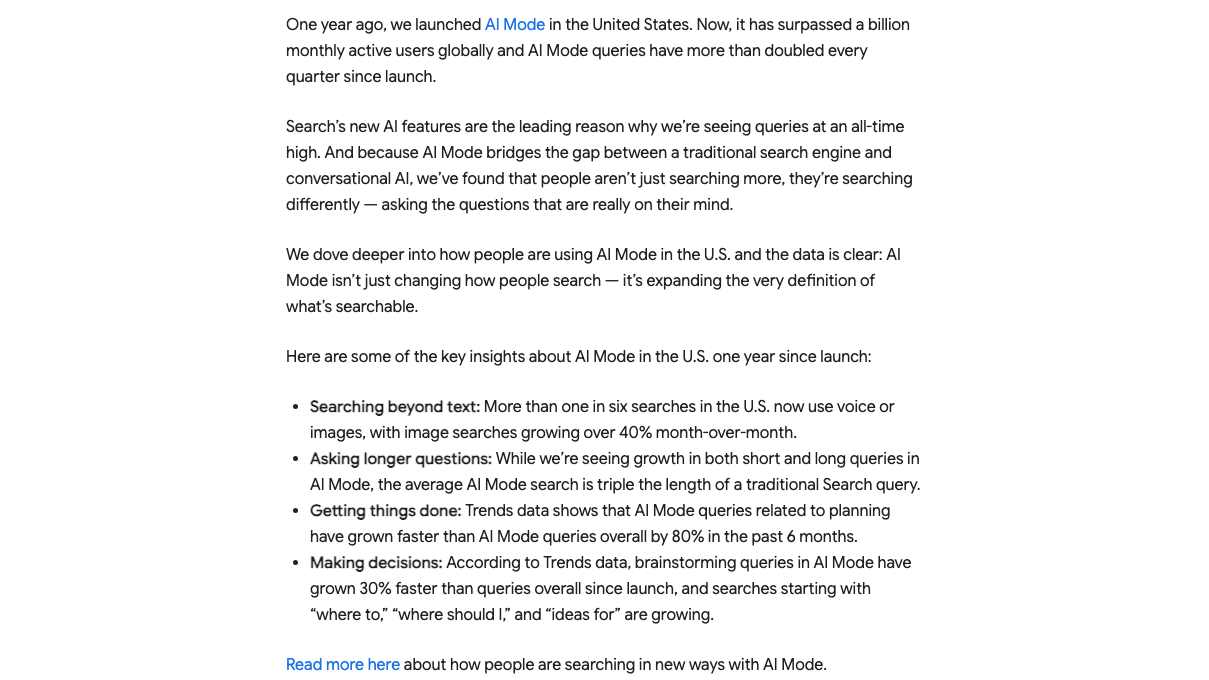
The average AI Mode search is triple the length of a traditional Search query. Queries about planning grew 80% faster than AI Mode queries overall in the six months before the post, and searches starting with "where should I" were on the rise.
Longer questions carry more of the asker's circumstances. OpenAI's own research makes the same point from the ChatGPT side. In a 2025 working paper covering usage through July 2025, OpenAI and academic researchers found that practical guidance made up about 29% of ChatGPT use. The paper defines that category as advice "highly customized to the user," which can be adapted through follow-up. Seeking information, the closest substitute for web search, grew from 14% to 24% of usage in a year.
Four ways intent changes in a conversation
The situation comes attached
A search box query like "CRM for small business" leaves the intent to guesswork. A conversational question usually includes the details: "We're a 12-person agency moving off spreadsheets, we use Gmail and we can't spend more than $50 a seat. What CRM should we use?"
We call this the situation layer: the part of a question that describes the asker's circumstances. It's where buying intent lives. Team size, current tools, budget and constraints decide which answer is right, and an answer engine uses them to decide which sources fit.
One question becomes several searches
Google's guide defines query fan-out as a set of related queries the model generates to fetch more information for the user's question. In B2B software, a single shortlist question can fan out into searches about pricing, integrations, alternatives and limits. A page that answers only the headline question competes for one of those searches. A page, or a small cluster of pages, that answers the sub-questions too can be useful for several.
Intent develops over turns
The first question is rarely the last. People refine: "which of those works with HubSpot?" then "what does the cheaper one cost for 20 users?" The intent narrows with each turn, and the sources an engine needs change with it. Later questions usually need more specific pages, like pricing details, integration documentation and comparisons.
People want a task done
The same OpenAI paper classified about 40% of ChatGPT messages as "doing," asking the assistant to produce something, against about 49% "asking." In B2B research, that looks like "build me a shortlist" or "compare these three tools in a table." The engine assembles the result from sources, and pages with clear, extractable facts are easier to assemble from.
Your competitors are building backlinks while you read this.
Organic outreach, social mentions, and citations from Editorial Circle member sites, with managed backlinks available as an add-on. Grow your domain authority without running the campaign yourself.

What doesn't change
Google's guide is direct about what you don't need to do. It says you don't need to write in a specific way just for generative AI search. AI systems understand synonyms and general meaning, so you don't have to worry about missing long-tail keywords or every variation of how someone might ask. The same guide says that from Google Search's perspective, optimizing for generative AI search is still SEO.
When the guide came out in May, an r/TechSEO post quoting its myth-busting section drew more than 200 upvotes. One of the most upvoted replies called the list of things to skip the most useful part.
Google releases the Official AI SEO/GEO Guide
Critical document as Google not only forms the main basis for RAG/QFO or grounding searches for most of the LLMs but Gemini is the fastest growing and possibly second largest LLM globally. The Document lists what you should do and also has...
If engines understand meaning, what's left to optimize? Matching a prompt's exact wording matters little, which is where narrow query optimization falls down. What matters is whether your content covers the situation the question describes and the sub-questions it fans out into. Our look at what separates a GEO consultant from an SEO consultant covers more of what Google's guidance means for AEO services.
What to focus on instead
Map buyer situations before keywords
Start a list of the situations your buyers are in. For a B2B product, that usually means some combination of team size, current tool, industry, budget and a trigger event like a price increase or a new regulation. Sales calls and support tickets are the best source, because buyers describe their situation before they ask a question.
Then check whether your site speaks to each one. A product page that says who it's for and what it replaces answers the situation layer. A page that lists features without context leaves the engine to guess.
A simple map for a help desk product might look like this:
| Buyer situation | Question it produces | Page that should answer it |
|---|---|---|
| Five-person team outgrowing a shared inbox | "What's the cheapest help desk that handles email and chat?" | Pricing page with small-team plans spelled out |
| Mid-size SaaS company leaving the market leader | "What's a good Zendesk alternative that imports our tickets?" | Alternatives page plus a migration guide |
| Company adding a second support language | "Which help desk supports multilingual knowledge bases?" | Feature page that names the languages and limits |
Each row is a situation you can check on every engine, and each points to a page you either have or need.
Cover the fan-out
For each core buying question, write down the searches it would fan out into. For "which help desk should a 15-person SaaS company use," those might be pricing for small teams, integrations with your CRM, alternatives to the market leader and what setup takes. If your site answers each on a clear page, an engine can use you at more points in its research.
In our own check of Perplexity's sources for 10 B2B software searches in September, pricing-related pages made up 37 of 234 sources. Help-center articles and comparison pages supplied many more. Our write-up of what Perplexity cites in B2B software searches shows which page types turned up for which kinds of question.
Write for the follow-up
Anticipate the second and third questions. State limits plainly: minimum seats, what the entry plan leaves out, which integrations need a paid tier. Engines answering a narrowing conversation need exactly those facts, and a page that hides them gives the engine a reason to cite someone else.
Bring something only you have
Google's guide contrasts commodity content, like a generic list of tips anyone could write, with non-commodity content built on first-hand experience. For B2B companies, that means real customer examples with numbers, your own data and specifics about how your product handles edge cases. A situation-rich question is exactly where generic content stops being useful.

You're getting AI traffic. But do you know where it comes from?
RankControl credits every visit to the assistant that sent it: ChatGPT, Perplexity, Claude, Gemini, Copilot, or Grok. Full source attribution, next to your Google traffic.
Find the conversational queries you already get
You don't need a tool to start. In an r/localseo post from February, a practitioner shared a tip from Chris Long for seeing longer, more conversational queries in Search Console. Open the Performance report, add a query filter and choose custom regex, then paste a pattern that matches queries of ten or more words:
^(?:\S+\s+){9,}\S+$
How to See AI Prompts in Search Console
I’m not a big fan of AI visibility tracking tools because, in my experience, their data is often garbage (it’s different every time you run a prompt). But, Chris Long on LinkedIn shared that you can use Google Search Console to see some of...
Some of the results will still be traditional searches, and the poster suggested changing the 9 in the pattern to 20 to isolate the longest ones. Either way, you'll see how people describe their situation when they look for you. Our guide to ChatGPT search prompts in Search Console goes further into what those queries mean.
Track questions, not strings
The last change is in measurement. Tracking a single prompt string on a single engine tells you little, because wording varies and answers change from run to run. A better unit is the buyer question, written with its situation, and checked across engines over time. Our guide to building prompt sets by persona, intent and location covers how to build that list.
Done by hand, checking 50 questions on seven engines takes about six hours a week, and publishing eight solid articles a month takes 16 to 24 hours more. Those are rough estimates.
RankControl's AI visibility tracking runs your 50 questions every week on seven engines, marks each one as mentioned, cited or both, and records which competitors and sources each engine used. The content engine writes each article against the pages already ranking for its keyword and publishes it on your own domain.
You can map situations and run the checks yourself with a spreadsheet. Or RankControl's agents can track your buyer questions every week and publish the pages that answer them, while your team gathers the customer detail only you have.
We'll show you exactly where your brand stands in AI search.
No commitment. $0 due today, cancel anytime. See how ChatGPT, Perplexity, Claude, Gemini, Grok, Google AI Mode, and Google AI Overviews talk about your brand today.