
Type "Zendesk alternatives" into Perplexity and you get an answer built from 10 sources. We opened every one of them. Each was a page from a company that sells help desk or customer service software, with its own list of Zendesk replacements, and not one came from Zendesk, from G2 or from Reddit.
We ran that search in the free Perplexity app on September 27, 2026. It was one of ten software buyer searches, running from "best CRM for a small B2B sales team" to "Datadog alternatives for a small engineering team," and across the ten Perplexity listed 234 sources.
If you sell software, the main finding is simple. In mainstream categories, Perplexity's sources are mostly software companies writing about themselves and about their rivals. The rest of this post checks that finding against bigger 2026 studies, then turns it into a list of pages worth publishing.
How we ran the test
The setup is simple enough that you can repeat it yourself. Every search went through Perplexity's free plan in Search mode, in an incognito session (those aren't saved to account history). No search ran twice, every run got a fresh session, and we copied down each source from the answer's Links tab. The tenth search ran into the free plan's limit. That answer got cut off before the end, but its source list survived intact.
| Search | Sources | Opening recommendation | Site with most sources |
|---|---|---|---|
| best CRM for a small B2B sales team | 25 | Pipedrive | HubSpot (7) |
| HubSpot vs Salesforce for a 50-person company | 25 | HubSpot | HubSpot (13) |
| best help desk software for a SaaS startup | 25 | Help Scout or Intercom | Intercom (9) |
| Zendesk alternatives | 10 | Freshdesk, Help Scout or Zoho Desk | None, 10 different sites |
| best project management software for a marketing agency | 25 | Teamwork.com | Wrike (7) |
| Asana vs monday.com | 10 | Depends on how the team works | monday.com (3) |
| best email marketing platform for B2B companies | 25 | HubSpot Marketing Hub | ActiveCampaign (9) |
| best payroll software for a US startup | 25 | Gusto | Gusto (10) |
| best SOC 2 compliance automation software | 24 | Vanta | G2 (7) |
| Datadog alternatives for a small engineering team | 40 | New Relic | Grafana (7) |
Every source then got a label for its publisher. We split software companies in two, separating the products each answer recommended up front from all the other vendors, and gave everything else its own label: review platform (G2, say), independent publisher, agency or community site. A single day and ten searches don't make a big sample, and Perplexity's sources shift between runs, so read every percentage below as a one-day snapshot.
Software companies supplied most of the sources
Software companies' own websites supplied 192 of the 234 sources, which is 82%. Everyone else had to share what was left:
| Who published the source | Sources |
|---|---|
| Software companies' own websites | 192 of 234 (82%) |
| Independent publishers, such as Forbes Advisor, CNBC Select and TechnologyAdvice | 24 |
| Review platforms: G2 (9) and Capterra (1) | 10 |
| Agencies | 7 |
| Reddit, YouTube, Wikipedia or LinkedIn | 0 |
Review sites barely registered, and seven of their ten appearances came from a single search, for compliance software. As for community sources, the only thing that came close was a single developer's dev.to post comparing Datadog alternatives.
If you've read the general studies, that mix will look strange. Ahrefs follows Perplexity's answers to 3.1 million US queries on every kind of topic, and its September update ranks Perplexity's 50 most-cited sites by share of their combined citations:
| Site | Share of citations to Perplexity's top 50 sites, all topics (Ahrefs, September) | Sources in our ten software searches |
|---|---|---|
| 21.6% (first) | 0 | |
| YouTube | 20.8% (second) | 0 |
So the two sites Perplexity leans on most across all topics didn't show up once when the question was about buying software.
Plenty of the vendor pages weren't blog posts at all. Pages about pricing accounted for 37 of the 234 sources, and help-center articles added many more, such as Help Scout's documentation on how its AI features are billed and Intercom's pricing FAQ. Ask what a tool costs, or whether it suits a 50-person team, and Perplexity goes straight to the vendor's own documentation.
How often does ChatGPT mention your brand?
Most founders have no idea. The answer might surprise you.

The recommended product often supplied the most pages
We've named the pattern that jumped out at us home-field sourcing. The product Perplexity ends up recommending is often the one supplying a big share of the sources, and you can see it plainly in four of the searches:
| Search | Recommended first | Sources from the recommended product's own sites |
|---|---|---|
| HubSpot vs Salesforce for a 50-person company | HubSpot | 13 of 25 (Salesforce supplied 2 in total) |
| best payroll software for a US startup | Gusto | 10 of 25 |
| best help desk software for a SaaS startup | Intercom or Help Scout, depending on how a team supports customers | 16 of 25, between them |
| best email marketing platform for B2B companies | ActiveCampaign and HubSpot, the two named first | 14 of 25, between them |
| All ten searches | The products named in each answer's opening | 108 of 234 pages (46%), but only 21 of 113 site appearances |
The HubSpot case is the starkest. Six of HubSpot's pages were knowledge base articles on connecting and syncing Salesforce with HubSpot, and the answer opened by calling HubSpot the better default for most companies of that size.
Gusto's pages did something cleverer. Five of them were guides to what rival payroll providers charge, covering QuickBooks and ADP through to BambooHR, so when Perplexity went looking for the price of the alternatives, the answer it found was Gusto's.
Look at the last row of that table, too. Counted by pages, the recommended products supplied almost half of everything. Counted by sites, it's about one in five, because a recommended vendor usually got cited for several pages at once.
We can't tell you which way the causation runs. Maybe a product gets recommended because it has the most useful pages. Maybe Perplexity decides a product is relevant first and only then fetches its pages. The buyer ends up in the same place regardless, reading a case for the recommended tool that's often in the vendor's own words.
"Alternatives" searches belong to your competitors
If you sell software, the Zendesk search is the cleanest example of a pattern you need to know about:
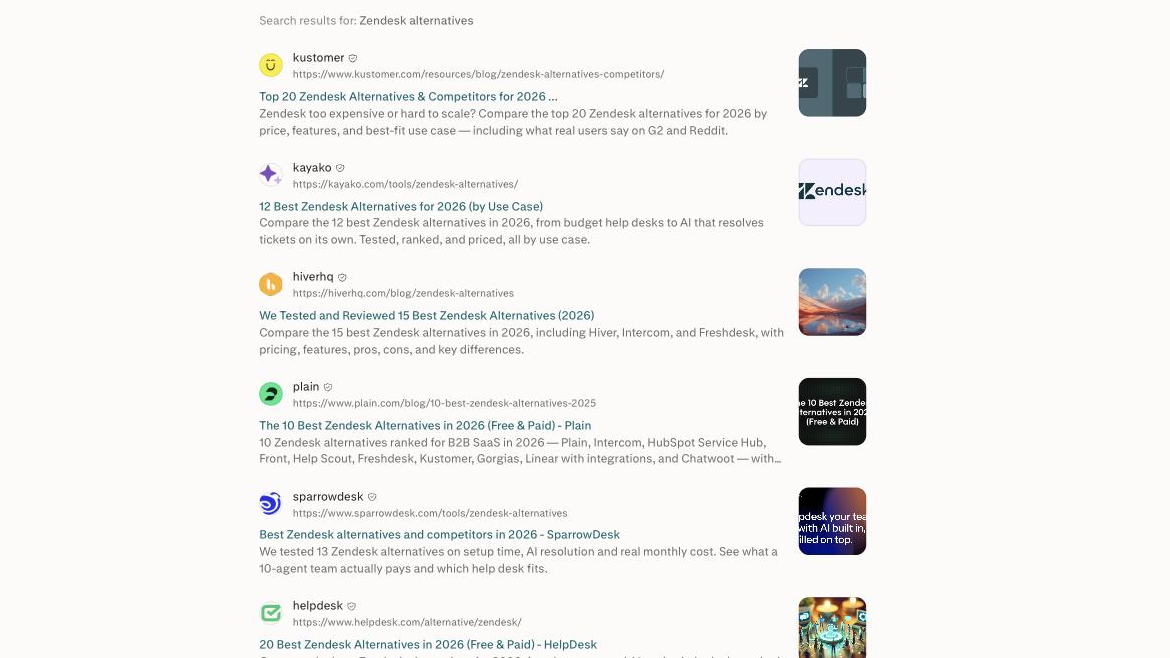
Every one of the ten sources was a competitor's "Zendesk alternatives" page, from Kustomer, Kayako, Hiver and Plain among others. At least three of them, judging by their own page descriptions, put their own product at the top. Then the answer recommended Freshdesk, Help Scout and Zoho Desk, none of which had a page in the sources at all.
Datadog's search played out the same way on a bigger scale. Most of its 40 sources were product, pricing and documentation pages from monitoring tools such as Grafana, New Relic and Sentry. Most of the rest were alternatives lists from other vendors, PostHog and Dash0 among them, and Datadog itself supplied nothing.
Category leaders should find this uncomfortable. Your buyer asks Perplexity for something to use instead of your product, and your competitors wrote the pages that answer is built from. The challenger's side of that trade is in our piece on why alternatives pages win AI citations.
Head-to-head searches were fairer. The sources for "Asana vs monday.com" included Asana's own comparison page and three monday.com blog comparisons, next to comparisons from Zapier, Wrike and Softr and two review sites, and our guide to comparison pages that get cited shows how to write your own.
G2 showed up in one category, Reddit in none
We expected a lot more G2. It's so often described as the source AI engines trust for software that its absence from nine of the ten searches surprised us. The exception was the SOC 2 search, where G2's category, comparison and alternatives pages supplied 7 of the 24 sources. A directory of audit firms for that standard added four more.
Next to CRM or email marketing, compliance software is a small and specialist category, and the mix seems to shift with that. In categories where the big vendors publish heavily, their pages fill the answer. When they don't, review platforms and specialist directories move into the gap. Our guide to review pages that get cited in AI search covers when a G2 profile is worth your time.
Why Reddit never showed up is harder to say. One SaaS founder complained in r/content_marketing back in March that whenever they searched their own category, Perplexity recommended the same two competitors. The sources behind those picks, they wrote, were almost all Reddit threads and niche tech blogs, which suggests their category has a community layer that the ones we tested don't. We weigh that kind of evidence claim by claim in which Perplexity SEO advice from Reddit still holds up.
Perplexity recommends my competitor every single time, I search for my product and I have tried asking this like 20 different ways, why is this?
I created a small SaaS product and I started testing Perplexity recommendations in my category after a few of my users mentioned they found my competitors through it, no matter how I phrase the question, the same two competitors come up, an...
15 hours a week manually. Or 15 minutes with RankControl.
Track citations, monitor competitors, and fix content gaps across every AI search engine. Automatically.

The type of search decides whose pages count
Sort the ten searches by the way a buyer worded them and the pattern comes into focus:
| Search type | Searches | Sources | From the products compared or recommended | From other software companies | From publishers, review sites, agencies and communities |
|---|---|---|---|---|---|
| Best-of ("best X for Y") | 6 | 149 | 69 | 51 | 29 |
| Head-to-head ("X vs Y") | 2 | 35 | 19 | 6 | 10 |
| Alternatives ("X alternatives") | 2 | 50 | 20 | 27 | 3 |
When the buyer names two products, those two supplied more than half the sources. Alternatives searches go the other way: the product being replaced supplied none of the 50, and its replacements plus their rivals supplied nearly all of them. Best-of searches left the most room for everyone else, with about one in five of their sources coming from publishers, review sites and agencies. If you're chasing a mention on an independent site, then, a best-of search is where it's most likely to pay off.
What this test can't tell you
A few limits matter here, because they decide how far you can stretch these numbers.
We counted every source on the Links tab, which lists everything Perplexity pulled for the answer, while the little citation markers inside the answer text point to only part of that list. We went with the full list because it's what a buyer sees when they check where an answer came from. If you counted only the inline citations, you'd get a somewhat different picture.
Source counts depended on the search. The two short ones, "Zendesk alternatives" and "Asana vs monday.com," returned 10 sources each, and the longer, more specific searches returned more, up to 40 for Datadog. We ran each search just once, from one account on the free plan, all on the same day.
Sorting sources by publisher also meant making judgment calls. We counted the open-source Uptime Kuma project as a software maker, for example, and a newsletter site about sales as a publisher, and a handful of sites could reasonably go either way. If we moved every borderline site to the other side, the 82% software-company share would shift by about three points.
How this compares with larger 2026 studies
Two bigger studies from this summer asked the same question and came back with different mixes. The reasons are worth understanding before you decide which number to believe:
| Study | What it covered | What it found for Perplexity |
|---|---|---|
| Growfusely, a content agency (July) | 1,739 citations from 128 software buying queries across 16 categories | Vendors citing their own pages made up 12% of Perplexity's citations, half ChatGPT's rate. Unlike ChatGPT, Perplexity also cited YouTube 47 times and Reddit 11 times |
| Overthink Group, another agency | 1,263 prompts on niche B2B categories with only 150 to 700 monthly Google searches each | G2 was the single most-cited domain, and more than 71% of G2's citations came from Perplexity. 11.3% of Perplexity's citations pointed to synthetic spam sites |
That last Overthink finding is the one we'd want you to remember. The authors' name for those sites is synthetic spam, and it fits, because they publish machine-written listicles by the thousand.
Why don't our numbers match either study? We'd put most of the gap down to two things. Growfusely's methodology notes that its queries ran through Perplexity's Sonar API, which is a developer product rather than the app your buyers open, and we tested the app. The other is category size. Our searches sat in big categories, where vendors like HubSpot and Gusto run large content libraries, and Overthink went niche on purpose. Our piece on why ChatGPT, Claude and Perplexity rank SaaS products differently compares these sources with Google's top results for the same searches.
One more data point comes from a Reddit user who ran 75 Perplexity searches on AI meeting note tools in June. They caught the vendor tilt from a different angle: of the 116 written reviews Perplexity cited, 50 had been published by the vendors themselves. Their runs also showed the sources moving around between identical searches, and that alone is a reason not to trust any single check.
I ran 75 Perplexity searches to see how much the cited sources change
I wanted to understand something about Perplexity that I kept noticing as a user: When you run the same kind of search more than once, how stable are the sources? And if you tell Perplexity to use a certain kind of source, does it actually...
What to publish if you sell B2B software
Which of your own pages stand a chance of landing in lists like these? Five kinds of page carried most of the weight across the ten searches. The technical side, crawler access and page structure included, is in our Perplexity SEO tutorial.
Pricing in plain text
Pricing pages are the easiest win here, since 37 pricing-related pages turned up among the sources. Your plan names, prices and billing rules belong in HTML text, and usage-based charges deserve a help-center explanation like the ones Intercom and Help Scout publish. Keep pricing behind a sales call and the answer will lean on somebody else's estimate of it. Gusto's pages on its competitors' prices show you exactly who's willing to write that estimate.
An honest category roundup
Teamwork.com was the answer's first pick in the agency project management search, and its blog supplied five of the sources, including its roundup of agency management software. The CRM search cited Pipedrive's CRM guide and three CRM roundups from Salesflare. Most of these vendors had the same page: a roundup that names real competitors and says who each one suits. If you're worried yours will read as a sales page in disguise, our listicle strategy guide shows how to avoid that.
Comparison and alternatives pages
If you're the challenger, publish the "[leader] alternatives" page, because that's what Perplexity pulled for alternatives searches. If you're the leader, your own page can't win that search. What you can do is publish a direct comparison with each serious challenger, the way Asana did for monday.com, so head-to-head searches carry your side of the story.
Help-center articles on integrations and migrations
In the HubSpot vs Salesforce search, nearly a quarter of the sources were HubSpot's six articles on its Salesforce integration. A buyer weighing two products wants to know how they'd connect them or move from one to the other, and documentation that explains exactly that answers their question head on.
Review profiles where your category uses them
Only one of our ten categories leaned on G2. Before you pour hours into a review profile, search your own category and see whether Perplexity cites G2 there at all, and if it does, keep your profile current.
Checking your own category
You can run this whole test yourself in a couple of hours. List 10 searches your buyers might plausibly make, with a mix of "best [category] for [use case]," "[competitor] alternatives," "[you] vs [competitor]" and "[you] pricing." Put each into Perplexity and write down every domain on its Links tab. At the end, tally your own sources against your competitors' and note which third-party sites keep showing up.
Then do it all again next month, because the sources won't sit still between runs. How much can a single answer change? Our look at Perplexity versus ChatGPT for research shows you, and the same buyer searches often come back with different sources on ChatGPT and on Google's AI Mode.
By our rough estimate, checking 50 questions on seven engines by hand takes about six hours a week. Publishing eight solid articles a month takes another 16 to 24 hours.
Every week, RankControl's AI visibility tracking puts your 50 questions to seven engines and tags each answer as a mention, a citation or both, along with the competitors and sources the engine drew on. Our content engine drafts each article against the pages already ranking for the keyword, then publishes it on your own domain.
A spreadsheet and a monthly reminder are all you need to run these searches yourself. If you'd rather hand it off, RankControl's agents can track the sources each week and publish the comparison and category pages missing from your buyers' searches.
AI search traffic grew 835% this year. Is your content ready?
RankControl generates 26 content formats optimized for ChatGPT, Claude, and Perplexity. Published on your domain, matched to your brand.