If your team checks AI visibility in one engine and calls it done, you're missing most of the picture. A September thread in r/SaaS shows how confusing this gets. The poster, at a Series B software company, had beaten their biggest competitor in Google on nearly every commercial keyword for two years, with better docs and better backlinks too. But when they had AI models list the main players in their category, the competitor was on the list and they weren't. Plenty of teams wonder the same thing without ever posting it.
Why does our biggest competitor show up in every AI answer and we don't?
Most replies said Google rankings don't carry over into AI answers. Fair enough, but we'd add a harder point: the AI engines don't line up with one another either. ChatGPT can treat you well while Claude hardly mentions you and Perplexity leads with a competitor. Below we look at why that happens and which of the causes you can actually fix, one engine at a time.
Three engines, three sets of AI product rankings
The most useful data we know of comes from an April post in r/SEO, and to us it says the engines agree on category leaders and on not much else. Its author ran 3,837 API requests across ChatGPT, Claude, Gemini and Perplexity with web search on, testing sixteen SaaS brands against twelve kinds of prompt.
HubSpot, the leader case, barely moved: 86% of ChatGPT's answers named it, and so did 99% of Perplexity's. The challengers are where the agreement falls apart:
| Brand | ChatGPT | Claude | Gemini | Perplexity |
|---|---|---|---|---|
| ConvertKit | 54% | 18% | 16% | 12% |
| Klaviyo | 32% | 65% | 62% | 67% |
| Adobe Creative Cloud | 39% | 14% | 44% | 2% |
| ClickUp | 85% | 59% | 85% | 78% |
The ConvertKit row is the one we'd lose sleep over. If you'd been a marketer there (it rebranded as Kit in 2024) looking only at ChatGPT, you'd have seen a healthy number and missed that the other three engines mentioned the product in under one answer in five. Klaviyo was the mirror image, doing worst on ChatGPT at 32%.
I ran 3,837 API calls to see if AI engines actually agree on brand recommendations. They really don't.
Many people still treat "AI search" as one thing, like if a brand shows up in ChatGPT, it'll show up everywhere. I wanted to test that, so I wrote a tool to hit the APIs of ChatGPT, Claude, Gemini, and Perplexity across 16 SaaS brands with...
Don't read those percentages as precise. Everything went through the APIs, and the reply with the most upvotes came from a person who builds AI tracking software. Their argument was that consumer apps personalize and localize answers in ways API calls never see. The overall shape still holds. If your product isn't the obvious default in its category, you're in the large group of brands the engines can't agree on.
Each engine reads a different slice of the web
This is the cause we'd go after first, since your work can move it. When an engine decides to search, a search system fetches a batch of pages before the model writes anything, and we call that batch the pre-answer shortlist. What's missing from the shortlist can't be cited. Beyond whatever the model remembers from training, it also can't recommend a product those pages never mention, and no two of the three engines build their shortlists from the same search system.
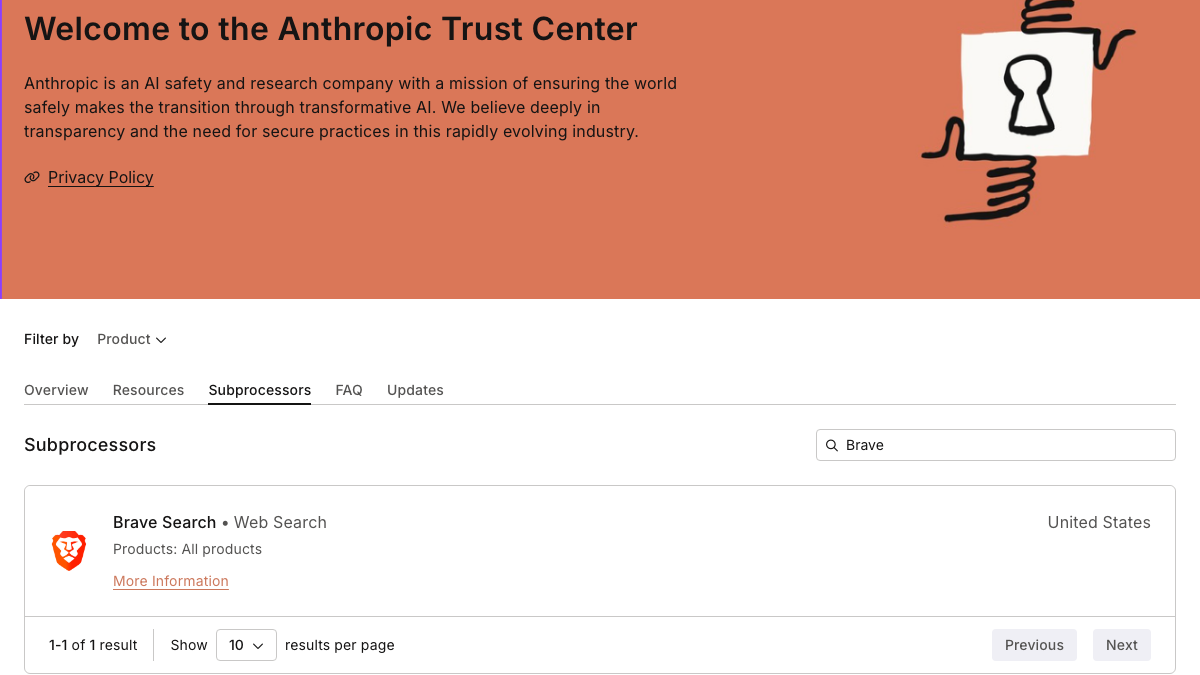
ChatGPT's draws on Bing and on Google results, plus an index OpenAI builds itself (we dug into that in whether ChatGPT search uses Bing). Claude's search runs partly through partners. Anthropic's Trust Center lists Brave Search, TurboPuffer and Parallel Web Systems under Web Search for its products, and doesn't say which one serves a given query. The screenshot shows the Brave Search entry, and the list has two more web search providers:
Claude-SearchBot, Anthropic's own crawler, is covered in Anthropic's crawler documentation, which says shutting it out may make a site less visible in Claude's search results. Perplexity sends out a crawler of its own, and PerplexityBot's role, per its bot documentation, is finding websites and linking to them in Perplexity's search results.
How different the shortlists can be
We wanted to see the gap ourselves, so on September 27, 2026 we lined up two data sets. Earlier that day we'd logged every source Perplexity showed across ten searches for business software, which became our study of what Perplexity cites in B2B software searches. Afterwards we pulled Google's top ten US organic results for the same queries.
| Comparison (same ten searches, September 27, 2026) | Result |
|---|---|
| Distinct pages Perplexity pulled | 233 |
| Of those, pages in Google's top 10 | 16, about 7% |
| Searches with no overlap at all | 3, including "HubSpot vs Salesforce for a 50-person company" |
| Sources per search | Perplexity 10 to 40, Google 10 |
| Domains in Google's top 10 that appeared anywhere in Perplexity's lists | 20 of 97 |
| Brave top-10 pages also in Google's top 10 | 4 for "best CRM for a small B2B sales team", none for HubSpot vs Salesforce |
The overlap was thin. Only about 7% of the pages Perplexity drew on also sat in Google's top ten, and on three searches, "HubSpot vs Salesforce for a 50-person company" among them, the lists shared nothing.
Some of this is plain arithmetic. Perplexity listed ten to forty sources per search against Google's ten results, so most of its pages had no room to appear in Google's top ten. Counting whole sites instead of pages barely helps, though. Google's top ten covered 97 domains, and only 20 of them turned up anywhere in Perplexity's lists.
We got through two searches on Brave before its site made us prove we weren't a bot, and both pointed the same way. For "best CRM for a small B2B sales team," four of Brave's top ten pages matched Google's top ten, and for HubSpot vs Salesforce, none did. Brave's public results page may not be exactly what Claude receives through Brave's API, but the two indexes plainly rank the same question differently.
Google's top result for "Zendesk alternatives" was a Reddit thread, and it wasn't one of the ten sources Perplexity gave for that search.

Built by the team that got cited in 48 hours.
Content generation, backlink building, AI visibility tracking, and Google rankings. One platform, zero guesswork.
Some answers come from memory, not search
Memory matters least for an established brand and most for a new one. Two of the three engines search only when they decide to. OpenAI's help center describes ChatGPT going to the web on its own whenever current information would improve the answer. Anthropic's web search help page says the newer Claude experience has no web search toggle at all; Claude goes to the web when doing so helps. Perplexity is built around search, and each answer in our test arrived with its sources listed.
Without a search, the model falls back on what it absorbed in training, which favors brands that were already famous when that data was gathered. We suspect that's part of why HubSpot did well everywhere in the r/SEO test. The person who ran it thought Perplexity leaned on the live web more than the others, and that fits with it giving HubSpot 99% and Adobe Creative Cloud 2%.
Claude was the stingiest with brand names in that test, averaging a 63% presence rate. ChatGPT and Gemini sat at 70% to 71%, and the poster's explanation was that Claude puts fewer tools in each answer.
So the search step counts for more with a young SaaS product. If you launched after the model's training data was gathered, you don't exist in its memory-only answers, and your only way in is a question that triggers a search and pulls your pages onto the pre-answer shortlist.
The same engine rarely gives the same answer twice
We'd stop reporting where you placed in a single AI answer, and randomness is why. SparkToro's Rand Fishkin and Patrick O'Donnell of Gumshoe put numbers on it in January. For their study of AI recommendation consistency, 600 volunteers put twelve prompts to ChatGPT, Claude and Google's AI, 2,961 times in total.
NEW research: https://t.co/yE1LogIFHO If you give ChatGPT the same request for product recommendations 100X, will you ever get the same list twice? And what does that answer mean for folks who try to track their brand presence in AI tools? Finally, some real answers 🧐 https://t.co/r8R7IMSJm5
 Rand Fishkin@randfishJan 28, 2026
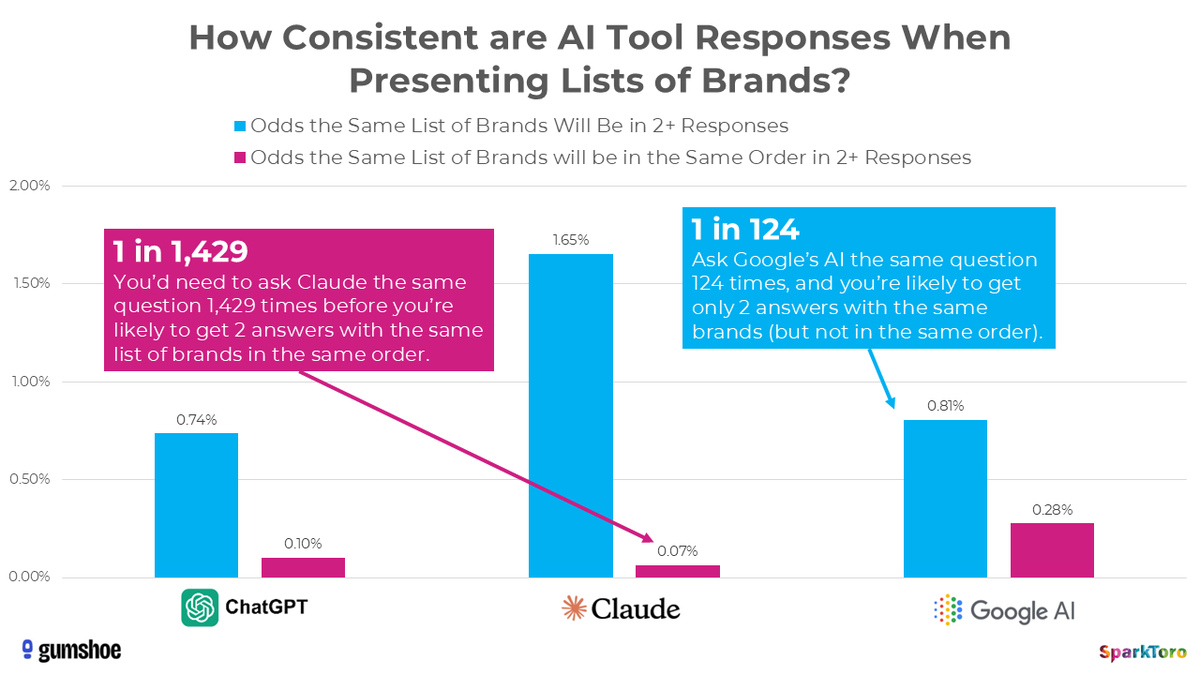
Two responses from ChatGPT or Google's AI had less than a one-in-a-hundred chance of naming the same brands, and matching the order too was nearer one in a thousand. Claude repeated itself only slightly more often.
So treat a single "position" from a single answer as close to worthless. Showing up in seven runs out of ten is something you can follow over time, while coming second once tells you little when the next run could drop you to fifth or leave you off.
The noise does have structure. Categories with only a few real options (the study used cloud computing providers for SaaS startups) produced far steadier lists than wide-open ones like new science fiction novels, since the engines simply had fewer names to choose among. Most SaaS categories land in between, and the crowded ones act like the novels.
This is also why two colleagues can get different answers to the same question without either being wrong. Your head of sales might see ChatGPT recommend you on Monday while your CEO sees it leave you out on Tuesday, and nobody made a mistake.
Buyers' phrasing matters most at the bottom of the funnel
If we could watch only one kind of question, it would be the switching question. When the r/SEO poster split results by prompt type, questions like "I want to move away from X, what should I use?" showed a 56% median spread between the engines. Beginner questions showed 6%.
That's the worst spot for disagreement. The person asking already pays for a product in your category and is close to buying.
People also word the same need in wildly different ways. SparkToro collected 142 prompts written by real people about picking headphones, and their average semantic similarity was just 0.081, so hardly any two were alike.
Those prompts generated 994 responses. The top brands still showed up in 55% to 77% of them, so a brand with strong coverage held up whatever the wording. For your own tracking, group questions by buyer situation, write each one several ways, and give switching and alternatives questions the most weight. How to write them is in our guide to building prompt sets by persona, intent and location.
Each engine trusts different sources
Searching the same web doesn't mean trusting the same pages, and Reddit is the clearest recent example. In August, ChatGPT began running far more searches limited to specific domains, and within about a week Promptwatch's citation tracking had Reddit's average share of ChatGPT Search citations down from 3.83% to 0.52%.
Over those weeks, Reddit's share on Google's AI features slid gradually, with no sudden break. If your ChatGPT visibility rested on Reddit threads, you'd have lost it in days while your place in Google's AI answers drifted slowly. What filled the hole is the subject of our piece on Reddit citations after GPT-5.6.
Review sites split too. Overthink Group, an agency, looked at about 1,260 B2B SaaS prompts in July and found G2 the most-cited domain overall. Perplexity accounted for more than 71% of the citations G2 received, so we'd expect G2 reviews to pay off mostly there.
Across larger samples, the domains each engine cites barely overlap, as our roundup of per-engine citation data shows.
The differences at a glance
| ChatGPT | Claude | Perplexity | |
|---|---|---|---|
| Where web results come from | Bing, Google results and OpenAI's own index | Search partners (Brave Search, TurboPuffer and Parallel Web Systems on Anthropic's Trust Center), plus Anthropic's Claude-SearchBot crawler | Perplexity's own crawler, PerplexityBot |
| When it searches | When it decides a question needs it | When it decides a search helps | For every answer in our test |
| Crawler to allow | OAI-SearchBot | Claude-SearchBot | PerplexityBot |
| Pattern in outside data | Reddit's citation share fell by about 86% in one week in August 2026 | Lowest average brand presence in the 3,837-request test | Source of most G2 citations in one B2B study |
See your first AI citation report in under 5 minutes.
No setup calls. No onboarding meetings. Connect your domain and see where AI mentions your brand right now.
What to do when your AI product rankings split
None of the fixes are exotic: it's the usual SEO and content work, diagnosed engine by engine. Start by measuring each engine on its own, because one blended average creates exactly the blind spot you saw in ConvertKit's numbers. For a clean check in each engine, follow our one-afternoon AI product ranking audit.
Then ask every question more than once and log how often you're named. For real precision, SparkToro's authors put the number at 60 to 100 runs. Few teams can manage that by hand, but even a handful of runs per question every week tells you which way you're moving.
Where an engine leaves you out, read what it cites before you change anything. A reply in the r/SaaS thread got this right: in some categories the "main players" answer is stitched together from three or four vendor comparison pages that borrow from one another. Getting onto those pages matters more than chasing forum mentions.
Two technical checks are quick. OAI-SearchBot, Claude-SearchBot and PerplexityBot each obey their own robots.txt rules, so blocking one hides you from that engine alone, and you'll find the user agents in our AI crawler list. Then get your site verified in both Google Search Console and Bing Webmaster Tools, a few minutes apiece. Microsoft Copilot still draws on Bing, and so does part of ChatGPT's search.
The bigger job is writing for switching questions. Those prompts split the engines more than any others, and alternatives and comparison pages are what answers them. Our guide to alternatives pages that win AI citations explains how to write those pages so they don't read like sales pitches.
RankControl's AI visibility tracking covers the measuring and the source-reading for you. Every week we put each of your questions to seven engines and log the sources each engine relied on.
The audit is the easy half. Spotting a gap as it opens is harder, since ChatGPT's Reddit shift unfolded over roughly a week with no announcement.
When a gap on one engine isn't worth chasing
You can let some gaps wait. If your analytics show next to no referrals from an engine and your buyers never mention it, fix the engines they do use first. Referral data undercounts AI's influence, though, since plenty of buyers read an answer and look you up by name later, so add a "which AI tool did you use?" field to your demo form to catch what analytics miss.
Waiting on a gap doesn't mean you stop watching the engine. We'd keep tracking all of them, for the reasons in why we track seven engines instead of one score. Buyers change habits and engines change behavior without notice, so check every engine weekly and let referral and demo-form data decide which gap you close first.
Doing it yourself or handing it off
By our rough estimate, checking fifty questions across seven engines by hand takes about six hours a week. Publishing eight solid articles a month adds another 16 to 24 hours, and that figure is just as rough.
RankControl's AI visibility tracking takes your 50 questions to seven engines every week. Our tracking labels each question mentioned, cited or both, and notes which competitors and sources each engine turned to. The content engine writes each article with the pages that already rank for its keyword as the benchmark, then publishes it on your domain.
Doing it yourself takes a spreadsheet and a clean browser session for each engine. Or hand it to RankControl's agents, which track your questions across every engine and publish pages to close the gaps, while your team writes the comparison and switching content nobody else could write as well.
Your competitors are building backlinks while you read this.
Organic outreach, social mentions, and citations from Editorial Circle member sites, with managed backlinks available as an add-on. Grow your domain authority without running the campaign yourself.