Every year brings a wave of SEO trend posts. Most are predictions. A few are worth reading because they measure something.
This post sticks to the second kind. Each trend below is backed by at least two dated measurements from the same source and method, so you can see the direction instead of a single snapshot. We also counted Google's own ranking updates from its public dashboard, from 2023 to October 2026.
The trends at a glance
| Trend | Earlier reading | Latest reading | Source |
|---|---|---|---|
| Google searches with no click | ~45% (2016), 60.45% (2024) | 68.01% (Jan to Apr 2026) | SparkToro |
| Branded searches with an AI Overview | 61.3% (July 2026) | 73.3% (Sept 2026 average) | Ahrefs |
| Commercial searches with an AI Overview | Baseline (Nov 2025) | Up 71% (Apr 2026) | Semrush |
| AI Overview results that also show ads | 5.17% (March 2025) | 25.56% (Oct 2025) | Semrush |
| Clicks with vs without an AI summary | 15% without | 8% with | Pew Research |
| Named Google ranking updates | 9 (2023) | 4 (2025), 7 (2026 to Oct) | Google's dashboard |
We call the pattern behind most of these the click squeeze. Search demand isn't falling. The share of searches that send a visitor anywhere is, and it's falling fastest where AI answers can settle the question.
Trend 1: more searches end without a click
SparkToro has measured zero-click searches with the same method for a decade, using Similarweb's US clickstream panel. Its June 2026 report found that "in the first four months of 2026, a whopping 68.01% of Google searches ended without a click."
| Period | Zero-click share |
|---|---|
| 2016 | About 45% |
| 2019 | About 49% |
| 2024 | 60.45% |
| January to April 2026 | 68.01% |
Rand Fishkin, who wrote the report, put the decade in one line. "That's a 33.8% increase (23 points) in a decade." Most of that growth came recently. Between 2024 and early 2026 alone, the share rose 7.5 points.
SparkToro sells audience research software and Similarweb sells traffic data, so both have an interest in the topic. But the method stayed the same across years, which is what makes the trend line useful.
Our zero-click search statistics post covers the full set of zero-click numbers in more depth.
Trend 2: AI Overviews spread to branded searches
AI Overviews started on informational questions. They've moved into searches for brand names.
Ahrefs tracked US desktop results for branded keywords across 232.8 million search crawls from July to September 2026. It found that "AI Overviews appeared in 82.91% of the US desktop search results for branded keywords" as of September 29.
| Month (2026) | Branded keywords with an AI Overview |
|---|---|
| July | 61.3% |
| August | 65.1% |
| September | 73.3% |
| September 29 | 82.91% |
That's a 12-point rise in monthly averages in two months. Ahrefs also found 76.2% of branded AI Overviews appeared in position one, above every organic result, including the brand's own site.
For brands, this changes what a search for your own name looks like. An AI summary of what other sites say about you now sits above your homepage.
200+ SaaS teams already track their AI citations.
They know exactly when ChatGPT mentions their brand, and when it stops. Do you?
Trend 3: AI Overviews move into commercial searches
AI Overviews are also moving down the funnel.
Semrush tracked more than 600,000 keywords across 10 industries from November 2025 to April 2026. It found that "AI Overviews grew an average of 71% across search engine results pages (SERPs) with commercial intent." Finance grew the most, with commercial queries triggering AI Overviews up 231% in six months.
An earlier Semrush study showed the same shift. In January 2025, 91.3% of searches with an AI Overview were informational. By October 2025, 42.9% were commercial, transactional or navigational.
Transactional searches were the exception. Semrush found AI Overviews on those fell 5%. When someone is ready to buy, Google still mostly shows results and ads.
Trend 4: ads are moving into AI results
Where AI Overviews go, ads follow.
Semrush reported that by October 2025, Google Ads appeared on "25.56% of search results that included AI Overviews," up from 5.17% in March. Semrush called it a 394% increase in eight months. Semrush's later study found ads and AI Overviews now appear together "roughly 2x more often than they did a year ago."
For organic search, that's another layer between the searcher and the first blue link.
Trend 5: AI summaries cut clicks
The click effect is the most important trend, and it now has two kinds of evidence behind it.
A panel study. Pew Research Center tracked 68,879 Google searches by 900 US adults in March 2025. It found that users "who encountered an AI summary clicked on a traditional search result link in 8% of all visits," against 15% when no summary appeared. Links inside the summary itself got clicked in "just 1% of all visits." Searchers were also more likely to end their browsing session after a results page with an AI summary, 26% of the time against 16% without one. Pew is a nonprofit with no product to sell, which makes this the cleanest data in the set.
A before-and-after study. When Google launched AI Overviews in France on July 22, 2026, Ahrefs compared 963 French domains before and after. Domains most exposed to AI Overviews saw their click-through rate fall 23.1%, and 82.2% of those highly exposed domains lost clicks. Ahrefs summed it up simply. "Every extra point of AI Overview exposure costs you roughly one point of click-through rate."
The France study matters because it isolates the change. The same sites, the same season, measured before and after one switch flipped.
Our guide to click-through rates by position shows what the remaining clicks look like by ranking.
How often does ChatGPT mention your brand?
Most founders have no idea. The answer might surprise you.

Trend 6: forum content fills the gaps
Reddit and other forums keep showing up where publishers used to.
Semrush's 2025 study of AI search found Quora was the most cited site in Google's AI Overviews, with Reddit second. Site owners notice it in their own results. On r/Blogging, a blogger described checking which sources Google's AI Overviews used for queries the blog had ranked for. The answers were pulling from old Reddit threads, some years old with only a few dozen upvotes.
ai overtaking my blog traffic
so i've been blogging about my niche for a while now, getting decent traffic and all that. but then these ai overviews started popping up and answering the same questions my top posts were ranking for. i checked which sources they're pullin...
This trend has a counter-current. In August 2026, ChatGPT sharply cut its Reddit citations. The two engines are moving in different directions on the same kind of source, which is why tracking a single engine gives an incomplete picture.
Trend 7: Google's update rhythm
We wanted to know whether Google is updating rankings more often. Its Search Status Dashboard lists ranking incidents, but only shows roughly the last year. So we rebuilt the history.
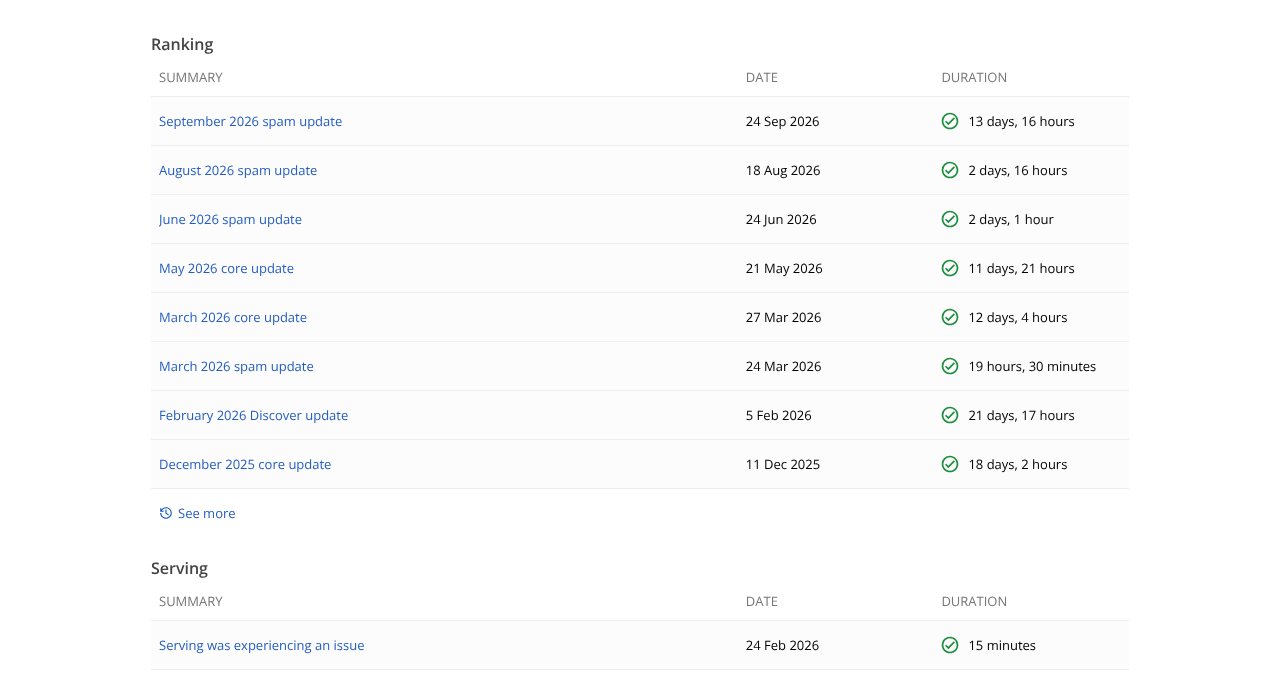
On October 19, 2026, we pulled the dashboard's live incident feed plus five archived copies from the Wayback Machine, merged them and removed duplicates. That gave us 47 incidents from December 2022 to October 2026.
| Year | Core updates | Spam updates | Other named updates | Total named updates |
|---|---|---|---|---|
| 2023 | 4 | 1 | 4 | 9 |
| 2024 | 4 | 3 | 0 | 7 |
| 2025 | 3 | 1 | 0 | 4 |
| 2026 (to mid-October) | 2 | 4 | 1 | 7 |
Three things stand out.
Named updates fell, then rose again. From nine in 2023 to four in 2025, then seven in 2026 with two and a half months still to go.
Spam updates picked up. Four in 2026 so far, more than any full year in the data.
Other named updates mostly disappeared. The helpful content and reviews updates of 2023 stopped appearing as separate entries. That's most likely because Google folded those systems into its core updates, not because the work stopped.
The 2026 row is partial, and the dashboard only lists what Google chooses to announce. But the rhythm is clear. Google is announcing fewer broad changes and more spam actions. Our post on scaled AI content and Google penalties covers what the spam side has targeted, and our guide to diagnosing core update traffic loss covers what to check after a broad update.
Trend 8: AI Mode joins the results
Google first opened AI Mode on March 5, 2025, inviting Google One AI Premium subscribers "to be the first to try out this experience in Labs." At the time, Google said AI Overviews were "now used by more than a billion people."
AI Mode is a separate, conversational search tab rather than a box above the results. It runs several searches at once behind the scenes and writes an answer, with links, from what it finds. That changes the unit of competition. Instead of ranking for one query, a page competes to be one of the sources for an answer built from many related queries.
We don't yet have two comparable, dated measurements of AI Mode's share of searches from the same source, so it doesn't make our trend table. But it belongs on any watch list, because it extends the click squeeze from a summary box to an entire results page.
How the sources compare
The trends above come from very different kinds of data. Knowing which is which helps you weigh them.
| Source | Method | Sample | Sells |
|---|---|---|---|
| SparkToro | Clickstream panel | US desktop and mobile users | Audience research software |
| Ahrefs (branded) | Search result crawls | 232.8 million US desktop crawls | SEO tools |
| Ahrefs (France) | Before-and-after comparison | 963 French domains | SEO tools |
| Semrush | Keyword database tracking | 600,000 to 10 million keywords | SEO tools |
| Pew Research | Browsing panel | 900 US adults, 68,879 searches | Nothing |
| Google's dashboard | Official announcements | All announced ranking incidents | Search ads |
Pew and the France before-and-after study are the strongest evidence for the click effect, because one has no commercial interest and the other isolates a single change. The crawl and keyword studies are best for prevalence, meaning how often AI Overviews appear.
What site owners are saying
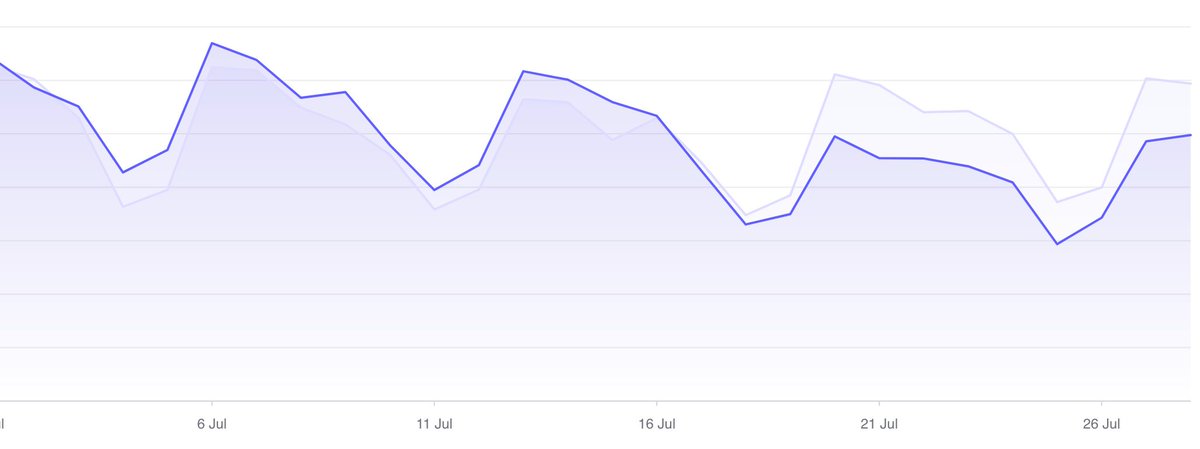
The data matches what publishers report. On X in July, All About Berlin, an independent expat guide, posted about a sudden 20% traffic drop despite stable rankings. The publisher blamed AI Overviews and wrote that, at that pace, the site would not survive into 2027.
A sudden 20% drop in traffic, despite a stable position in search. Google is pushing AI overviews more aggressively, which is pushing the websites it was trained on further down. At this pace, All About Berlin will not survive into 2027. https://t.co/XGE9frIkHN
 All About Berlin@aboutberlinJul 29, 2026
On r/Futurology, a widely upvoted thread asked what the web looks like if search engines keep handing answers to AI instead of sending traffic to the sites that wrote them. The top reply noted that Reddit itself had said human traffic was down for the same reason.
Search engines sent Traffic to websites. AI keep it. What does the web looks like in ten years if that continues?
How to track these trends on your own site
You don't have to wait for the next study. Most of these trends show up in your own data.
- Impressions versus clicks. In Search Console, compare the last three months with the same period a year ago. Rising impressions with flat clicks is the click squeeze on your site.
- Branded searches. Use Search Console's branded queries filter to watch searches for your name. If they hold up while other clicks fall, awareness is intact.
- AI Overviews on your key searches. Search your ten most valuable queries every month and note which show an AI Overview and whether it mentions you.
- AI referrals. In your analytics, filter referral traffic for chatgpt.com, perplexity.ai and gemini.google.com. The numbers will be small, but the trend matters.
- Update dates. Note Google's announced updates against your traffic graph, so you can tell a trend from a one-time drop.
A simple monthly sheet with those five columns will tell you more about your own SEO trends than any annual report.
Single readings worth knowing
Some useful numbers have only one dated measurement so far. They don't show a direction yet, but they're good baselines to compare future studies against.
| Reading | Figure | Source and date |
|---|---|---|
| Google searches with an AI summary | About one in five | Pew Research, March 2025 |
| Value of an AI search visitor vs. an organic visitor | 4.4 times, based on conversion rate | Semrush, July 2025 |
| Google's worldwide search share | 89.94% | StatCounter, September 2026 |
| Bing's worldwide search share | 5.29% | StatCounter, September 2026 |
Pew's one-in-five figure is a useful contrast with the 2026 numbers above. Ahrefs found AI Overviews on most branded searches by late 2026, which suggests how far the feature spread in about a year and a half, though the two studies measured different things.
What isn't a measured trend yet
Some popular claims don't have trend data behind them, at least not from a source we could confirm.
- Search engine share shifting to Bing or ChatGPT. We could confirm a single StatCounter reading for September 2026, Google at 89.94% and Bing at 5.29%, but not a comparable earlier point from the same chart.
- AI search overtaking traditional search. Semrush has projected that AI search visitors could pass traditional ones by 2028 for some topics, but labels it an extrapolation, not a measurement.
- Exact AI referral traffic growth. Retail analytics firms report fast growth, but we couldn't confirm the latest figures on their own pages this time.
Treat these as possibilities to watch, not trends to plan around.
What the trends mean for your SEO
| Trend | What to do |
|---|---|
| Fewer clicks per search | Track impressions and branded search alongside clicks |
| AI Overviews on brand searches | Check what AI summaries say about you, and fix the sources |
| AI Overviews on commercial searches | Publish comparisons and buying guides with real data |
| Ads in AI results | Expect organic results to sit lower on the page |
| Forums in AI answers | Show up where your buyers ask questions, honestly |
| More spam updates | Avoid scaled, thin pages entirely |
The common thread is that ranking is no longer the whole job. Pages that rank still feed AI answers and still win the clicks that remain, but you also need to know where you're being named when nobody clicks. Our SEO statistics post covers the static numbers, and our AI search adoption statistics cover how people are using AI search.
Doing it yourself or handing it off
Keeping up with these trends means publishing pages that answer real questions, and checking where you show up across Google and AI engines every week.
RankControl handles both. We find the questions your buyers search, write each article against the pages already ranking for it and publish it to your site. We track your Google and Bing rankings, plus up to 50 buyer questions every week across seven AI engines. Expect traffic from Google first, with AI citations following more slowly as links and mentions build up.
15 hours a week manually. Or 15 minutes with RankControl.
Track citations, monitor competitors, and fix content gaps across every AI search engine. Automatically.