
You finish a draft, paste it into a content checker, and it tells you to add 14 more related keywords it pulled from the top results. So you wedge them into sentences that didn't need them, and the article gets worse to read.
Related keywords are worth using. Most advice about them is still built on "LSI keywords," a label Google's John Mueller dismissed in 2019, and it rarely tells you where each term should go. This guide covers how to find related keywords for free and where each one belongs, with a plain test for when you've crossed into stuffing.
What related keywords are
Related keywords are the words and questions that sit inside the same topic as your main keyword. For a page about "standing desks," they'd include "desk height for 6 foot person," "electric vs manual standing desk" and brand names a buyer would compare. They show search engines that your page covers the whole topic.
They come in four kinds, and each one does a different job on the page.
| Kind | Example for "standing desk" | What it does |
|---|---|---|
| Close variants | sit stand desk, height adjustable desk | Same search, different words |
| Subtopic questions | how tall should a standing desk be | A part of the topic people ask about |
| Entities | Uplift, FlexiSpot, ergonomics | Named things a full answer would mention |
| Next-step searches | standing desk mat, best desk converter | What the reader looks for after |
Most guides lump these together as "keywords to sprinkle in." Splitting them matters because a subtopic question wants a heading, while an entity only needs to show up where it fits.
"LSI keywords" are a myth, related keywords aren't
Latent semantic indexing is an old method for matching documents by the words they share. Somewhere along the way, SEO tools started calling any related term an "LSI keyword." Mueller shut that down in a July 2019 tweet, writing that "there's no such thing as LSI keywords" and that anyone saying otherwise is mistaken.
What Google does use is its own set of meaning systems. Its How Search Works page says a synonym system, about five years in the making, helps it find relevant pages even when they don't use your exact words, and that it improves results for more than 30% of searches.
Google's grasp of meaning got much stronger later in 2019. Pandu Nayak called BERT "one of the biggest leaps forward in the history of Search" in Google's launch post, and at launch it helped Google read about one in ten US English searches. Then in 2021 came MUM, which Google's own post describes as 1,000 times more powerful than BERT and trained across 75 languages.
So the idea behind related keywords holds up, but the label doesn't. More people still search for the wrong term than the right one. Google keyword data puts "lsi keywords" at 320 US searches a month and "related keywords" at 90. One of the pages ranking for "lsi keywords" this month was first published in October 2019, the same year Mueller's reply went out, and last updated in November 2020.
Why they matter more in AI search
Google's AI answers don't run one search. Google's Search Central page on AI features, last updated December 10, 2025, says AI Overviews and AI Mode may use "query fan-out," which means issuing many related searches across subtopics and sources to build one response.
In practice, a reader types one question and Google quietly asks several of its own. Each of those side searches is a related keyword. A page that answers the subtopics has more chances to be pulled in than a page that repeats the main phrase. Our breakdown of Google AI Mode vs AI Overviews covers how the two features pick pages differently.
A September 2026 preprint on arXiv adds some weight here. Ben Moore and Liam Dunne studied about 2 million citations from ChatGPT, Claude, Gemini and Google's AI features across 10,000 pages, and found that how closely a page matched the meaning of the prompt was the strongest predictor of being cited. FAQ blocks and structured data looked helpful in the raw data, but the effect faded to about zero once the authors accounted for differences between sites.
Treat that paper with some care. It's a preprint, so nobody has peer reviewed it yet, and it observes patterns rather than running a controlled test. Its pages also come from 19 B2B SaaS workspaces, so other markets may behave differently. Still, it points the same way as Google's fan-out docs.

Your competitors are getting cited by AI. You're not.
Every day without citation tracking is a day your competitors pull ahead in ChatGPT, Perplexity, and Claude.
How to find related keywords for free
You don't need a paid tool for this. You need about an hour and a sheet with four columns, one for each kind in the table above.
1. Read the search results page
Search your main term in a logged-out browser and read what Google shows around the results. The People Also Ask box is the best single source of subtopic questions, and each one you open loads a few more.
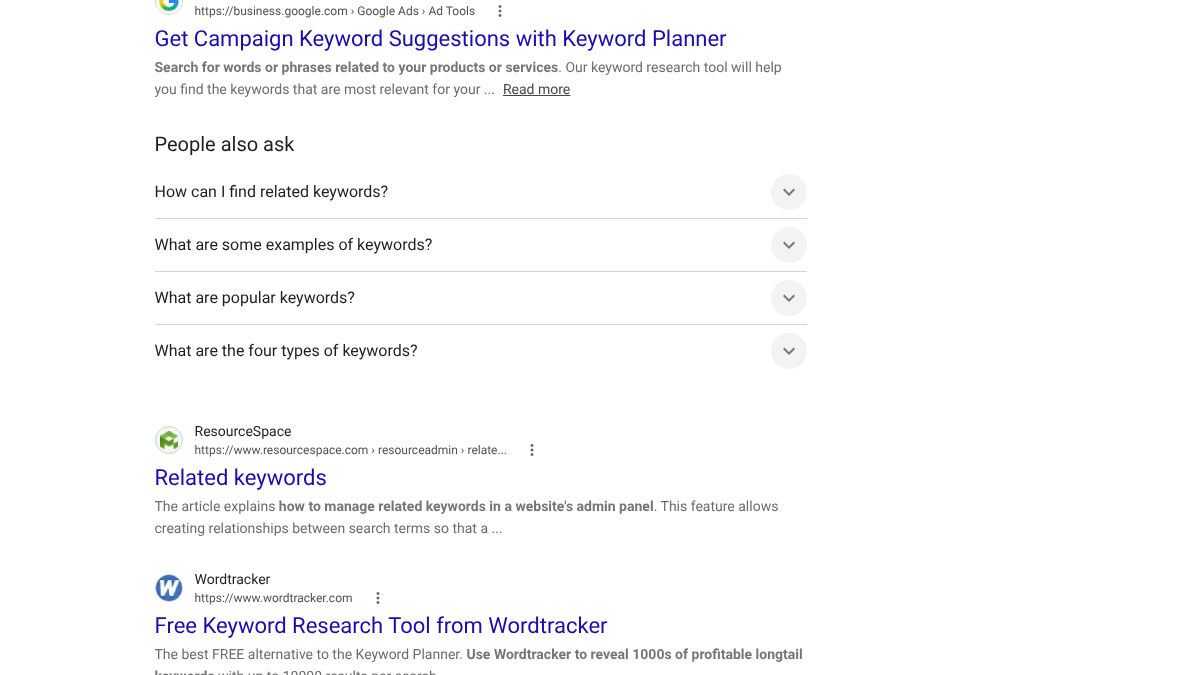
For "related keywords" on October 18, the box asked "How can I find related keywords?" and "What are the four types of keywords?" The second one is a different topic, which our guide to types of keywords answers. Not every question in the box belongs on your page, so mark the off-topic ones and link out to a page that answers them.
2. Let autocomplete and related searches fill gaps
Type your main term slowly and note what Google suggests, then try it with "how," "vs" and "for" after it. Scroll to the bottom of the results for the related searches row, which tends to surface next-step searches. Our keyword research method for small business walks through the alphabet trick if you want more.
3. Check Search Console for the page itself
If the page already exists, open Search Console's Performance report, filter by that page, and open the Queries tab. A reply in an r/DoSEO thread called Search Console "the most underrated keyword research tool" because it shows what you're close to ranking for. Another reply in the same thread added a useful warning, that just adding those queries as H2s wasn't enough on its own to move them.
4. Read the top three pages' headings
Open the top three results and list their H2s. Any subtopic all three cover is one searchers expect, so your page needs it too. Any subtopic none of them cover is your chance to add something new.
5. Add volume only if you need it
Volume helps you decide which subtopic gets a full section and which gets a sentence. Google's Keyword Planner is free with a Google Ads account. Keywords Everywhere's cheapest plan was $84 a year for 100,000 credits on its pricing page on October 19. If some terms look like buyer searches, our guide to commercial intent keywords explains how to sort them.
Where each related keyword goes
Here's the rule I'd use in place of a density number. Call it the one-home rule. Every related term on your list gets one home on the page where it does a job. If you can't name the job, the term doesn't go in.
| Spot on the page | What goes there | Rule of thumb |
|---|---|---|
| Title and H1 | The main keyword | One term, said plainly |
| First 100 words | The main keyword once, plus one close variant | Say what the page answers |
| H2 and H3 headings | Subtopic questions, phrased the way people ask | One question per heading |
| Body copy | Close variants and entities | Only where they explain something |
| FAQ section | People Also Ask questions you didn't give a section | Answer in two or three sentences |
| Image alt text | Words that describe the image | A related term only if it's in the picture |
| Internal link text | The topic of the page you link to | Describe the target page |
Headings do most of the work. A subtopic question as an H3 tells readers and search engines exactly what that part answers, and it's the piece Google's fan-out searches are most likely to match.
Entities work differently. Naming the tools, places or people a full answer would mention is what makes a page read as complete. One clear mention in the right sentence is enough.
200+ SaaS teams already track their AI citations.
They know exactly when ChatGPT mentions their brand, and when it stops. Do you?

How to tell when it's stuffing
Google's spam policies, last updated August 28, 2026, define keyword stuffing as "filling a web page with keywords or numbers in an attempt to manipulate rankings." The examples it lists include blocks of city names a page wants to rank for and words repeated so often that they sound unnatural.
Nowhere does the policy give a percentage. Working SEOs landed in the same place this year in a 57-comment r/SEO thread asking whether stuffing still hurts in 2026:
Is keyword stuffing still hurting SEO in 2026?
Interested to know how people are handling keywords nowadays.I still see websites where the same keyword is repeated constantly in titles, headings, product descriptions and blog content. My understanding is that actively hurts rankings and...
The top reply said there's no magic density threshold where a page turns into spam, and several others said the same thing on their own. Most described a similar habit of putting the main term in the title, H1 and opening, then writing about the topic and letting variants show up. One added that the pages that tank are the ones nobody read out loud before publishing.
That read-aloud test is the best check I know. Read each paragraph out loud. If a term makes you stumble, or you'd never say it that way to a customer, rewrite the sentence or cut the term.
An r/aeo thread called adding FAQ markup to every page for AI citations "keyword stuffing 2.0," and the preprint above found FAQ blocks did little once site differences were taken out. Add an FAQ when readers have real leftover questions, not to hold more keywords.
A worked example using this page
This post follows its own rule, so you can check it. The main term, "related keywords," is in the title, the first paragraph and several H2s. The People Also Ask question "How can I find related keywords?" became an H2, and the stuffing question got its own section. The old label, "LSI keywords," sits only where it explains something, in the myth section.
Entities such as BERT, MUM, Search Console and query fan-out each appear where they answer a part of the topic. The question about the four types of keywords got a link instead of a section, because it belongs to another page.
The same logic works across a site. Our topical authority guide covers how to split a topic into pages without making one thin page per keyword.
Doing it yourself or handing it off
By hand, finding and sorting related keywords takes about an hour per article, and placing them well adds another hour of editing. For eight articles a month, that's around 16 hours before anyone writes the drafts. Those are rough estimates.
RankControl's content engine writes each article against the pages already ranking for its keyword and publishes it on your own domain. Our AI visibility tracking then checks your questions every week on seven AI engines, so you can see which pages get mentioned or cited.
You can run this whole method yourself with a search bar, Search Console and a spreadsheet. Or RankControl's agents can do the research and writing every month while you work on the product.
How often does ChatGPT mention your brand?
Most founders have no idea. The answer might surprise you.