
Most readers decide whether to stay before they finish your first paragraph. Most AI answers pull from that same paragraph too. So the blog introduction does two jobs at once. It has to hook a person and it has to be quotable on its own.
This guide covers how to write blog introductions that do both. It starts with what reading research says, then gives five formulas with before-and-after examples, and ends with the mistakes to cut.
What reading research says
The best-known research here is old, but it has held up. In 1997, Jakob Nielsen of NN/g found that "79 percent of our test users always scanned any new page they came across; only 16 percent read word-by-word."
In 2006, NN/g ran an eyetracking study of 232 users and found they read web pages in an F-shaped pattern. Their eyes move across the top, then across a shorter line further down, then down the left side.
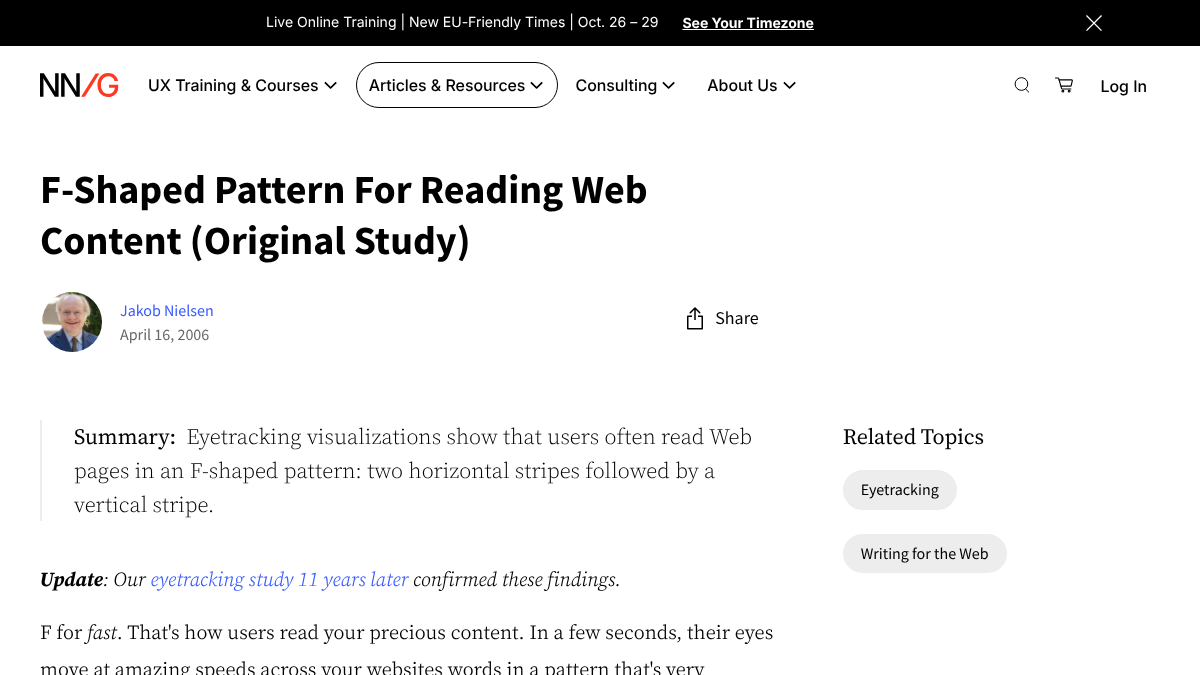
The practical lesson from that study is blunt. "The first two paragraphs must state the most important information," Nielsen wrote. Readers "will probably read more of the first paragraph than the second." NN/g's page now notes that its eyetracking study 11 years later confirmed the findings.
Google's guidance points the same way. Its page on creating helpful, people-first content, updated October 5, 2026, asks whether a page provides "original information, reporting, research, or analysis." An intro that gets to the original part quickly passes that test in the first lines.
Why the intro matters for AI answers
The same paragraph that keeps a reader is the one AI engines are most likely to lift. Our analysis of where in an article AI engines pull citations from found that most cited passages come from the top third of a page.
So the goal is an intro that would make sense if it were the only thing someone read. We call this the standalone opening. It names the subject, gives the key fact and doesn't lean on anything later in the post.
Know exactly what AI says about your competitors.
RankControl's Recon Agent monitors competitor citations across ChatGPT, Perplexity, Claude, Gemini, Grok, Google AI Mode, and Google AI Overviews. See where they show up and you don't.

How long should a blog introduction be?
Shorter than most. One content agency's guide suggests about 100 words, and no more than 150. That's a sensible ceiling. Many good intros are two short paragraphs of 30 to 60 words each.
The first paragraph does the real work. It should answer the question or make the main point. The second can say what the post covers, or add one more reason to keep reading.
Five intro formulas, with examples
Here are five ways to open a post, with a weak version and a stronger one for each. The weak versions are the kind that fill most blogs.
1. Answer first
Best for how-to and question posts. Start with the answer, then expand.
Weak. "Many people wonder how often they should post on their blog. It's a common question, and in this article we'll explore the answer."
Stronger. "For most small businesses, one well-researched post a week beats three thin ones. Here's how to work out the right pace for your site, and what to do if you can't keep up."
2. The specific problem
Best for readers who already feel the problem. Name it exactly, in their words.
Weak. "Customer service is one of the most important parts of any business."
Stronger. "You answer the same five questions in your support inbox every week. A short help page for each one can cut those emails, and it gives search engines something useful to show too."
3. The surprising fact
Best when you have a real number or finding. Lead with it.
Weak. "Reading habits online have changed a lot over the years."
Stronger. "In NN/g's research, 79% of people scanned a new web page instead of reading it word by word. So your first two lines are often all a reader sees before they decide."
4. The short scenario
Best for stories and case studies. Keep the scene to two or three sentences, then get to the point.
Weak. "Let me tell you a story about a time I struggled with my website. It was a few years ago, and I had just started my business."
Stronger. "A bakery owner posts a new recipe every week for a year and gets almost no traffic. Then they rewrite the first paragraph of each one to answer what people search, and visits start to climb. Here's what they changed."
The bakery is an example we made up for this guide, so treat it as a model, not a case study.
5. The contrarian claim
Best when you can back it up. Say the thing most people get wrong, in the first sentence.
Weak. "There are many opinions on how long a blog post should be."
Stronger. "Word count doesn't decide whether a post ranks. Google says there's no ideal length, and the data on AI citations finds almost no link between length and being quoted."
26 content formats. Published on your domain. Matched to your brand.
Guides, comparisons, listicles, case studies, and more. RankControl generates content that gets cited by ChatGPT, Perplexity, Claude, Gemini, Grok, Google AI Mode, and Google AI Overviews.

What the guides that rank actually do
We read the opening lines of the five top-ranking guides for "blog introductions" on October 19, 2026. None opened with the stock line about how fast the digital world is changing, which they all warn against. Two opened with a direct question tied to a specific number or situation.
That's interesting, because the guides disagree about questions. One of them calls question openers a cliché when the answer is obvious. Another opens its own article with a question. The difference is the kind of question. "Do you want more traffic?" tells the reader nothing. "Can your intro hold a reader for 30 seconds?" sets up a test.
So use a question only when it's specific and the answer isn't obvious.
After the hook: the next three lines
Most advice stops at the first sentence. The lines just after it matter as much. A freelance writer on X called this the lock-in zone. These are the sentences where readers confirm the hook, decide if the post is worth their time, and decide whether to trust you.
Many writers make this mistake and it costs them their audience… We focus so much on the hook, And forget something just as important… The Lock In Zone. These are the next few lines after the hook. This is where your readers: Confirm your hook. Decide if it’s worth their
 Olabode@bodefreelanceOct 17, 2026
In practice, that means following the hook with proof or a clear promise. If your first line is a surprising fact, the next should say where it comes from. If it's an answer, the next should say what the rest of the post adds.
Mistakes to cut
These are the habits that waste the opening.
- Throat-clearing. Lines about how fast everything is changing say nothing. Delete them and start with the next sentence.
- Restating the title. The reader just read it. Move on.
- Long backstory. A personal story can work, but get to the point within three sentences.
- Promising without delivering. "In this post, we'll explore" is a table of contents, not an intro. Give something first.
- Vague claims. "SEO is important" adds nothing. "Most traffic from Google goes to the first few results" adds something.
Here's a quick test. Read only your first paragraph. If someone saw just that, would they know what the post is about and learn one real thing? If not, rewrite it.
For a related tactic, our guide to key takeaways blocks covers a short summary near the top. And our playbook for writing content AI agents cite covers the rest of the page.
Rewriting an old intro
Old posts are often the quickest place to apply all this. Open a post that gets impressions in Search Console but few clicks, and read its first paragraph.
If the answer to the post's main question is buried in section three, move a short version of it to the top. If the opening is a story, cut it to two sentences and put the point right after. If the first line restates the title, delete it.
Then check the second paragraph. It should tell the reader what they'll get from the rest of the post, in one or two lines. Keep everything else the same. You're only changing the first 100 words, so it's fast, and it's the part most readers and AI answers actually see.
A quick intro template
If you want a starting point, this works for most informational posts.
- Sentence one. The answer or the main point, in plain words.
- Sentence two. The key fact, number or reason that supports it.
- Sentence three. Who it's for, or when it applies.
- Short second paragraph. What the rest of the post covers.
That's roughly 60 to 100 words. Adjust from there.
Doing it yourself or handing it off
Rewriting intros on old posts is one of the quickest wins in content. For a post you already have, it takes 15 to 30 minutes. Across a whole blog, it adds up to days.
RankControl writes each new article with the answer near the top, against the pages already ranking for its keyword, and scores the draft for how easily AI engines can quote it, with a list of fixes. Its AI visibility tracking then checks up to 50 buyer questions every week across seven AI engines. Expect traffic from Google and AI search first, with citations following more slowly as other sites link to and mention you.

Your competitors are getting cited by AI. You're not.
Every day without citation tracking is a day your competitors pull ahead in ChatGPT, Perplexity, and Claude.