In June, an accountant on r/ukaccounting described a small business client who had emailed over a multi-page "tax restructuring plan" written with an AI prompt. It promised to sidestep National Insurance by turning payroll into "reimbursable casual loans," and it cited a tax case from a different country. One reply summed up the change in a line: it's gone from "my mate told me" to "chat gpt told me."
Anyone finding that clients are using ChatGPT before calling you, and the questions have somehow got worse?
Had a small business client email me a massive, multi-page layout of a "tax restructuring plan" they’d generated using an AI prompt. They were genuinely convinced they’d found a legal loophole to completely bypass their National Insurance c...
Clients now ask an AI before they call, and some of them ask it which firm to call. This playbook covers what those questions look like, what ChatGPT's and Perplexity's APIs cited when we asked six of them on September 26, 2026, and what an accounting firm can change. Other sources were checked the same day.
What clients ask AI before they call
The shift is recent. In a March 2026 survey of 1,002 US adults by a local SEO software company, 45% said they had used AI tools for local business recommendations in the past year, up from 6% a year earlier. That's a fast change for a purchase people used to make on a friend's or a banker's word.
Money questions got there first. When OpenAI launched a personal finance feature in ChatGPT in May, it said more than 200 million people a month were already coming to ChatGPT for budgeting and investment questions.
Google is moving the same way on informational tax searches. One enterprise SEO platform's tracking found AI Overviews on tax-planning searches, such as "tax brackets" and "capital gains tax," went from 0% in May 2024 to 63% in December 2025. Local searches behaved differently: its finance "near me" queries sat at about 20%, after Google tested AI Overviews there and pulled back.
That splits the playbook in two. "CPA near me," with about 74,000 US searches a month, still runs mostly through the map pack, where your Google Business Profile and reviews do the work. Questions like "CPA for real estate investors in Denver" increasingly get answered by an engine that reads pages and picks names, and that's where most firms have no plan yet.
What the answers cited when we asked
We ran six questions a business owner or investor might ask through OpenAI's API and Perplexity's API, with web search available to both. The consumer apps can answer differently, since they add memory and location, so read this as a snapshot from one day.
| Question | OpenAI's API | Perplexity's API |
|---|---|---|
| Best accounting firm for a SaaS startup in Austin, Texas | 5 firm sources, 4 of them service or city pages | 20 sources, 12 of them directory listings and roundups |
| CPA for real estate investors in Denver | 7 firm sources, 5 of them built around real estate | 20 sources, including BiggerPockets and a Reddit thread |
| Who can help a small software company claim the R&D tax credit? | 2 IRS pages, no firms named | 15 sources, 8 of them from accounting and tax firms |
| Outsourced bookkeeping for a Shopify store | No search, no firms named | 17 sources: bookkeeping firms and Shopify's own pages |
| Fractional CFO for a Series A startup | No search, no firms named | 17 sources: CFO firms plus banking and finance apps |
| How do I choose a good accountant for my small business? | No search, no citations | 16 sources, 7 of them from accounting software vendors |
When a question named a city and a niche, specialty pages won. Four of the five pages OpenAI's API cited for Austin were service or city pages, including one firm's page for SaaS startups in Austin, and only one was a homepage. For Denver, one cited firm had built its entire domain around real estate investors.
Perplexity rewarded depth in a different way. One Austin firm and one Denver firm each filled three of Perplexity's 20 slots with three different pages of their own sites.
26 content formats. Published on your domain. Matched to your brand.
Guides, comparisons, listicles, case studies, and more. RankControl generates content that gets cited by ChatGPT, Perplexity, Claude, Gemini, Grok, Google AI Mode, and Google AI Overviews.

Build a page for every niche you really serve
The test points to a simple move: a page for each niche and city you actually serve, written so an engine can lift it. Say who the clients are, what the engagement includes, which software you work in and who leads it. A page called "Tax and accounting for real estate investors in Denver" answers the Denver question in a way a homepage listing twelve services can't.
Niche pages work best when the niche is real. Jason Staats, who runs events and a YouTube channel for accounting firm leaders, made the case in June, including becoming "the accountant for X" through the software vendors and influencers an industry already follows.
If you're looking to build a niche client base in an accounting firm, look at 4 things: 1. Where are the chokepoints A permitting process, a parts dealer, a mandatory training. A firm who only works with franchisees of a grocery chain gets flown to the franchisor's HQ twice per
 Jason Staats⚡@jasononfirmsJun 5, 2026
A marketer at a small firm described the other side of that choice on r/DigitalMarketing: $12 to $15 per click on Google Ads for accounting terms that barely converted and a slow blog, with a Google Business Profile as the one channel that reliably produced calls. One reply said to niche down, pointing to a client that only does bookkeeping for remote contractors and uses content to become the known voice for them.
Marketing for an accounting firm is tough
I've been handling marketing for a small accounting firm for about 8 months now. Started with Google Ads because that seemed like the obvious move for a service business, but the CPCs for anything accounting related are INSANE. We're paying...
Each page needs details a generic competitor can't copy: the software that industry runs on, the filings that trip up that client type, the questions they ask in the first meeting and how you price that kind of work. Our playbook for recruiting agencies found the same pattern with specialty and city pages for recruiters.
Answer the questions that come before a firm name
Four of our six questions never reached a firm name on OpenAI's API. Three of them didn't trigger a search at all, so the model answered from memory with checklists and credentials. In the Shopify answer, the only brands it named were software tools such as QuickBooks Online and A2X. For the R&D credit question, it searched, cited two IRS pages and described the kinds of help available without naming anyone.
Perplexity showed who owns that earlier stage. For "How do I choose a good accountant for my small business?", 7 of its 16 sources came from accounting software vendors such as QuickBooks and Xero. The other nine came from a business bank, an insurer, a chamber of commerce and a handful of other sites, including two national online accounting services. No local CPA firm appeared. We call that the vendor gap: the questions buyers ask before they pick a firm are answered by companies that sell software to firms.
The R&D question shows what closing the gap looks like. Perplexity's sources there were mostly firms, including BDO and Withum, and each had a page explaining the credit in plain terms. An explainer from a firm that does the work carries things a software vendor's post can't, such as the documentation a credit study needs and the mistakes the firm sees at filing time.
Good candidates are the questions you answer on every discovery call: whether a business should elect S corp status, what an R&D credit study involves, how to switch accountants in the middle of a year and what monthly bookkeeping should cost. Our guide to finding the prompts your buyers ask ChatGPT covers other ways to build that list.
Get onto the lists and profiles the engines read
Directories carried much of Perplexity's Austin answer: listings and roundup posts supplied 12 of its 20 sources, led by four Clutch pages and three from DesignRush. For the Denver question, BiggerPockets and Reddit appeared, the places where real estate investors ask each other for referrals.
So check which directories show up for your niche questions and make sure your firm is listed accurately on them, with the same description and specialties as your own pages. Our breakdown of what AI search engines trust covers how reviews and mentions feed those answers.
The map pack still matters for the near-me half of the playbook. A study of 216 local markets in August 2026 found Google's local pack nearly unchanged between two checks days apart, with 0.82 overlap, while ChatGPT's list of local businesses overlapped only 0.36. When Google did show an AI Overview for a local buying question, 87.6% of the businesses it named were already in the map pack. Our guide to local SEO for AI search covers the profile work.

Your competitors are getting cited by AI. You're not.
Every day without citation tracking is a day your competitors pull ahead in ChatGPT, Perplexity, and Claude.
Keep every claim inside the advertising rules
Accounting marketing has rules most industries don't. The AICPA Code bars advertising that is false, misleading or deceptive, including promotion that creates unjustified expectations of favorable results. For anything touching IRS matters, Circular 230 section 10.30 sets the same standard for CPAs and enrolled agents alike.
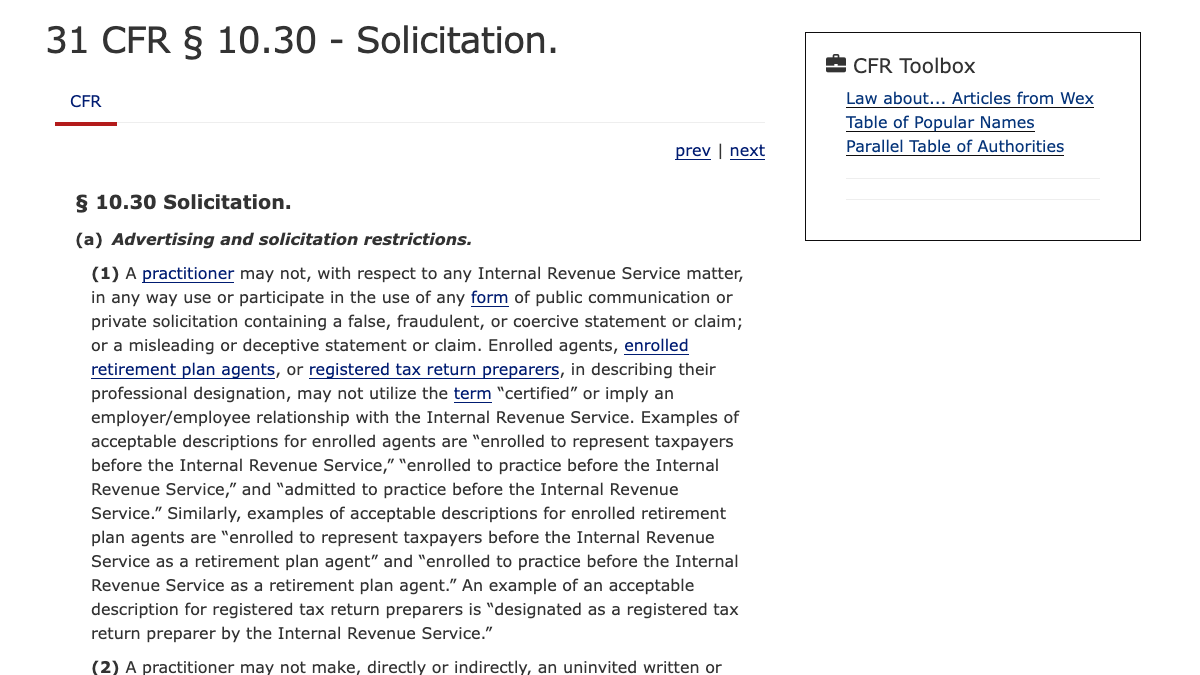
State boards go further. Texas bars self-laudatory statements and testimonials that aren't based on verifiable facts. Florida requires any ad that calls a CPA a "specialist" to say the term is a self-designation that the state and federal government don't sanction.
These rules matter more in AI search, because engines lift sentences out of pages and repeat them without your caveats. A line like "we find every deduction" on a service page can surface in an answer as a promise. The details engines like to quote are also the safe ones: credentials, years in practice, the industries you serve and published fees. Circular 230 lets you publish a fee schedule, with one catch: you can't charge more than those rates for 30 days after the last date you published them. The AEO guide for legal services covers the same tension for law firms.
Track the questions your clients ask
AI answers send fewer clicks than they influence. Someone who hears your firm's name in ChatGPT may search for it later or calls from the map pack, and that visit gets credited to Google. A free-text "How did you hear about us?" field on your intake form catches some of what analytics misses.
The better measure is the question itself. Keep a list of 20 to 50 questions your best clients would ask, weighted toward your niches and cities, and check them on each engine every month. Note whether your firm is named, how the answer describes you, which of your pages are cited and which competitors and directories appear.
Done by hand, checking 50 questions on seven engines takes about six hours a week, and publishing eight solid articles a month takes 16 to 24 hours more. Those are rough estimates, and tax season doesn't leave those hours free.
RankControl handles the repeated parts. AI visibility tracking runs your 50 questions every week on seven engines, marks each one as mentioned, cited or both, and records which competitors and sources each engine used. The content engine writes advice articles for each niche against the pages already ranking for the topic and publishes them on your own domain.
You can run this with a spreadsheet and an hour a week outside tax season. Or RankControl's agents can run it every week while your partners focus on the client work only they can do.
200+ SaaS teams already track their AI citations.
They know exactly when ChatGPT mentions their brand, and when it stops. Do you?