
Right now a buyer somewhere is describing their problem to ChatGPT in three sentences and asking for a shortlist. OpenAI's own usage research puts ChatGPT at roughly 2.5 billion prompts per day from more than 700 million weekly users, and its analysis of over a million conversations found that practical guidance, the ask-me-what-to-do category your buyers live in, makes up 28% of everything people type. Finding what people ask ChatGPT about your category sounds impossible because no platform publishes prompt logs. It isn't. The prompts leave fingerprints in six places, and this guide walks through how to lift them.
Why There's No Search Volume for What People Ask ChatGPT
Every keyword tool runs on data Google exposes. AI engines expose nothing. OpenAI, Anthropic, Google, and Perplexity keep prompt logs private, so a "ChatGPT search volume" column cannot exist, and any vendor selling one is estimating. We made the full argument in Keyword Research Is Dead. Prompt Research Is Here., so here's the short version: the demand didn't disappear, it moved somewhere your dial can't reach.
And the demand is large. Digital Commerce 360 research found 80% of B2B technology buyers now use AI tools as much as or more than search engines, with generative AI chatbots ranked the single most influential source for building vendor shortlists.
So the job changes. You stop asking "how often is this searched" and start asking a better question: where do buyers write these questions down where I can actually read them? Six places.
Source 1: Search Console Already Holds Conversational Buyer Queries
Your Google Search Console data is the cheapest prompt research you'll ever run, because the phrasing buyers use on Google is the phrasing they carry into ChatGPT.
The workflow:
- Open the Performance report and filter out branded queries.
- Sort by impressions, not clicks, and look at positions 5 through 20. These are questions buyers ask when they don't know your name yet.
- Filter for queries containing "how", "what", "best", "vs", "compare", or "alternative". Longer queries, anything over 30 characters, matter most.
- Export the top 20. Those exact phrases become the seed of your prompt list.
The whole exercise takes under an hour. Paste each seed query into ChatGPT, Claude, Gemini, and Perplexity in a fresh incognito session and note where your brand shows up and where it's absent. That map of presence and absence is your baseline.
Source 2: Sales Calls and Support Tickets Are Prompts in Draft Form
Your buyers write prompts for you every day. They just address them to your sales team instead of an AI.
Pull the last 20 discovery call transcripts and copy every question a prospect asked before the demo started, word for word. "Does this work if we already use HubSpot?" is a prompt. "How is this different from X?" is a prompt. So is the sentence a churned customer typed into a support ticket at 11pm. Keep the original wording, because the messy phrasing is the asset. Cleaning it up into marketing language destroys the match with what real people type into a chat box.
Add one question to onboarding: "What were you trying to solve when you found us?" The answers arrive pre-formatted as buyer prompts, in buyer words, with buyer context attached.
See your first AI citation report in under 5 minutes.
No setup calls. No onboarding meetings. Connect your domain and see where AI mentions your brand right now.

Source 3: Let the AI Engines Hand You Their Follow-Up Questions
The engines themselves are a prompt discovery tool, and each one behaves differently. Perplexity surfaces related questions directly under every answer. ChatGPT suggests follow-up prompts mid-conversation. Claude synthesizes without suggesting much, which makes it the wrong place to harvest but a fine place to test.
Run each of your seed queries and capture every related question the engine offers. These suggestions are generated from patterns in real usage, which makes them the closest thing to a leaked prompt log you will ever get. Then go one step more direct: ask the model "What would someone ask you if they were evaluating tools in [category]?" and let it generate a starter panel for you.
One thing I should've mentioned earlier: run every probe in a fresh session with history off. Personalization contaminates results fast, and a contaminated baseline is worse than none.
Source 4: Review Sites and Communities Speak in Buyer Prompts
G2 and Capterra review titles are problem statements written in the exact words a buyer would use in a chat window. "Finally stopped losing leads between tools" tells you the prompt is some version of "why am I losing leads between my CRM and my email tool." Read the titles and opening lines of the 50 most recent reviews in your category, yours and your competitors', and extract the problem language.
Worth noting: this source pulls double duty. Industry analysis shows brands are 6.5x more likely to be cited by AI engines through third-party pages than through their own websites, and review platforms sit near the top of that third-party list. The same pages that teach you buyer language are the pages the engines trust when they answer. Reddit threads in your category work the same way. The thread titles are prompts, and the engines cite the threads.
Your competitors are building backlinks while you read this.
Organic outreach, social mentions, and link exchanges, with managed backlinks available as an add-on. Grow your domain authority without running the campaign yourself.

Source 5: Reverse-Engineer the Prompts Behind Competitor Citations
Here's the thing about competitor citations: every one of them is a confirmed buyer prompt. When ChatGPT names a competitor in response to a question, someone real asked it and the engine handed your rival the slot. No guessing about whether the query has demand. The citation is the proof.
The manual version: take your seed list, run every question across the four major engines, and log which competitors get named and which URLs get cited for each. The prompts where competitors appear and you don't are your highest-priority targets, because the buyer intent is verified and the answer slot is winnable.
One founder we spoke with ran 90 category prompts through three engines and got zero mentions of his product in all 90 responses. The useful discovery wasn't that competitors were winning. It was that the sources defining his category were publications he had never pitched and had no presence on.
We ran 1,400 buyer prompts across ChatGPT, Perplexity, Claude, and Gemini for 50 B2B SaaS companies. Here's what the data actually shows.
This inference at scale is exactly what RankControl's Radar Agent does: it mines the queries buyers ask in your category, and the weekly citation checks then show you where competitors get recommended and you don't.
Source 6: Freeze a Prompt Panel and Run It on a Schedule
Discovery gives you a pile of prompts. A prompt panel turns the pile into a channel you can manage.
Write 20 to 50 prompts covering four intent types: broad category questions ("best [category] for small teams"), niche variants ("[category] for agencies under 10 people"), head-to-head comparisons ("[competitor A] vs [competitor B]"), and problem-first descriptions that never name a product at all. Write them before running any of them. Choosing prompts after you've seen flattering answers is how teams bias their own tracking.
Then run the identical set across the same engines every two weeks and log four things: mentioned or not, top-three placement or not, which sources were cited, and what changed since last run.
To be fair, the skeptics have a point about volatility. AI answers drift run to run, and industry tracking found 70 to 90% of cited domains churned within six months. That volatility is the argument for a panel, though. A single check is noise. The trend across ten runs is signal, and share of voice across engines is the metric that makes the trend legible. The real problem was never running the audit once. It's knowing when the answers change after you stop looking.
Who is still manually prompting ChatGPT to check if their brand shows up? There has to be a better way.
I have been spending about 30 minutes every morning typing variations of our target queries into ChatGPT, Gemini, and Perplexity to see if our brand gets mentioned. Copy pasting results into a spreadsheet. Tracking changes week over week. I...
Turning Discovered Prompts Into Pipeline
Every prompt where you're absent is a content brief. If buyers ask "best [category] for agencies" and no engine names you, that comparison page or agency case study is the fix, and our content engine exists to ship those pages on your domain without eating your roadmap.
The payoff justifies the work. Across our customer base, visitors arriving from AI engines convert at several times the rate of traditional organic traffic; industry benchmarks put AI referral conversion near 14% against under 3% for classic search. These are shortlist-ready buyers who already asked their questions and got your name as the answer.
Budget honestly, though. The GSC audit takes about an hour. Call and ticket mining runs 3 to 4 hours. Engine harvesting and review mining add another 4 to 5. Competitor probing across four engines takes 3 to 4 more, and each biweekly panel run costs 2 to 3 hours after that. Call it 12 to 15 hours for the first sprint, then 5 to 6 hours a month forever.
You can absolutely run this whole system by hand. Or RankControl's agents can run discovery, tracking, and the content that closes the gaps for you every month, for $400 a month, while you build product.
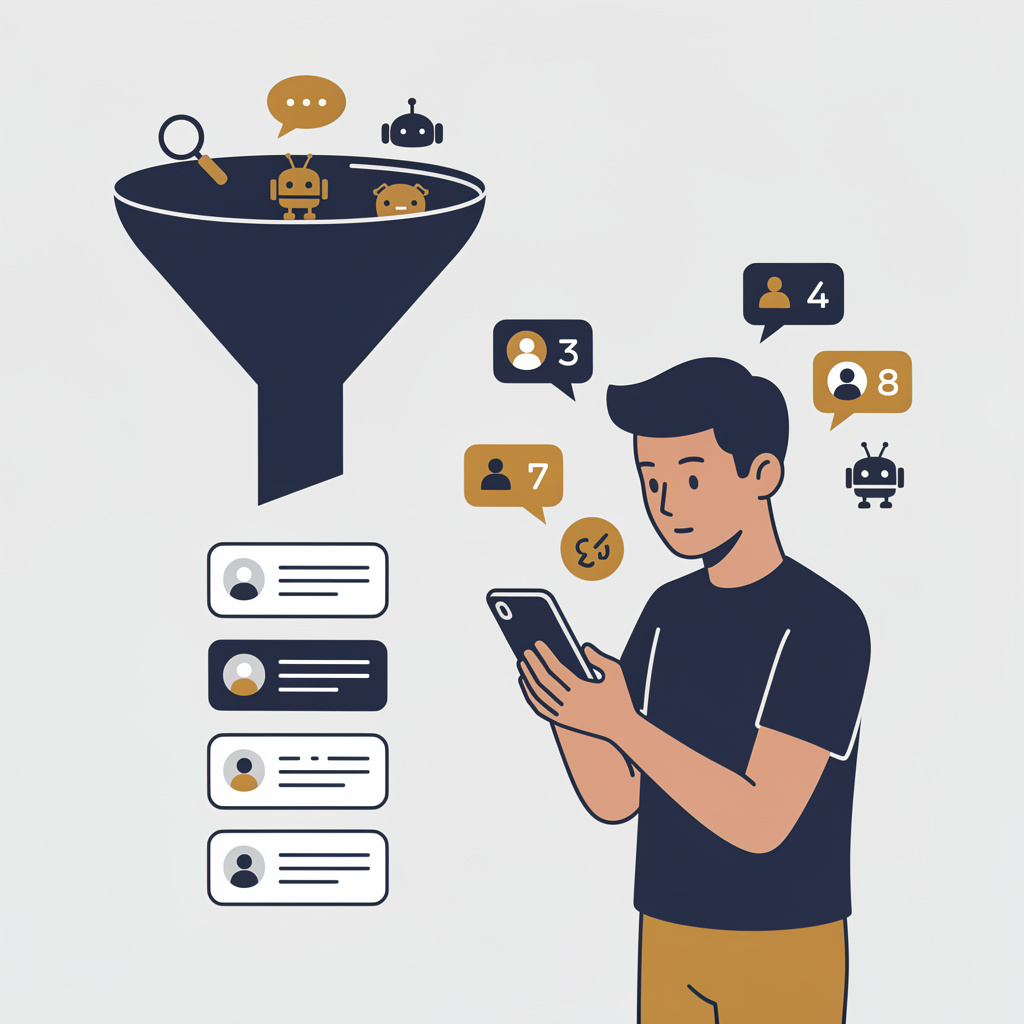
You're getting AI traffic. But do you know where it comes from?
RankControl credits every visit to the assistant that sent it: ChatGPT, Perplexity, Claude, Gemini, Copilot, or Grok. Full source attribution, next to your Google traffic.
The founders who win the next two years of AI search will be the ones who found out what their buyers were actually asking, before their competitors even knew the questions existed.