
If an agency pitches you "ASO" this quarter, ask what the letters stand for before you look at the price. You could be buying app store optimization or one of the newer AI search meanings, and the work behind each is quite different.
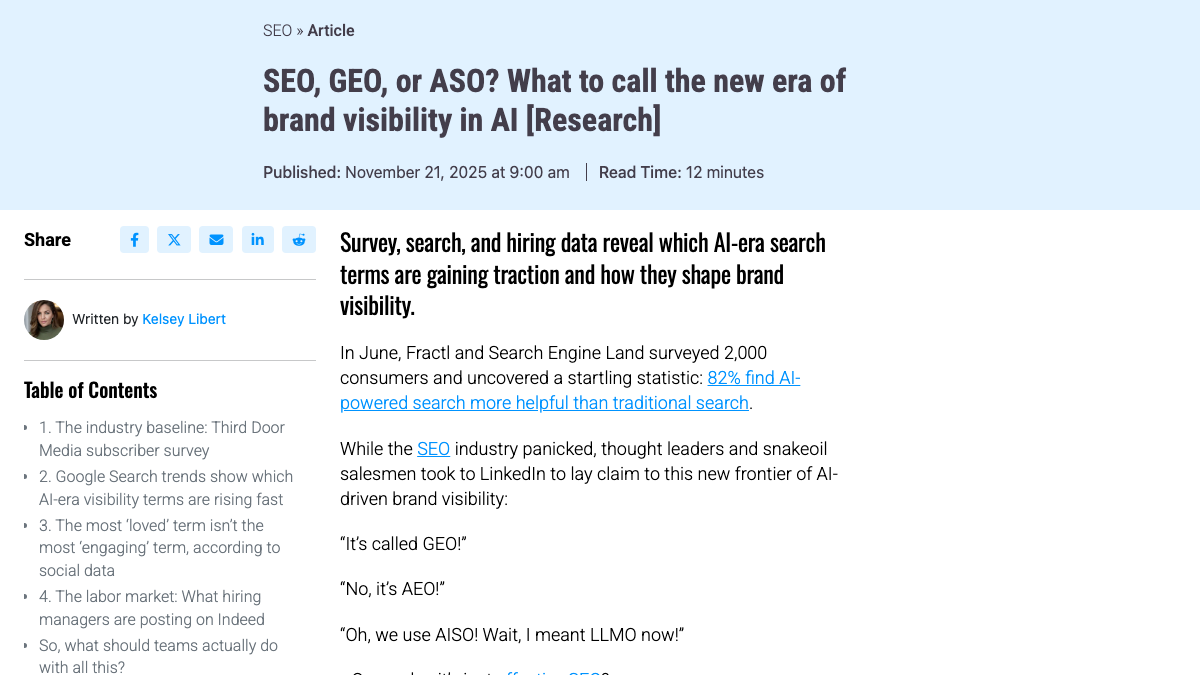
Search Engine Land saw this coming in November 2025. It ran research on naming the work of getting brands seen in AI answers, and in its search-trend data one term broke out: "answer search optimization," or ASO, with interest up 152% quarter over quarter. The same passage warned readers to write the term out early, because most people still connect ASO with app store optimization.
The warning held up. ASO now carries three or more AI meanings besides the app store one, and the app stores run part of their own search through AI. I'll cover each meaning and what Google and Microsoft call the work, then give you a quick test for naming it in a brief. We checked every source on September 26, 2026.
ASO already meant several things
Long before AI came along, the acronym was crowded. When we typed "what is aso" into Google on September 26, marketing barely featured on page one. The first three organic spots went to two kinds of administrative services: organizations that take over HR and payroll for small employers, and "administrative services only" plans, where an employer self-funds its health benefits.
App store optimization turned up at number four. Below it sat more pages about benefits, then a medical explainer about antisense oligonucleotides.
The bare acronym is messier. Just "aso" brought up a payroll video and the stock page for Academy Sports and Outdoors, which trades under ASO. There was also an abstract about a lab assay, plus two pages from colleges. Roughly 18,100 people in the US search "aso" every month, and that number can't tell you which ASO any of them wanted.
Three AI meanings arrived within a year
App marketers have used ASO for over ten years. Since late 2025, other marketers have hung at least three AI expansions on it:
| Expansion | Where it shows up | What it describes |
|---|---|---|
| Answer search optimization | Search Engine Land's November 2025 research, agency glossaries | Getting your content used as the answer in AI and voice results |
| Agentic search optimization | An SEO agency's June 2026 framework, a March 2026 press release | Getting chosen by AI agents that research and buy for people |
| AI search optimization | Agency service pages and vendor sites | Visibility in ChatGPT, Gemini, Perplexity and Google's AI results |
| App store optimization | App marketers, for more than a decade | Ranking and converting in the App Store and Google Play |
Each makes sense on its own. The confusion starts when two end up in one meeting. One vendor's ASO is about AI agents finishing tasks on your site, another's is about your content being quoted in answers, and both decks can carry the same three letters.
The AI sense of ASO hasn't spread far, judging by Search Engine Land's survey of 342 readers, which asked which terms they recognized and which single one they use:
| Term | Recognized it | Named it as the one term they use |
|---|---|---|
| GEO | 84% | 42% |
| AEO | 61% | 14% |
| AI SEO | 16% | |
| Plain SEO | 14% | |
| AISO and similar terms | Below half |
GEO leads both columns, and next to those numbers the ASO habit looks thin.
What the platforms call it
Neither Google nor Microsoft uses ASO for any of this, and the two don't even agree with each other. Google's guide, published May 15, 2026, carries the title "Optimizing your website for generative AI features on Google Search" and brings up AEO and GEO only to make one point. From where Google sits, it says, optimizing for generative AI search "is optimizing for the search experience, and thus still SEO."
Microsoft leaned the other way. Its advertising arm put out "From discovery to influence: A guide to AEO and GEO" for retailers in January. Bing Webmaster Tools, meanwhile, files its numbers on how often Copilot and Bing's AI summaries cite you under "AI Performance," so one company already uses two names.
For a longer comparison, our explainer on what SEO for ChatGPT is called puts GEO, AEO and LLMO side by side. AIO, which has two meanings of its own, is covered in our guide to LLM SEO, GEO, AEO and AIO.

Built by the team that got cited in 48 hours.
Content generation, backlink building, AI visibility tracking, and Google rankings. One platform, zero guesswork.
App store optimization is becoming AI search too
Part of app store optimization, the original ASO, now happens through AI search as well, which makes the clash worse. Apple got there first. At its June 2025 WWDC it announced App Store tags written by large language models, drawing on an app's metadata among other sources, and people check the tags before they appear in search.
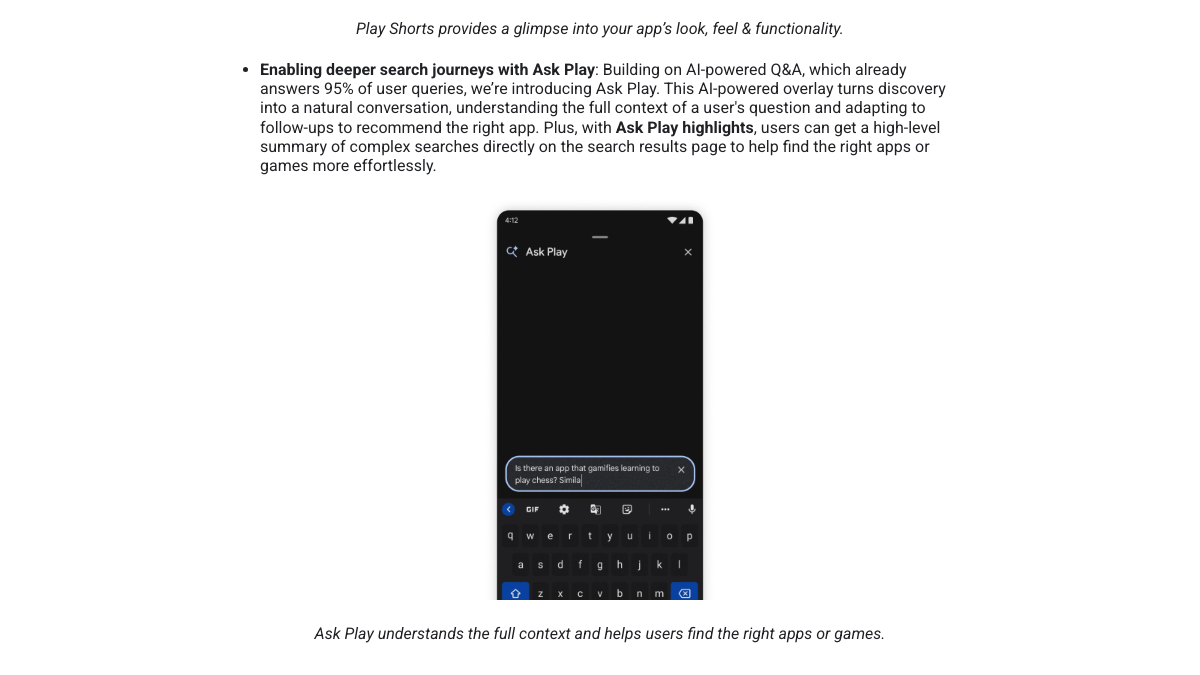
Google's turn came at I/O in May 2026, where it showed Ask Play, a way to search the Play Store conversationally. It sits on an AI Q&A feature that Google says already answers 95% of user queries.
So if you market an app in 2026, you're doing some AI search optimization, only inside a store. The old levers still work, though. Apple's search documentation still treats text relevance as a main ranking factor, meaning your app's title, subtitle and keywords, plus its primary category. User behavior, such as downloads and ratings, is the other.
An indie developer posted about exactly this in September. Their offline transcription app went from 154 to 205 subscriptions in under a week, mostly thanks to App Store search with no ads. They worked from ASO tools and Google Trends, plus the words people really use when they hunt for a transcription app.
ASO isn’t dead. App Store search became my biggest growth channel.
I’ve been spending a lot more time on ASO over the past month, and it’s probably been the biggest reason LoroNote started growing faster. LoroNote is an offline speech-to-text app for iPhone and iPad. Current numbers: $6,719 revenue$1,050 M...
The ChatGPT app directory adds another job
ChatGPT runs its own storefront now. OpenAI brought apps into ChatGPT in October 2025 and opened submissions that December, with a directory where people browse featured apps or search for any published one. The submission docs now call these listings plugins. You give each a name, a short description and a long one, then pick a category and write starter prompts that show when the plugin is useful.
Discovery in that directory has more in common with app store work than with earning citations for web pages. So "ASO for ChatGPT" could mean two unrelated projects: your site quoted when ChatGPT answers, or your plugin turning up in the directory. The skills overlap a little, and the daily routine almost not at all.
Agents are a third case: an AI agent that books or buys for someone picks you based on whether it can read your pages and act on them, and our piece on agentic engine optimization covers that.
The surface test
What I'd suggest is a habit we've named the surface test. Decide where you want to appear before you pick an acronym, and the name and the work both follow:
| If the goal is to show up in... | Call it | Main work |
|---|---|---|
| Answers in ChatGPT, Perplexity, Gemini and Google AI Mode | AI search optimization, or AEO and GEO | Pages that answer buyer questions, and mentions on the sites the engines cite |
| App Store or Google Play search | App store optimization | Title and keywords, screenshots and ratings |
| ChatGPT's app directory | ChatGPT app listing | Descriptions, category, starter prompts and the app itself |
| Tasks an AI agent completes for a user | Agentic search optimization | Structured product data and pages an agent can act on |
Then write the phrase in full wherever it first appears, whether that's a brief or a proposal, a web page or a pitch deck, and use the acronym later only if you need it.
For anything you want people to find, the search data backs you up. "AI search optimization" gets about 1,300 US searches a month. The acronym forms barely register next to it: "ai aso" gets 50 and "aso ai" gets 20. Put "ASO" in the title of a page or a service and you're competing with payroll companies and health plans, plus stock quotes and every blog about app marketing.
See your first AI citation report in under 5 minutes.
No setup calls. No onboarding meetings. Connect your domain and see where AI mentions your brand right now.

Which name to use
Aleyda Solis had the practical take in May. Her advice was to use whichever terms help clients see the opportunity, as long as a fresh label doesn't make AI search seem like a separate thing from SEO.
In practice, I don’t really care what optimizing for AI Search is called: SEO, AI Search Optimization, AEO, GEO, or whatever the new acronym ends up being. I’m the first one to adapt to the terminology clients use if it helps them understand the opportunity, get internal buy-in, https://t.co/OPiBxOY0oA
 Aleyda Solis 🕊️@aleydaMay 17, 2026

Someone on r/WebsiteSEO asked the flip side of that question the same month: are SEO, GEO, AEO and AIO really distinct disciplines, or "just the same thing with different names depending on who's trying to sell you a course"?
SEO vs GEO vs AEO vs AIO, can someone please explain this like i'm 5
I keep seeing these terms get thrown around in marketing spaces and at this point i'm too embarrassed to ask in most places but here goes... What's the actual difference between SEO, GEO, AEO and AIO? Are these legit separate disciplines or...
On the web, I'd say the course-seller theory mostly holds. App stores and agents break it, because the surfaces and the mechanics differ. For AI answers, we'd spell out "AI search optimization" or "AI visibility" and let app marketers keep ASO, since it was theirs first. If a vendor pitches you ASO, ask them to name the surface before you compare quotes.
Whatever you call it, measure it by engine
Expect the names to keep shifting faster than the work itself. What you need to know is whether buyers see your brand named and your pages cited when they ask, and that changes by engine. The difference between those two measures is laid out in our mention tracking and citation tracking comparison.
Done manually, 50 questions across six engines eats roughly five hours a week. Eight solid articles a month would add another 16 to 24 hours, and both numbers are rough estimates.
Of the four rows in the surface test, RankControl handles the first. Each week, AI visibility tracking puts your 50 questions to six engines and marks each question as mentioned, cited or both. The content engine writes each article against whatever already ranks for it, then publishes to your own domain. It doesn't touch app store optimization, though, so if the App Store is where your growth comes from, hire an ASO specialist.
A spreadsheet and an hour a week will get you the checks if you do them yourself. The other option is letting RankControl's agents run them weekly while your team keeps debating the name.
Your competitors are building backlinks while you read this.
Organic outreach, social mentions, and citations from Editorial Circle member sites, with managed backlinks available as an add-on. Grow your domain authority without running the campaign yourself.