
Most lists of the most popular AI tools are someone's favorites with a number in the title. We wanted to rank them by what people actually do, so we pulled four kinds of usage data in October 2026 and compared them.
The four sources measure different things, and none of them is perfect on its own. Google searches show demand, extension installs show what people keep in their browser, visits and app users show daily habit for chatbots, and developer token counts show which tools do the most work. Read together, they give a fair picture of the most popular AI tools in 2026.
| Measure | What it counts | Source |
|---|---|---|
| Search demand | Monthly US Google searches for each tool's name, Oct 2025 to Sept 2026 | Google search volume estimates |
| Browser extensions | Users listed on each extension's Chrome Web Store page | Chrome Web Store, Oct 19, 2026 |
| Chatbot use | Visits, app users and referrals | Similarweb, Sensor Tower, Statcounter |
| Developer apps | Tokens processed by apps that share their usage | OpenRouter, Oct 2026 |
Ranked by search demand
We pulled US monthly searches for 40 AI tool names. Here are the top 15 in September 2026, with the change from October 2025.
| Rank | Tool | US searches, Sept 2026 | Change since Oct 2025 |
|---|---|---|---|
| 1 | ChatGPT | 124,000,000 | Flat |
| 2 | Canva | 30,400,000 | Flat |
| 3 | Gemini | 30,400,000 | +124% |
| 4 | Claude | 9,140,000 | +649% |
| 5 | Janitor AI | 4,090,000 | +49% |
| 6 | Grammarly | 2,740,000 | -33% |
| 7 | Grok | 2,240,000 | Flat |
| 8 | Character AI | 2,240,000 | -45% |
| 9 | NotebookLM | 1,220,000 | +122% |
| 10 | DeepSeek | 1,220,000 | -19% |
| 11 | Remove.bg | 1,220,000 | Flat |
| 12 | Perplexity | 1,000,000 | -55% |
| 13 | CapCut | 1,000,000 | Flat |
| 14 | Sora | 673,000 | -80% |
| 15 | QuillBot | 673,000 | -45% |
ChatGPT gets about four times as many searches as anything else on the list. Canva ties Gemini, though most Canva searches are about its design tool rather than its AI features.
Some names need a caveat. "Gemini" also catches the star sign and a crypto exchange, and "Claude" catches people named Claude, so both overstate a little. Google also reports these volumes in coarse buckets, which is why several tools share the exact same number.
The biggest movers
The year-on-year change is the most useful part of the data, because the ambiguity in a name stays roughly constant over time.
Claude grew the fastest, from about 1.2 million searches in October 2025 to 9.1 million in September 2026, more than seven times higher. Gemini more than doubled, from 13.6 million to 30.4 million. NotebookLM, Google's research notebook, also more than doubled.
The fallers were mostly tools that peaked in an earlier wave. Sora dropped about 80%, from 3.35 million to 673,000. Perplexity fell about 55%, and Character AI, Midjourney, QuillBot and Microsoft Copilot each fell around 45%. Jasper, one of the first AI writing tools, fell about 70%.
We'd call this the general-assistant squeeze. As ChatGPT, Gemini and Claude add image, video, research and writing features, people search less for the single-purpose tools that used to do those jobs on their own.
26 content formats. Published on your domain. Matched to your brand.
Guides, comparisons, listicles, case studies, and more. RankControl generates content that gets cited by ChatGPT, Perplexity, Claude, Gemini, Grok, and Google AI Mode.

Chatbots by visits and app users
Search demand only shows who people look up. For the chatbots, three other datasets show who people actually use. Our AI chatbot market share post covers each one in detail, so here's the summary.
| Chatbot | Share of AI chatbot site visits, May 2026 | Share of AI assistant app users, May 2026 | Share of AI referrals to websites, Sept 2026 |
|---|---|---|---|
| ChatGPT | 52.7% | 46.4% | 80.48% |
| Gemini | 27.3% | 27.7% | 10.91% |
| Claude | 8.9% | 10.3% | 0.95% |
| Grok | 2.8% | Under 5% | Not tracked |
| Perplexity | 1.3% | Under 5% | 5.85% |
The visit and app numbers come from Similarweb and Sensor Tower, and the referral numbers from Statcounter. On the first two, they agree with the search trend. Gemini and Claude are gaining fast, and ChatGPT still leads by a wide margin.
Perplexity is the odd one out. Its share of visits is tiny, but it sends a far bigger share of clicks to websites, because answering with sources is what it's built for. Falling search demand for its name doesn't mean it stopped mattering to publishers.
Falling searches don't mean falling use
The search and app data disagree in one important way, and it's worth spelling out. Similarweb's 2026 generative AI report measured US monthly app users year on year, and several tools whose searches fell were still growing.
| App | US searches for the name, Oct 2025 to Sept 2026 | US monthly app users, year on year |
|---|---|---|
| Perplexity | -55% | +94% |
| ChatGPT | Flat | +87% |
| Claude | +649% | +349% |
| Grok | Flat | +117% |
| Gemini | +124% | +31% |
| DeepSeek | -19% | -23% |
| Microsoft 365 Copilot | -45% for "microsoft copilot" | -31% |
Perplexity is the clearest case. People searched for its name less often, yet its US app users nearly doubled. Once someone has an app on their phone, they stop typing its name into Google. Search demand catches tools on the way up and undercounts them once they're habits.
The tools that fell on both measures, DeepSeek and Microsoft 365 Copilot, are the ones actually losing ground. Gemini shows the opposite mix, with fast search growth and the slowest app growth of any assistant that grew. Its spread owes a lot to being built into Android and Google's own apps.
Survey data adds one more angle. In Pew Research Center's February 2026 survey, 44% of US adults said they'd used ChatGPT, 24% Gemini, 8% Grok and 6% Claude. On that measure, Grok was more widely tried than Claude, even though Claude now has more searches and more app users.
AI tools people keep in their browser
Browser extensions are a different kind of signal. Someone has to choose to install one and leave it running. We checked the user counts shown on the Chrome Web Store for some of the best-known AI extensions on October 19.
| Extension | Users listed | Rating |
|---|---|---|
| Grammarly | 40,000,000 | 3.9 |
| Sider | 5,000,000 | 4.9 |
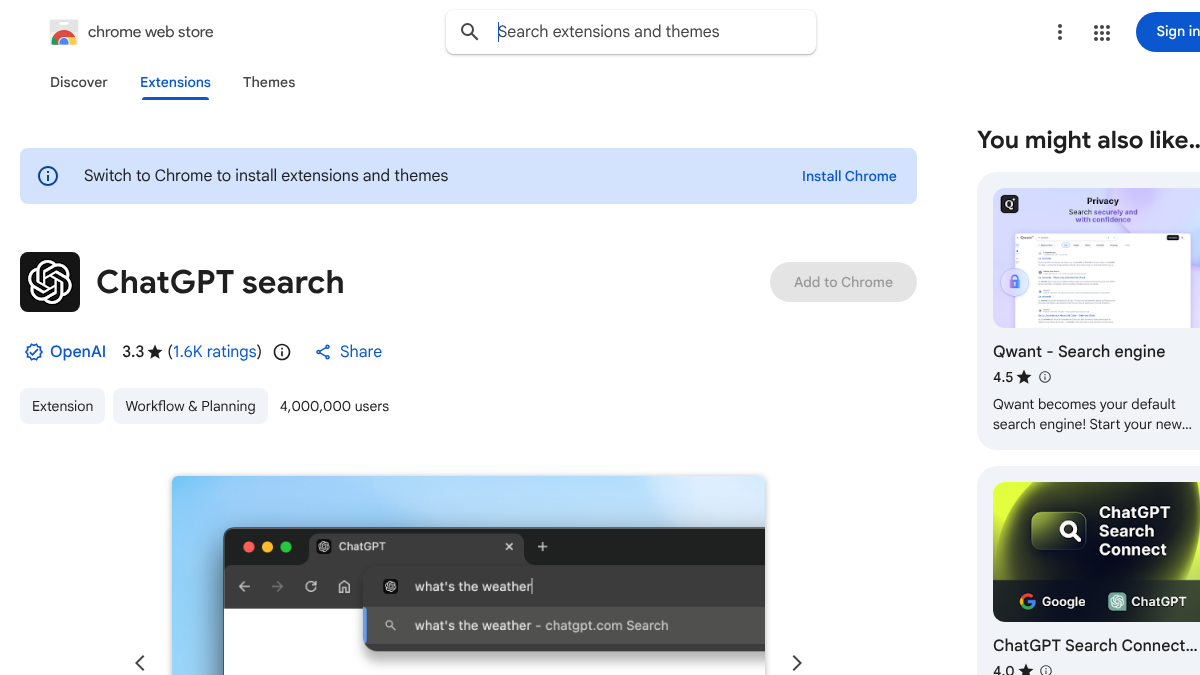
| ChatGPT search (OpenAI) | 4,000,000 | 3.3 |
| Monica | 3,000,000 | 4.8 |
| Merlin | 900,000 | 4.4 |
| MaxAI | 700,000 | Not shown |
Grammarly is in a league of its own, with eight times the users of the next AI extension. It's also a reminder that its search decline doesn't mean people stopped using it. Once something is installed and working, nobody needs to search for it.
OpenAI's ChatGPT search extension, which makes ChatGPT the browser's default search, showed 4 million users and the lowest rating on the list. The Chrome Web Store also rounds these numbers, so treat them as minimums.
What developers run most
Developer tools show up poorly in search data, so we looked at OpenRouter, which publishes token counts for apps that choose to share their usage.
On October 17, Claude Code led with 1.46 trillion tokens in a day, followed by Hermes Agent at 1.29 trillion. Kilo Code, Cline and OpenAI's Codex also made the top 10. Seven of the top 10 apps were coding agents.
Search demand points the same way, more quietly. Replit drew about 201,000 US searches a month in September and Lovable about 165,000, up from 135,000 a year earlier. GitHub Copilot fell from 74,000 to 60,500. Cursor's numbers are muddied by the ordinary word cursor, so we left it out of the ranking.
OpenRouter only counts apps routed through it, and many coding tools connect to model makers directly. So this ranking shows which tools do heavy work there, not total users. Our LLM statistics page covers the models behind these apps.
Your competitors are getting cited by AI. You're not.
Every day without citation tracking is a day your competitors pull ahead in ChatGPT, Perplexity, and Claude.
Creative tools
Image, video, voice and music tools sit lower on the search charts, but several of them grew.
| Tool | What it does | US searches, Sept 2026 | Change since Oct 2025 |
|---|---|---|---|
| Suno | Music | 550,000 | +22% |
| ElevenLabs | Voice | 368,000 | +22% |
| HeyGen | Video avatars | 201,000 | -18% |
| Veo | Video | 201,000 | +22% |
| Midjourney | Images | 165,000 | -45% |
| Kling AI | Video | 135,000 | +23% |
| Runway | Video | 165,000 | +50% |
Video and audio tools mostly grew, while the image tool that defined 2023 faded. Midjourney's searches fell from 301,000 to 165,000 as image generation moved inside the big assistants.
Companion and character apps
Character chat is one of the biggest AI categories by search, and one marketers often overlook. Character AI drew 2.24 million US searches in September, down from 4.09 million a year earlier. Janitor AI moved the other way, from 2.74 million to 4.09 million, overtaking it.
That's a large audience by any standard. Janitor AI alone gets more US searches than Perplexity, DeepSeek and NotebookLM combined. It's also a reminder that the most searched AI tools aren't all work tools.
Meta AI sits in an odd spot. Searches for "meta ai" fell from 368,000 to 301,000, yet Similarweb measured its US monthly app users up 435% year on year, the fastest growth of any assistant in its report. Most people reach it inside Instagram, WhatsApp and Facebook, so they never need to search for it.
Writing, study and meeting tools
The standalone tools for writing, studying and meetings had a harder year. Most of their search demand fell as the big assistants took over the same jobs.
| Tool | What it does | US searches, Sept 2026 | Change since Oct 2025 |
|---|---|---|---|
| Grammarly | Writing checks | 2,740,000 | -33% |
| QuillBot | Paraphrasing | 673,000 | -45% |
| Turnitin | Plagiarism and AI checks | 450,000 | -18% |
| Otter.ai | Meeting notes | 165,000 | -18% |
| Gamma | Presentations | 60,500 | -55% |
| Notion AI | Workspace AI | 18,100 | -33% |
| Fireflies.ai | Meeting notes | 18,100 | -33% |
| Jasper | Marketing copy | 8,100 | -70% |
Some of this is seasonal. September sits at the start of a school year, so study tools like QuillBot and Turnitin may recover later in the term. But the drop is broad, and it hits the tools that do one thing a general assistant now does for free.
Grammarly shows the limits of search as a measure again. Its searches fell a third, yet its 40 million extension users make it one of the most used AI tools anywhere. It wins by sitting inside the text box people already type in.
Using is not paying
Popular doesn't mean paid. A chart on r/EconomyCharts this month claimed 98% of US households weren't paying for AI yet, and it drew more than 1,200 upvotes. The replies mostly mocked the stretched axis that made the paying line look like it was soaring.
98% of US households aren't paying for AI yet
One developer in the thread said they spend about $1,000 a month on AI at work and see no reason to pay at home. That matches the business data. Ramp's AI Index found 43.8% of US companies on its platform paid for Anthropic in August 2026 and 39.8% paid for OpenAI. Money flows through work far more than through homes.
The overall ranking
Putting the measures together, here's how we'd rank the most popular AI tools in October 2026.
| Rank | Tool | Category | Strongest evidence |
|---|---|---|---|
| 1 | ChatGPT | Assistant | 124M monthly US searches, over 1B weekly users |
| 2 | Gemini | Assistant | 30.4M searches, 27.3% of chatbot visits |
| 3 | Grammarly | Writing | 40M extension users |
| 4 | Claude | Assistant | 9.1M searches, fastest growth, top developer app |
| 5 | Canva | Design | 30.4M searches, AI built into a huge user base |
| 6 | Grok | Assistant | 2.2M searches, 2.8% of chatbot visits |
| 7 | Character AI | Companion | 2.2M searches, but falling |
| 8 | Perplexity | Answer engine | 5.85% of AI referrals despite falling searches |
| 9 | NotebookLM | Research | 1.2M searches, more than doubled |
| 10 | DeepSeek | Assistant | 1.2M searches, top model among developers |
Janitor AI, a character chat site, would make the top 10 on search demand alone, with 4.1 million US searches in September. We ranked it lower because no other measure confirms it at that scale.
What this means for marketers
For anyone trying to reach buyers, the takeaway is concentration. Three general assistants, ChatGPT, Gemini and Claude, are absorbing jobs that used to belong to a dozen separate tools. They're also where buyers now ask for recommendations. If your audience leans toward students or creators, widen the list, since Canva, CapCut and the character apps each draw more US searches than most business AI tools in our set.
That's why AI visibility work focuses on a short list of engines. RankControl's AI visibility tracking checks your buyers' questions across ChatGPT, Perplexity, Claude, Gemini, Grok and Google AI Mode every week, which covers the assistants at the top of this ranking.
How we gathered the data
Search volumes are monthly US Google searches from Google Ads data, pulled October 19, 2026, comparing October 2025 with September 2026. Extension counts were read from each Chrome Web Store page the same day. Chatbot visit, app and referral shares come from Similarweb, Sensor Tower and Statcounter as reported in our market share post. Developer app tokens come from OpenRouter's public rankings, licensed CC BY 4.0.
Each measure has blind spots. Search demand misses tools people open directly, extension counts round down, and OpenRouter misses traffic that goes to model makers directly. The overall ranking is our judgment across all four.
You can track all this by hand each quarter. Or RankControl's agents can handle the content side every month, writing and publishing articles on your site and checking how the leading AI assistants answer your buyers each week, while you focus on your product.
200+ SaaS teams already track their AI citations.
They know exactly when ChatGPT mentions their brand, and when it stops. Do you?