In June, a post in r/GEO_optimization asked agency owners a plain question. If you signed a client for a six-month GEO project, what GEO KPIs would you report every month? The best of its 33 replies fit in a short paragraph. What convinces a client, it said, is a number you can re-run in front of them, which a vendor's score can't offer.
That reply split the report in two. Leading numbers show who gets named and cited for a fixed set of buyer prompts. Lagging numbers show AI visits, assisted conversions and branded search. GEO, short for generative engine optimization, is the work of getting your brand into answers from ChatGPT, Perplexity, Gemini and the rest. Our AEO vs GEO vs SEO guide covers how it differs from classic SEO.
This post turns that split into one page you can hand to a founder or CMO. For depth, our breakdown of AI visibility metrics that matter grades how far each number can be trusted. The AI visibility dashboard guide builds a full dashboard, and our post on AI visibility reporting for clients covers what agencies show. Sources were checked on October 19, 2026.
The one-page GEO KPI scorecard
Every row below has a formula you can check by hand and a source you can name. The leading rows come from a fixed set of 20 to 50 buyer prompts, run on each engine every week, with your brand name left out of the prompts.
| KPI | Formula | Data source | Type | Cadence | What a good move looks like |
|---|---|---|---|---|---|
| Mention rate | Answers that name you ÷ answers checked, per engine | Weekly prompt checks | Leading | Check weekly, report monthly | Up across three or more checks, on buying prompts |
| Citation rate | Answers that link to your pages ÷ answers checked | Weekly prompt checks | Leading | Check weekly, report monthly | Up, and the cited pages are the ones you built for those prompts |
| Share of voice | Your mentions ÷ mentions of all tracked brands | Weekly prompt checks | Leading | Monthly | The gap to the leader shrinks and holds for a quarter |
| Accuracy rate | Brand-fact answers with the right price and category ÷ brand-fact answers | Weekly prompt checks | Leading | Monthly | Every answer gets your price and category right |
| Bing Citation Share | Your citations ÷ all citations for the same grounding query | Bing Webmaster Tools | Leading | Monthly | Up across a whole topic, not one query |
| AI assistant sessions | Sessions in GA4's AI Assistant channel, plus Perplexity referrals | GA4 | Lagging | Monthly | Up month over month, with engaged sessions rising too |
| AI-assisted conversions | Conversions where an AI session took part ÷ all conversions | GA4 and your CRM | Lagging | Monthly, judged quarterly | A steady count you can tie to forms or deals |
| Branded search | Branded clicks this month ÷ the same month last year | Search Console | Lagging | Monthly | Rises a few weeks after mention rate rises |
Two rows are missing on purpose. Position inside an answer isn't here, because it changes almost every run. A blended visibility score isn't either, since a flat score can hide a rising mention rate and a falling citation rate.
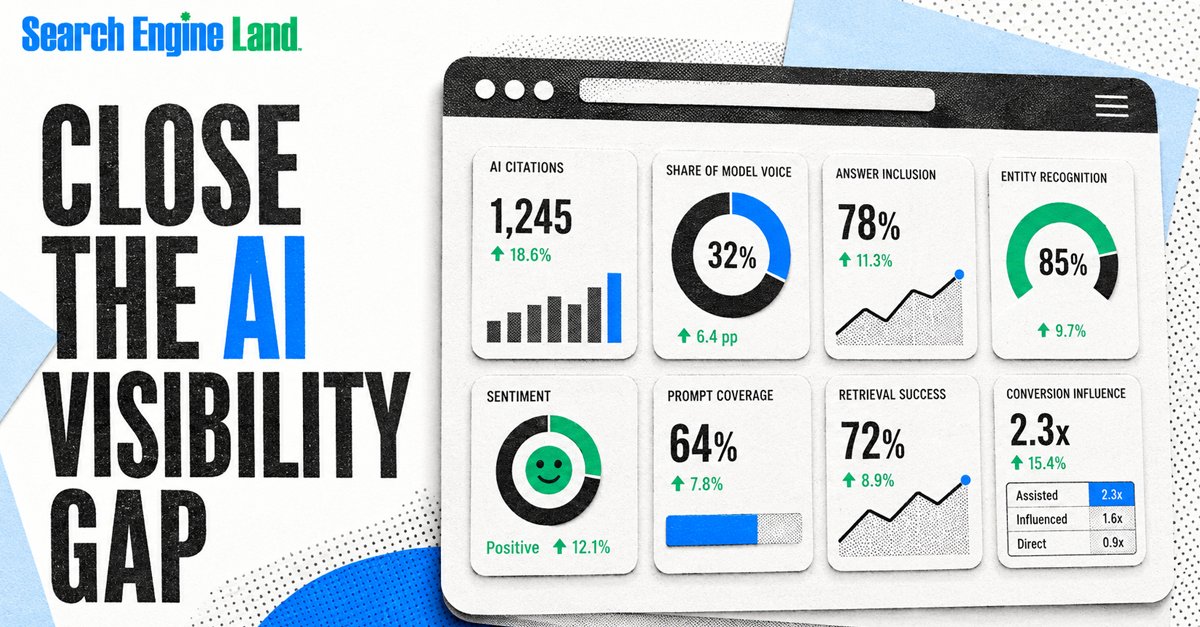
Search Engine Land made the same case in August. A brand can shape an AI answer without ever earning a click, so a report has to count the things rankings miss.
AI search creates a measurement gap: your brand may influence answers without earning a click. Track what rankings miss: – AI citations – Share of Model Voice – Answer inclusion – Prompt coverage – Conversion influence Full breakdown here 👉 https://t.co/kz5Eh9QLfA https://t.co/xH1VnP1eRK
 Search Engine Land@senginelandAug 1, 2026
Your competitors are building backlinks while you read this.
Organic outreach, social mentions, and citations from Editorial Circle member sites, with managed backlinks available as an add-on. Grow your domain authority without running the campaign yourself.

Leading and lagging, and why you need both
Leading numbers move first and tell you what to fix. Lagging numbers move later and tell the boss whether any of it paid off.
With only the leading half, you get the pushback from an r/SEOorganic thread in October. A poster shared 304K impressions in a generative AI report over three months, and several replies said impressions mean little without clicks. With only the lagging half, you see traffic move and can't say why.
Most teams lean on the lagging half today. In the SEOFOMO ecommerce SEO and AI search survey, Aleyda Solis found that roughly 40 to 45% of respondents treat AI referral traffic as a primary KPI. Share of voice was the main KPI for only about 15 to 20%. With 40-odd ecommerce SEOs in the sample, read it as a direction.
Budgets are moving faster than the measurement. Conductor's State of AEO/GEO report, published with Search Engine Journal, says 94% of the 250+ enterprise leaders it surveyed plan to spend more on AEO and GEO in 2026. Their top complaint about measuring it was data quality. Conductor sells AEO software, so weigh that as vendor research.
Aleyda Solis also has a three-layer framework that tags each business number as observed, proxy or modeled. That idea is worth stealing. Mark every lagging row with how sure you are of it, so nobody reads a modeled number as a measured one.
How many runs make a GEO KPI reportable
Call it the re-run test. A GEO KPI is reportable when someone else could run the same prompts next week and land near the same number. Most single checks fail it.
SparkToro's January 2026 study had 600 volunteers run 12 prompts 2,961 times. The odds of ChatGPT or Google's AI giving the same list of brands twice were under 1 in 100, and the same order closer to 1 in 1,000. The post's advice was to ask each prompt at least 60 to 100 times, then average. Even so, top brands in one category still showed up 55 to 77% of the time, which is why a rate holds up where a rank doesn't.
The volunteers weren't a controlled sample, and steadiness varied a lot by category. Few teams will run 100 passes per prompt, so spread the runs across many prompts. For 20 prompts run three times each, our metrics post found a mention rate near 50% can swing about 18 points between two checks by chance alone.
The re-run test also breaks blended numbers. In an r/aeo thread from October, a marketer said their score looked fine while competitors were winning the buying prompts. The best replies split prompts by intent before averaging, so "what is X" never counts the same as "best X for Y".
AI visibility scores are confusing
On the page, show the leading rows for buying prompts on their own line, and put the full set below it.
Bing Citation Share: the free number few people report
Bing Webmaster Tools gives you a free citation number straight from the engine. Its AI Performance report arrived in February 2026 and shows where your pages get cited in Copilot, Bing and some partner AI tools. On June 16, Bing added four views to it in preview:
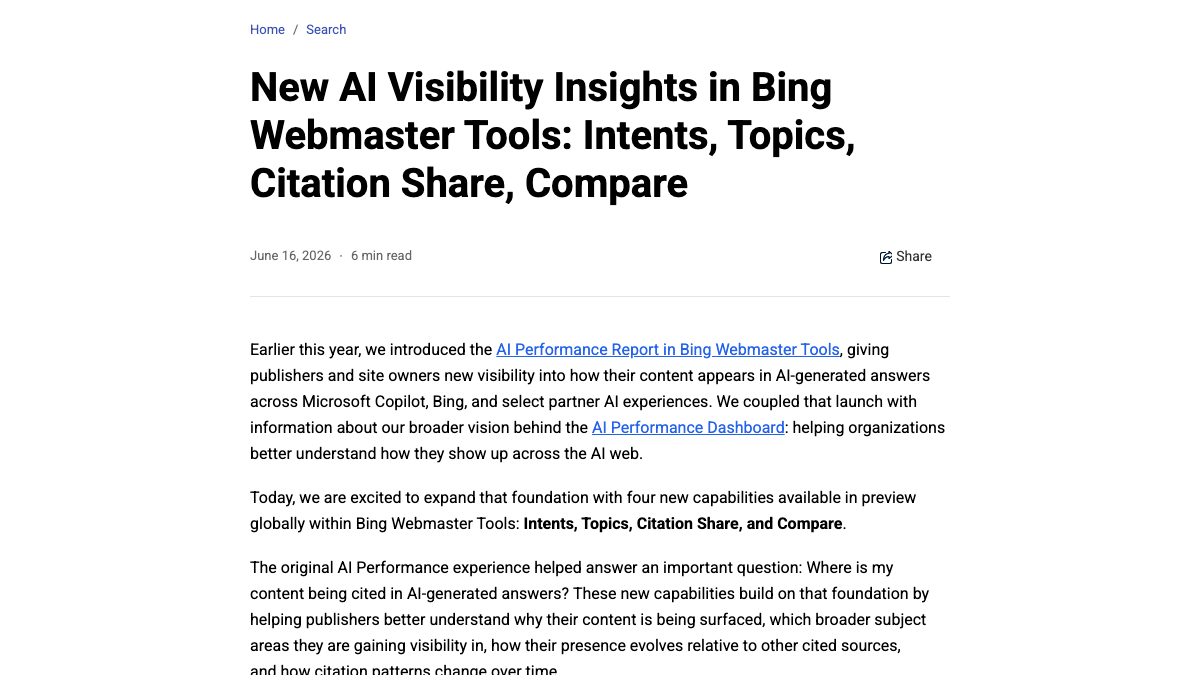
Bing's post defines Citation Share as "the percentage of citations attributed to your site out of all citations shown across all sites for that same grounding query." Intents and Topics sort those queries by type and theme, and Compare lays a past period over the current one.
Bing says Citation Share is meant to be observational, so it doesn't work as a ranking or a scoreboard. Report it by topic and by month, and don't celebrate a single query. It covers Microsoft's AI surfaces only, so it sits next to your prompt checks for ChatGPT and Perplexity.
You're getting AI traffic. But do you know where it comes from?
RankControl credits every visit to the assistant that sent it: ChatGPT, Perplexity, Claude, Gemini, Copilot, or Grok. Full source attribution, next to your Google traffic.
GA4: where AI visits land
Google's default channel group has an AI Assistant channel for visits "from sources like ChatGPT, Gemini, Deepseek, Copilot, or Grok." Perplexity isn't named there, so it can land in Referral. Google's own AI Overviews and AI Mode count as Organic Search, which means one of the biggest AI surfaces never shows up in the AI row.
To get Perplexity and Claude in the same row, build a custom channel group. Google's page on custom channel groups has a ready AI assistants example with a regex you can paste:
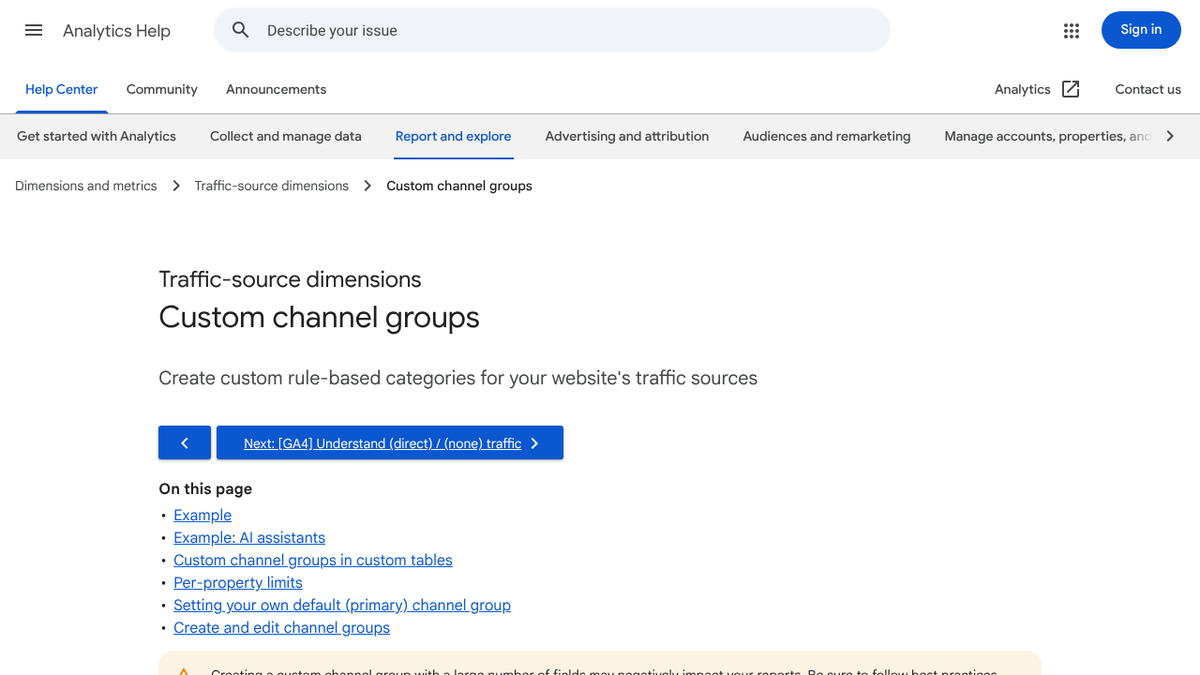
The step people miss is the order. GA4 sorts each session into the first channel whose rule it matches, and Google tells you to move AI Assistants above Referrals. Leave it below, and Referral takes those visits first.
Some ChatGPT visits still won't show up. An October thread in r/SEO_for_AI asked where ChatGPT traffic goes in GA4, after the poster saw Direct and Unassigned grow at the same time.
One reply gave a check you can run today. When ChatGPT strips the referrer, the visit lands in Direct. When it adds utm_source=chatgpt.com with no medium, GA4 can't map it to a channel, so it lands in Unassigned. In Explore, filter session source to chatgpt.com and split by medium. Rand Fishkin replied that ChatGPT looked like a likely suspect and that he was checking it with clickstream data, since a missing referrer can't hide a click from a panel. Until that's out, report the Unassigned share you can prove and leave Direct alone.
Count AI sessions across the whole site, including pages that were never cited. Similarweb's 2026 report on generative AI found that 65% of the URLs ChatGPT cites sit two or three folders deep, yet 58.8% of its referral visits land on homepages. Our GA4 guide to AI referral tracking walks through the full setup.
Search Console: the branded line
Branded search is the slowest lagging row and often the most convincing one. A buyer reads your name in an answer, then searches for it later, and that visit never counts as AI.
Google added a branded queries filter to Search Console in November 2025:
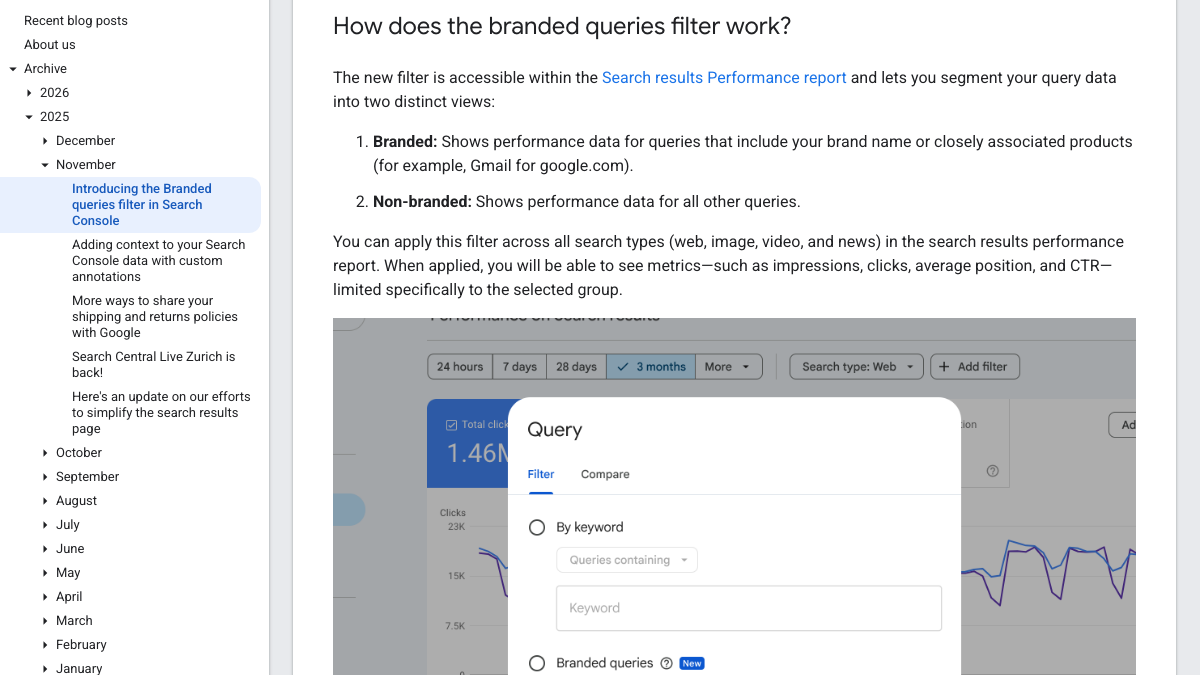
It sorts queries with an AI-assisted system rather than a keyword list, so it catches misspellings and product names. It only works on top-level properties with enough query volume, so check yours first. Compare branded clicks with the same month last year, since branded demand swings with the season.
When a number drops
Treat a drop in a leading row as a work order. Check whether it shows on more than one engine and more than one check, then look at which sources the engine used instead. Our checklist for when AI citations drop goes through it step by step.
Judge the lagging rows over a quarter, and say so on the page. Monthly AI sessions and conversions are often small numbers that jump around.
Filling the page every week
The page is quick to read and slow to fill. Our metrics post puts a 20-prompt, three-run check on two engines at about two hours a week. Seven engines takes closer to seven hours, before the monthly pull from GA4, Bing and Search Console.
RankControl fills most of the leading half. Our AI visibility tracking checks your buyer prompts every week on seven engines, marks each answer as mentioned, cited or both, and shows which competitors were named. Our analytics show AI-referred visits by source. The weekly brief email lists new citations and visits, so a drop shows up in the dashboard rather than your inbox.
You can fill this page by hand with a prompt sheet and three free consoles. Or RankControl's agents can run the weekly checks and publish articles for the prompts you're missing, while you spend the meeting on what changed.
We'll show you exactly where your brand stands in AI search.
No commitment. $0 due today, cancel anytime. See how ChatGPT, Perplexity, Claude, Gemini, Grok, Google AI Mode, and Google AI Overviews talk about your brand today.