
You open the planning doc and the AEO column has 14 items in it. Someone wants an llms.txt file, someone else read that content should be "chunked" for AI, and a vendor is quoting for special AI schema. Meanwhile, the comparison pages sales keeps asking for haven't moved in two quarters.
In July, a recent graduate asked r/aeo where to even start, since everyone seemed to have a different opinion on what works:
where do I start with AEO?
I recently graduated college and I'm trying to get into content marketing. I have started with SEO courses but a lot of them already feel out of date. I am currently looked into AEO and GEO but the more I read the more it feels like everyon...
Most replies said to learn SEO first. The most practical one said to pick a product you know and ask ChatGPT and Perplexity a real buyer question while logged out. Then read which pages each answer pulled from.
We agree with both, and they point at the same rule. Rank AEO projects by what they unlock and how much evidence backs them, instead of by how new they sound. This guide covers what to cut and what to run first, then how to score the rest. Sources were checked on September 27, 2026.
Cut the projects Google told you to skip
The fastest way to shrink the list is to delete things. In May, Google published a guide to optimizing for its generative AI features, and its closing section spells out what to focus on:
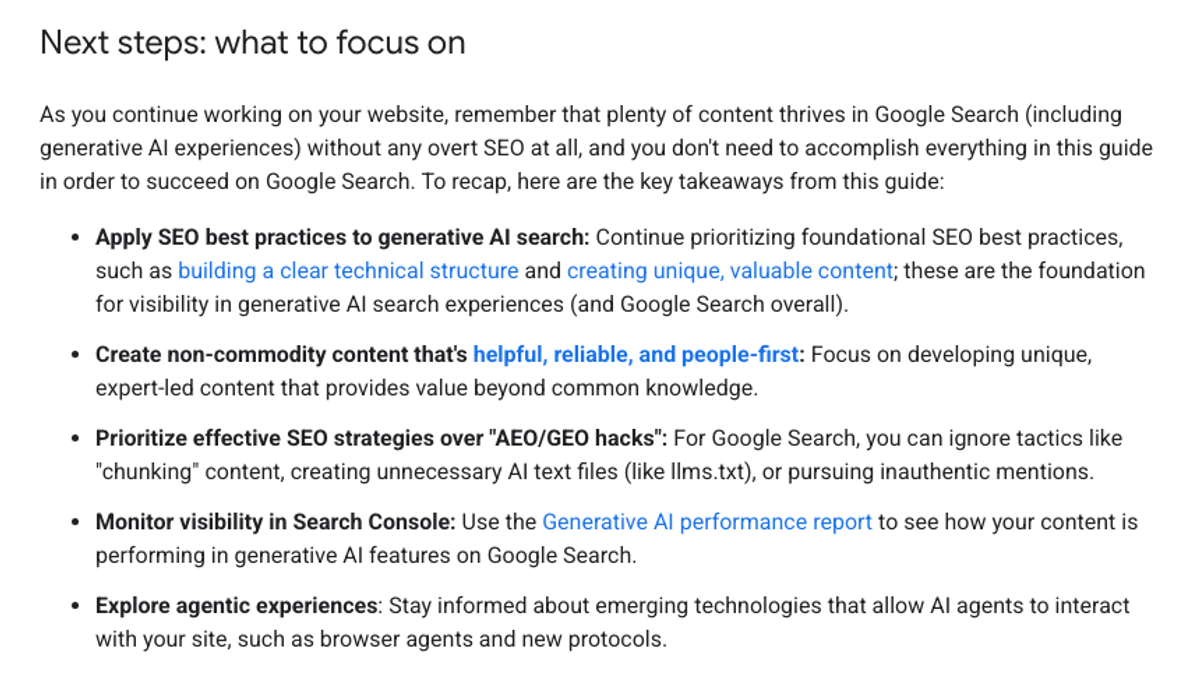
A section earlier in the same guide, titled "what you don't need to do," names the specifics. Google lists llms.txt and other AI files, chunking content and rewriting content just for AI as unnecessary. It also says special structured data isn't required for its AI features. A post in r/GEO_optimization in September called that list a free procurement tool:
Google published a "what you don't need to do" list for AI optimisation and it kills off half the GEO packages being sold
The poster made a point we'd underline. Google isn't saying schema is useless, since it still earns rich results in normal search. It's saying you don't need a separate "AI schema" line item. The same goes for mentions: genuine coverage on other sites seems to help, while manufactured mentions are what Google warns against.
Google's guide only covers Google. Do ChatGPT or Perplexity reward any of these? We haven't seen public evidence that they do. Our look at whether llms.txt is a helpful standard or a dead end goes through what's known.
See your first AI citation report in under 5 minutes.
No setup calls. No onboarding meetings. Connect your domain and see where AI mentions your brand right now.
Run the gate projects first
Some projects don't improve visibility on their own. They decide whether anything else on the list can work. We call these gate projects, and they go first because they're small and everything else waits on them:
| Gate project | Rough effort | What it unlocks |
|---|---|---|
| Check that AI search crawlers can reach your site | Under an hour | Every citation from ChatGPT, Perplexity and Claude search |
| Confirm key pages are indexed in Google and Bing | A few hours | Answers built on either search engine's results |
| Set up a fixed list of questions to track | A day | The ability to tell whether any later project worked |
The crawler check is quick, and it's usually fine. On September 27 we fetched robots.txt from 161 sites that AI engines had cited or Google had ranked for 12 B2B software questions. Of the 151 files we could read, 149 let OpenAI's search crawler in. The two that didn't were Reddit and Quora, which block almost every crawler by default.
So you'll probably pass. The catch is that a blanket "block all AI bots" rule, added to keep content out of model training, also blocks the search crawlers. OpenAI's documentation says sites that block OAI-SearchBot won't be shown in ChatGPT search answers. Our robots.txt checklist for AI crawlers lists which user agents to allow.
Indexing matters because ChatGPT pulls from both search engines' results as well as OpenAI's own index, as our piece on whether ChatGPT search uses Bing covers.
The tracking gate is easy to skip, and it's the one that bit us this month. When we tried to pull Bing results automatically for a comparison, one search came back as dictionary definitions of the word "best." The query was "best crm for small b2b sales team." Nothing flagged it as broken. If we hadn't opened the raw results, we'd have reported a finding that wasn't real. Whatever you track, look at the raw answers before you trust the summary.
Run each question more than once, too. Our guide to tracking AI citations for free covers how many answers you need before a change means something.
Score everything else on one sheet
Once the gates are open and the obvious cuts are gone, score what's left. We use three questions for each project:
- How many of your tracked questions could it change? A project that touches one question can wait.
- How strong is the evidence that it works? Official guidance or a published study beats a vendor's case study.
- How many hours will it take, including review?
Here's how a typical B2B backlog scores out:
| Project | Questions it touches | Evidence | Effort | Verdict |
|---|---|---|---|---|
| Fix pricing and plan facts on your own pages | Every question about your product | Strong | Low | Do now |
| Pages answering your top buyer questions | Most category questions | Strong | Medium | Do now |
| Refresh pages that rank but aren't cited | Some | Some | Medium | Next |
| Earn genuine mentions on review sites and in communities | Many | Some | High | Start now, runs for months |
| Special AI schema | None extra | Google says not required | Medium | Skip, keep normal schema |
| llms.txt | None found | None for Google | Low | Skip |
| Rewriting pages into chunks | None | Google says unnecessary | High | Skip |
The first row is the one we'd push hardest. When we checked AI answers about help desk software this month, two of the errors we found were prices repeated without saying they were annual-billing prices. On the source page, the billing period sat in a toggle above the table. Fixing that kind of thing on your own pages is usually an afternoon's work. Our Perplexity citation audit shows how those errors travel from a page into an answer.
The mentions row scores lower on effort but stays on the list for a reason. In a 2025 study of 75,000 brands, Ahrefs found brand mentions across the web correlated with AI Overview visibility at 0.664, against 0.218 for backlinks. That's a correlation, not proof, and it's slow work, which is why it starts early and runs in the background.
To find refresh candidates, compare two lists for each buyer question: the pages that rank on Google's first page, and the pages AI answers cite. Search Console's Generative AI report shows which of your pages already earn impressions in Google's AI features. A page that ranks well but never shows up in answers is usually missing a direct answer near the top or a visible date.
Your competitors are building backlinks while you read this.
Organic outreach, social mentions, and citations from Editorial Circle member sites, with managed backlinks available as an add-on. Grow your domain authority without running the campaign yourself.

Put quick signals ahead of slow ones
Order matters as much as the score. Fixes on your own pages can show up in answers within weeks, once engines recrawl them. Mentions and reviews take months to build. If the slow projects go first, you'll spend a quarter without knowing whether anything worked.
A sequence that holds up for most B2B teams looks like this:
| Weeks | Focus |
|---|---|
| 1 to 2 | Gate projects, plus a baseline run of your question list |
| 3 to 6 | Facts on your own pages and answers to your top buyer questions |
| 7 to 12 | Comparisons and refreshes, then a second measurement run |
| Ongoing | Genuine mentions, reviews and community answers |
Our 90-day AI SEO timeline goes deeper on what to expect in each stretch.
How to say no to the rest
Every AEO request should come with one sentence: which tracked questions will this change, and how will we know? If nobody can name the questions, the project waits.
It also helps to know who to listen to. In July, Glenn Gabe shared the advice Lily Ray gave CMOs starting from zero:
Some wise words from @lilyraynyc. There's a lot of BS being thrown around regarding GEO/AEO. Be careful out there. :) "What Lily told CMOs starting from zero: 1) be skeptical, a lot of the loudest voices don't really know what's going on 2) the people best equipped for this are https://t.co/oWe1imRSGr
 Glenn Gabe@glenngabeJul 23, 2026

Her advice was to be skeptical of the loudest voices and lean on your experienced SEOs, since so much of AI search runs on web retrieval. She also warned against the idea that SEO is dead. Our robots.txt check points the same way: 149 of the 151 cited or ranking sites we could read let search crawlers in.
Done by hand, checking 50 questions on seven engines takes about six hours a week, and publishing eight solid articles a month takes 16 to 24 hours more. Those are rough estimates.
RankControl's AI visibility tracking runs your 50 questions every week on seven engines, marks each one as mentioned, cited or both, and records which competitors and sources each engine used. The content engine writes each article against the pages already ranking for its keyword and publishes it on your own domain.
You can run this triage yourself with a spreadsheet and a fixed question list. Or RankControl's agents can handle the tracking and publishing while your team works through the rest of the list.
You're getting AI traffic. But do you know where it comes from?
RankControl credits every visit to the assistant that sent it: ChatGPT, Perplexity, Claude, Gemini, Copilot, or Grok. Full source attribution, next to your Google traffic.