The usual case for SEO is clicks: someone searches, finds your page and visits. But most search results never get clicked. That doesn't mean they did nothing. Every time your name appears in front of a searcher, they see it.
That's the part of SEO that builds brand awareness, and it's easy to miss because it doesn't show up as traffic. This guide covers how owned content builds recall, what the research says about exposure without a click, how branded search shows it's working and how AI answers add a second layer.
An impression is a sighting
Google defines an impression in its Search Console help. "An impression means that a user has seen (or potentially seen) a link to your site in Search, Discover, or News."
No click needed. A page that ranks for a hundred searches a day puts your name in front of a hundred people a day, even if only a few visit. Over a year, a library of articles can reach far more people than the click numbers suggest.
We call this the unclicked impression. It's the sighting that never shows up in your traffic report, but still adds one more moment of familiarity with your name.
What research says about exposure and recall
The idea that seeing something makes people like it more is old. Psychologist Robert Zajonc's 1968 paper, "Attitudinal Effects of Mere Exposure," described what became known as the mere-exposure effect, the finding that people tend to develop a preference for things simply because they're familiar with them. Applying it to search is an analogy, not a search study, but it's the basic reason repeated visibility matters.
The closest controlled data on search comes from paid ads. In 2013, Ipsos MediaCT and Google ran 61 simulated search experiments with 800 US consumers per study across 12 product categories. Ipsos reported that "search has a positive impact on both top-of-mind awareness and unaided brand awareness even when the consumer doesn't click on the ad."
In MarketingDive's write-up of the study, 14.2% of people who saw the brand in the top ad position could name it unaided, against 8.2% of a control group that didn't see it.
Three caveats. It's about paid ads, not organic results. It tested only the top paid position. And Google, which sells those ads, ran it with Ipsos. Still, it's the clearest evidence that appearing in search, without a click, can move recall.
Your competitors are building backlinks while you read this.
Organic outreach, social mentions, and citations from Editorial Circle member sites, with managed backlinks available as an add-on. Grow your domain authority without running the campaign yourself.
A worked example
Here's what the unclicked impression looks like in numbers. These are illustrative, so swap in your own from Search Console.
| Measure | Example |
|---|---|
| Published articles | 40 |
| Average impressions per article per month | 500 |
| Total impressions per month | 20,000 |
| Click-through rate | 3% |
| Visits per month | 600 |
| People who saw the name but didn't click | 19,400 |
In this example, for every visit, about 32 more people saw your name in the results and moved on. Your traffic report shows the 600. The other 19,400 sightings are the awareness work, and they repeat every month as long as the pages keep ranking.
That's why impressions are worth tracking as their own number, alongside clicks. A month where clicks stay flat but impressions grow is still a month where more people saw your name, and over a year those sightings add up to recognition you can't buy with a single campaign.
Branded search: the signal that it's working
If awareness is building, more people search for you by name. Branded searches, like "Acme pricing" or "Acme reviews," are the lagging signal that people remember you.
We checked Google Trends for four software companies known for large, long-running content programs, comparing their US search interest over five years. We averaged 12 weeks at each end of the window to avoid picking a single spike.
| Brand | Late 2021 average | Late 2026 average | Change |
|---|---|---|---|
| HubSpot | 12.6 | 24.4 | +94% |
| Ahrefs | 1.0 | 4.1 | +308% |
| Zapier | 3.2 | 6.3 | +97% |
| Semrush | 1.4 | 4.8 | +235% |
All four roughly doubled to quadrupled on the same index, checked October 19, 2026. That doesn't prove their content caused it. Product growth, advertising and their markets growing all push branded search up too. But it's consistent with what you'd expect from companies that have put their name in front of searchers, year after year.
A thread on r/seogrowth asked whether brand searches are becoming more important than keywords. The top reply argued they work together. Ranking without brand trust tends to get weaker clicks, while people searching your name click more and come back, so the teams doing well build both.
Are brand searches becoming more important than keywords for organic growth?
Branded search and AI visibility
Branded search also lines up with how often AI answers mention you. Ahrefs studied 75,000 brands and found branded search volume correlated with visibility in Google's AI Overviews at 0.392. Branded web mentions correlated more strongly, at 0.664.
Ahrefs is clear that "correlation ≠ causation," and that the factors it studied showed "moderate to very weak correlations." But the direction is consistent. Brands people know and search for tend to be the brands AI answers name. Our post on whether AI recommendations lift branded search looks at the other direction of that link.
You're getting AI traffic. But do you know where it comes from?
RankControl credits every visit to the assistant that sent it: ChatGPT, Perplexity, Claude, Gemini, Copilot, or Grok. Full source attribution, next to your Google traffic.
AI answers are a second layer of exposure
AI answers add a new kind of impression. When ChatGPT, Perplexity or Google's AI Mode names your brand in an answer, that's another sighting, often in a more trusted context, because the answer reads like a recommendation.
Owned content feeds this in two ways. Your own pages can be cited directly when they answer a question clearly. And your content earns mentions and links from other sites, which are what AI answers draw on most. Our analysis of how often AI cites your own site shows how different branded and unbranded questions are.
So the awareness loop now runs through three channels, which are search results, branded searches and AI answers. Content shows up in all three.
How to measure it
You can't see recall directly, but you can see its signals.
| Signal | Where | What to watch |
|---|---|---|
| Reach | Search Console impressions | Growth month over month |
| Recall | Branded queries in Search Console | Growth in branded clicks and impressions |
| AI exposure | AI answers for your key questions | How often you're named |
| Direct visits | Analytics, direct traffic | Slow growth over quarters |
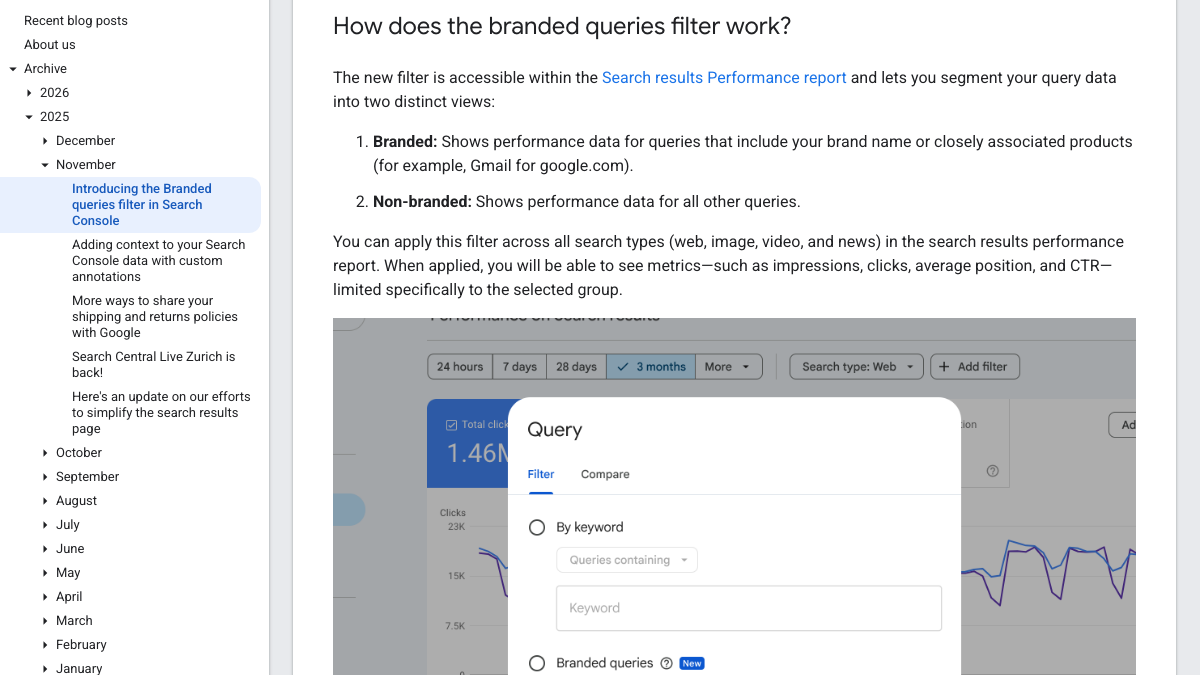
Search Console now has a branded queries filter in the Performance report, which splits branded and non-branded searches for you.
A simple monthly routine:
- Note total impressions for the last 28 days.
- Filter to branded queries and note impressions and clicks.
- Check a fixed set of AI questions in a few engines, and note whether you're named.
- Compare with last month and the same month last year.
The trend matters more than any single number. Our guide to measuring SEO ROI covers tying these signals to revenue, and our post on AI visibility scores covers building a single AI number.
What to publish for awareness
Content built for awareness looks a bit different from content built only for conversions.
- Answer questions in your category, including early-stage ones buyers ask before they know you exist.
- Put your name where it's natural. In examples, in your own data, in a clear byline.
- Publish original data. It gets cited and linked by others, which spreads your name further.
- Be consistent. Awareness comes from repetition. One article a week for a year does more than a burst.
- Cover the topics you want to be known for. Depth in a few areas makes your name stick to them.
Our guide to how long it takes AI search to learn a brand covers the timing on the AI side.
Mistakes to avoid
- Judging content only by clicks. Impressions are reach too.
- Ignoring branded search. It's the clearest sign awareness is growing.
- Expecting quick results. Recall builds over months and years.
- Publishing in bursts. Steady exposure beats occasional spikes.
Doing it yourself or handing it off
Brand awareness from SEO comes down to one thing: putting useful pages with your name on them in front of searchers, consistently, for a long time.
RankControl handles that. We find the questions your buyers search, write each article against the pages already ranking for it and publish it to your site on a steady schedule. Our AI visibility tracking checks up to 50 buyer questions every week across seven AI engines and shows how often each answer names you. Expect traffic from Google first, with AI citations following more slowly as links and mentions build up.
We'll show you exactly where your brand stands in AI search.
No commitment. $0 due today, cancel anytime. See how ChatGPT, Perplexity, Claude, Gemini, Grok, Google AI Mode, and Google AI Overviews talk about your brand today.