
An agency owner posted in r/agency in August with a problem that sounds like success at first. They'd signed 42 clients since February on three-month contracts. Then a lot of them left as soon as the first contract ended, and they couldn't work out why.
My agency's churn rate is really high
Hi everyone. So I started a PPC agency around February and we closed 42 clients. We have initial 3 month contracts but I noticed a lot of clients leave after the initial contract. I'm wondering if this is normal cuz I'm extremely alarmed wi...
The most upvoted reply said to survey the clients who leave before guessing. Others pointed at the usual suspects, which were over-promising in sales, small clients who want results fast, and value the client can't see after month three.
Content marketing for agencies has all of those problems, plus a new one. Clients now know AI can write. So the service has to be sold, staffed and reported in a way that makes the agency's part obvious. This guide covers all three.
What the market pays for
Start with the rates, because they explain what clients are actually buying.
| Who does the work | Typical rate | Source |
|---|---|---|
| Blog writers on Upwork | $15 to $35 an hour | Upwork's cost guide |
| Writing services companies on Clutch | $25 to $49 an hour | Clutch writing services pricing guide |
| Content marketing agencies on Clutch | $100 to $149 an hour | Clutch digital marketing pricing guide, updated September 2026 |
The writing itself is the cheap part. Clients pay three to five times more an hour when the work includes choosing topics, knowing their business, editing for accuracy and showing results. That's the service an agency should sell.
Demand is still there. "Content marketing services" gets about 6,600 US searches a month and "content marketing agency" about 3,600, with advertisers paying around $17 a click for the second, per Google Ads data.
Selling it when clients know AI can write
The Content Marketing Institute's 2026 survey of 1,015 B2B marketers shows the tension. Among teams using AI tools, 89% already use them to create content. When asked where they'll spend more in 2026, 45% picked AI tools and 19% picked agencies and outsourcing.
So don't sell articles. Sell the things a client's own AI subscription can't do for them.
- Knowledge of the client's business, turned into a source file every article is written from.
- Topic choice based on what their buyers search and what AI answers cite.
- Fact-checking every claim before it goes live.
- Monthly proof of what the content did.
The same CMI survey gives you a useful line for sales calls. Among marketers using AI for content, 87% said productivity improved, but only 39% said content performance improved. Speed is easy to buy. Results are what clients still need help with.
How often does ChatGPT mention your brand?
Most founders have no idea. The answer might surprise you.

Packaging the retainer
Most content clients understand three shapes of offer. The details matter less than being clear about what each includes.
| Package | What's in it | Who it suits |
|---|---|---|
| Foundation | Strategy, 4 articles a month, monthly report | Small businesses starting from zero |
| Growth | Strategy, 8 articles, refreshes of older posts, comparison pages | Companies with some traffic and clear competitors |
| Authority | Growth plus original research, outreach for links and AI visibility tracking | Brands in crowded categories |
Put a price on the strategy and reporting as well as the words. If a client asks for a cheaper per-article deal, that's a writing services request, and the $25 to $49 an hour market is waiting for it.
Several agencies have started selling AI search visibility as an add-on. One agency owner wrote in r/agencynewbies this month that it added close to $40,000 of monthly revenue in 11 months, mostly as an upsell to existing SEO clients. Their advice was that showing where AI mentions a competitor but not the client sells itself in a monthly report.
Which client pages get cited
It helps to know what you're building toward. This month we checked Google's AI Overviews for real searches in a few common agency client types, and the pages that got cited were very concrete.
For dental questions, 12 of the 22 sources cited were ordinary practice pages that answered one question clearly. For real estate questions, 9 of 20 were agent and brokerage pages, most of them city-specific guides to costs and timelines. For software comparisons, the vendors' own comparison pages ranked and were cited.
Few of them were generic articles. Most were the local, specific version of a question the client's own staff answer every day. That's good news for agencies, because it's exactly the knowledge a client can hand over in an interview and a generic AI draft can't invent. Our guides to SEO for dentists and SEO for real estate show the full numbers.
Staffing it with AI in the mix
A content retainer needs three roles, even if one person covers two of them on small accounts.
- A strategist owns topics, the client relationship and the monthly report.
- A writer, or an AI operator, drafts each article from the client's source material.
- An editor checks every fact, link and claim, and keeps the client's voice.
An agency that writes for immigration law, cybersecurity and finance clients described its setup in r/agency. Before writing anything, they build each client a knowledge base covering services, buyers, every important page on the site and past writing to match. Every draft goes through research, writing, a revision against all past client feedback and a check of every claim and link.
The replies agreed on the weak spot. The knowledge base drifts. A client changes positioning three months later, nobody updates the file, and the AI keeps writing against old facts. Put a quarterly knowledge base review in the contract.
Google's guidance backs up the editing role. Its page on generative AI content, updated October 1, says it's critical to manually fact-check all AI-generated content before publishing. Our guide to AI content creation covers that process step by step.
The unit math
Here's a rough model for one Foundation client, with assumptions you should replace with your own. Say an article takes four hours across the three roles, including research, drafting, editing and publishing. Add four hours a month for strategy and reporting.
That's about 20 hours a month for four articles. At a blended internal cost of $50 an hour, the work costs $1,000. A retainer priced at $2,500 to $3,000 leaves room for sales, account management and the months when a client needs more attention.
If you price closer to writing rates, the math stops working. That's usually why agencies that win clients on price find them leaving after three months.
15 hours a week manually. Or 15 minutes with RankControl.
Track citations, monitor competitors, and fix content gaps across every AI search engine. Automatically.

Proving it works
Reporting is what keeps content clients past the first contract. One agency owner selling AI visibility put it plainly, saying reporting drives retention for them. Show what you did each month and what changed.
There's finally better data to show. Search Console's generative AI performance report now covers every site.
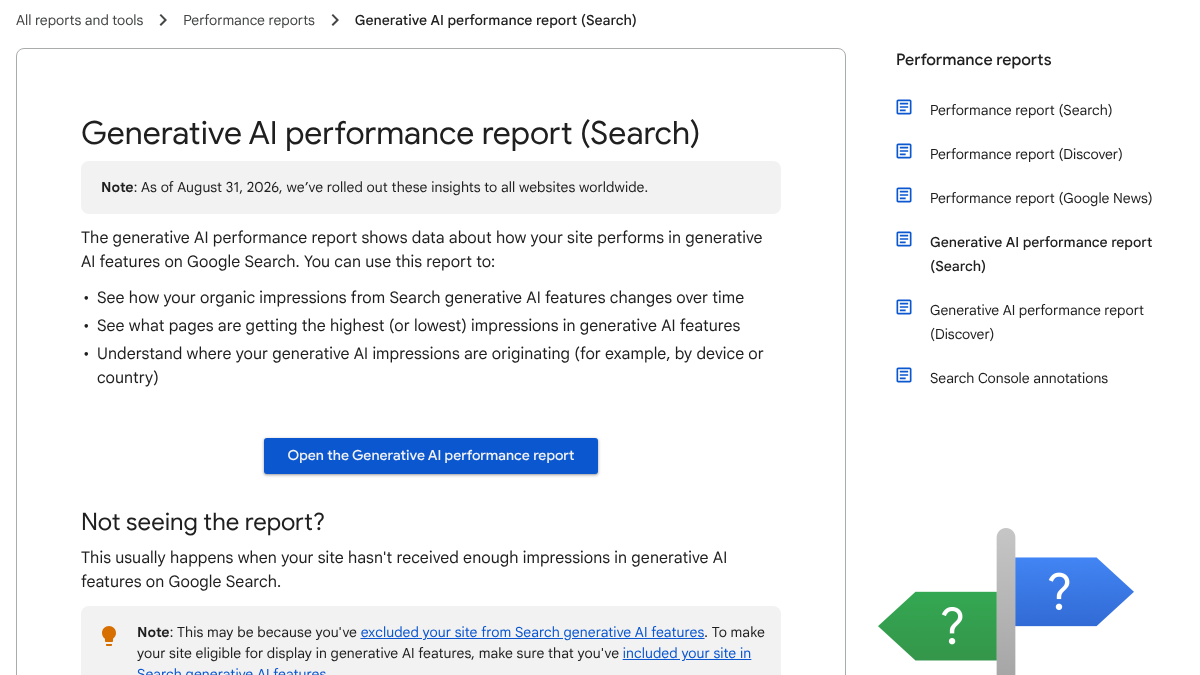
It shows how often a client's pages appeared in AI Overviews and AI Mode, which pages appeared most, and by country and device. It doesn't show clicks or the searches behind the impressions, so pair it with other data.
A good monthly report covers four things.
- Articles published and updated, with links.
- Search Console clicks and impressions for those pages, plus generative AI impressions.
- Visits and signups from AI assistants. ChatGPT adds utm_source=chatgpt.com to its links, so GA4 can attribute them, though some mobile visits lose the tag.
- Whether AI answers name the client for their main buying questions, compared with last month.
Our post on AI visibility metrics covers which numbers to put in front of clients and which to leave out.
Setting expectations in the sales call
Most churn starts in the sales call. Content takes months to rank, and AI answers change week to week, so say that before the client signs.
Agree on three things up front. Decide which buying questions you're targeting, which numbers you'll report each month, and what you'll change if those numbers haven't moved after 90 days. Then put the first report on the calendar before the first article goes live.
A minimum term longer than three months helps too, since content rarely shows its value that fast. One reply in the churn thread suggested letting clients cancel after the first month, then locking in the rest of the year.
What this costs in hours
For each client, plan on roughly 20 hours a month for four articles, including about four hours of strategy and reporting. Onboarding a new client, with interviews and the knowledge base, takes another 8 to 12 hours up front.
You can staff all of this yourself. Or RankControl's agents can handle the production for you every month, writing articles from each client's brand facts, publishing them on the client's site after approval and checking six AI engines every week, while your team focuses on strategy and the client relationship.
AI search traffic grew 835% this year. Is your content ready?
RankControl generates 26 content formats optimized for ChatGPT, Claude, and Perplexity. Published on your domain, matched to your brand.