
On October 19, 2026, Google still showed an eBay listing for MAC's Fix+ setting spray whose description began, "As of my last knowledge update in September 2021, MAC Cosmetics offered a variety of setting sprays." A seller had asked a chatbot to write it and pasted the answer, disclaimer and all.
That's the clearest picture of automated content creation gone wrong. Nothing about the tool was broken. The step where a person reads the output before the public does was simply missing. This guide covers which content you can safely hand to automation, which needs a check and which should stay human, by content type.
Most new pages already use AI
Automation isn't a fringe practice anymore. Ahrefs analyzed 900,000 new web pages in April 2025 and found AI-generated content in 74.2% of them, though most mixed AI with human writing. Only a small share was pure AI.
So the question for most teams isn't whether to automate. It's where the person goes in the process, and what they check when they get there.
What we found when nobody checked
We searched Google on October 19, 2026, for three phrases chatbots use when they don't know something. These were "as an AI language model," "I cannot fulfill this request" and "as of my last knowledge update." We limited each search to one big platform at a time and read every result by hand.
After removing joke merchandise, posts that only discussed the phrase and results from other sites, we counted at least 34 live product or business listings with the chatbot's words in them.
| Platform | Listings with chatbot text | Examples |
|---|---|---|
| eBay | 15 | Model airplanes, a Special Forces patch, Disney Dollars, a vintage aftershave |
| Etsy | About 11 | Gemstones, wall art titled "I'm sorry, I cannot fulfill this request," a silver ring |
| Amazon | 6 | Books whose descriptions say the AI has no information about them |
| Tripadvisor | 2 | A guest house description and a day tour listing |
Tripadvisor also had five forum answers where someone pasted a chatbot reply, including taxi prices "as of my last knowledge update in September 2021." Google's results shift from search to search, so treat 34 as a floor.
The pattern in every case was the same. The model was asked about something it didn't know, it said so, and the automation published that admission as product copy. A check against the source, or one human read, would have caught every one.

Your competitors are getting cited by AI. You're not.
Every day without citation tracking is a day your competitors pull ahead in ChatGPT, Perplexity, and Claude.
What to automate, check or keep human
Here's how we'd split common content types for a small business. The rule behind it is simple. Automate when the input is structured and checkable, check when facts are involved, and keep it human when the content depends on real experience or someone has to answer for it.
| Content type | Automate | Human check | Keep human |
|---|---|---|---|
| Product descriptions | Draft from your spec sheet | Every fact against the spec | |
| Meta titles and descriptions | Yes | Spot-check a sample | |
| Social posts from published articles | Draft them | Edit voice before posting | Replies to comments |
| Blog articles | Research and first draft | Facts, numbers and examples | Your own stories and opinions |
| FAQ pages | Draft from support tickets | Answers against your policies | |
| Translations | Yes | Key pages by a native speaker | |
| Email newsletters | First draft | Voice and offers | Who it goes to and when |
| Case studies | All of it, with the real customer | ||
| Customer reviews and testimonials | Never | Only real customers write these | |
| Pricing, legal, medical or financial claims | All of it |
The eBay and Amazon listings broke the first row. They automated the draft and skipped the check against the spec, so the model filled the gap with a disclaimer.
Why some rows stay human
Case studies and testimonials stay human for a legal reason as well as a trust one. The FTC's rule banning fake reviews and testimonials took effect in October 2024, and it covers reviews that misrepresent who wrote them, including AI-generated ones.
Replies stay human because that's where audiences judge you. In a September r/SaaS thread, one account owner shared numbers from six weeks of mostly scheduled posting. Sixteen scheduled X posts drew a median of 12 views and no likes from strangers, and the account lost a follower. Another reply in the thread said that fully automated accounts build nothing, because nobody answers well when someone finally engages.
Pricing and legal claims stay human because the model doesn't know your current terms. It will happily invent a refund window or a discount that sounds right.
What happens when the volume runs ahead
Automation makes volume cheap, and volume is what gets sites in trouble. In the same r/SaaS thread, a founder said nine AI agents wrote 240 articles for one of their blogs. It ranked for a few weeks, then the whole domain dropped to zero in days, with no authority underneath to hold it up.
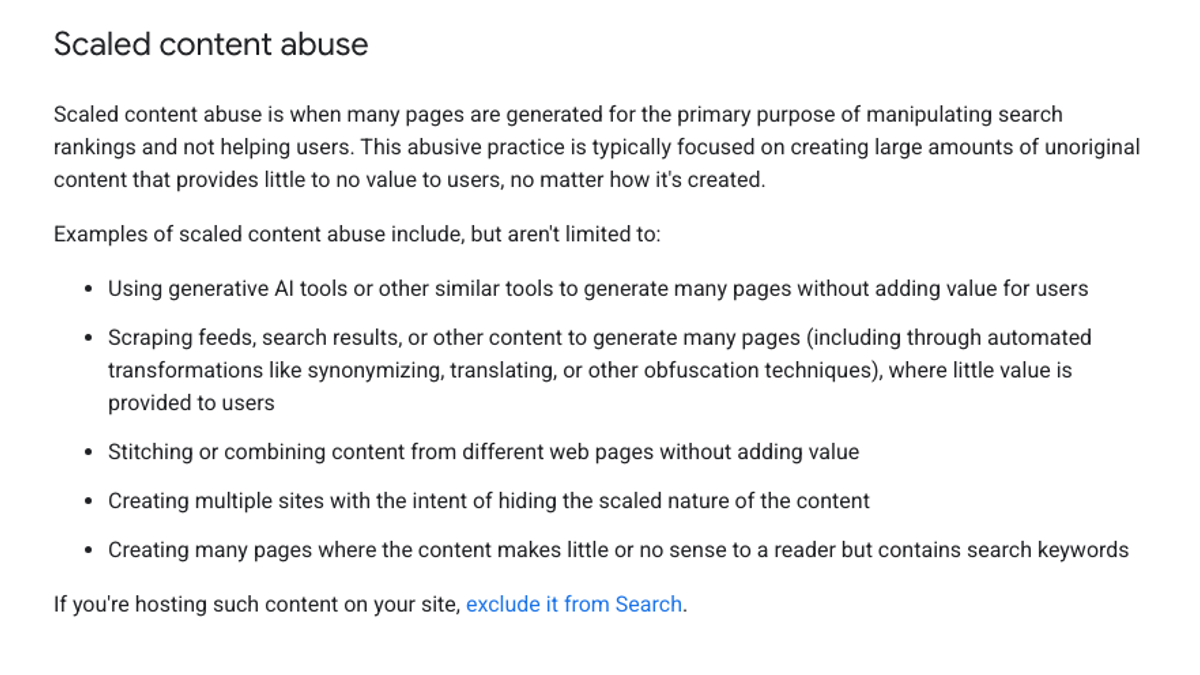
Google's spam policies call this scaled content abuse, and the examples include "using generative AI tools or other similar tools to generate many pages without adding value." Our guide to automating SEO content within Google's quality standards covers how to pace output and where to put checks.
200+ SaaS teams already track their AI citations.
They know exactly when ChatGPT mentions their brand, and when it stops. Do you?

A three-step check before anything goes live
You don't need a heavy review process. These three checks catch most automation failures, including every one in our search.
- Search the draft for chatbot phrases. "As an AI," "language model," "knowledge update," "I cannot," "I'm sorry, but" and "Certainly! Here" should never reach a customer. A simple find, or a filter in your workflow, catches them.
- Check every fact against its source. Prices, specs, dates, names and numbers each need a source you trust, not the model's memory. If the source is missing, the fact comes out.
- Have one person read it as a customer would. Does it answer what they came for, and would you put your name on it?
Our guide to an AI content publishing workflow shows where these checks fit between draft and live page.
Signs a draft needs a person
The leaked listings had tells beyond the obvious phrases. Learn them, and you'll catch the drafts that slip past a phrase filter.
- Hedging about basic facts. An Etsy jasper listing said "it's possible that it might be a less common or local name." A seller knows what they're selling. A model guessing doesn't.
- Dates in the past. Several listings mentioned 2021 or 2022 as if they were current. Any year in a draft should be one you put there.
- Advice instead of description. The Tripadvisor guest house listing offered "a general description" of guest houses rather than describing the one being listed.
- The same sentence shapes on every page. When 50 product pages all open the same way, readers notice even if they can't say why.
Setting up product descriptions the safe way
Product descriptions are the most common place to start, and where most of the leaks happened. Here's a setup that avoids them.
- Give the model only your spec sheet and your brand rules. Tell it to use nothing else.
- Ask it to return "MISSING" for any fact the spec doesn't include, instead of filling the gap.
- Run the chatbot-phrase search on every draft, then send anything with "MISSING" back to a person.
- Check a sample of each batch against the spec before publishing the rest.
That flips the failure mode. Instead of the model covering a gap with a disclaimer, the gap becomes a visible task for someone on your team.
Where to start automating
Start where you have the most repetitive work and the clearest source. For a store, that's usually product descriptions from spec sheets. For a service business, it's FAQ drafts from support emails. For a content team, it's social drafts from articles you've already published and checked.
Leave anything with a customer's name, a price promise or a legal claim until last. If you're in SaaS, our SaaS version of this split goes deeper on articles and product marketing.
What this takes each month
Here's a rough monthly budget for a small team running automation with checks, by my estimate.
| Task | Hours a month |
|---|---|
| Set up and maintain prompts or tools | 2 to 4 |
| Fact checks on drafts | 6 to 10 |
| Human edits on voice and examples | 4 to 8 |
| Replies, case studies and anything kept human | 6 to 10 |
| Total | 18 to 32 |
Most of those hours are checks, and that's on purpose. The time automation saves should come from drafting, never from skipping the review.
Doing it yourself or handing it off
You can build this pipeline yourself, with prompts, checks and a review step. Or RankControl can run much of it for you. We plan and write articles from your brand profile and publish them to your site only after you approve, with auto-publish off by default. We also turn each published article into social drafts for eight platforms, so you review and post instead of starting from a blank page.
How often does ChatGPT mention your brand?
Most founders have no idea. The answer might surprise you.