
On September 26 we pulled Google's top results for 11 common B2B software searches and compared the title Google showed for each page with the title the page actually sets. We could read 78 of them. Google showed 64 more or less as written, sometimes with the site name dropped or the end cut off for length.
It changed the other 14. In 10 of those, the replacement was the page's own H1 heading, word for word. The page ranking first for "best help desk software" sets one title and shows searchers a different one, because its H1 says something else.
That's a small thing, and it's exactly the kind of thing this list is about. None of these techniques is new. Some date back to the early 2000s. So why do they get skipped? Mostly because they work on pages you already have, which feels less productive than launching new ones. Here are the 10 we'd work through first in 2026.
Start with pages Google already ranks
The first three techniques are about pages that already get impressions. We call the set of them the almost-there list: pages averaging somewhere between positions 8 and 20 for queries people actually search.
1. Make your title tag and H1 agree
Google's title links are generated automatically, and its documentation lists the sources it draws on. Heading elements like the H1 come third, right after the title element and the page's main visible title.
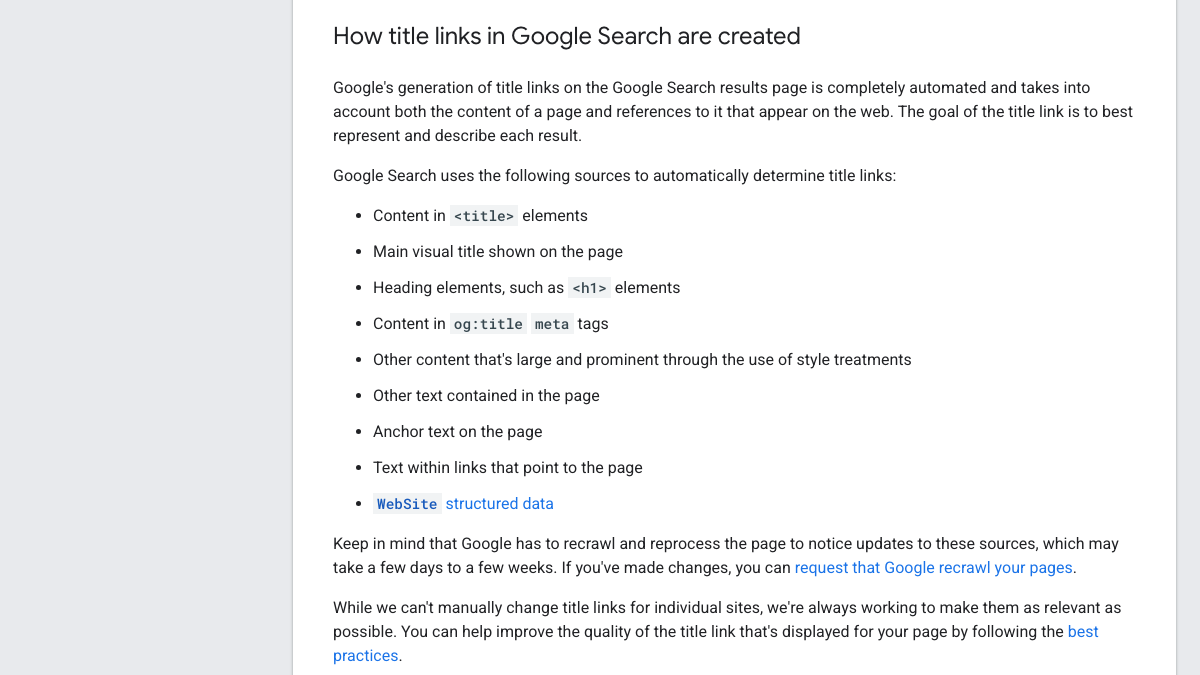
Here's how the 78 readable titles from our test broke down:
| What Google showed | Pages |
|---|---|
| The page's title exactly as written | 23 |
| The title with the site name dropped | 32 |
| The title cut short for length | 9 |
| A different title, taken from the page's H1 | 10 |
| A different title from somewhere else | 4 |
So when a page's title and H1 said different things, Google often picked the H1. The top result for "best help desk software" has a title promising faster support and an H1 promising to fix customer support, and the H1 is what shows. Neither version is wrong, but the page owner didn't get to choose.
The fix takes minutes. Make the title and H1 say the same thing, or close enough that either works in the results, and put the search phrase near the front of both. Some of the gaps we saw may also be stale, since Google has to recrawl a page to notice a new title, which its documentation says can take a few days to a few weeks.
2. Work your almost-there pages first
Open Search Console's performance report, set it to the last three months and filter the query table by position. Anything averaging 8 to 20 with real impressions goes on the almost-there list.
These pages already match what Google thinks the query wants. A brand new article on the same topic would need months to reach the same spot, if it gets there at all. Honestly, if we only had one afternoon for SEO this month, this is where we'd spend it.
When a poster in r/seogrowth asked in August which underrated technique had actually moved rankings for people in 2026, one reply described exactly this: improve the pages already getting impressions instead of publishing another article, and give the ones sitting at positions 8 to 20 stronger internal links.
Whats one underrated SEO technique that actually moved rankings for you in 2026?
been doing SEO for a while now and honestly.. the usual stuff like keyword research, backlinks, on-page — everyone knows it.. curious what actually worked for u that most people are still sleeping on in 2026.. could be anything — a small ch...
For each page, compare it with the top five results for its main query. The gap is usually a missing sub-question or an answer buried halfway down the page.
One check first. If the top five are a different type of page from yours, such as free tools ranking above your guide, better writing won't close the gap. The intent has moved, and you'd need a different page to match it.
3. Link to them from pages that already win
Internal links from your strongest pages seem to carry more weight than links from pages nobody visits. The simplest version we've seen came from Rodrigo Rocco, who runs a niche job board business, in September.
Page in positions 8 to 15 give it one internal link from a page already in the top 3 anchor text close to the query that page wants that is the version I actually use not 40 random links one good one from a strong URL to a page that is already close what I keep seeing
 Rodrigo Rocco 👨💻📈📗 from JobBoardSearch 🔎@rrmdpSep 21, 2026
His version is one link, from a page already in the top 3, to a page sitting at positions 8 to 15, with anchor text close to the query it wants. He reports gains of two to four positions within three to four weeks. That's one person's experience, but it fits how links work in general, and it costs nothing to try.
Our look at whether backlinks still matter in 2026 found that most top-10 pages had fewer than 10 other websites linking to them, which is part of why the links you control do so much of the work.
200+ SaaS teams already track their AI citations.
They know exactly when ChatGPT mentions their brand, and when it stops. Do you?

Fix the links inside your own site
4. Write anchor text that describes the page
Google's guide to links says anchor text tells people and Google something about the page you're linking to. The same guide warns against cramming in every related keyword, since keyword stuffing breaks its spam policies. Aim for a short phrase a reader would understand out of context.
The poster who started that r/seogrowth thread said exact-match anchors to older articles had done more for their rankings this year than any external backlink. We'd go a step softer, with anchors that describe the page and sit close to its main query, varied a little from link to link. A blog where every internal link says "read more" or "this post" is wasting its easiest signal.
5. Find and fix orphan pages
Google's own guidance on this is one sentence long.
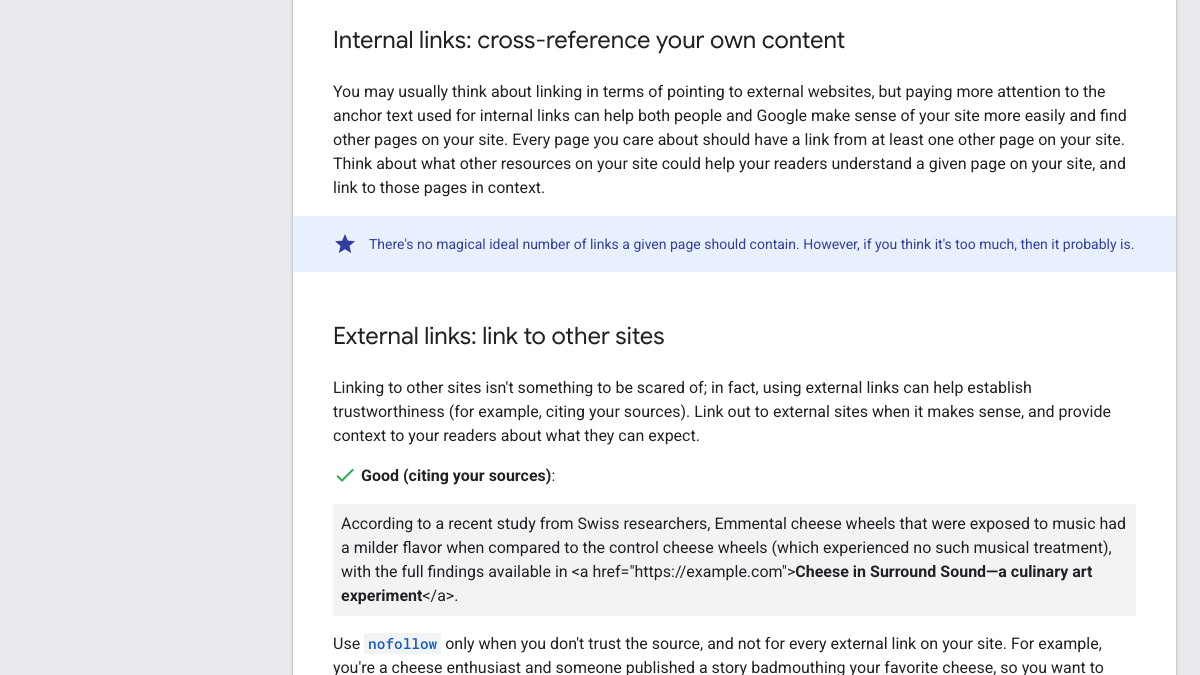
Every page you care about should have a link from at least one other page on your site. Pages with none, usually called orphan pages, pile up on sites that publish often, because new posts link out to old ones and nothing links back.
Most site crawlers can list pages that appear in your sitemap but receive no internal links. Fix the ones worth keeping with a link from the closest related page. For the rest, ask whether they should exist at all, which leads into the next group.
Clean up before you publish more
6. Merge pages that compete for one query
Keyword cannibalization sounds dramatic, but it usually looks mundane: several posts from different years on the same question, each ranking on page two and none on page one. Search Console shows it when you filter the report to one query and open the Pages tab.
Merge the best parts into the strongest page and redirect the others to it. Keep the URL with the most clicks and outside links, even when another post has better writing, and move that writing onto it. Google's documentation on duplicate URLs calls a redirect a strong signal that the target should become the canonical page. A reply in the same r/seogrowth thread said merging and redirecting had been a huge help this year, and that the audit exposed how many posts they'd written about a single topic.
7. Improve or retire thin pages
This one needs care. Google's guidance on helpful content asks whether you're removing a lot of older content because you believe it'll make your site seem fresh, then answers its own question in brackets: "No, it won't."
So don't delete for the sake of a smaller site. Pull the pages with no impressions over the past year and sort them into two piles. Pages that answer a real question badly get rewritten or merged into a stronger page. Pages nobody needs, such as old event announcements or near-duplicate tag pages, can go.
Our guide to topical authority for AI search explains why a focused library of pages tends to beat a big, scattered one.
8. Refresh pages that are fading
Content decay is slow enough that nobody notices it. A guide that ranked well two years ago slips as newer pages cite newer data. Compare each page's clicks over the last three months with the same months a year earlier, and put the biggest drops at the top of your list.
A real refresh adds new information, such as current numbers or a section on what changed this year. Google said in 2019 that it can make sense to give a substantially changed article a fresh date, but not to artificially freshen a story without adding significant information. Its helpful content questions call out changing dates to seem fresh by name.
Our piece on which refresh signals trigger re-indexing covers the AI search side of refreshes.
How often does ChatGPT mention your brand?
Most founders have no idea. The answer might surprise you.

Look past Google's blue links
9. Check how Bing sees your site
Bing is the search engine most SEO plans skip, and in 2026 that's a bigger miss than it used to be. Microsoft's Copilot answers from Bing's index, and ChatGPT has leaned on Bing for search results. In February, Bing added an AI Performance report to Bing Webmaster Tools, which shows how often your pages are cited in Copilot and in Bing's AI summaries.
Verify your site, then check that your important pages are indexed there, since a page Google has indexed isn't always in Bing. Our post on Bing's June 2026 AI update covers the most recent changes.
While you're at it, search for your key pages on Brave Search, which Anthropic lists among Claude's web search providers. Our check of AI citations against Google rankings shows how differently each AI engine picks its pages.
10. Show up where Google ranks forums and video
In our title test, a Reddit thread ranked in the top five for 5 of the 11 searches, and YouTube videos appeared on two others. For "best help desk software," the second result was a Reddit thread from a small IT team asking for recommendations.
You can't rank your own site in those spots, but your brand can be in them. That means someone from your team answering real questions in the communities your buyers use, under their own name, and recording short videos for the questions where Google shows video. Keep it useful. Most communities remove obvious promotion fast, and a recommendation from someone else in a thread reads very differently from one you post about yourself.
In July, Google also added platform properties to Search Console, so you can see how that content performs in Google Search.
🚨 Google is rolling out a new Search Console property type: "platform properties", allowing you to track how your Instagram, TikTok, X and YouTube content performs in Google Search and Discover. With this release Google is making something explicit that many in our industry https://t.co/IiitQGf5vn
 Aleyda Solis 🕊️@aleydaJul 7, 2026

What we'd stop spending time on
Underrated has an opposite, and a few habits still eat time without moving rankings.
FAQ markup for rich results is the clearest example. Google stopped showing FAQ rich results in May 2026 and has since removed the documentation for them. FAQs can still help readers, but the markup no longer earns the bigger search listing it used to.
Bulk link packages are another. Google's spam policies target links built to manipulate rankings, and a batch of cheap links is more likely to be ignored than to help.
The last is hunting for secrets. When someone asked r/SEO for their hidden secrets in April, the most upvoted reply told them to stop looking, and argued that Google and SEO are predictable and repeatable.
SEO hidden secrets.
Hello everyone, not to boder anyone on here, but I wish to ask/ know. What would you say is that one seo hidden secret you’ve been keeping that has been working for you. Could be for on page/ off page.. Free will answers only. Appreciate it...
That's blunt, but we mostly agree. Every item on this list is something you can put on a monthly checklist.
How to fit this into a normal month
None of this needs a big project. In the first week, pull the almost-there list and fix titles and H1s. In the second, add internal links from your top pages. Use the third week to merge or refresh your two weakest pages, and the fourth to check Bing and find one community thread worth answering.
New content still matters, and it's the part that takes the most hours. Done by hand, publishing eight solid articles a month takes 16 to 24 hours, and checking 50 questions on seven engines takes about six hours a week. Those are rough estimates.
RankControl handles that side. The Radar agent finds the questions your buyers actually search, checks them against real search data and plans titles onto your content calendar. The content engine writes each article against the pages already ranking for its keyword and publishes it on your own domain, and AI visibility tracking runs your 50 questions every week on seven engines, alongside your Google and Bing rankings.
You can work through this list yourself with Search Console and a spreadsheet. Or RankControl's agents can keep new pages coming while your team works on the almost-there list.
15 hours a week manually. Or 15 minutes with RankControl.
Track citations, monitor competitors, and fix content gaps across every AI search engine. Automatically.