
A post in r/content_marketing this year had a title most writers could have written themselves. It said the brief is where most content dies, before the writer even starts. One reply said they now reject any brief where every line is about the article and not one line is about the reader. A content brief generator can make that worse, because it fills the article lines in seconds and leaves the reader lines blank.
This guide is the brief I'd hand a writer today. It splits the fields a generator fills well from the ones a person has to decide, then adds what a page needs to get quoted in AI answers. Tool prices were checked on October 19, 2026.
What a content brief generator gives you
Search "content brief generator" and the top results are mostly free tools. The first result on October 19 was SEO Review Tools' generator. It returns five title ideas and ten related keywords, along with an average word count and five related questions. QuillBot and Taskade sit just below it with similar forms, while Moz and Semrush show pages for their own brief features.
None of those pages explains why a field is there. None of them has a field for AI answers. The best "how to write a brief" guide ranking for the related term, content brief template, was published in September 2021. It never mentions ChatGPT or AI Overviews.
So the generator gives you a fast first pass on the SEO half. That's useful. It's also the half that matters least when two pages target the same keyword with the same outline.
The content brief template, field by field
The pattern in that r/content_marketing thread showed up in other threads too. Writers split brief fields into mechanical ones and strategic ones. Mechanical fields come from the pages already ranking, so software reads them well. Strategic fields come from your company, your buyers and your opinion, and no tool can see those.
Mechanical fields a generator fills well
| Field | What goes in it | Why it matters for Google | Why it matters for AI answers |
|---|---|---|---|
| Target keyword and variants | The main phrase plus 5-10 close variants | Tells Google what the page is about | Variants match the extra searches AI tools run behind one question |
| Search intent | Informational, commercial or a mix, from the top 10 results | A page that misreads intent rarely ranks | Engines pick pages whose purpose fits the question type |
| Outline | H2 and H3 headings based on what ranking pages cover | Covers the subtopics Google expects | Clear headings let an engine find the right passage |
| Word count range | The spread of ranking pages, not their average | Keeps the page deep enough to compete | Matters little, since engines quote passages |
| Questions to answer | From People Also Ask, forums and Reddit | Can win featured snippets | Each one is a ready answer block an engine can lift |
| Internal links | 3-6 of your pages to link to | Spreads authority and helps crawling | Links your related pages into one topic |
Strategic fields a person must decide
| Field | What goes in it | Why it matters for Google | Why it matters for AI answers |
|---|---|---|---|
| Reader | One sentence on who this is for and what they've already tried | Shapes the page toward real searchers | Engines answer a person's situation, so the page should name it |
| The after-reading line | What the reader can say after reading that they couldn't before | Gives the page one clear job | It's the sentence you want an engine to quote |
| Difference | How this piece will beat what already ranks | A copy of the top 10 rarely outranks the top 10 | A page that repeats the top 10 gives an engine no reason to pick it |
| Proof | Your data, examples, quotes, screenshots, customer words | Shows first-hand experience | Named sources make claims easier to trust and lift |
| Sources | The 3-5 outside sources to cite, with dates | Supports the page's claims | Gives an engine a clear, dated fact to quote |
| Voice and limits | Brand tone, claims to avoid, words you never use | Keeps the page on brand | Stops wrong claims that engines then repeat |
| What it should not do | Topics to skip, angles to avoid | Keeps the page tight on one intent | A focused page answers one question cleanly |
| CTA | The single next step for the reader | Ties traffic to a goal | Readers who arrive from an AI answer need one clear next step |
The after-reading line comes straight from that Reddit thread. If you fill in only one strategic field, fill in this one. Another reply in the same thread asked what the piece should not do, which is why that row is in the table too.
For the reader and proof fields, it helps to start from what buyers really ask. Our guide on finding what buyers ask AI before you write covers where to get those questions.

Your competitors are getting cited by AI. You're not.
Every day without citation tracking is a day your competitors pull ahead in ChatGPT, Perplexity, and Claude.
What changes when the brief has to serve AI answers
Most SEO briefs were built for a page that gets read top to bottom. AI engines read differently. They pull a passage, often near the top, and quote it.
Search Engine Land reported on a study by growth advisor Kevin Indig that looked at 1.2 million AI answers and 18,012 verified citations. It found 44.2% of ChatGPT's citations came from the first 30% of a page, with 31.1% from the middle and 24.7% from the last third.
So add three lines to the brief that most templates skip.
- Answer placement. Write the direct answer to the main question in the first 100 words, and say so in the brief.
- Standalone sections. Each H2 should make sense if someone reads only that section.
- Dated sources. Every number needs a named source and a date, listed in the brief before writing starts.
The third one isn't new. A commenter in an r/GEO_optimization thread pointed out that rewarding verifiable facts goes back a decade in Google's systems. Another said pages with named sources and direct answers are easier for AI systems to pull and trust. Then they added the part people skip. Structure gets a page into the candidate set, but mentions on other sites often decide who gets picked.
If you already have pages that fail these checks, that's a rewrite job, and our guide to content optimization covers it.
Content brief generator tools compared
Most paid tools pair a brief or outline with a score that grades the draft against ranking pages. Here's what each one offers at its entry price, from each vendor's pricing page on October 19, 2026.
| Tool | Entry price | What you get for briefs | Catch |
|---|---|---|---|
| Ahrefs AI Content Helper | Free, 1 document a month | Topic checklist with coverage scores | Paid Ahrefs plans start at $129 a month |
| Frase | $39/mo yearly, $49 monthly | Briefs plus a draft score with SEO and GEO parts | Starter covers 10 articles a month |
| Surfer | $49/mo yearly, $59 monthly | Content Editor with outline, guidelines and a live score | Discovery covers 120 documents a year |
| Semrush Content Toolkit | $60/mo, 7-day trial | SEO briefs and content scoring | The SEO Writing Assistant needs the Pro plan at $139.95 |
| Clearscope | $129/mo, 14-day trial | 20 topic explorations and 20 drafts a month | Highest entry price among the paid tools here |
| MarketMuse | No public price | Full written briefs with personas and groupings | Paid tiers are demo only, free tier has 0 briefs |
MarketMuse writes the most complete brief of the group. Its brief view reads like a document a strategist would hand over, opening with an executive summary and then target personas for each content group.
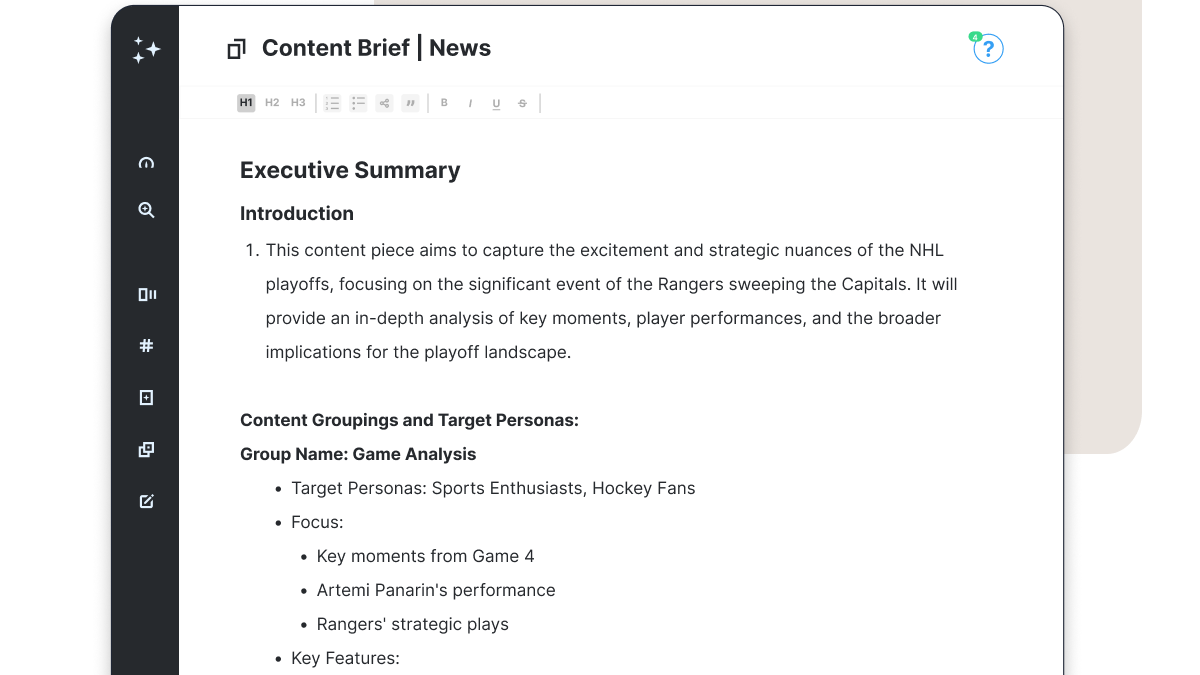
Even there, the personas and focus points are drawn from the topic, not from your buyers. The tool knows what hockey articles cover. It doesn't know which reader you lost last quarter. Our RankControl vs MarketMuse comparison covers its tiers in more depth, and the best SEO content tools list covers the scoring side.
200+ SaaS teams already track their AI citations.
They know exactly when ChatGPT mentions their brand, and when it stops. Do you?

Where generators fall short
Every tool above is good at the mechanical table. They read the top 10 pages and tell you what they share. That's the same input every competitor gets for the same keyword, so the brief can only push you toward the average page.
The numbers from Orbit Media's 2026 blogger survey show the risk. Of 1,042 content marketers, 92.4% now use AI for blogging, and only 13.9% report strong results, the lowest share the survey has recorded. The survey ties that drop to fewer marketers doing keyword research and editing, not to briefs, so don't read it as proof that briefs fail.
Here's where I'd expect a generator to let you down.
- It can't fill the difference field, since it only sees what already exists.
- It can't supply proof, because your data and customer words aren't on the web.
- It lists sources that ranking pages used, which are often the same stale stats.
- It writes a reader persona from the topic, which is rarely the buyer you need.
The same Orbit survey puts the average post at 1,312 words and 3 hours 20 minutes of writing time, so 20 more minutes on the strategic fields barely moves the total.
A 20-minute routine for a brief that works
You can turn any generator's output into a full brief with a short routine.
- Run the generator and keep the keyword, intent, outline and questions. Turn its single word count into a range.
- Open the top three ranking pages yourself and write one line on what all three miss.
- Fill the after-reading line and the reader field before you touch the outline again.
- Reorder the outline so the answer to the main question comes first.
- List 3-5 sources with dates, and mark any stat older than two years.
- Add the voice limits and what the piece should not do. A shared brand profile keeps those the same for every brief.
Done by hand, the routine takes roughly 20 minutes a brief, so a team publishing eight articles a month spends close to three hours on briefs alone. That's before anyone writes a word.
Where RankControl fits
RankControl doesn't sell a standalone brief tool. Our content engine writes each article against the pages already ranking for its keyword. The engine then scores the article for how easily AI engines can quote it and gives you a fix list. Once articles are live on your site, AI visibility tracking checks 50 questions every week across seven AI engines, so you can see whether the answers mention or cite you. We offer one flat plan at $400 a month with a 7-day free trial.
You can run the template above with a free generator and 20 minutes per piece. Or RankControl can write and check the work every month while you decide what the company should say.
How often does ChatGPT mention your brand?
Most founders have no idea. The answer might surprise you.