
A strong guide goes up, gets added to the sitemap, and everyone moves on. Months later it has a handful of backlinks, almost no internal links, and a ranking stuck on page two. That's an internal link structure problem, and it costs you twice now.
Googlebot follows your links to find pages and decide which matter. The AI crawlers running for OpenAI, Anthropic and Perplexity lean on the same links, and they're pickier about how those links get built.
This guide starts with page levels, link templates, anchors and faceted URLs, then moves into what AI crawlers can read, orphan pages and a quarterly audit. Every source here was checked on October 19, 2026.
What internal link structure means
Strip it down and it's just the map of which pages on your site link to which, and through what kind of link. A page outside that map leans entirely on your sitemap to get found.
Most sites settle into three levels without really planning to.
| Level | Examples | Its job in the link map |
|---|---|---|
| Home | The homepage | Links to every hub and gets the most links from other sites |
| Hubs | Category pages, product pages, pillar guides | Group related pages and link down to each one |
| Articles | Blog posts, docs, help pages | Link up to their hub and across to close neighbors |
Click depth is how many clicks a page sits from your homepage, and three or fewer is the number everyone repeats. None of the three top-ranking guides for this keyword actually cites a source for that figure, and Google's own SEO Starter Guide doesn't give one either. It only calls links "a crucial resource" for helping Google find your pages. Treat three clicks as a habit worth keeping, since Google has never once said it enforces it as a rule.
Deciding which pages deserve the most links is its own job, covered in our cornerstone content guide. Grouping pages by topic is another, covered in topic clusters vs content hubs. This post is about the wiring between pages once you've decided what matters.
The four link templates every site runs on
Most internal links on a site come from a handful of templates that repeat on every page, which is why one broken template can wreck thousands of links at once.
| Template | What it tells crawlers | How it usually breaks |
|---|---|---|
| Main nav | Which hubs matter most | Menus built by scripts, or mega menus with 200 links where nothing stands out |
| Breadcrumbs | Where a page sits in the levels | Schema added to pages that show no trail |
| In-body links | Which pages explain a point further | Vague anchors like "click here" |
| Related posts | Which pages are close neighbors | Picked by date instead of topic |
Breadcrumbs do something the others don't: they state the hierarchy outright on the page, and hand deep articles a link straight back up to their hub.
A common habit is slapping BreadcrumbList schema across every template and calling it done. An r/WebsiteSEO thread asked whether that schema belongs on every page, and the top reply made a point most guides skip: the markup is supposed to describe a trail a reader can see. Inject it where no trail shows, and it stops matching the page.
Should Breadcrumb schema (JSON-LD) be added to every single page for optimal SEO?
guys,Quick question regarding Breadcrumbs and Structured Data: I know that setting up Breadcrumbs with BreadcrumbList schema helps Google better understand a site's structure and can generate rich snippets in SERPs. My question is: Is it be...
Related-post widgets are the template nobody checks. Plenty pull from whatever's newest, so the same handful of recent articles gets linked from every page while older ones sink. Switch the widget to pull by topic, and older pages get links from neighbors that make sense.

Your competitors are getting cited by AI. You're not.
Every day without citation tracking is a day your competitors pull ahead in ChatGPT, Perplexity, and Claude.
Anchor text that tells crawlers where they land
Google's crawlable links doc, updated December 10, 2025, asks for anchor text that's "descriptive, reasonably concise, and relevant." It warns against "click here" and against cramming keywords into every link.
The clearest data on anchors comes from Cyrus Shepard, who studied 23 million internal links across 1,800 sites and roughly 520,000 URLs for Zyppy. Pages with at least one exact-match anchor got about five times the traffic of pages with none.
So aim one link per key page at the exact words people search, and let the rest vary naturally. A link reading "internal link audit" tells both kinds of crawler far more than one that just says "this post."
The same study found something else worth knowing about raw link counts. URLs at zero to four internal links averaged roughly two clicks from Google Search, while URLs at 40 to 44 pulled in about four times that. Past roughly 45, traffic dips again. Shepard calls his own work a correlation study, and he's right to hedge. Strong pages collect links partly because editors enjoy linking to them, so cause and effect may run both ways.
Faceted navigation and the crawl it wastes
Shop and listing filters are where link structure falls apart at scale. Every combination of color, size and price can spin off into its own URL, and a crawler can't tell which are worth fetching without fetching them.
In a December 2024 Search Central post, Google's Gary Illyes wrote that faceted navigation is "by far the most common source of overcrawl issues site owners report to us." Google later folded that post into a standing doc, last updated December 18, 2025, which offers two real paths forward.
- Block it. Disallow filter URLs in robots.txt, or push filters into URL fragments, the part after
#, which never affects crawling. Keep crawlable links pointed only at the unfiltered listing and each product. - Make it crawlable. Use the standard
&between parameters, hold filters in the same order every time, and return a proper 404 for empty results rather than a redirect. Userel="canonical"to point filtered variants back at the main page.
An r/TechSEO thread about one small shop's filters landed on a calm consensus: crawl budget isn't a real concern for a small site, and a few thousand filter URLs is fine. A few hundred just need their canonicals fixed. Millions is where you reach for robots.txt first.
What AI crawlers can and can't follow
Most top-ranking guides give AI crawlers a single throwaway sentence. That's a real gap, since these bots may not run the scripts Googlebot runs. Google's own doc says links added through JavaScript still count once they render as a proper <a> element with an href.
The AI crawlers aren't nearly as upfront. I read the crawler pages from OpenAI, Anthropic and Perplexity on October 19, 2026. Each explains what its bot is for and how to block it, but none says whether it runs JavaScript. Anthropic's page carried a date of April 7, 2026; the other two carried none.
The only sizable measurement published is already getting old. Vercel's December 2024 study of traffic on its own network found that none of the major AI crawlers rendered JavaScript, naming GPTBot and ClaudeBot among them. GPTBot fetched script files on 11.5% of its requests, and ClaudeBot on nearly a quarter of its own, but neither ran the code. That data is nearly two years old and covers only Vercel sites, so read it as a warning sign, not proof of how these bots behave today.
Call this the view-source test. Open a page, view its raw source before any script runs, and search for your main nav links. Plain <a href> tags mean every crawler can follow them. A menu that only appears after scripts load means the AI crawlers likely see a page with no way out.
Every vendor runs more than one bot, too. Per OpenAI's crawler docs, GPTBot gathers training data while OAI-SearchBot finds pages for ChatGPT search: blocking GPTBot alone leaves you in ChatGPT search, blocking OAI-SearchBot alone takes you out of it. Anthropic splits traffic into ClaudeBot, Claude-User and Claude-SearchBot, and Perplexity keeps PerplexityBot and Perplexity-User separate too. Our guide on whether to block AI crawlers covers that call, and auditing AI crawlers in server logs shows which bots actually reach your pages.
200+ SaaS teams already track their AI citations.
They know exactly when ChatGPT mentions their brand, and when it stops. Do you?
Orphan pages need triage before links
An orphan page has zero internal links pointing to it. A thin-linked page has exactly one. In Ahrefs' 2023 audit of just over a million domains, Patrick Stox found that 66.2% of sites had at least one page hanging on a single dofollow internal link. Ahrefs sells a site audit tool, so finding problems suits its business, though a million domains is still a large sample.
Don't link every orphan the moment you find it, though. An r/bigseo thread on cleaning up orphan pages settled on advice most agreed with: check what each page actually is first. Old campaign pages, thin variants, paginated lists and tag archives usually need a noindex or outright removal instead of a fresh batch of links.
| What the orphan is | What to do |
|---|---|
| A page that still answers a real question | Link it from its hub and from two or three close articles |
| A near copy of a better page | Redirect it to that page |
| A dead campaign or thin page | Noindex it or remove it |
For pages you keep, one r/WebsiteSEO user suggested links from at least three other pages as a sane floor.
A quarterly audit with the Search Console Links report
Most people only look at internal links once something's broken. An r/seogrowth thread asking how often people check found most reach for it only when a page underperforms, with just a few running real monthly or quarterly passes. One reply flagged a useful signal: a page whose impressions keep climbing while its position stays stuck on page two.
How often do you actually check your internal linking?
A calendar beats waiting around for a drop to notice. Once a quarter, run through these five steps.
- Open Search Console's Links report and export the "Top linked pages" table under internal links.
- Sort fewest links to most. Pages you care about near the top of that list are under-linked.
- Crawl the site and compare what it reaches against your sitemap. Sitemap pages the crawl never touches are your orphans.
- Run the view-source test on one page from each template.
- For every page stuck on page two, add one link from a strong related page with a clear anchor. Our guide to pages stuck on page two covers the rest.
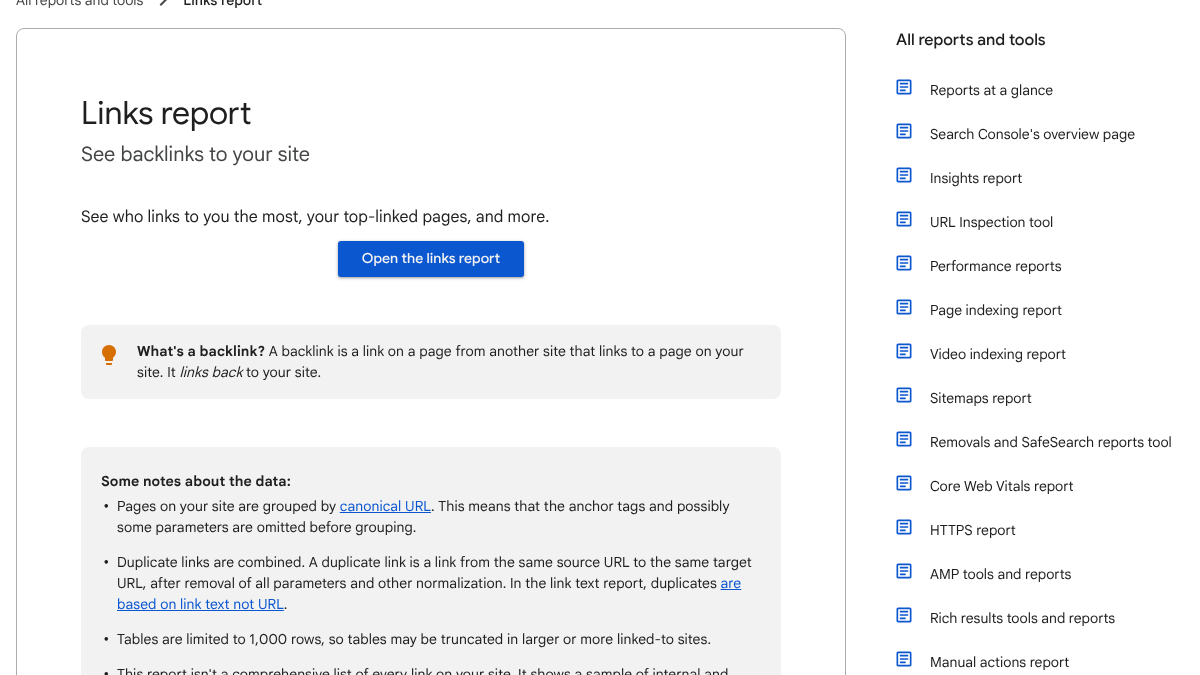
Google's Links report help page says tables stop at 1,000 rows and show a sample of links, not all of them. Duplicate links from the same source to the same target only count once. On a big site, trust your own crawl over the report. Our walkthrough of backlinks in Search Console covers the external half.
When nothing fits any of this, leave it alone and note it so next quarter's audit skips past it. By hand, the first pass on a site with a few hundred pages takes about a day, and each quarterly check after that takes a few hours.
Doing it by hand or having it done
The first audit is the easy part. Keeping new pages wired in is harder, since every new article starts life as an orphan until something links to it.
RankControl's content engine handles that for every article. Each new article links to existing pages on your site, found by scanning your sitemap, and to other articles RankControl has already published.
You can run this audit yourself every quarter with Search Console, a crawler and a spreadsheet. Or RankControl's agents can write and link new articles every month while you fix the templates.
How often does ChatGPT mention your brand?
Most founders have no idea. The answer might surprise you.