
Asana's pricing page has the name of a live experiment sitting in its raw HTML. We fetched it on September 26 with plain curl, no JavaScript, and geo_localized_pricing_addon was right there in an Optimizely setup script that waits for cookie consent before it loads. Big software companies test their pricing pages all the time, and Google's rules allow it.
So does A/B testing a landing page hurt SEO rankings? On its own, no. What can hurt is how you split traffic, how long the test runs, and how far apart the versions are. Conversions carry their own risks too, and a few of those come from the testing tool itself.
What Google says about A/B testing and rankings
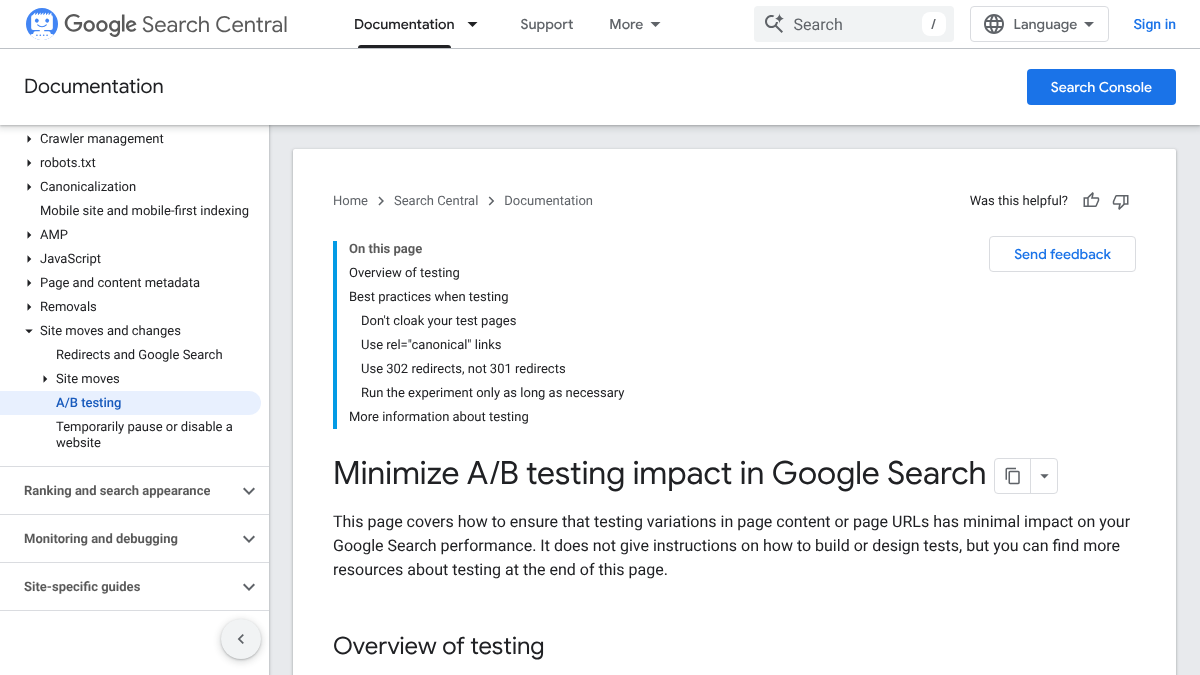
Google's page on website testing, last updated in December 2025, is short. It comes down to four rules:
- Don't cloak. Showing Googlebot one set of URLs and people another "is against our spam policies, whether you're running a test or not."
- If the test uses several URLs, put
rel="canonical"on each variant pointing at the original. Google prefers that tonoindexbecause it "more closely matches your intent." - Use a 302 redirect for redirect tests, never a 301, so the original URL stays in the index.
- End the test when it's done. Google warns that a test running "for an unnecessarily long time" can look like an attempt to deceive.
John Mueller added a wrinkle in July. A developer asked him on Bluesky about long-running holdout groups. He said Google may index one version or the other, and that if the versions are "significantly different, that could be visible in search results too." In a follow-up he said he knew of no penalty for varying content, since lots of sites have it, but that constant change makes a page harder to debug. Search Engine Roundtable wrote up the exchange the next day.
That leaves two separate risks. Cloaking is a spam problem, and it's easy to avoid. The quieter one is index flip-flop: Googlebot crawls version B on a Tuesday, indexes it, and your title and snippet in search results change even though nobody on your team touched the page.
Three ways to split a landing page
How you split traffic decides what each crawler sees. Most teams use one of these setups:
| Setup | How people get the variant | What Googlebot gets | What AI crawlers get | Main risk |
|---|---|---|---|---|
| Client-side script | The page loads, then a script rewrites the headline or layout | Either version, since Googlebot runs JavaScript | The original HTML | Flicker and a slower page |
| Server-side or edge | The server picks a version before sending HTML | Either version, bucketed like any visitor | Either version, the same way | Index flip-flop if versions differ a lot |
| Split URL | Visitors get redirected to a second URL | The original, with 302s and canonicals in place | Whichever page the server redirect sends them to | Duplicate pages if a canonical is missing |
Google's own testing tool is gone, for what it's worth. Google Optimize shut down on September 30, 2023, and Google now points people to AB Tasty, Optimizely and VWO, which connect to Google Analytics. All three run client-side by default and sell a separate server-side product.
If your test sends people to a second URL, treat the redirects the way you would in a site move. Our migration checklist covers the redirect mistakes that cost pages their positions.
AI crawlers are your permanent control group
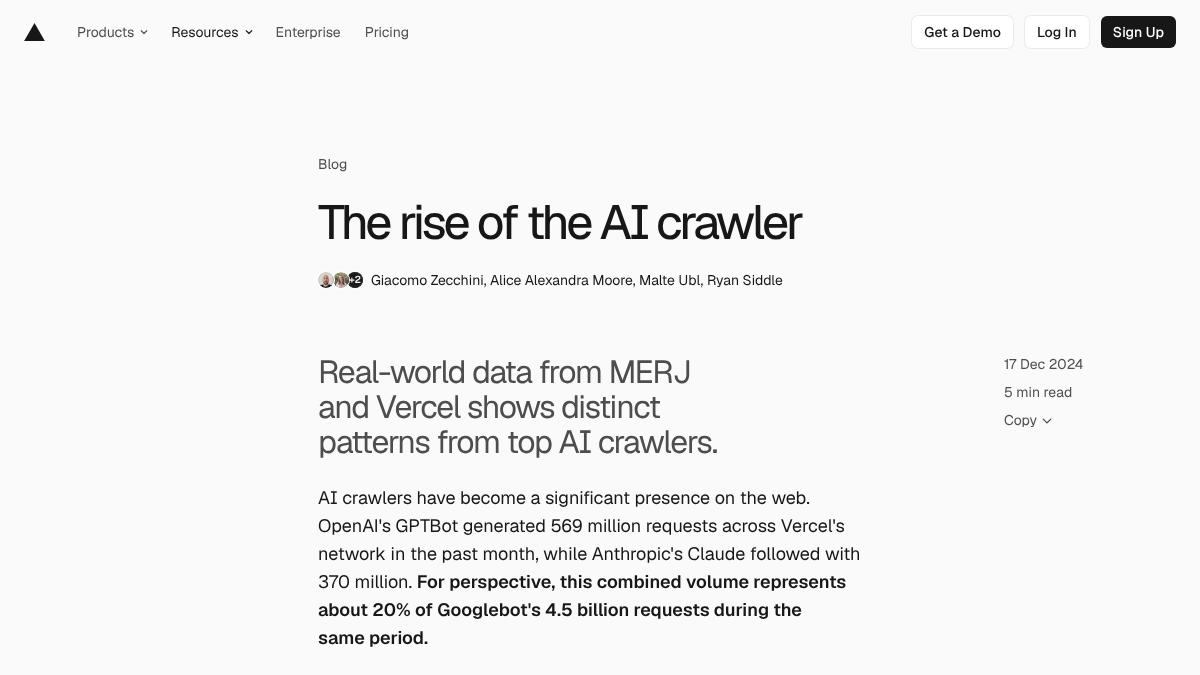
AI search changes the math here. Vercel and MERJ studied real crawler traffic across Vercel's network in late 2024 and found that "none of the major AI crawlers currently render JavaScript." That covers GPTBot, OAI-SearchBot, ClaudeBot and PerplexityBot. They sometimes download script files, but they never run them.
Follow that through and a client-side test has a group of visitors who never get bucketed. We call them the permanent control group: every AI crawler reads your original HTML, whatever the test tool shows people. If your variant rewrites the headline or the plan names, ChatGPT and Perplexity keep quoting the old copy until you ship the winner into the server-rendered page.
We couldn't find anyone who has published a test of this exact case, so treat it as a strong inference from how the crawlers work, not a measured result.
Server rendering has its own surprises. When we fetched HubSpot's pricing page the same day, it sent our Chrome user agent a 75 KB shell with 36 characters of visible text, because the page builds itself in the browser. Sent as Googlebot, GPTBot or ClaudeBot, the same request came back as a 794 KB page with nearly 29,000 characters of plan copy. HubSpot pre-renders for bots, AI crawlers included, so what bots read comes from a separate rendering path from what people see.
That's why the most useful check takes two minutes. Fetch your test page with a Googlebot user agent and a GPTBot user agent, then compare the headline each gets with the one in your browser. Our AI crawler list has the user agent strings, and your server logs show which bots fetched the page during the test.
Know exactly what AI says about your competitors.
RankControl's Recon Agent monitors competitor citations across ChatGPT, Perplexity, Claude, Gemini, Grok, Google AI Mode, and Google AI Overviews. See where they show up and you don't.

Where testing tools cost you conversions
The SEO risks are manageable. The conversion risks come from the tool, and they're easy to miss because they skew the result you're reading.
Client-side tools either let the original flash before the variant paints, which is called flicker, or they hide the page until the swap is done. Hiding it delays Largest Contentful Paint, one of Google's Core Web Vitals, and a slower page can drag down conversions in both arms at once.
A marketer on r/PPC made a sharper point last December. Every landing-page testing tool they'd used, Google Optimize included, slowed the page down, and they worried the lighter variant could win because it loaded faster rather than because its copy was better. If that happens, you ship copy that didn't earn the lift, so compare load times between the two arms before you call a winner.
In September, someone in r/SEO asked whether anyone had run a landing page test without ranking trouble. The most direct reply said they'd never had SEO issues and that Google is well aware people A/B test, as long as middleware doesn't route Googlebot somewhere different.
A/B Testing a Landing Page
Has anyone successfully run an A/B test on a landing page before? If so, what tools did you use, and did you notice any issues with SEO or rankings during the test?
SEO split testing is a different experiment
A CRO test splits people. An SEO split test splits pages: you change the title tag or internal links on half of a group of similar pages, leave the other half alone, and compare organic clicks between the two groups. It needs lots of templated pages, like categories or locations, which means a single landing page can't be SEO split tested at all.
Most published results come from the companies that sell these tests, so they lean toward wins. SearchPilot, for one, reported a 25% lift in organic traffic for Iceland Groceries in 2020 after adding internal links between category levels. That's a big number for a small template change, and it's the kind of result vendors lead with.
The same company's 2025 roundup is more useful because it admits a loss: removing an embedded map cost one site about 7% of its organic traffic. Null results count too. Cyrus Shepard split-tested Google's new rel="ugc" attribute across thousands of pages in 2019 and saw no ranking change, which matched what Google had said it would do.
SEO Experiment: A/B split test of Google's new UGC attribute on 1000s of pages • Replace rel="nofollow" with rel="ugc" • Results: No change in the source page rankings, confirming hypothesis + Google statements What would you like to see tested next? https://t.co/CVKP3sVKE3 https://t.co/HGIhMoCAOh
 Cyrus SEO@CyrusShepardOct 15, 2019

How to A/B test a landing page without hurting SEO
A single landing page gets a CRO test, then, with your rankings as something to protect while it runs. Here's the order we'd follow:
- Change one thing, like a headline or the number of form fields, not the whole layout. Mueller's comment is the reason: the closer the versions, the less it matters which one Google indexes.
- Pick the split method before the tool. For a page AI engines already quote, server-side or edge assignment keeps crawlers in the same experiment as people.
- Size the test. Put a 3% baseline and a one-point lift into Evan Miller's sample size calculator at its default 95% significance and 80% power, and it asks for about 4,800 visitors per variation. At 300 visitors a week, that's over seven months, so test bolder changes or skip the test.
- Run it for at least a full week. Optimizely's guidance sets the minimum at one business cycle, seven days, so weekday and weekend visitors both count.
- Put a canonical on any variant URL and keep redirects at 302. Skip
noindexon variants. - Stop on schedule. Ship the winner into the server-rendered page, delete the test script, and redirect any variant URL back to the original.
- Watch rankings and AI answers for a month after the rollout.
Budget roughly two hours to set up a client-side test and a day or two of developer time for a server-side one. After that, expect about an hour a week of checks while it runs, and the same for the month after you ship.
26 content formats. Published on your domain. Matched to your brand.
Guides, comparisons, listicles, case studies, and more. RankControl generates content that gets cited by ChatGPT, Perplexity, Claude, Gemini, Grok, Google AI Mode, and Google AI Overviews.

Conversions and rankings move on different clocks
Conversion data shows up daily. Ranking and citation changes lag, since Google has to recrawl and reindex the page and AI engines quote whatever they fetched last. A variant can win on signups in two weeks while the ranking effect of shipping it doesn't show for another month.
So keep two scoreboards. Conversions live in your analytics, and if AI engines send you visitors, tag those referrals in GA4 so you can see whether they convert differently on the new page. Rankings live in Search Console and a rank tracker. Search Console's AI performance report shows impressions in AI Overviews and AI Mode by page, though it reports impressions only, no clicks.
The confusion people worry about is real, just smaller than they fear. A question in r/TechSEO in May asked whether crawlers that keep seeing different content get confused and move on. The top reply drew the line at cloaking and warned against testing on URLs with the same or similar slugs, because those pages can end up competing with each other.
A/B Split Testing (with different content) - how do crawlers behave?
As the title suggests, my company is running a split test and showing different content and images (but the product + service is the same). So - my question is - what do you guys think to the impact of this on the actual URL? I'm pretty sur...
One test, two scoreboards
You can run all of this by hand. Fetch the page as each bot before and after the test, check your rankings weekly, and ask ChatGPT and Perplexity your buyer questions to see which copy they quote. For one page that's a few hours a month.
Or RankControl can keep the SEO scoreboard for you. It tracks your Google and Bing rankings and checks up to 50 buyer questions every week across seven AI engines through its AI visibility tracking, so after you ship a winner you can see whether the page held its positions and citations. Its analytics count AI crawler visits and AI-referred visits too, which shows whether the bots have been back since the change.

Your competitors are getting cited by AI. You're not.
Every day without citation tracking is a day your competitors pull ahead in ChatGPT, Perplexity, and Claude.