
Pull up the Pages tab in Search Console for any blog that's been running a few years and sort by clicks. A small handful of URLs carry almost all the traffic, then the list drops off a cliff. Whether you planned it or not, those few pages are already your cornerstone content.
Cornerstone content is that small set of pages, the ones that cover your most important topics completely and that the rest of your site points back to. Below is how to choose them deliberately, build them so they hold up, and keep them current on a schedule you can actually stick to.
What cornerstone content means
Credit for the idea usually goes to Brian Clark, who founded Copyblogger and wrote about it around 2007. The original post has since vanished from its old address, so treat that exact year as folklore rather than fact. Copyblogger kept the idea alive anyway. In a 2010 post on cornerstone pages, Derek Halpern described pulling your best posts together under one resource page and linking them up.
It reached a wider audience through a plugin. Yoast SEO 4.6, released April 11, 2017, added a cornerstone checkbox right in the WordPress post editor. Check it, and the plugin starts treating that article as a priority in its own internal linking suggestions.
So the idea came from bloggers and a plugin maker, not Google. It's a way of deciding where your effort goes.
You'll also hear this called a pillar page, and Semrush's own social posts have used the two terms interchangeably more than once this year. The distinction: pillar page describes where something sits inside a topic cluster, which our guide to topic clusters vs content hubs covers. Cornerstone content describes which pages you've chosen to invest in and keep current, which is what the rest of this guide covers.
Why only a few pages get the title
Most pages on the web earn Google nothing at all. Ahrefs' long-running traffic study, led by Tim Soulo, found 96.55% of the roughly 14 billion pages in its index got zero organic visits, and since that index leans toward pages Ahrefs could actually find and crawl, the real figure across the whole web is probably worse.
Position matters just as much. Backlinko's study of 4 million results puts the click rate for the top organic result at 27.6%. Page two, by contrast, pulled clicks on just 0.63% of searches.
Put those two numbers together and spreading effort thin stops making sense. A page has to fight hard to get noticed, and you can't make 200 pages fight that hard. Five, maybe.
Orbit Media's 2026 survey of 1,042 content marketers found only 13.9% reported strong results, the lowest share in the survey's 13-year run.
Here's a quick filter I'd call the carry test: if this page vanished from Google and AI answers tomorrow, would you actually lose sales, sign-ups or links you'd notice losing? If the honest answer is no, it isn't cornerstone content, no matter how long it is.
So how many should you have? About one per main thing you sell, or one per core question buyers ask before buying. For most small and mid-size sites, that lands at three to eight pages total.
AI search traffic grew 835% this year. Is your content ready?
RankControl generates 26 content formats optimized for ChatGPT, Claude, and Perplexity. Published on your domain, matched to your brand.

How to choose cornerstone content
Pull together 15 to 25 candidates from your top pages by clicks, your top pages by links, and whatever your sales team answers every week on calls. Then score each one against four signals.
| Signal | Where to find it | Score 2 if |
|---|---|---|
| Money topic | Your product pages and sales calls | The topic sits one step from a buying decision |
| Link magnet | Search Console Links report, "Top linked pages" | It's already in your top ten by internal or external links |
| Near page one | Search Console Performance report | Average position is between 8 and 20 for its main query |
| Shelf life | Your own judgment | The answer will still be true in two years |
Give a page a 1 for a partial fit and a 0 for a miss. Anything landing at 6 or more out of 8 makes the shortlist.
The money signal carries the most weight. A guide titled "how to choose a CRM for a 10-person team" sits closer to an actual sale than "the history of CRM software," even on a day the history post pulls in more traffic.
The link signal is often sitting in plain view already. Search Console's Links report shows exactly which pages other sites link to most, and which pages your own site links to most. A page that's already pulling links has done half the work for you.
For the near-page-one signal, our guide to content optimization walks through finding these pages inside Search Console step by step; a page at position 11 already has Google's attention. Some candidates fail at a glance: news posts age out fast, and a page with almost no impressions might have a deeper problem. Our guide on thin content vs authority helps you tell the two apart before you sink hours into the wrong one.
How to build a cornerstone page
Most of the time you're not starting from a blank page. You're rebuilding your strongest candidate, or merging two or three weaker posts on the same topic into one and redirecting the old URLs.
Open with the answer itself. The first paragraph should say what the page covers clearly enough that someone could quote it without reading further; our piece on the key takeaways tactic shows one way to pull that off.
From there, cover the whole question properly. List the five to ten follow-up questions a buyer asks next and give each one its own section with a plain heading. Work in the specifics that make a page genuinely hard to copy: real prices, real limits, real dates, named sources.
Length on its own is a weak goal to chase. Our guide to pillar pages in the AI search era has the data on why section quality beats raw word count, plus how to write each section so it holds up standing alone.
Links are what actually turn a long post into a cornerstone page. Link out from it to the narrower posts that go deeper on each sub-topic, then link back from those narrower posts to the cornerstone with an anchor that names its topic plainly. Repeat this every time you publish something new in the area.
Cannibalization is the worry that comes up most. One Reddit user asked across two SEO forums how to stop a cornerstone page from stealing rankings away from the narrower pages feeding it. The usual fix keeps the cornerstone page broad and the supporting posts narrow, and the topic clusters guide linked above has a full section on exactly that.
Marking cornerstone pages in WordPress
If you're running Yoast, the cornerstone switch sits right in the plugin's panel underneath each post.
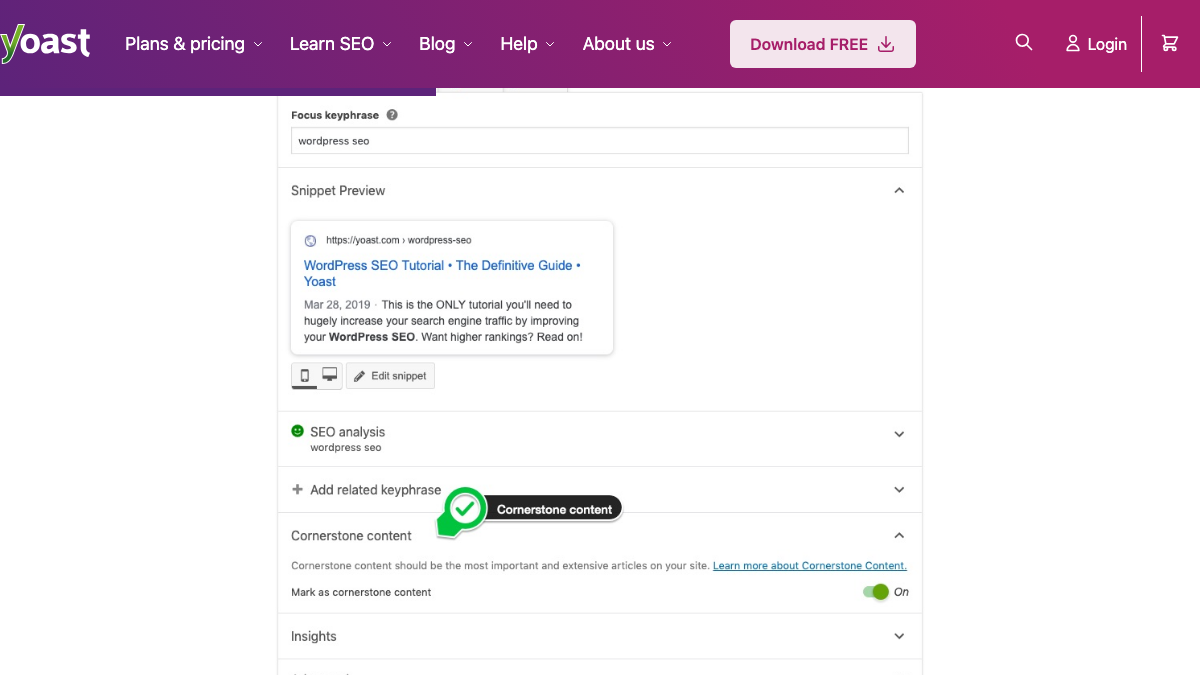
Flipping it changes how the plugin behaves. The paid version favors marked pages in its internal link suggestions, and its SEO analysis checks them more strictly. Yoast Premium can even surface a list of marked pages that haven't been touched in a while.
The switch is really a note to yourself and the plugin, nothing more. Google never sees a cornerstone label. What it sees is the links you build and the updates you make because you flagged the page as one that matters.
No plugin? A plain spreadsheet works too. Track the URL, its main query, its score from the table above, and the date you last touched it.

Built by the team that got cited in 48 hours.
Content generation, backlink building, AI visibility tracking, and Google rankings. One platform, zero guesswork.
A maintenance routine that keeps them earning
Nearly every top-ranking guide on cornerstone content tells you to update these pages "regularly," and almost none of them say how often or what to actually check. Here's a routine built to live in an actual calendar.
| When | What to check | What to do |
|---|---|---|
| Monthly | Clicks and position for the main query in Search Console | Note any drop of more than a few spots |
| Monthly | Whether AI answers still cite or name you for the page's questions | Log it, and look into any loss |
| Quarterly | Facts, prices, screenshots and dates | Fix what changed, then update the modified date |
| Quarterly | Posts published since the last check | Add links from the new posts to the cornerstone page |
| Yearly | The four-signal score for every page | Demote, merge or swap pages that no longer pass |
The quarterly fact check is the one step everyone skips. Orbit Media has tracked how many bloggers update old posts since 2017, and that share peaked at 73% during 2020 to 2022. A habit alone tells you little, though, which is why a second Orbit finding matters more: bloggers who update old content are twice as likely to report strong results.
AI answers turn over faster than Google rankings do. Our topical authority guide covers how quickly citations shift, and when a cornerstone page loses its spot in AI answers specifically, the AI citation drop checklist walks through what to rule out first. The yearly review is what catches drift generally: topics shift, products change, and a page that passed the carry test two years ago might not pass it today.
Cornerstone content in AI answers
While researching this piece on October 19, 2026, we noticed Google's AI Overview for "cornerstone content" cited Yoast's own guide as a source, even though that same Yoast page didn't crack the top 10 blue links for the term. Yoast's page opens with a plain, direct definition, exactly the kind of passage an AI answer can lift cleanly.
That's a useful lesson to carry into your own cornerstone pages. AI engines reach for passages that answer a question cleanly, and a well-maintained cornerstone page is the most likely spot on your site to have one. Citations still tend to arrive slowly, and links and mentions elsewhere on the web do much of that work.
You only find out by checking. RankControl's AI visibility tracking runs your questions every week across seven engines, including ChatGPT, Perplexity and Google AI Mode, and shows whether each answer mentions or cites you, and which competitors show up in your place.
What this costs in time
Picking and scoring candidates runs about three to four hours for a site with 100 to 300 posts. Rebuilding one cornerstone page well takes 8 to 12 hours, plus another two or three adding links back from older posts. Five pages comes out to roughly 55 to 80 hours for the first pass, and after that the routine above costs about two hours a month plus a day each quarter. Treat all of that as a rough estimate.
Staffing this isn't cheap either. ClearVoice, which sells content services, puts the base pay of a small in-house content team, a strategist, a writer and an editor, at roughly $197,000 a year. That's one vendor's number, but it explains why so few teams keep up with even five pages on their own.
You can run the whole thing yourself with Search Console, a spreadsheet and a few quiet days each quarter. Or RankControl can take the steady part off your plate. The content engine writes each article against the pages already ranking for its keyword and publishes it on your own domain, with weekly tracking across seven engines showing which pages AI answers still use. There's one flat plan at $400 a month with a 7-day free trial.
See your first AI citation report in under 5 minutes.
No setup calls. No onboarding meetings. Connect your domain and see where AI mentions your brand right now.