A B2B company with a 15-year-old domain moved to a new one in October 2025. The migration had no redirect plan, and the old server went offline before anyone could fix it. Google impressions fell from about 700,000 a month to about 14,000. When the team asked r/TechSEO whether to start a six-month link building campaign, one reply cut through the rest: finish the migration and don't change anything else.
Domain migration disaster — 98% traffic drop. Recovery strategy check?
Hey everyone, looking for honest feedback on our situation and recovery plan. We're a B2B company with an international presence. In October 2025 we migrated from our legacy domain (15+ years old, ~700k monthly impressions) to a brand new d...
That advice holds for most sudden drops. You recover website traffic by fixing the specific thing that broke, then waiting the right amount of time for that kind of problem. This guide covers the fix and a realistic timeline for each common cause, from technical breaks to core updates. It also covers what slows recovery down and how to tell whether it's working.
Name the cause before you fix anything
Recovery work only helps if it matches the cause, so diagnose first. If clicks fell to almost nothing in a few days, work through our checklist for near-zero drops. If the drop lines up with a Google update, our guide to separating core update losses from AI search shifts helps you tell the two apart.
Once you know the cause, the timeline follows from it:
| Cause | The fix | Realistic timing |
|---|---|---|
| Technical break: noindex, robots.txt, firewall | Remove the block, then request indexing | Often days, once Google recrawls |
| Site migration without redirects | Map every old URL to its new one | A few weeks or more for medium sites, longer for large ones |
| Manual action | Fix every issue, then file a reconsideration request | Reviews take several days or weeks, longer for link issues |
| Spam update | Bring the site in line with spam policies | Systems learn "over a period of months" |
| Core update | Improve or remove unhelpful content | A few days to several months, sometimes the next core update |
A drop caused by AI Overviews answering the question is a different case. Rankings hold while clicks fall, so there's nothing to "recover" in the usual sense. Our AI Overviews recovery playbook covers that situation.
Recovering from a technical break
Technical breaks recover fastest because the cause is binary: Google either can or can't crawl and index the pages. In a thread we covered in our near-zero checklist, a developer had set every page's robots tag to noindex, and the listings came back within a day of the fix. A news site whose indexing stalled after a Cloudflare switch recovered a few days after the change was reversed.
The steps are short:
- Remove the block, whether it's a noindex tag, a robots.txt rule or a firewall setting.
- Run a live URL Inspection on your homepage and your top pages to confirm Google can now fetch and index them.
- Request indexing for the most important pages and resubmit your sitemap.
- Watch the Crawl Stats report for requests climbing back to normal.
Resist the urge to "improve" anything else that week. If traffic returns, you'll know why.
200+ SaaS teams already track their AI citations.
They know exactly when ChatGPT mentions their brand, and when it stops. Do you?

Recovering from a botched site migration
Migrations fail when old URLs lead nowhere. Google's site move guidance says that for medium-sized sites it can take a few weeks or more before Google shows the new URLs instead of the old ones, and larger sites take longer. That's with redirects in place from day one. Without them, the clock doesn't start until you fix the mapping.
Start with the URLs that mattered. Export the pages that earned clicks in the 12 months before the move from Search Console, then redirect each one to its closest match with a 301. One-to-one matches beat "fuzzy" rules or sending everything to the homepage, which Google tends to treat as a soft 404. If the domain itself changed, use the Change of Address tool in Search Console, and keep the old domain and its redirects live.
The r/TechSEO team had implemented about 1,100 redirect rules with fuzzy matching and was weighing a €12,000 link campaign on top. The reply we opened with was right. Links pointed at a site whose old URLs still don't resolve cleanly spend money on the wrong problem, and they add a new variable just when you need to read results.
Recovering from a manual action
A manual action is the one cause Google tells you about, in the Manual actions report in Search Console. Fix every issue on every affected page before you ask for a review. Google's help page says a good reconsideration request explains the exact problem, describes the steps you took and documents the outcome.
Google says most reviews take several days or weeks, and link-related requests can take longer. Don't resubmit while a request is pending. If you bought a site that already carried the action, say so in the request.
Recovering from a spam update
Spam updates don't send a message, and they don't reverse quickly. Google's spam update documentation says making changes may help a site improve "if our automated systems learn over a period of months that the site complies with our spam policies." For link spam there's a harder rule: when Google's systems neutralize spammy links, any ranking benefit they gave the site is lost and "cannot be regained."
That changes what recovery work looks like. In an r/SEO thread from September, a site hit by a spam update saw traffic return in mid-August, then fall back to its low point on August 28. The team had fixed technical issues and added an llms.txt file, and its domain authority had risen from 8 to 17.
Why did my organic traffic drop again after a short recovery?
I’m trying to understand a strange pattern in my Google Search Console data and would appreciate some advice from people experienced with Google algorithm updates. My website was affected around the time of a Google Spam Update, and organic...
One reply explained the pattern well. A spam classifier judges link and content signals, so technical cleanup doesn't touch it, and a brief rebound can be a reassessment window rather than a recovery. For a spam hit, remove or rework the pages the policies describe, such as mass-produced or thin pages, and stop any link schemes. Then give it months.
Recovering from a core update
Core updates are the slowest and least certain. Google puts it directly:
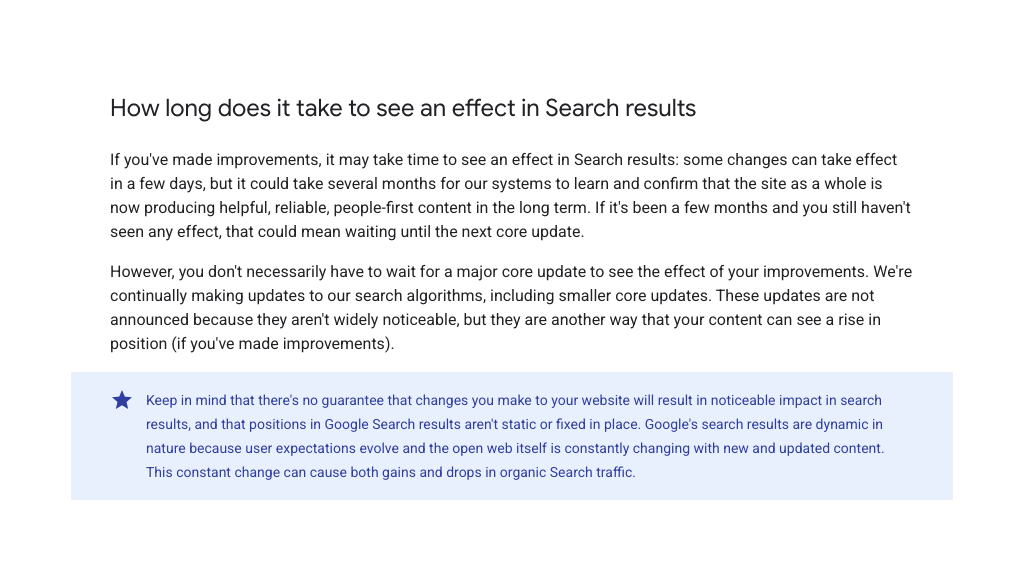
Recoveries do happen. In an r/Blogging thread, one blogger described falling from about 100,000 views a month to 5,000 after a 2023 core update. Their traffic started growing again in August 2025 and reached about 300,000 views a month after a March core update. Others haven't been so lucky. Our look at helpful content update recoveries found that trackers watching hundreds of hit sites logged none in the first nine months.
The work is content work: find the pages that lost the most, compare them with what now ranks, and improve or remove the ones that don't serve the searcher. Our piece on why traffic drops for months and then suddenly recovers explains why the payoff usually arrives all at once.
How often does ChatGPT mention your brand?
Most founders have no idea. The answer might surprise you.

One-variable recovery
The biggest recovery mistake is changing everything at once. We call the alternative one-variable recovery: fix the cause you identified, hold everything else still and watch the pages that dropped. When you change the content, the templates and the link profile in the same month, you can't tell which change worked, and you can't undo the one that hurt.
A few specific moves to hold off on during recovery:
- Starting over on a new domain. As one r/Blogging reply put it, a new domain doesn't reset anything if the same content problems follow you.
- Mass-deleting pages before you know the cause. If the problem turns out to be a firewall rule, you've thrown away pages that were fine.
- Launching a redesign or a CMS change mid-recovery.
- Buying links while any link-related issue is open.
Tracking whether it's working
Track the pages and queries that dropped, not the sitewide total. Export them from Search Console on the day you start, then compare the same list weekly. Annotate each fix with its date so you can line it up against the chart later.
Set checkpoints that match the cause. For a technical fix, look for movement within one or two weeks. For a migration, a month. For spam and core updates, judge progress quarterly, and expect nothing obvious for the first several weeks.
Watch your AI visibility alongside rankings. Google's AI Overviews and AI Mode draw on its index, so a site that loses Google visibility tends to lose those citations too, and they come back on the same clock.
Doing the recovery work yourself or handing it off
Most recovery work is patient and repetitive: fix the cause, then publish better pages and check the same queries week after week.
Done by hand, checking 50 questions on seven engines takes about six hours a week, and publishing eight solid articles a month takes 16 to 24 hours more. Those are rough estimates.
RankControl's AI visibility tracking runs your 50 questions every week on seven engines, marks each one as mentioned, cited or both, and records which competitors and sources each engine used. The content engine writes each article against the pages already ranking for its keyword and publishes it on your own domain.
You can run the recovery yourself with Search Console, a spreadsheet and patience. Or RankControl's agents can handle the weekly checks and the new content while your team fixes what broke.
15 hours a week manually. Or 15 minutes with RankControl.
Track citations, monitor competitors, and fix content gaps across every AI search engine. Automatically.