
You've probably run into the claim that 90% of online content would be AI-generated by 2026. It's 2026 now, so let's actually check. The best answer available comes from Pew Research Center, published August 20, 2026. In its July 2026 sample of web pages, 10% carried strong signs of AI writing. Among the pages it could date to after ChatGPT's release, that share rose to about 35%.
That's a real number. It's also nowhere close to 90%. What follows is every estimate worth knowing, what each one actually counted, and who had a stake in the result, plus the story of where that 90% line originally came from. I pulled up both versions of the report behind it on October 19, 2026, and they don't say the same thing at all.
The Pew study: about 10% of pages, a third of new ones
Pew's team, led by Samuel Bestvater and Aaron Smith with three colleagues, pulled 10,000 random English pages from each of 49 monthly Common Crawl snapshots running from January 2021 to July 2026. That works out to 490,000 pages total. Common Crawl is the free public web archive that a lot of AI labs themselves train on.
Every page ran through an open detector from Pangram, a model called editlens_Llama-3.2-3B. To sanity-check that choice, Pew ran 62,370 pages from seven of the crawls through Pangram's paid model, Pangram 3.3, and compared the two. They agreed 96% of the time, with a Cohen's kappa of 0.61. Any page scoring 0.2 or above counted as showing real signs of AI writing or editing, per Pew's own methodology notes.
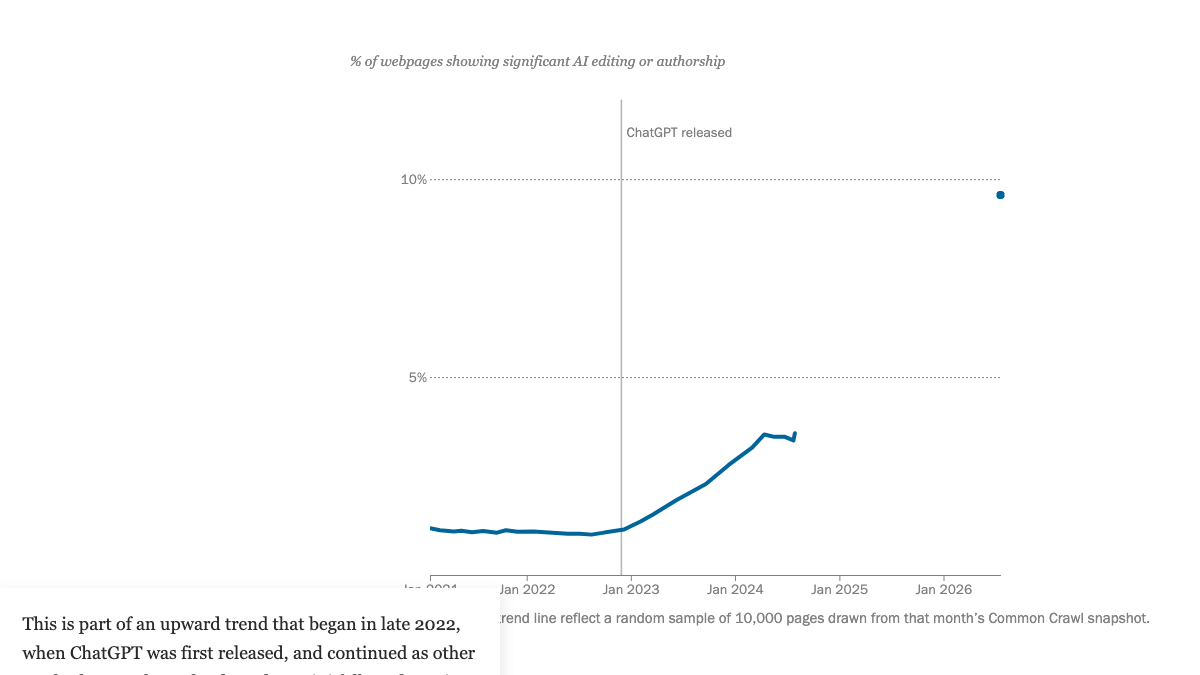
Before ChatGPT launched in November 2022, that rate sat near 1%. It climbed to 10% of all sampled pages by July 2026. Split by domain, the pattern holds up: about 10% on .com pages, 4.6% on .org, and only around 1% on both .edu and .gov.
Over one-third of recently published pages on the internet may have been written or substantially edited by #AI. In a July 2026 snapshot of webpages, 35% of the pages that were published after the release of ChatGPT show signs of AI authorship. https://t.co/OJ5ZaXEJSv
 Pew Research Center@pewresearchAug 20, 2026
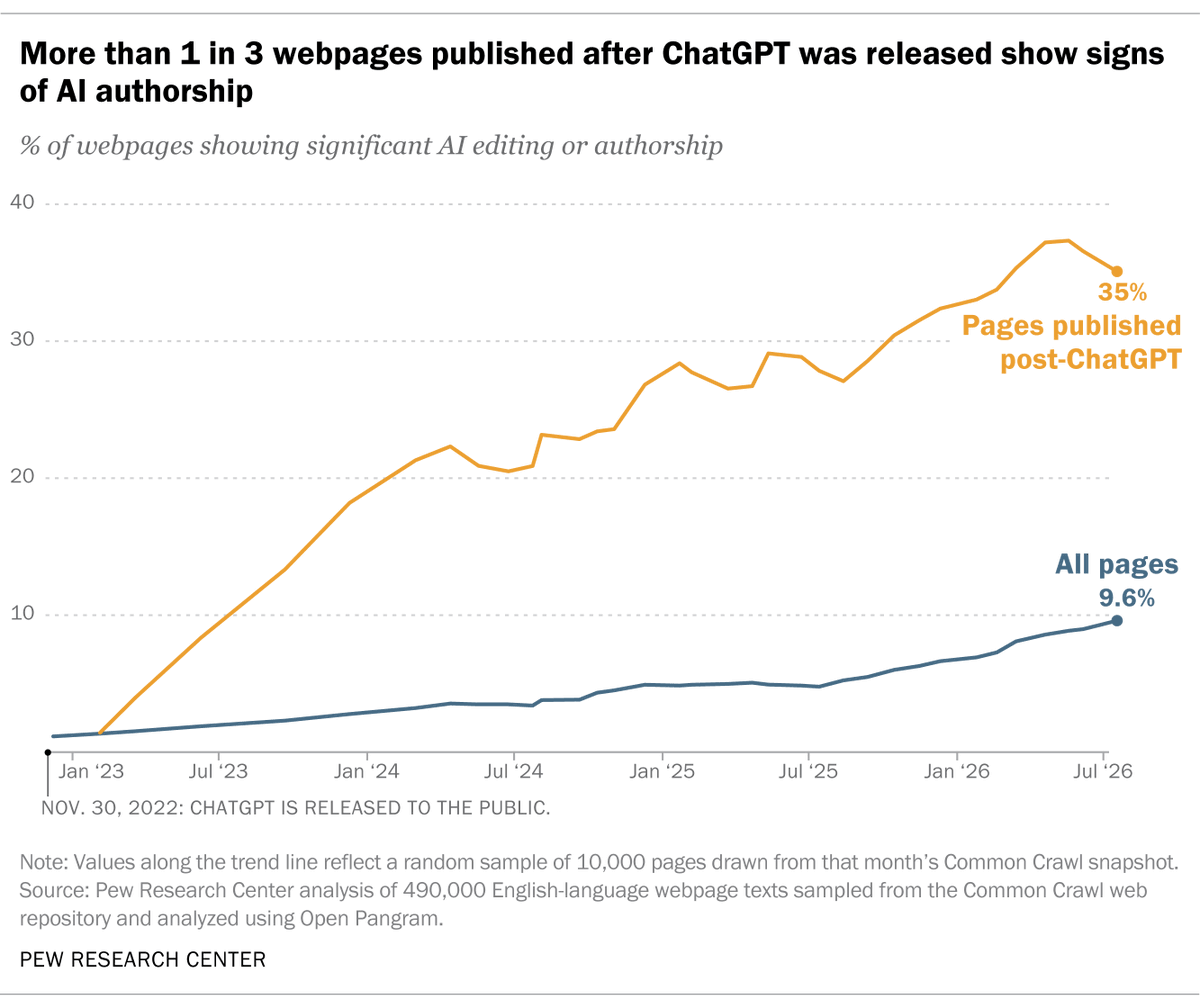
The 35% figure needs a caveat, which Pew states plainly rather than burying. Only 10% to 15% of pages in any given crawl carry a publish date in their code at all, so the "after ChatGPT" number is built from that smaller dated subset, which leans toward blogs and content sites specifically. Pew also flags that its open detector runs a higher false-positive rate on older pages.
Two days after the study went up, a commenter on r/dataisbeautiful caught that exact dating issue. Over on r/whennews, reply after reply landed on some version of "less than I expected." Most people had guessed considerably higher going in.
How much of the internet is written with AI, 2023 to 2026
Pew also tracked how writing habits themselves shifted from 2023 to 2026. Em dashes now show up about twice as often. Oxford commas rose 63%, and words like "interplay" and "testament" more than doubled in frequency. The "it's not X, it's Y" construction nearly tripled, a pattern one r/whennews commenter couldn't resist mocking by using it in their own reply.
Every estimate, ranked by how it was measured
The table below puts the main figures side by side, running roughly from the most careful method to the least rigorous. Pay closest attention to the third column, because every study here counted a genuinely different thing.
| Source | Date | What it measured | Sample | Figure | Who ran it, and their stake |
|---|---|---|---|---|---|
| Pew Research Center | Aug 2026 | All pages in Common Crawl samples | 490,000 pages from 49 crawls | 10% of July 2026 pages; about 35% of dated post-ChatGPT pages | Nonprofit research group, nothing to sell |
| Princeton researchers (Brooks, Eggert, Peskoff) | Oct 2024 | New English Wikipedia articles (one platform) | 2,909 new articles from August 2024 | Over 5% flagged as AI, called a lower bound | Academic team, two detectors |
| Graphite | May 2026 | New English articles and listicles only | 55,400 Common Crawl URLs | 49.9% mostly AI in Q1 2026 | SEO agency; averaged three outside detectors |
| Graphite (first version) | Oct 2025 | Same as above | 43,000 URLs on its own page; 65,000 in press coverage | AI passed human-written in November 2024 | SEO agency; one detector, since replaced |
| Ahrefs | May 2025 | New pages, one per domain | 900,000 pages found in April 2025 | 74.2% had some AI text; 2.5% pure AI | Sells SEO tools, including its own AI detector |
| Ahrefs | Jul 2025 | Google's top 20 results | 600,000 pages for 100,000 keywords | 86.5% had some AI text; 4.6% pure AI | Same as above |
| Originality.ai | Logged to Sep 2025 | Google's top 20 for 500 keywords | About 10,000 sites per two-month period | 17.31% AI in Sept 2025, peak 19.56% | Sells an AI detector |
| AWS researchers (Thompson et al.) | Jan 2024 | Machine translation, not AI writing | 6.38 billion sentences | 57.1% sat in sets translated into 3+ languages | Amazon science team |
| Thales Bad Bot Report | 2026 report on 2025 data | Web traffic, not text | Thales and Imperva network data | 53% of traffic was bots | Sells bot protection |
| Europol Innovation Lab | Apr 2022 | Nothing; an expert forecast about synthetic media | None | "As much as 90%" by 2026 | Police agency quoting a 2020 book |
Two of those rows aren't measuring AI-written text at all, and the final one never measured anything in the first place. Both get their own section further down.
Your competitors are building backlinks while you read this.
Organic outreach, social mentions, and citations from Editorial Circle member sites, with managed backlinks available as an add-on. Grow your domain authority without running the campaign yourself.

Why the numbers don't agree
Call it the denominator problem. Every one of these studies divides its count of AI pages by some total, and those totals differ wildly from study to study. Pew's base includes old pages written long before ChatGPT existed, which drags its 10% figure down. Its 35% number only counts the dated, newer slice. Graphite's base is articles and listicles carrying article markup specifically, which is exactly why it lands near half. That tracks with an Ahrefs survey of 879 content marketers, where blog posts were the single thing they made with AI most often.
The other real split is where each study draws its line for "AI." Graphite counts an article as AI only when most of its text reads that way. Pew counts a page the moment it shows "meaningful" signs of AI writing or editing, full stop. Ahrefs counts any page carrying any AI text whatsoever, which is exactly why its 74% figure sounds so dramatic next to the others. By Ahrefs' own internal breakdown, only 2.5% of those new pages were purely AI from top to bottom.
So the honest range for 2026 looks like roughly one page in ten across the whole web, and roughly half of new blog-style articles specifically. Which number applies to you depends entirely on which question you're actually asking.
For a wider set of AI figures aimed at marketers, see our AI statistics roundup for 2026.
Graphite: the half-AI figure that went viral
Graphite's first study landed on October 14, 2025, and it made headlines for claiming AI had already passed humans in new articles. Its own page says it sampled 43,000 URLs from Common Crawl. Vice and a wave of posts on X said 65,000 instead. Both numbers still circulate online, though 43,000 is what's actually on Graphite's page.
That original page now carries a note saying it's been replaced. The newer version, published May 15, 2026, is the one worth citing going forward. Graphite sampled 55,400 URLs this time, ran each through three detectors, Pangram, Copyleaks and GPTZero, and averaged the three estimates together. Its false-positive rates on pre-ChatGPT articles ran from 1.36% to 1.84%.
The story that data tells is a fast climb followed by a flat line. Twelve months after ChatGPT launched, 35.9% of new articles were mostly AI. By Q1 2025 the split sat at 49.6% AI against 50.4% human. AI briefly edged ahead at 50.9% in Q4 2025, then dipped back to 49.9% in Q1 2026.
Graphite's own theory is that the plateau happened because mostly-AI articles simply don't perform well in search. That may well be right. It's also worth pointing out that Graphite is an SEO agency, and "AI-only articles don't work" happens to be a convenient finding for a firm that sells SEO services for a living. Graphite also admits it never tested how well its detectors catch AI drafts that a person later edited by hand.
Ahrefs: 74% if any AI counts
Ahrefs ran its own in-house detector, called bot_or_not, on 900,000 English pages its crawler found in April 2025, taking exactly one page per domain so every result came from a different site. The study itself came out May 19, 2025, written by Ryan Law, Ahrefs' director of content marketing.
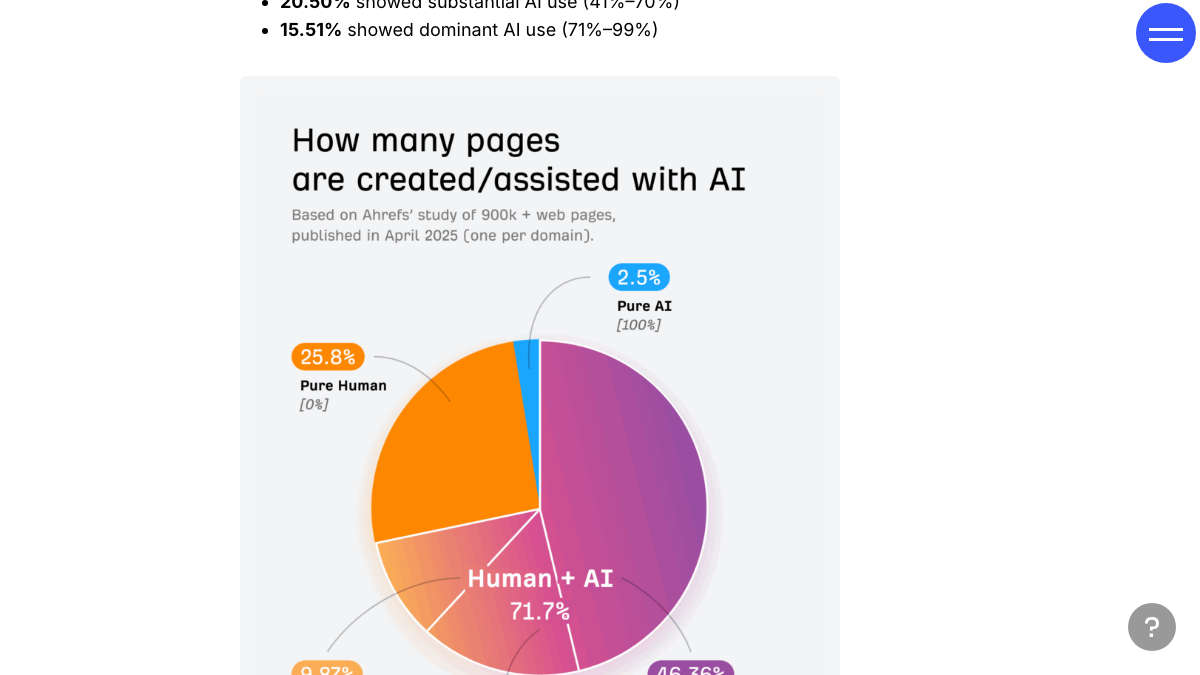
Of those new pages, 74.2% carried at least some AI text. Only 25.8% read as purely human from end to end. That mixed middle ground is where most of today's web actually sits. Roughly 15.5% of all pages were mostly AI, meaning 71% to 99% of the text got flagged.
Ahrefs is refreshingly upfront about its own limits here. "No AI content detector is perfect," the post itself admits. It also notes the study doubled as a dry run for a detector Ahrefs was about to start selling to customers. None of that makes the number wrong, but it's context worth having.
Originality.ai: AI in Google's top 20
Originality.ai tracks how much of Google's top 20 results reads as AI over time. It checks 500 informational keywords and roughly 10,000 sites every two months, leaning on Internet Archive snapshots to reach back to older dates. A page counts as AI once its detector scores 0.5 or higher.
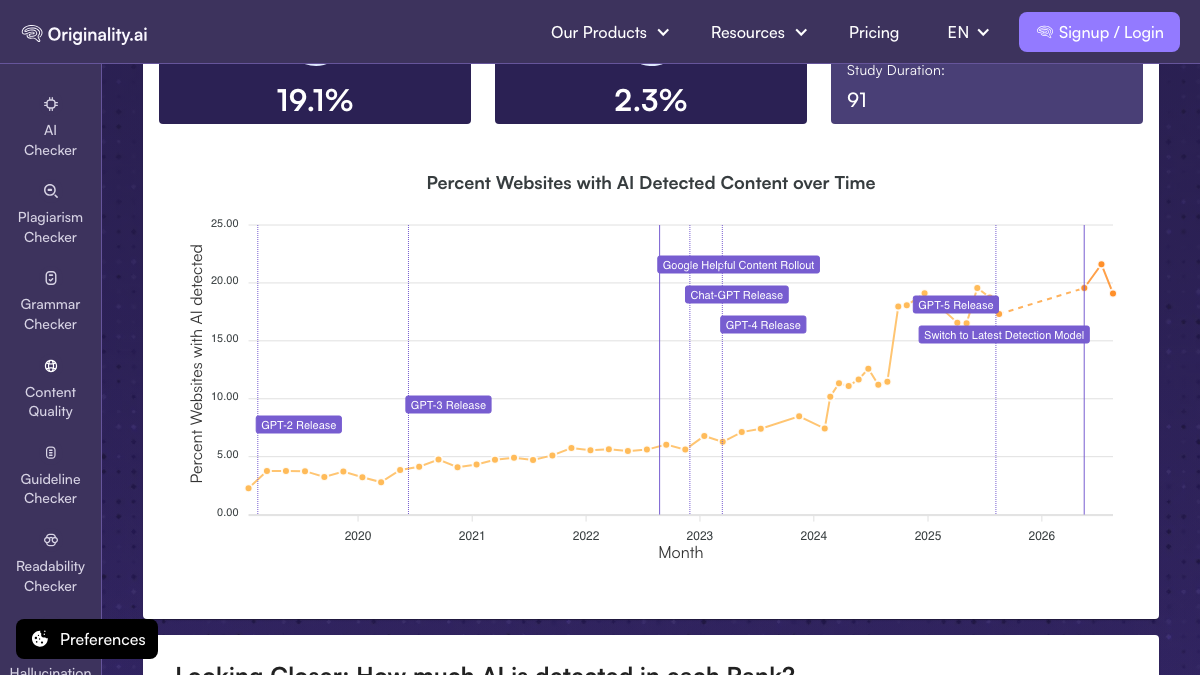
Its written log shows 2.27% back in February 2019 and 17.31% as of September 17, 2025, after peaking at 19.56% that same July. The chart plots a handful of newer points collected after the company switched over to a newer detection model.
One detail buried in that log says a lot about how these tools actually behave. The 2.27% reading comes from February 2019, which Originality.ai itself places before GPT-2 even had a public release. Almost none of those pages could possibly have been AI-written, which makes that number a rough read on the tool's own false-positive floor rather than anything real. Worth keeping in mind too: Originality.ai sells a detector, so a rising AI number is good for its own pitch.
You're getting AI traffic. But do you know where it comes from?
RankControl credits every visit to the assistant that sent it: ChatGPT, Perplexity, Claude, Gemini, Copilot, or Grok. Full source attribution, next to your Google traffic.
Wikipedia and science papers run lower
Single platforms tell a calmer story than the web taken as a whole. In October 2024, Princeton researchers Creston Brooks, Samuel Eggert and Denis Peskoff checked new Wikipedia pages using two detectors, GPTZero and the open-source Binoculars. They deliberately set the bar so only 1% of pre-GPT-3.5 articles would get flagged by mistake. Even with that conservative threshold, over 5% of new English articles from August 2024 still came up as AI.
The authors themselves call that a lower bound, since any detector misses some genuinely AI-written text. They also found the flagged articles tended to run lower quality, and skewed noticeably self-promotional or one-sided.
Science is pushing in the same direction from a completely different angle. A Cornell team led by Yian Yin looked at more than 2 million papers across arXiv, bioRxiv and SSRN from 2018 through mid-2024, publishing their results in the journal Science in December 2025. Authors who adopted AI tools posted about a third more papers on arXiv, and over 50% more on the other two platforms.
Even so, papers that were probably written with AI help were less likely to get accepted by journals, even when the writing itself scored well on quality. One reviewer on r/PhD said the journal they review for now runs every submission through GPTZero first. Rejections went up as a result, they said, but reviewers ended up with less to actually read.
Where the "90% by 2026" line came from
This one has a real, traceable source, and it was never a measurement. Europol's Innovation Lab published a report back in April 2022 called "Facing reality? Law enforcement and the challenge of deepfakes." In its chapter on understanding deepfakes, the original 2022 PDF says exactly this.
"Experts estimate that as much as 90 % of online content may be synthetically generated by 2026."
The footnote traces back to a single book, "Deepfakes: The Coming Infocalypse" by Nina Schick, published in 2020. That chapter is specifically about synthetic media, which the report defines as media made or altered with AI: faked video, audio and images. It says nothing whatsoever about blog posts or written text.
Here's the part that surprised me. The current version of the report says it was published in January 2024 and "replaces the previous one," including updates to that same chapter. The 90% sentence is simply gone from it now. Search today's PDF and you won't find it, which is exactly why some people assume the quote was invented outright.
It wasn't invented. It was a 2020 forecast about synthetic media, quoted inside a 2022 report about deepfakes, then quietly dropped in a 2024 revision. Futurism ran it in September 2022 under the headline "Experts: 90% of Online Content Will Be AI-Generated by 2026," and it's been passed around as a fact about written text ever since. Pew's actual count for July 2026 is 10%.
Two numbers that measure something else
The AWS paper by Brian Thompson and colleagues, posted in January 2024, is about machine translation, not AI writing at all. The team built a set of 6.38 billion sentences from Common Crawl and found 57.1% of them sat inside groups that had been translated into three or more languages. The poor quality of those groups suggested they'd been run through translation software, often starting from weak English source pages.
That's a genuine problem for low-resource languages, and the paper's own title calls the amount shocking. But a page a translator ran through isn't a page an AI actually wrote. If you've seen "57% of the web is AI" floating around, this paper is almost certainly the root of it, and the claim stretches well past what it actually found.
Bot traffic is the other common mix-up. The 2026 Thales Bad Bot Report, from the firm that owns Imperva, found bots made up 53% of web traffic in 2025, with bad bots alone accounting for 40%. Those are requests hitting servers, not words sitting on pages. Our AI crawler access statistics cover which AI bots sites actually let through the door.
How much can you trust an AI detector?
On a single page, not much at all. The study everyone cites here came out of Stanford. Weixin Liang, James Zou and colleagues tested seven popular detectors against 91 TOEFL essays, every one of them written entirely by people. The paper ran in the journal Patterns in July 2023.
On average, those detectors flagged 61.22% of the essays as AI. 89 of the 91 essays got flagged by at least one detector. The very same tools came close to perfect on essays written by US eighth graders. Plain, simple English apparently reads as AI to these tools, which puts non-native writers at genuinely unfair risk.
The fix the researchers tried was a strange one. When they asked ChatGPT to make the same essays sound more native, the false-positive rate dropped to 11.77%. In other words, running human writing through AI polish made it look more human to the detectors, not less.
AI detector marks my human generated text as 100% AI-assisted
Was struggling with grief and sadness, so wrote it down and posted it on Substack. Well, their AI detection thinks that it's 100% AI. I rambled on an actual paper, and don't use AI for writing.
The post linked above shows exactly how this feels in real life. Someone wrote about their own grief by hand, posted it to Substack, and the site's built-in detector marked it 100% AI. The top reply, sitting past 2,000 upvotes, called detectors useless outright.
So why trust Pew's numbers at all, given all that? Because a study spanning 490,000 pages is asking a fundamentally different kind of question. Pew itself says "AI detection models aren't perfect" and can absolutely misjudge any single page, but errors spread across a sample that large tend to wash each other out. Even so, agreement between two different Pangram models isn't proof of real accuracy, and a kappa of 0.61 still leaves genuine room for doubt.
Do AI-written pages rank?
Mostly, it doesn't seem to matter much how the text got made. Ahrefs checked 600,000 pages sitting in Google's top 20 for 100,000 keywords back in July 2025. The correlation between a page's AI share and its ranking position came out at 0.011, which is functionally zero.
Google has said as much itself, in its February 2023 guidance, under the heading "Rewarding high-quality content, however it is produced." Graphite's 2026 study points to its own separate research showing that mostly-AI articles "largely do not appear in Google and ChatGPT." Both things can be true at once. AI text itself isn't punished, but generic articles that add nothing new rarely win regardless of who or what wrote them.
We cover this evidence in more depth in can AI-written blog posts rank in AI search, and the policy side of it in is Google targeting AI content or low quality.
What this means if you publish
If half of new articles out there are mostly machine-made, the bar for actually standing out has quietly moved. Graphite's plateau hints that plenty of publishers tried pure AI volume and gave up once it stopped paying off. What still earns real clicks is whatever a model genuinely can't make up on its own, a price you checked today, a test you actually ran yourself.
RankControl's content engine writes each article against the pages already ranking for its keyword and publishes it on your own site. Our AI visibility tracking then checks every week how your brand shows up across seven AI engines, plus your Google and Bing rankings. We offer one flat plan at $400 a month with a 7-day free trial.
You can track all of this by hand, with a spreadsheet and a few hours a week set aside for it. Or you can let RankControl handle the writing and the weekly checks while you get on with running the actual business.
We'll show you exactly where your brand stands in AI search.
No commitment. $0 due today, cancel anytime. See how ChatGPT, Perplexity, Claude, Gemini, Grok, Google AI Mode, and Google AI Overviews talk about your brand today.