Ask how many shoppers use AI to decide what to buy, and you'll find answers anywhere from 17% to 75%. The surveys aren't wrong. They're measuring different people, asking different questions and, in most cases, selling something related to the answer.
This post lines up the main 2026 data on AI shopping side by side, with who ran each study, who it asked and what the sponsor sells. Then it shows why the numbers disagree and what they add up to.
The headline numbers
| Source | Finding | Who was asked | Date | Sponsor sells |
|---|---|---|---|---|
| Bain Consumer Lab | 30% to 45% use generative AI for product research | US consumers | Nov 2025 | Retail and AI consulting |
| Bain Consumer Lab | 17% plan to start holiday shopping on an AI platform | US online shoppers | Nov 2025 | Retail and AI consulting |
| Capgemini | 53% have bought based on AI recommendations | 10,000 consumers, 13 countries | Latest edition | AI and digital consulting |
| Capgemini | 64% willing to buy on AI recommendations | 10,000 consumers, 13 countries | June 2023 | AI and digital consulting |
| BrightLocal | 45% used AI tools for local business recommendations | 1,002 US adults | 2026 | Local SEO software |
| Google with Ipsos | 75% make faster, more confident decisions with AI Mode | 13,189 shoppers who already use AI Overviews or AI Mode | Dec 2025 | Search ads |
| Adobe | 69% less likely to return an item bought with AI help | Not disclosed | Sept 2026 | Analytics and commerce software |
Two things jump out. Every sponsor has a stake in AI shopping looking big. And the groups being asked range from all consumers to people who already shop with AI.
We call this the denominator problem. A percentage only means something once you know what it's a percentage of. "75% of people" sounds like most shoppers. In Google's case, it's 75% of shoppers who already use Google's AI features.
How many shoppers research with AI
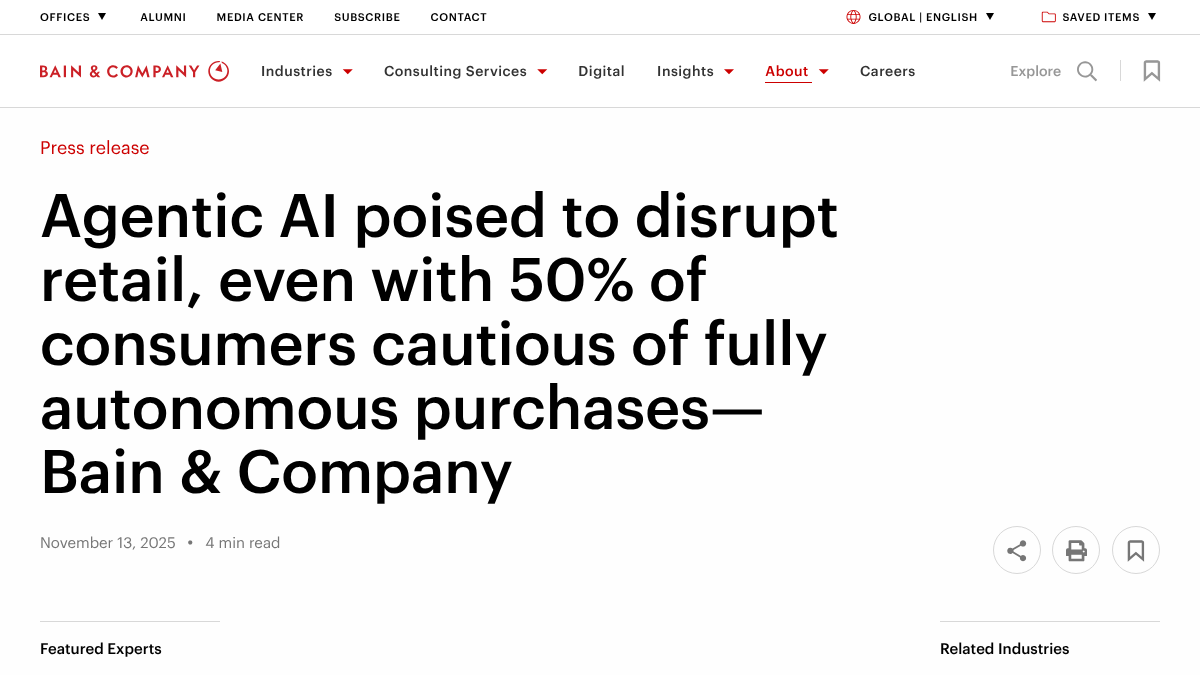
Bain's figure is the most cited. In a November 13, 2025 press release, Bain reported that "30% to 45% of US consumers currently use Generative AI for product research and comparison, according to Bain's Consumer Lab Generative AI Survey."
The range itself is telling. Bain didn't give a single number, which suggests the share depends heavily on the product category. Researching a laptop and researching toothpaste are different habits.
Capgemini's older survey went higher. In June 2023, it reported that "70% of consumers use generative AI tools when seeking recommendations for new products and services." That survey covered 10,000 consumers in 13 countries, and it asked about recommendations in general, which is a lower bar than active research.
For local purchases, BrightLocal's 2026 Local Consumer Review Survey of 1,002 US adults found that use of ChatGPT and other AI tools for local recommendations rose "from 6% last year to 45%." That made AI the third most popular source of business recommendations in the survey.
26 content formats. Published on your domain. Matched to your brand.
Guides, comparisons, listicles, case studies, and more. RankControl generates content that gets cited by ChatGPT, Perplexity, Claude, Gemini, Grok, Google AI Mode, and Google AI Overviews.

How many have actually bought
Research is one thing. Buying is another.
Capgemini ran the same kind of survey twice, which makes it the closest thing to a before-and-after in this data. In 2023, 64% of consumers said they were "willing to make purchases based on these AI-generated recommendations."
In its latest edition, "From Hype to Habit," Capgemini found that "53% of consumers have made purchases based on Gen AI recommendations, and 64% are open to buying new products suggested by AI." The sample was again 10,000 consumers across 13 countries.
So willingness held steady at 64%, and a bit more than half now say they've followed through at least once. That's a real shift from intention to behavior, though "made purchases based on" could mean anything from a full AI-led decision to a single suggestion that tipped the balance.
Where shopping starts
Bain also asked where people would begin. It found "17% of unique online shoppers say they will begin their holiday shopping with an AI platform such as ChatGPT or Perplexity, and 30% plan to start with AI-enabled Google search."
That's a useful split. Starting on a standalone AI assistant is still a minority habit. Starting on Google, with AI built in, is far more common. For most shoppers, AI arrives through the search engine they already use.
How shoppers feel about it
The trust numbers are mixed.
Google's figure is the most positive. In May 2026, Google wrote that "75% of people report making faster, more confident decisions using AI Mode in Search." The footnote is unusually detailed. It came from an Ipsos survey Google commissioned in December 2025, with 13,189 adults across 25 countries who had made a considered purchase in the past week "and use Google AI Overviews and/or AI Mode for shopping."
That last part is the denominator problem again. People who already shop with AI Mode and like it enough to keep using it are a friendly group to ask.
Bain found more caution. Its release said "half of consumers are not comfortable letting AI autonomously handle end-to-end transactions, but customer trust is rising fast."
Adobe added one more angle. Its 2026 holiday forecast reported that "69% say they are less likely to return an item they bought with the help of an AI assistant." Adobe didn't publish the sample size or method for that figure.
What the traffic data says
Surveys measure what people say. Traffic data measures what they do, at least on the sites being tracked.
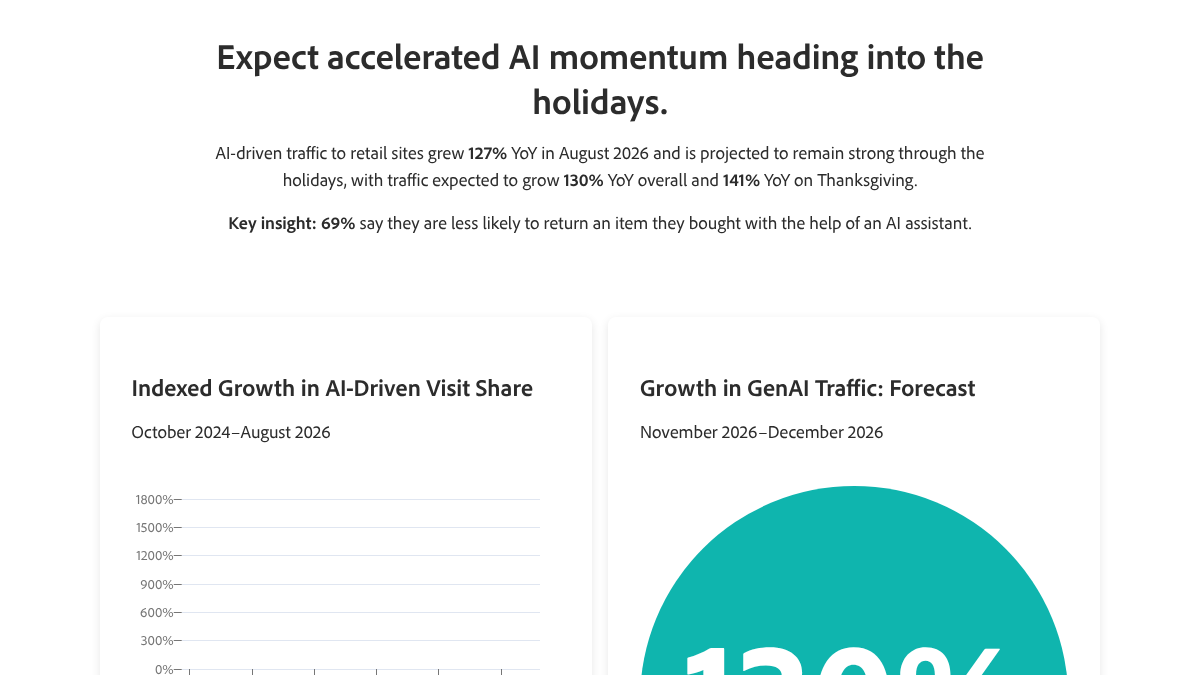
Adobe reported that "AI-driven traffic to retail sites grew 127% YoY in August 2026," and forecast growth of 130% over the holidays and 141% on Thanksgiving. Adobe's numbers come from transactions on retail sites using its analytics, not a survey. For the 2025 holidays, Adobe counted a 693.4% jump in AI traffic to US retail sites, from a small starting base.
Shopify reported similar growth on its own stores. In May 2026, it said referral sessions from AI chatbots "grew more than 8x year-over-year on Shopify storefronts as of Q1 2026." It also reported how those visitors behaved.
| Measure | AI-referred sessions | Organic search sessions |
|---|---|---|
| Start on a product page | More than half | 20% |
| Conversion rate | Nearly 50% higher | Baseline |
| Average order value | 14% higher | Baseline |
That fits the survey picture. Shoppers who come from AI arrive later in the decision, often straight to a product, and are more likely to buy. Shopify itself called the signals "early."
Our roundup of AI referral traffic and conversion statistics covers the site-owner side of these numbers in more depth.

Your competitors are getting cited by AI. You're not.
Every day without citation tracking is a day your competitors pull ahead in ChatGPT, Perplexity, and Claude.
The buying layer is live
The platforms are building for purchases, and research is just the first step. Our explainer on what agentic commerce is covers the protocols behind it.
On September 29, 2025, OpenAI launched Instant Checkout. "More than 700 million people turn to ChatGPT each week for help with everyday tasks, including finding products they love," the announcement said. US users could buy from Etsy sellers in chat, with more than a million Shopify merchants "coming soon." At launch, it supported "single-item purchases."
Google is moving the same way. Its May 2026 announcement said that since launching a Direct Offers pilot in January 2026, "brands like Chewy, Gap and L'Oreal have surfaced highly relevant deals as shoppers explore their options."
Our explainer on ChatGPT shopping for DTC founders covers how checkout inside ChatGPT works for merchants.
A short timeline of AI shopping
Lining the data up by date shows how quickly the buying side caught up with the research side.
| Date | What happened |
|---|---|
| June 2023 | Capgemini finds 64% of consumers willing to buy on AI recommendations |
| September 2025 | OpenAI launches Instant Checkout in ChatGPT, starting with Etsy sellers |
| November 2025 | Bain reports 30% to 45% of US consumers use generative AI for product research |
| December 2025 | Ipsos surveys 13,189 AI Mode and AI Overviews shoppers for Google |
| January 2026 | Google starts its Direct Offers pilot with brands including Chewy, Gap and L'Oreal |
| Early 2026 | Shopify sees AI chatbot referrals grow more than 8 times year over year |
| May 2026 | Google announces new ad formats for AI Mode, citing the Ipsos survey |
| August 2026 | Adobe measures 127% year-over-year growth in AI traffic to retail sites |
| September 2026 | Adobe forecasts 130% growth in AI traffic for the holidays |
In about three years, the story moved from whether shoppers would trust AI suggestions to whether they'll buy inside the chat. The survey numbers moved more slowly than the products did.
Why the numbers disagree
| Reason | Example |
|---|---|
| Different groups asked | All US consumers (Bain) vs. shoppers who already use AI Mode (Google) |
| Different questions | "Use for research" vs. "have made a purchase" vs. "willing to buy" |
| Different regions | US only (Bain, BrightLocal) vs. 13 or 25 countries (Capgemini, Google) |
| Different timing | 2023 surveys vs. late 2025 and 2026 |
| Sponsor interest | Every source sells consulting, software or ads tied to AI shopping |
| Hidden methods | Adobe's 69% and Bain's exact sample aren't published |
None of this makes the data useless. It means each number answers a narrower question than its headline suggests. Read them together and the picture is consistent. A large minority of shoppers now use AI somewhere in their research, a smaller share start their shopping there, and the traffic it sends is small but growing fast and converting well.
How to read the next AI shopping stat
New figures arrive every month. Five questions sort the useful ones from the noise.
- Who was asked? All consumers, online shoppers or people who already use the AI product? The narrower the group, the higher the number.
- What was the exact question? "Have you ever used," "do you regularly use" and "did you buy because of" are very different bars.
- Where? Global averages blend countries at very different stages.
- Who paid for it? A company selling AI commerce tools has a reason to publish a big number.
- Is the method published? Sample size, field dates and the question wording should be public. If they aren't, treat the figure as marketing.
Run the headline numbers above through these and most of the apparent disagreement goes away.
What shoppers still check before buying
AI answers don't replace the old trust signals. They summarize them. BrightLocal's 2026 survey found trust in reviews holding at 49%, meaning nearly half of consumers trust online reviews as much as personal recommendations.
Recency matters more than it used to. In the same survey, 32% of consumers said they look for reviews written in the last two weeks, up from 20% the year before, and 74% look for reviews from the last three months.
That's the raw material AI answers draw on when they describe a product or a local business. Fresh, specific reviews on your own site and on the platforms shoppers trust give AI something accurate to repeat.
What we found in retailers' robots.txt files
If shoppers are asking AI what to buy, retailers need AI crawlers to be able to read their product pages. On October 19, 2026, we checked the robots.txt files of 14 large US retailers for rules blocking OpenAI's, Perplexity's and Google's AI crawlers.
| Result | Retailers |
|---|---|
| Fetched successfully | 13 of 14 |
| Explicitly block any of the AI crawlers we checked | 0 |
| Name AI crawlers and give them the same access as Googlebot | 1 (Gap) |
| Couldn't be fetched by a standard request | 1 (Best Buy) |
Most of the sites didn't mention AI crawlers at all, which means they're allowed by default. Gap's file grouped OpenAI's, Perplexity's, Amazon's, Meta's and Anthropic's crawlers with Googlebot and gave them the same access, with only checkout and account pages blocked. Gap is also one of the brands Google named in its Direct Offers pilot.
We tested the check against a site known to block AI crawlers first, to make sure it caught real blocks. Big retailers, it seems, want their product pages read.
What a brand saw in its own orders
On r/IndiaBusiness, the sales head at a shampoo brand described noticing a new source in their order data over a few weeks. ChatGPT was sending real orders, for both of their products.
People are asking ChatGPT what to buy and then actually buying it. Saw it in our own orders this month a lot of times.
I'm the sales head at deSal shampoo company, we make shampoo for hard water and another for pool chlorinated water. Was going through orders yesterday and came across a source that didn't exist a few years ago and is now showing up regularl...
To check it wasn't a tagging mistake, the team typed the questions buyers would ask, including comparisons with bigger brands in specific cities. The poster wrote that ChatGPT and Gemini named their brand as the winner, not for every phrasing but almost every time. The part that stuck with them was the lack of visibility. With Google, you can see the keyword and act on it. With AI answers, nothing tells you when you're mentioned or when you stop being mentioned.
What this means for stores
- Make product data complete. AI answers pull prices, specs and availability from your pages and feeds.
- Answer comparison questions. Shoppers ask "X vs Y" and "best X for Y." Pages that answer those directly give AI something to cite.
- Earn reviews and coverage. AI answers lean on what other sites say about you.
- Keep crawlers allowed. Check your robots.txt doesn't block the AI crawlers you want reading your catalog.
- Track the questions that matter. Check regularly whether AI answers name you for your key products.
Our ecommerce SEO audit covers the product data side, and our guide to ecommerce content marketing covers the content that answers buyers' questions.
What the data doesn't tell us
- How much revenue AI actually drives. Traffic growth is fast but starts from a small base.
- Which categories lead. Most surveys don't break results out by product type.
- How agentic checkout performs. Buying inside chat is new, and no independent data on it exists yet.
- What independent researchers would find. Nearly every number here comes from a company that sells something related to AI shopping.
For the broader picture beyond shopping, our AI search adoption statistics cover how people use AI search overall.
Doing it yourself or handing it off
Shoppers asking AI what to buy are looking for clear answers to specific questions, like comparisons, buying guides and "best for" pages. Publishing enough of those to cover your catalog takes steady work.
RankControl handles that. We find the questions your shoppers search, write each article against the pages already ranking for it and publish it to your store, including on Shopify. Our AI visibility tracking checks up to 50 buyer questions every week across seven AI engines and shows whether each answer names you. Expect traffic from Google first, with AI citations following more slowly as links and mentions build up.
200+ SaaS teams already track their AI citations.
They know exactly when ChatGPT mentions their brand, and when it stops. Do you?