
On September 26 we checked the dates on pages that OpenAI's and Perplexity's APIs cited for 12 B2B software questions. Of the 87 cited pages we could date, the median carried a date just 74 days old. The Google top-10 pages the engines skipped had a median of 212 days.
That's a cadence question, and it has two halves: how often you publish new pages, and how often you update the ones you already have. A lot of advice covers only the first. This guide covers both, starting from that freshness data and ending with a simple way to work out a refresh schedule. Sources were checked on September 27, 2026.
How fresh cited pages are
Here's how the dates broke down. We used the latest date in each page's metadata, which is usually the last-modified date:
| Page age on September 26 | Pages the engines cited (87) | Google top-10 pages they skipped (59) |
|---|---|---|
| 30 days or less | 36% | 17% |
| 31 to 90 days | 22% | 20% |
| 91 to 180 days | 24% | 12% |
| 181 days to a year | 10% | 19% |
| More than a year | 8% | 32% |
Dates in metadata aren't perfect, since some sites update them without changing much. The gap is still wide: 58% of cited pages were dated within 90 days, against 37% of the pages the engines passed over.
Larger studies point the same way. In July 2025, Ahrefs analyzed about 17 million citations and found pages cited by AI assistants were 25.7% fresher by publication date than pages in Google's organic results. ChatGPT showed the strongest preference for newer pages. Google's AI Overviews were the exception, citing pages slightly older than the organic results on average.
ChatGPT can also ask for recent pages directly. In August, Aleyda Solis shared research showing ChatGPT's rebuilt search tool can attach a freshness window to its queries:
🚨 ChatGPT rebuilt its search tool: Between 16th and 20th August, ChatGPT's search tool call went from JSON to a compact query language with freshness windows, domain targeting and separate verticals for products, places, images and widgets 👇 A fantastic in-depth research by https://t.co/gB61534xoE
 Aleyda Solis 🕊️@aleydaAug 21, 2026

When a query carries a 30-day window, a page last touched in March isn't in the running, however good it is.
Buying topics age faster than explainers
The 12 questions covered two kinds of topics: seven best-tool questions, such as the best CRM for a 10-person sales team, and five SOC 2 compliance questions. The cited pages aged very differently:
| Question type | Median age of cited pages | Cited pages dated within 90 days | Cited pages older than a year |
|---|---|---|---|
| Best-tool questions (56 pages) | 62 days | 38 | 1 |
| SOC 2 explainers (31 pages) | 114 days | 12 | 6 |
Comparisons and best-of lists go stale quickly because the facts in them change: prices, plan limits, features and which products exist at all. When we asked a model with no web access to write posts about help desk software, every draft carried outdated prices. Engines searching the live web pick the page that has current ones.
Explainers age more slowly. What SOC 2 is doesn't change month to month, and a well-built explainer from last spring can still be the best source. Even so, the cited explainers were fresher than the ones skipped, with a median of 114 days against 331.
That suggests a review interval for each type of page:
| Page type | Suggested review interval |
|---|---|
| Comparisons, alternatives and best-of lists | Every 1 to 3 months |
| Pricing and plan pages, and posts quoting prices | Every 1 to 3 months, and whenever a price changes |
| How-to guides tied to a product's interface | Every 3 to 6 months |
| Explainers and definitions | Every 6 to 12 months |
| News and announcements | Publish a new post instead of updating |
These intervals are our suggestions based on the data above. Adjust them when a page's topic changes faster or slower than usual.
AI search traffic grew 835% this year. Is your content ready?
RankControl generates 26 content formats optimized for ChatGPT, Claude, and Perplexity. Published on your domain, matched to your brand.

Google doesn't reward frequency on its own
None of this means publishing more often helps by itself. Google's John Mueller has said publishing frequency isn't a ranking signal. In January 2023, someone asked him about a site that published every day. According to Search Engine Roundtable's report, he replied that "publishing frequency alone does not make something spam." Posting daily is fine, he added, if you have new and relevant things to post every day.
Updates have a similar rule. Google's guidance on helpful content lists these as warning signs:
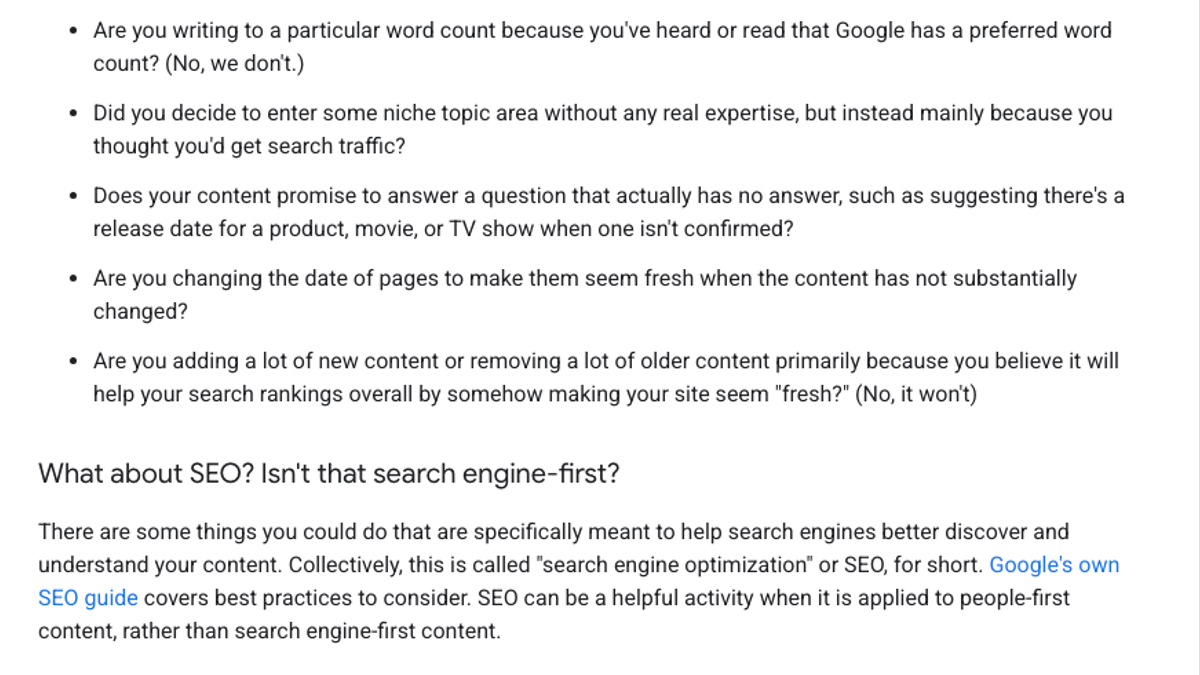
A refresh has to change what the page says. Update prices and plan details, replace old screenshots, add new examples or data, and remove sections that no longer apply. Then change the date. Our guide to content refreshes and reindexing signals covers how to get updated pages recrawled.
Work out your cadence floor
Start with refreshes, since they're the part most schedules skip. We call the minimum pace the cadence floor: the number of page updates per month needed to keep every page within its review interval.
The math is simple. Divide the number of pages of each type by its review interval in months, then add the results. A site with 24 comparison and best-of pages on a three-month interval needs 8 updates a month for those alone. Add 30 explainers on a twelve-month interval, and that's another 2 or 3 a month.
Where do the page counts come from? Your sitemap lists every URL, and most content management systems can export pages with their last-modified dates. Sort them by type and date, and the pages already past their interval become your first month's refresh list.
Once the cadence floor is covered, the rest of your capacity goes to new pages. That order matters. A team that publishes four new posts a week while its comparison pages slide past six months old is adding pages faster than it can keep them citable.
Set new-page cadence from your question gaps
For new pages, work back from demand. If you already track AI visibility, the list comes straight from it: the questions where no answer names you. Otherwise, list the buyer questions where you don't appear in AI answers, group questions one page could answer, and decide how many months you want to close them in. Forty gap questions that group into 20 pages, closed over five months, means about one new page a week.
Then check that pace against what you can review. Every new page needs its facts checked on the day it's published, and a pace you can't check is a pace that fills the site with stale pages later.
Consistency matters more than any single number. In June, someone starting an educational site asked r/SEO how many posts a week to publish:
For sites that rely on blogs, how many do you recommend per week?
The most useful reply said there's no ideal number. In that commenter's view, two or three solid posts a week kept up for six to twelve months beats posting daily for a month and then stopping. The same reply added that time should go to updating older posts too.
Survey data backs the idea of a steady rhythm. Orbit Media's 2026 survey of 1,042 content marketers found only 13.9% said their blog delivers strong results, an all-time low. Publishing monthly or less was one of the approaches the survey linked with weaker results, and it was becoming more common. Using AI for blogging, which 92.4% of respondents did, didn't correlate with results either way.

Built by the team that got cited in 48 hours.
Content generation, backlink building, AI visibility tracking, and Google rankings. One platform, zero guesswork.
Give it six months before changing it
New pages take time to earn citations. In August, an AI visibility tracker shared data in r/aeo showing the median page was 203 days old when an engine first cited it. A cadence judged after six weeks will look like it failed.
Compare pages in cohorts by publish month instead. Check what share of each month's pages rank in Google's top 20 by day 90, and what share are cited for their target questions by day 180. Our guide to tracking published articles over time sets out that schedule, and our 90-day AEO content calendar shows how to lay out new posts and refreshes week by week.
If cohorts published after you started refreshing on schedule earn citations faster, keep going. If citations stall while the cadence floor is met, the problem is usually what's on the pages, and publishing more won't fix it.
Done by hand, publishing eight solid articles a month takes 16 to 24 hours, and checking 50 questions on seven engines takes about six hours a week. Those are rough estimates, and scheduled refreshes add more on top.
RankControl covers most of this. The content engine writes each article against the pages already ranking for its keyword and publishes it on your own domain. AI visibility tracking runs your 50 questions every week on seven engines and marks each one as mentioned, cited or both. And RankControl flags pages when rankings or citations slip, then rewrites them on approval.
You can work out your cadence floor with a spreadsheet and your sitemap. Or RankControl's agents can keep new pages and refreshes moving while your team checks the facts.
See your first AI citation report in under 5 minutes.
No setup calls. No onboarding meetings. Connect your domain and see where AI mentions your brand right now.