You ask ChatGPT for the best tools in your category, and your brand shows up third. You ask again an hour later and it's gone. A rival you've never worried about is now first. That's the problem AI visibility tries to measure, and it's why so many teams don't trust the number yet.
One marketer in r/b2bmarketing put the doubt plainly. Tracking seemed to mean trying dozens of prompts, copying results into a spreadsheet and then wondering whether any of it ever produced a customer.
Is AI visibility useful, or is it just another vanity metric?
I’m trying to understand how marketing and business leaders know whether their company appears in answers from ChatGPT, Gemini, or Perplexity. Right now, the process seems to involve trying dozens of prompts, copying results into a spreadsh...
This guide is the map. It covers what AI visibility means, how the engines pick sources, how to measure it without fooling yourself, what to fix and what to report. Each part sums up the evidence and points to the post that goes deep. Sources were checked on October 19, 2026.
What AI visibility is
AI visibility is how often AI engines name you, link to you or pick you when buyers ask questions in your category. It's a rate across many questions, never a badge you earn once.
Those three outcomes are worth keeping apart, because they don't move together:
| Outcome | What happens in the answer | What it gets you |
|---|---|---|
| Mention | The engine names your brand | Awareness, and often a branded search later |
| Citation | The engine links to one of your pages as a source | A chance at a visit, and proof your page did the work |
| Recommendation | The engine picks you for the buyer's job | A place on the shortlist |
The gap between the first two is often wide. When we checked Help Scout on September 26 with five buyer questions, it was named in 24 of 30 answers but its own site was linked in just 4. The walkthrough of how to check your AI visibility shows the full run.
The gap between the last two matters more than most dashboards admit. One r/b2bmarketing reply described treating being named and being picked as two separate results, since you can sit in a list and still lose the pick. For the four counts most programs track, including share of voice and how accurately you're described, see our explainer on what AI visibility means.
How AI engines pick their sources
Each engine has its own taste, and that's the first thing a report has to respect. Ahrefs publishes the 50 domains each AI assistant cites most, from its Brand Radar data. Reddit tops five of its seven lists, with 16.8% for ChatGPT and 28.5% for Gemini in the September 2 update.
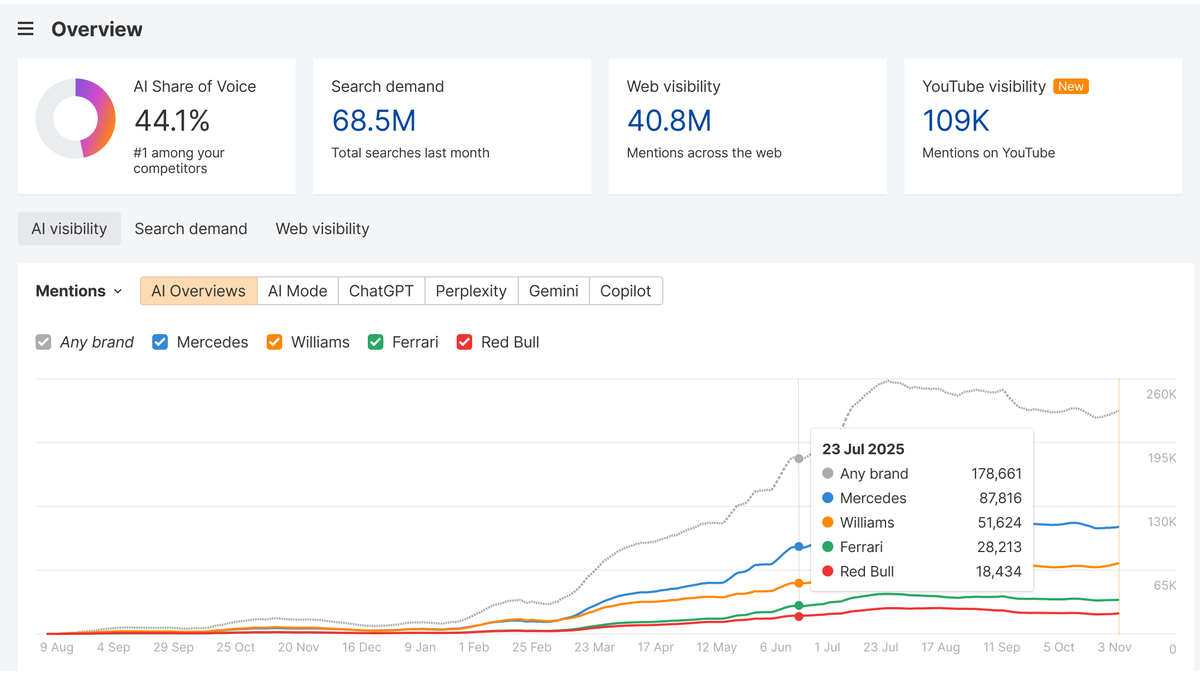
Copilot breaks the pattern. Amazon leads its list at 16.8% and Reddit isn't in its top 50 at all. Claude is different again, since a study of 379,321 Claude citations from June found that brand-owned domains took 64% and Reddit took none.
The engines also barely agree with each other. A 2026 study of 100,000 prompts found only about 11% of the domains cited by ChatGPT and Perplexity overlapped. In a separate count by an AI visibility tracker, nearly 70% of 11,647 cited websites showed up on just one of five engines. That second study comes from a firm that sells measurement, so treat the exact share with some care. The direction matches the first study.
For many buying questions, your own site is a small slice of the sources. A Shopify SEO agency looked at 1,851 sources cited for product questions across Google AI Mode, ChatGPT and Perplexity, as Search Engine Journal reported. Just 2.8% were brand-owned pages, while 59% were third-party review sites.
The top sources can also be stable. The LLM Authority Index tracked Google AI Overviews for money and health questions from July to September, and 84 of its top 100 domains held their rank across all three months. NerdWallet led at 15.4% of answers. The full engine-by-engine table, and what seems to move each one, is in our per-engine citation data.
See your first AI citation report in under 5 minutes.
No setup calls. No onboarding meetings. Connect your domain and see where AI mentions your brand right now.
How to measure AI visibility with repeat checks
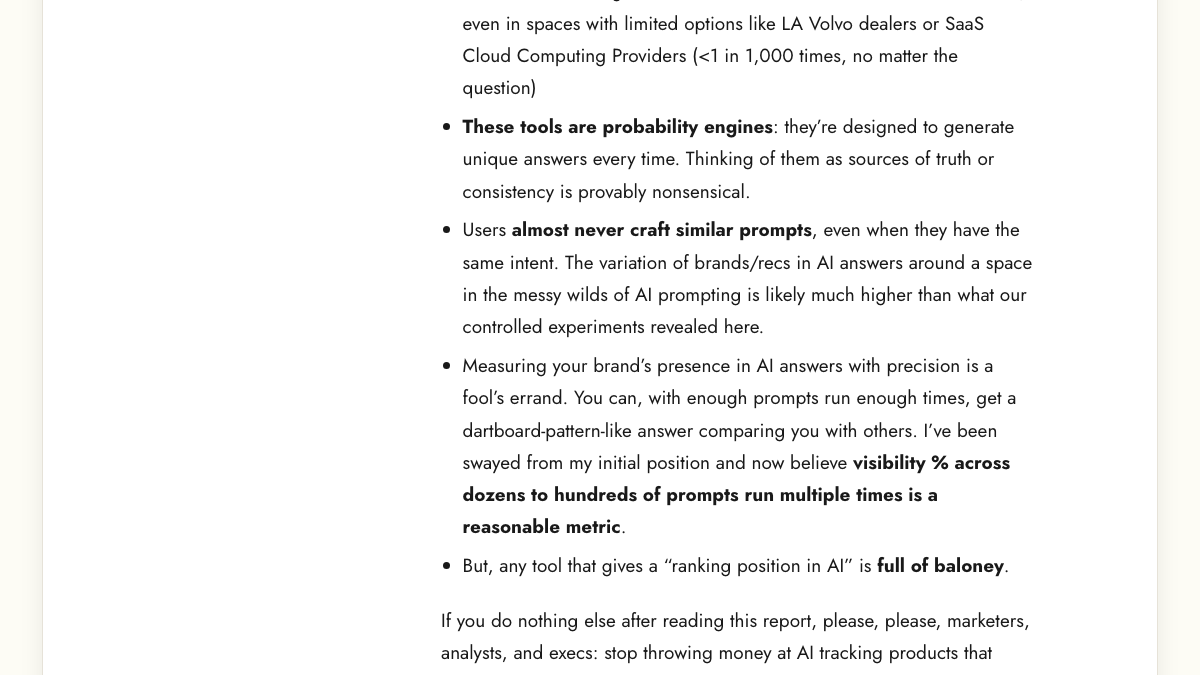
The biggest mistake is trusting one run. I call it the snapshot fallacy. You check once, see your name, and report a win that a second run would have erased.
The evidence for this is strong. In a SparkToro study, 600 volunteers ran 12 prompts through ChatGPT, Claude and Google's AI tools close to 3,000 times. The odds of getting the same list of brands twice were under 1 in 100.
Sources churn even faster than brand names do. The "Don't Measure Once" paper on arXiv found that roughly 65% of cited sources changed from one day to the next. Its authors put the number of repeat runs needed for a steady reading at about seven. Both studies have a stake in the answer, since SparkToro ran its work with a visibility startup and one of the paper's three authors works at a monitoring company. Their results still match what marketers keep finding by hand, which one r/b2bmarketing reply summed up as same prompt, same day, different answer.
So measure the way the data behaves:
- Write 30 to 50 questions your buyers really ask, and keep the set fixed.
- Run them on each engine you care about, every week, signed out.
- Log mention, citation and pick for each answer, plus the rivals and sources named.
- Report counts like "recommended in 6 of 20 answers" per engine, and read the trend over three or four weeks.
That last point came up in an r/MarketingandAI thread, where one marketer said a count like that reads far more clearly than a score of 30. Our AI citation tracking guide covers question sets, run counts and how to read a change.
Free first-party data fills some gaps. Search Console's Generative AI report shows how often your pages appeared in Google's AI features, by page, country, device and date.
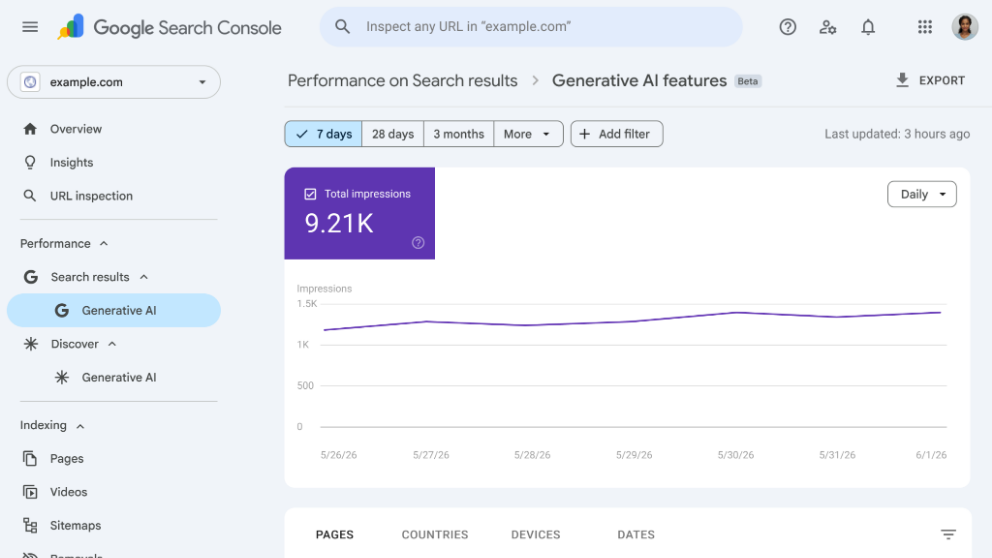
It counts impressions only, with no queries or clicks, and it covers only Google. Bing Webmaster Tools has its own AI report for Copilot. Neither tells you what ChatGPT or Perplexity say about you.
Paid tools do the repeat runs for you. Semrush's AI Visibility Toolkit and Ahrefs Brand Radar are the best-known. RankControl's AI visibility tracking checks 50 questions every week on seven engines and shows, for each answer, whether you were mentioned or cited and which competitors were named. For a quick first look, run the free AI visibility checker.
How to improve AI visibility
Start with the symptom, not a tactic list. Each symptom points to a different fix, and the time cost ranges from an hour to months.
| What you see | Likely cause | First fix |
|---|---|---|
| No engine ever cites your site | AI crawlers are blocked | Check robots.txt and firewall rules |
| Engines read you but cite a rival | No page answers the exact question | Write a page that answers it in the first lines |
| Answers get your facts wrong | An old or unclear page is the source | Fix the claim on the page it came from |
| Rivals are named and you aren't | Third-party sites don't mention you | Earn a place on the review sites and lists engines cite |
| You dropped overnight | A model update or a lost source | Rerun the questions on other engines first |
The fourth row is the slow one, and the Shopify agency study explains why. If 59% of the sources for product questions are review sites, most of the work sits on pages you don't own. Our AI search optimization playbook walks through each symptom with rough hours. The roundup of AI visibility optimization tools sorts ten tools by which gap they close.
Fixing a gap once isn't the hard part. The real problem is knowing when it stops working. A page cited in October can drop out by November, and you won't see it unless you check again.
Your competitors are building backlinks while you read this.
Organic outreach, social mentions, and citations from Editorial Circle member sites, with managed backlinks available as an add-on. Grow your domain authority without running the campaign yourself.
What to report about AI visibility
Reporting is where most programs stall, because the people reading the report care about revenue. In the AgencyAnalytics 2026 agency benchmarks report, 55% of 494 agency staff said clients ask whether marketing can be tied to revenue. That beat questions about AI use in campaigns (52%) and about falling organic traffic (42%).
One caveat is worth keeping. AgencyAnalytics sells reporting software, and it asked agencies what they hear, not clients what they want. The direction still matches what marketers say on Reddit. In r/MarketingandAI, one marketer listed what they track today and asked which metrics clients really care about.
What does your AI visibility report actually look like?
We’re currently tracking things like brand mentions across ChatGPT/Gemini/Perplexity, competitor visibility, recommendation share, citations and AI referral traffic where available. But reporting still feels much less standardised than SEO....
A useful monthly report has a line per engine with these parts:
- Mention, citation and pick counts for your fixed questions, next to two or three rivals
- The sources cited most often, with new ones flagged
- Wrong facts found in answers, with the page each came from
- Branded search, AI referral visits and what you changed that month
Branded search earns its place because many buyers read your name in an answer and then search for you on Google. Search Console's branded queries filter, added in November 2025, splits those searches out. It only works on top-level properties with enough query volume.
Don't promise clean attribution. In the r/b2bmarketing thread, several marketers said tying AI mentions to closed deals is still the unsolved part. Report what moved next to what you did, and skip the blended score that hides which engine changed. Our guide to AI visibility reporting for clients has a full report template.
Where to start this week
If you're starting from zero, this order works:
- Ask each engine what your company is and does, and fix any wrong facts first.
- Write your 30 to 50 buyer questions.
- Run them once on every engine to set a baseline.
- Pick the two biggest gaps and match each to a fix from the table above.
- Repeat the check every week and log the changes.
Done by hand, checking 50 questions on seven engines takes about six hours a week. Publishing eight solid articles a month to close the gaps takes 16 to 24 hours more. Those are rough estimates, and they assume someone who already knows the site.
RankControl runs those 50 questions weekly on ChatGPT, Perplexity, Claude, Gemini, Grok, Google AI Mode and Google AI Overviews, and tracks your Google and Bing rankings too. AI-referred visits and AI crawler visits show up as separate counts. A new citation sends you a notification, while a lost one shows only in the dashboard. RankControl is $400 a month with a 7-day trial.
You can run all of this yourself with a fixed question list, a spreadsheet and a protected hour each week. Or RankControl's agents can run the weekly checks while your team works on the fixes.
You're getting AI traffic. But do you know where it comes from?
RankControl credits every visit to the assistant that sent it: ChatGPT, Perplexity, Claude, Gemini, Copilot, or Grok. Full source attribution, next to your Google traffic.