
In September, a small-business owner in Kansas posted in r/growmybusiness that most of their customers now said they'd found things through ChatGPT or Google's AI Overviews. So they asked ChatGPT to recommend a business like theirs. Theirs didn't come up.
The replies split two ways. Some said AI search is just SEO, so keep doing SEO. Others said to get mentioned on other sites, like a friend in Nebraska whose traffic arrived only after a local blog wrote about them. Both answers fix a real problem, and they fix different ones.
That's why this AI search optimization playbook starts from what you can see going wrong rather than from a checklist. AI search optimization means getting your pages cited and described correctly by AI answer engines, from ChatGPT and Perplexity to Google's AI Overviews. There are six common symptoms, and each has its own play. Sources were checked on September 27, 2026.
Find your symptom first
Run 20 of your buyers' real questions on the engines they use, then match what you see:
| What you see | How to confirm it | Play | Rough time to fix |
|---|---|---|---|
| Engines never cite any page on your site | Check robots.txt and firewall rules for AI search crawlers | 1 | 1 to 3 hours |
| Your site is read, but a rival's page gets cited | Compare the cited pages with your closest page | 2 | 2 to 4 hours per page |
| Answers describe you wrong | Log the cited URLs and check each wrong fact | 3 | A day, plus follow-ups |
| Competitors are named and you aren't | Count how many cited pages mention you | 4 | Months |
| You're cited but get no visits | Compare citations with AI referrals in analytics | 5 | 2 to 3 hours to set up |
| Citations dropped overnight | Rerun the questions and check other engines | 6 | About an hour to diagnose |
The time estimates are rough and assume one person who knows the site.
Play 1: the engines can't read you
AI search engines use their own crawlers, and the ones that matter for citations aren't the training crawlers most people block. OpenAI's GPTBot collects training data, while OAI-SearchBot fetches pages for ChatGPT search. Anthropic splits its bots the same way, and Perplexity's search crawler is PerplexityBot. The full roster is in our AI crawler list.
On September 27 we fetched the robots.txt files of 60 well-known B2B software companies and could read 57. None blocked OAI-SearchBot, PerplexityBot or Claude-SearchBot. Two, Canva and Figma, blocked GPTBot. Figma went further. Its rules let ChatGPT's, Perplexity's and Claude's search crawlers reach a list of 8,953 allowed pages, including its homepage and pricing pages, and everything else is blocked.
So robots.txt is rarely the problem for established software companies. Two other layers can block crawlers without showing up there. Three of the 60 robots.txt files didn't load for an ordinary browser request, and two returned a 403 error, which suggests a firewall screening visitors before any rule applies. Cloudflare also now lets customers treat search, agent and training bots separately. Since September 15, 2026, new Cloudflare domains block training and agent bots on pages that show ads, while search crawlers stay allowed.
The fix is to allow the search crawlers in robots.txt, then check your firewall or CDN logs to confirm those bots actually get 200 responses.

Built by the team that got cited in 48 hours.
Content generation, backlink building, AI visibility tracking, and Google rankings. One platform, zero guesswork.
Play 2: you're read, but never cited
Once access is fine, this is where most of the work sits, and it usually comes down to page shape. Engines cite the page that answers the exact question, and buyers ask narrow ones. In our test of software buying questions, a small applicant tracking vendor won a question about E-Verify, LinkedIn and Indeed with three narrow pages from its own site. It appeared in none of the other eleven answers.
Rankings help less than you'd expect. Ahrefs found that 28.3% of ChatGPT's most-cited pages had no Google organic visibility at all, so a page doesn't need to rank on Google to be cited by ChatGPT.
The fix is to give every buyer question a page that answers it in the first paragraph:
- a plain pricing page with real numbers
- a page for each integration or compliance claim
- compare pages for the rivals buyers name on calls
- pages for the segments you serve well
Budget two to four hours for each page you're missing.
Play 3: you're cited, but described wrong
Wrong answers usually trace back to a page somewhere that says the wrong thing, such as an old review or a partner page from two pricing changes ago. A head of marketing asked r/SEO in July whether anyone else was checking how ChatGPT describes their company, and the replies turned into a working method.
Anyone else checking how ChatGPT describes their company?
I’m the head of marketing of a growing startup and recently started asking ChatGPT about our company and our competitors to see what comes up.It got me wondering how other companies are handling this. Do you actually monitor how ChatGPT, Cl...
The most upvoted reply suggested asking the engine where it got its information, then correcting those sources. Another commenter pushed back that the sources a chatbot lists may not be the ones it used. A third suggested fresh sessions with memory off, the same questions each time, and a record of the model, date, answer and cited URLs. We'd combine them: log the cited URLs, but confirm each wrong fact on the page itself before asking anyone to change it.
Fix your own pages first, since those are the ones you control. Then contact the sites carrying the wrong facts. Our response plan for wrong AI answers covers the order.
Play 4: competitors are named, and you aren't
AI answers name five or six brands, and they name the ones most of their sources agree on. In our check of 25 help desk answers, every brand named in more than half the answers appeared on at least 62% of the pages the engines cited.
Getting onto those pages is the play. Open every source the engines cite for your questions and treat the list as targets: roundups to pitch, review profiles to fill, comparison pages to write and videos to make. Don't skip video. In our count of Reddit, YouTube and Wikipedia citations, YouTube supplied about 28% of the AI Overview sources on 30 B2B software searches. YouTube itself ranked in Google's organic top 10 for only 9 of them.
Start with narrow questions where you have a real edge, such as a price point or an integration. Broad "best software" questions take months, because the pages they draw on change slowly.
Play 5: you're cited, but nobody clicks
Some of this comes with the format. Pew Research found in July 2025 that Google users clicked a traditional result in 8% of visits when an AI summary appeared, against 15% when none did. A citation often works like a brand impression, and the visit comes later through a branded search or a direct visit.
So measure the whole path to a sale. ChatGPT adds utm_source=chatgpt.com to many of the links it sends, which makes those visits easy to find in analytics. Track branded search volume alongside citations, and ask new customers where they heard about you. Our guide to measuring ChatGPT search against Google covers the setup, which takes two to three hours.
If citations stay high and branded demand stays flat for a quarter, the cited pages may be answering the question too completely. Give readers a reason to click through, such as a calculator or a template they can copy.
See your first AI citation report in under 5 minutes.
No setup calls. No onboarding meetings. Connect your domain and see where AI mentions your brand right now.
Play 6: you dropped overnight
Before you change a page, check whether the engine changed. On August 14, ChatGPT's citations of Reddit fell by about 86% within days, while other engines kept citing the same threads. Brands that showed up through those threads lost that path in ChatGPT without changing anything.
Answers also move on their own. Ahrefs found that AI Overviews change every 2.15 days on average, with about 70% of the content differing between consecutive checks, even though the meaning barely shifts.
The diagnosis takes about an hour:
- Rerun the affected questions three times, in fresh sessions.
- Run the same questions on two other engines.
- If only one engine dropped you, the engine probably changed, so watch it for two weeks before rewriting anything.
- If every engine dropped you at once, look at your own site first: a redirect, a noindex tag, a robots.txt edit or a firewall change.
What Google says you can skip
Google published its own guide to optimizing for generative AI features in May 2026, and it's blunt about several popular tactics:
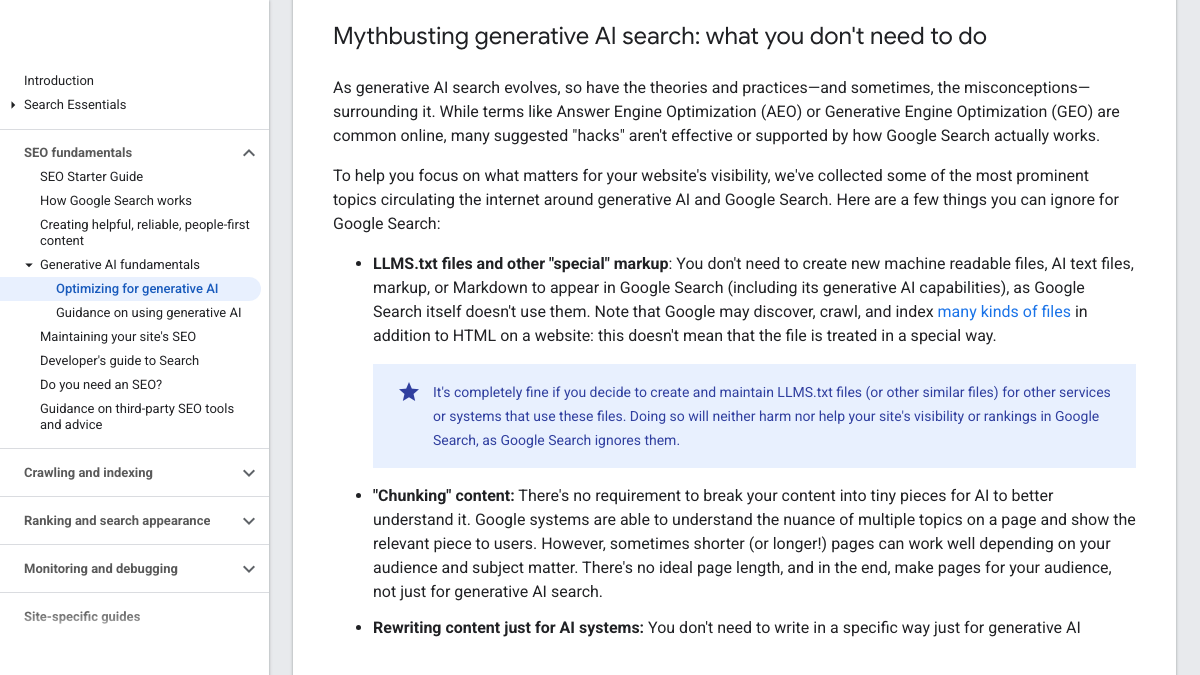
The list starts with llms.txt files and other special markup, "chunking" content and rewriting pages just for AI systems. It also warns against seeking inauthentic mentions and overfocusing on structured data. Google says its generative AI features depend on the same core ranking and spam systems as the rest of Search, so manufactured mentions run into the same spam filters.
That guidance covers Google Search only. The advice still transfers, since every play above rewards pages an engine can reach and answers other sites confirm.
Running the playbook every week
The plays aren't a one-time project. Engines change their sources and competitors keep publishing, so a page that won a citation in spring can lose it by fall. What keeps the playbook working is a fixed set of questions checked on a schedule, with each result logged against the play it points to.
Done by hand, checking 50 questions on seven engines takes about six hours a week, and publishing eight solid articles a month takes 16 to 24 hours more. Those are rough estimates.
RankControl's AI visibility tracking runs your 50 questions every week on seven engines, marks each one as mentioned, cited or both, and records which competitors and sources each engine used. The content engine writes each article against the pages already ranking for its keyword and publishes it on your own domain.
You can run the six plays yourself with a question list and a spreadsheet. Or RankControl's agents can run the weekly checks and publishing while your team handles the fixes only people can make, like pitching roundups and correcting third-party listings.
Your competitors are building backlinks while you read this.
Organic outreach, social mentions, and citations from Editorial Circle member sites, with managed backlinks available as an add-on. Grow your domain authority without running the campaign yourself.