
On November 4, I asked Perplexity and ChatGPT the same question, "best payroll software for a 10-person company." Both picked Gusto at about $109 a month for ten people. Yet they cited almost none of the same pages, and neither credited a claim to Gusto's own site.
Perplexity leaned on payroll roundups from rho.co, Rankite and Onfolio. ChatGPT credited Fit Small Business and CNBC Select. Onfolio's comparison was the only page both engines used.
That gap is what AI citation analysis is for. Analysis shows why each page got picked, so you know what to change on yours. This guide works through that answer, then rolls it up across many questions.
What AI citation analysis looks at
AI citation analysis means reading why an engine cited each source, by tracing every claim back to its page and to the search that found it. A tracker gives you the source list, and our AI citation finder guide builds one for a whole topic.
I think of it as reading the citation trail, the path from a sentence in the answer back to the search that found its source. Each citation has five parts worth a column in a sheet.
| Layer | What to record | Where to find it |
|---|---|---|
| Claim | The sentence the source backs | The chip next to it |
| Page | The cited URL and its date | Hover card or sources panel |
| Passage | The lines the claim came from | A search inside the page |
| Search | The query that pulled the page in | Perplexity's links tab, Bing, fan-out tools |
| Dropped pages | What was read but not cited | Full source list minus inline citations |
The first three work in any engine. The last two depend on what each engine shows you, which isn't much.
Step 1: Tie each claim to its source
Start with the answer, not the source list. Copy it into a sheet, one claim per row, from the picks to the prices.
Perplexity puts a source chip after each sentence or table row, and hovering a chip shows every page behind that claim.
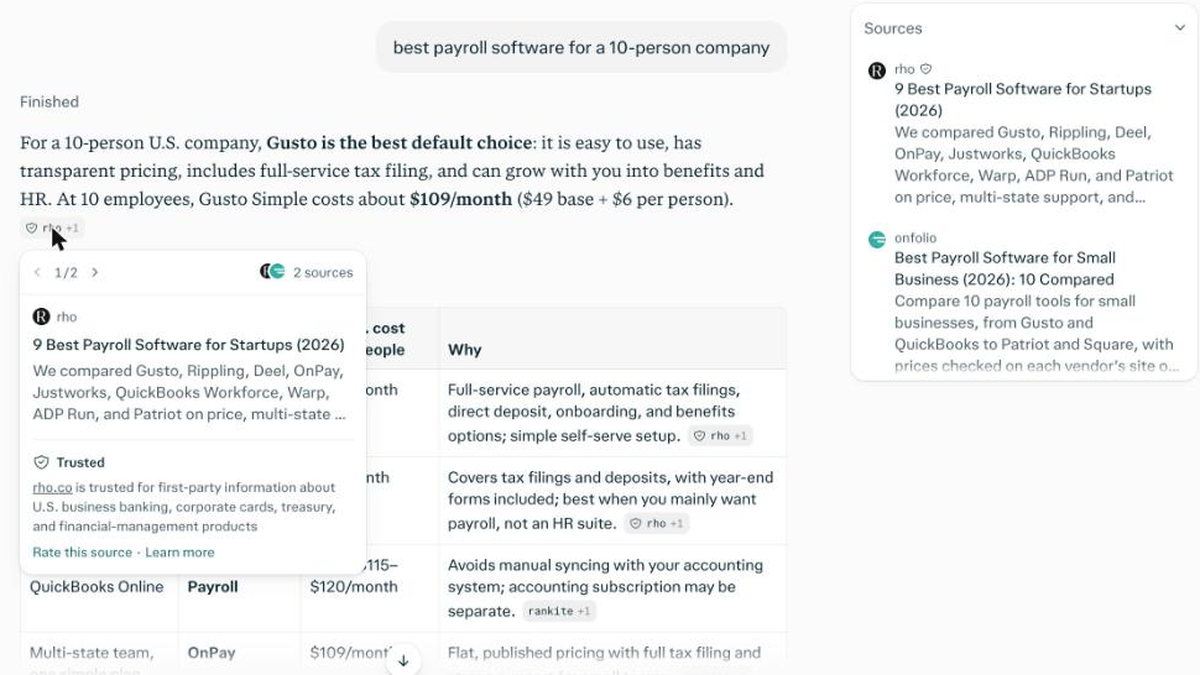
The hover card showed something a plain source list hides. The rho.co page carried Perplexity's Trusted label, which said rho is trusted for first-party facts about "U.S. business banking, corporate cards, treasury." Rho sells banking, and here it was backing payroll prices. Perplexity's page on source labels says the label covers a whole site. I can't prove it helped rho win, but it earns a note in the sheet.
ChatGPT groups its chips by paragraph, so one chip can stand behind a whole table. The chip under its price table opened three pages, each with a date.
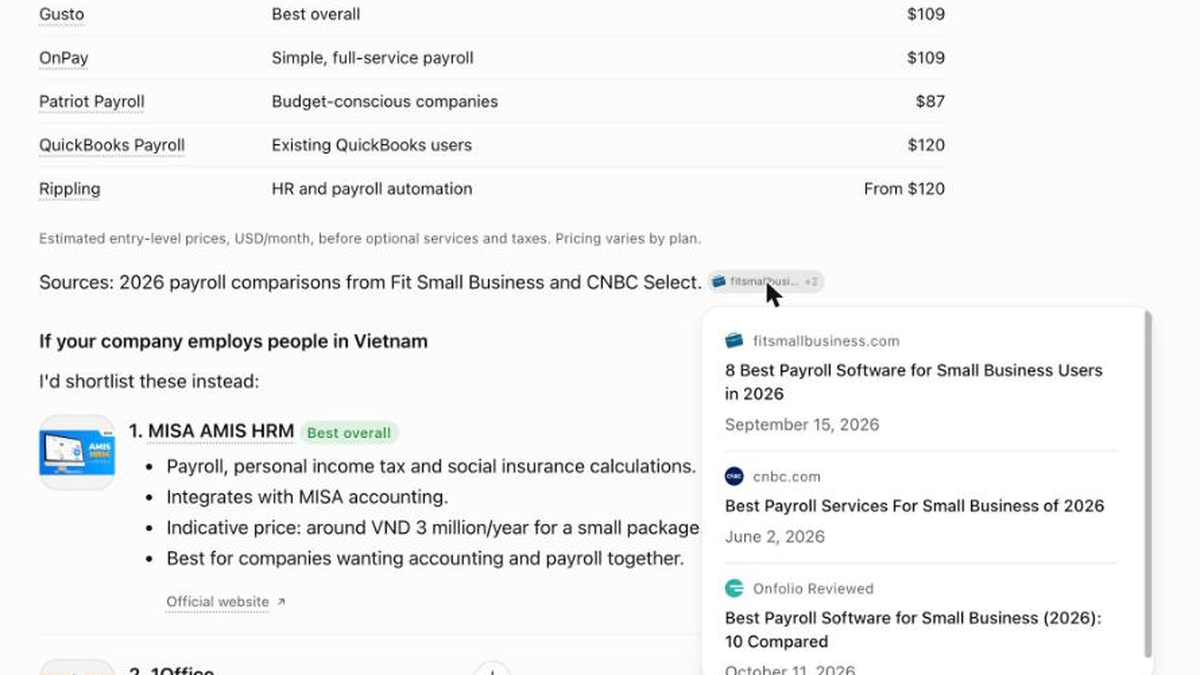
Every price in that table traced to a roundup, and none to a vendor's pricing page.
Step 2: Find the passage it lifted
Open each cited page and search it for the claim's key words or numbers. For the payroll answer, I searched for "$109."
All three of Perplexity's lead roundups had the same kind of passage. Rho's said Gusto Simple and OnPay "are $49 plus $6, which comes to $109 a month at 10 people." Onfolio's had a table column headed "Monthly cost for 10 people," and Rankite's said a 10-person team "pays $109 per month."
Gusto's pricing page lists the base fee and the per-person fee. The cited pages had already done the sum for the team size in the question. Each also dated its prices, and rho re-checked on October 19 and Onfolio on October 24.
So for each passage, note its shape and whether it carries a date.
The passage's shape can matter more than the page's polish. A team on r/seogrowth watched Perplexity and ChatGPT pass over their 3,000-word guide for a 500-word rival post that answered the price question under a heading. They rebuilt around tables and direct answers and took the citation back.
My content is objectively better, so why is Perplexity/AI citing the other guy?
Honest talk: my team spent weeks writing a deep guide for a client. original data, expert quotes, 3000 words. objectively the best resource on the web. But when i asked perplexity and chatgpt, they cited a generic 500-word competitor post....
An April study of 602 prompts on arXiv adds numbers. Its authors scored how much of each cited page carried over into the answer, and pages with numbers or statistics scored about 62% higher.
Format alone didn't help, which surprised me. Pages written as Q&A scored about 6% lower than pages that weren't, so a question heading over a thin answer gives the engine little to use.
We'll show you exactly where your brand stands in AI search.
No commitment. $0 due today, cancel anytime. See how ChatGPT, Perplexity, Claude, Gemini, Grok, Google AI Mode, and Google AI Overviews talk about your brand today.

Step 3: Tag the role each source played
Not every citation does the same job. One page supplies a price, while another is a link the answer barely used. A commenter on r/GenEngineOptimization suggested tagging this role for each citation, and it's become the most useful column in my sheet.
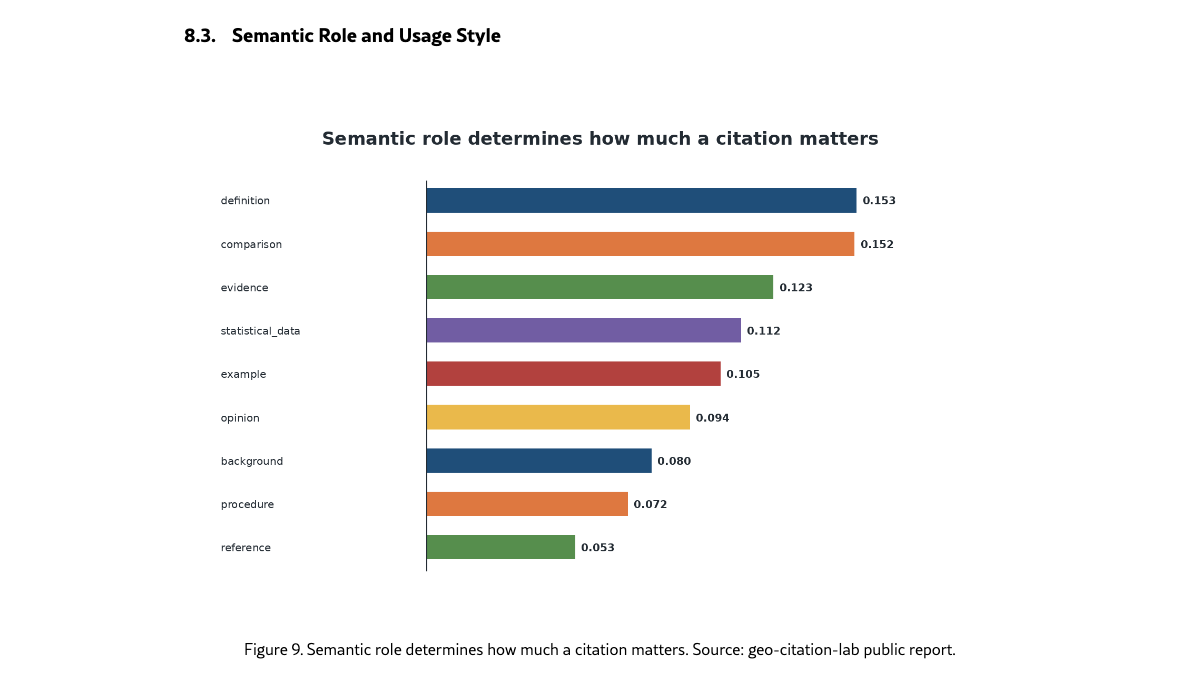
The same arXiv study measured how much each role mattered. Sources used for a definition or a comparison carried the most into the answer, and plain references carried about a third as much.
For buyer questions, I use five tags.
- Shortlist, the page that supplied the list of products
- Price, the page a number came from
- Fit, the page behind a "best for" line
- Definition, the page that explained the category
- Reference, a link that backs nothing in particular
One caution about the study. Its influence score measures text overlap between the page and the answer, so it shows what got carried over rather than what the model weighed. The authors say so, and some of their prompts came in Chinese and English pairs. Treat the role ranking as a strong hint.
Step 4: Work out the search that found it
Engines rarely search for your question word for word. Google says AI Overviews and AI Mode may use a "query fan-out" technique, "issuing multiple related searches across subtopics and data sources." ChatGPT runs its own background searches too.
The search often decides the citation before anyone reads your content. AirOps and Kevin Indig studied 16,851 queries in ChatGPT. The first result in its web search was cited 58% of the time, against 14% for the tenth.
What you can see depends on the engine.
| Engine | What it shows about its searches |
|---|---|
| Perplexity | The links tab lists the search it ran |
| ChatGPT | Nothing. A practitioner on r/aeo reads them in the network tab |
| Copilot | Bing's AI Performance report lists grounding queries |
| Google AI Overviews and AI Mode | Nothing per answer |
When you can see the searches, read the words in them. In her August write-up of fan-out research, Lily Ray wrote that every word the model puts in a search "tells us something about what the model is looking for."
New on my Substack: I spent the past few months watching how ChatGPT's fan-out queries have been evolving and paying close attention to the awesome research being done in our space on this topic. My interpretation is that I think the site: operator is being used as a way to https://t.co/Y1osmK2S5S
 Lily Ray 😏@lilyraynycAug 17, 2026

Her write-up found ChatGPT aiming more searches at domains it already trusts. In a study of 15 million fan-outs published October 12, Ahrefs found "official" in 13.1% of English fan-out queries. For running shoes, though, the top words were "best," "2026," "review" and "vs," which points at third-party reviews.
Some of these searches reach your own reports. Ray found one search limited to a single site that drew about 197,000 Search Console impressions and exactly one click.
Step 5: Look at what was read but dropped
The pages an engine read and skipped tell you as much as the ones it cited. As Ray puts it, retrieved means fetched, and cited means it made the answer as a link.
In my Perplexity run, the sources panel held ten pages, and five domains led a claim. Vendor lists from Gusto, ADP and Paycom were fetched, and none of them led a claim. The one vendor page that did was Zoho's, and it backed a line about Rippling, a rival.
Compare the dropped pages with the cited ones on their dates and on who wrote them. The cited roundups compared many vendors with prices checked in October. Gusto's list said June 2026 in its summary, and it ranks products from a company that sells one of them.
Dropping is normal. In the AirOps data, 58% of the pages ChatGPT saw were never cited for any query they turned up in. Our post on sites that never get cited covers that retrieval gap.
Know exactly what AI says about your competitors.
RankControl's Recon Agent monitors competitor citations across ChatGPT, Perplexity, Claude, Gemini, Grok, Google AI Mode, and Google AI Overviews. See where they show up and you don't.

Give every citation a reason code
Once a citation has its claim, passage, role and search, write down why you think it won. I call this a reason code, and I pick it from a short, fixed list.
| Reason code | What you saw | Fix for your page |
|---|---|---|
| Ranked | Top of the search that found it | Rank for the fan-out wording |
| Direct answer | The number sat under a matching heading | Answer in the first line under that heading |
| Done the math | The page worked the figure for the asker's case | Show totals for common team sizes |
| Dated fact | The price was marked as checked recently | Date your prices and recheck each quarter |
| Comparison | Several options in one table | Publish a fair comparison table |
| Trusted site | The engine labels or keeps citing the domain | Earn mentions on the sites engines use |
| Location | The answer changed with the asker's country | Say which countries you serve |
The last row came from my run, where ChatGPT read my location and added payroll tools for another country.
Then roll the codes up. Run 20 buyer questions on two or three engines, tag every citation and count. If most winners in your market are "Done the math" and "Dated fact," your next pages are comparisons with worked costs and dated prices. If they're mostly "Trusted site," the work happens off your site, and our breakdown of how AI engines choose sources explains why.
A citation isn't a recommendation
One more column belongs in the sheet, the brand the answer told the reader to pick. The cited page and the picked brand often differ, as the payroll run showed.
The owner of a baking substitutions site on r/Agentic_SEO counted more than 280,000 AI recommendations in three months. Reading the answers, they found some that cited their page and then sent the reader to a rival.
My page was cited by AI, but it recommended my competitor instead
I noticed something weird with AI citations that I hadn’t really seen anyone talking about. AI assistants were using my pages as sources, but then sending the reader to another site. For context, I run a baking substitutions site. The pages...
Engines also differ in how much each citation counts. In the arXiv study, ChatGPT cited about 7 sources per prompt and Perplexity about 16, but each ChatGPT source carried far more into the answer. Our piece on mention vs citation tracking covers how to report both.
How long this takes by hand
My rough estimate is 10 to 15 minutes per answer. Twenty questions on three engines make 60 answers, or 10 to 15 hours a pass. Engines swap sources after model updates, so the harder part is noticing when your October pass stops being true.
RankControl's AI visibility tracking checks 50 of your buyer questions every week across seven AI engines. We record whether each answer named or cited you, plus the competitors and sources it used, and notify you when a new citation appears. Our content engine writes each article against what already ranks and scores it for how easily AI engines can quote it, with a fix list.
You can run this analysis by hand with two browser tabs and a sheet. Or RankControl's agents can run the weekly checks and write the pages your reason codes point to, while you focus on your product. The free AI visibility checker shows which sources ChatGPT cites for three of your buyer questions, with no signup.
26 content formats. Published on your domain. Matched to your brand.
Guides, comparisons, listicles, case studies, and more. RankControl generates content that gets cited by ChatGPT, Perplexity, Claude, Gemini, Grok, Google AI Mode, and Google AI Overviews.